
THE MATCHUP LAB · NFL
Centro del partido
Marcadores, estadísticas y la historia del partido.
Buscando actualizaciones…
Dallas Cowboys 38, Philadelphia Eagles 21 in regulation
Complete NFL Week 7 recap and season assessment
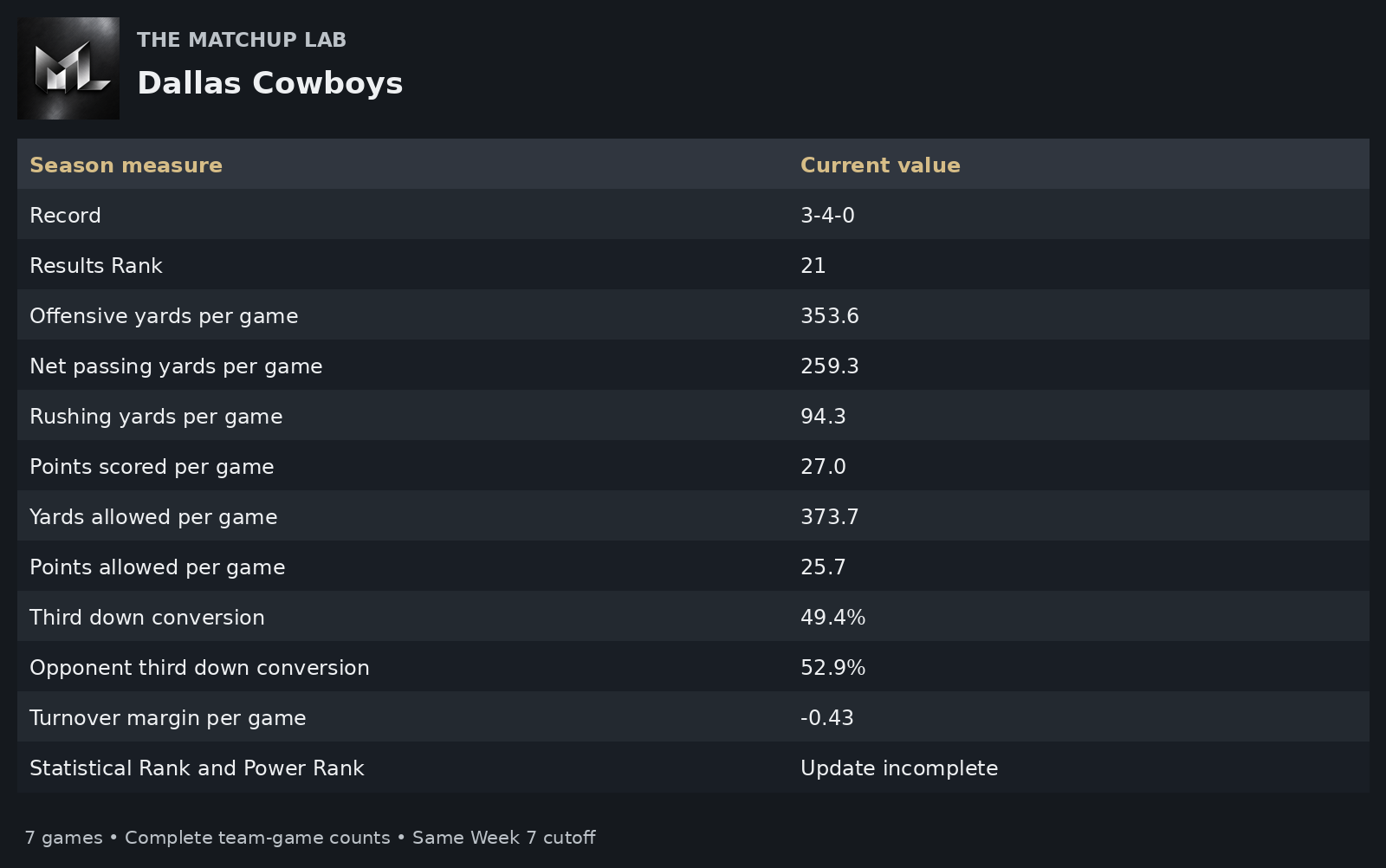
Dallas finally gave a productive offense a clean possession record in Philadelphia. The Cowboys gained 416 yards, ran for 204 and converted eight of thirteen third downs without a giveaway. That made thirty-eight points more than an isolated passing burst. The defense still allowed three touchdowns, so the win does not remove the need for firmer resistance between scoring possessions. Dallas now owns a positive season scoring margin despite four losses. Keeping drives alive without donating the next chance is the practical route to making that broader production appear in the record more often.
Dallas averages 353.6 yards and 27.0 points per game, with 25.7 points allowed. That positive scoring balance makes four defeats worth examining rather than excusing. Monday's clean possessions showed a practical way to make production count. Maintaining that protection and forcing earlier defensive stops would let the offense's useful gains build a margin instead of repeatedly paying for opportunities already lost.
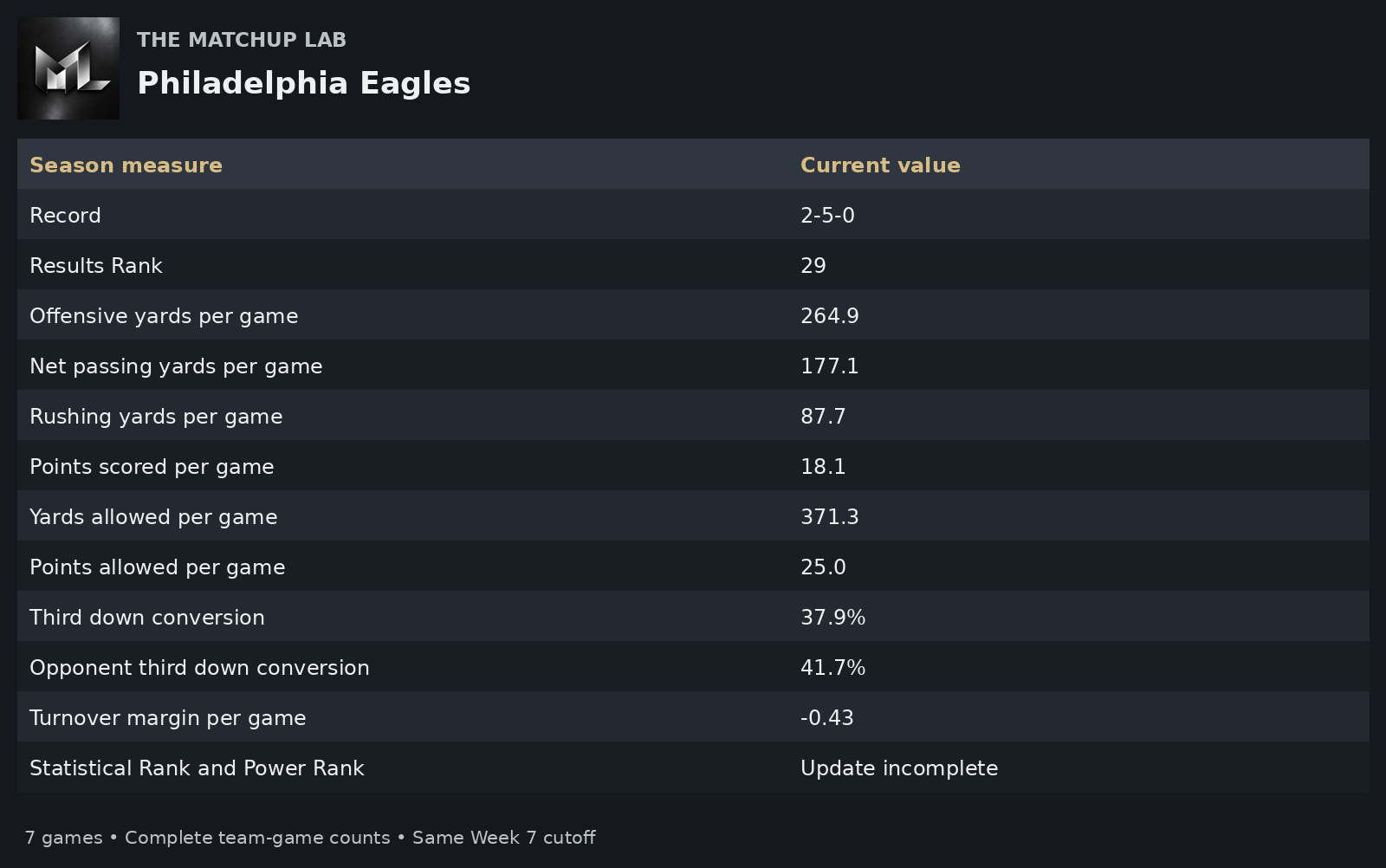
Philadelphia produced 321 yards and three touchdowns but allowed Dallas to rush for 204 yards and extend eight of thirteen third downs. The Eagles' one giveaway added a cost that the Cowboys did not return. Their season offense has scored only 127 points, leaving little room for a defense to concede thirty-eight. The response needs to begin on ordinary downs, where stopping the run can make the next passing situation more predictable. Philadelphia also needs longer productive offensive sequences so its defense is not required to solve every failure with another immediate stop.
The Eagles' season offense averages 264.9 yards and 18.1 points, against 25.0 allowed. That scoring gap makes repeated defensive concessions difficult to absorb. Philadelphia needs useful offensive gains before the next difficult down and defensive resistance that forces an opponent to continue working. Protecting one possession cannot compensate for an afternoon in which the other offense repeatedly sustains its own.
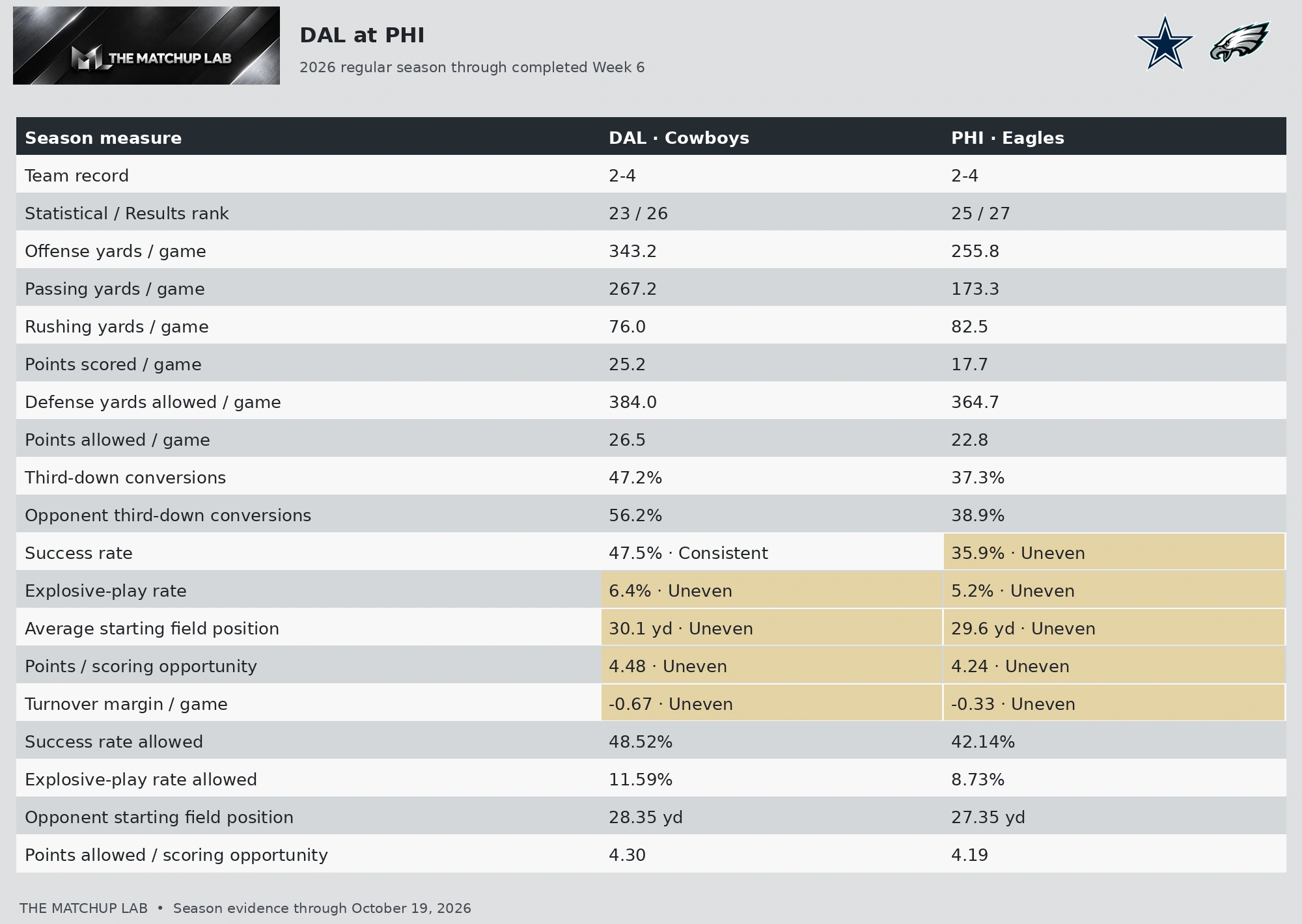
Dallas and Philadelphia arrive with the same 2–4 record and different degrees of offensive trouble. The Cowboys have still made ordinary gains at a much higher rate than the Eagles, but their opponents have produced long plays far more frequently. Philadelphia has struggled both to sustain progress and to find those escape gains. That gives Dallas an opportunity to establish control through useful downs rather than an immediate search for a spectacular play. The Eagles need to make the next tackle end the series, not simply delay the moment their offense has to answer another score.
Neither team has protected possession well enough to make an empty drive a harmless event. Dallas has lost more opportunities than it has gained, while Philadelphia has also operated with a negative turnover margin. Their non-turnover starting positions have been reasonably favorable. The problem is making that territory survive all the way to a scoring attempt. Dallas' full-season scoring rate remains materially higher, but twenty-nine points across the last two games show how quickly earlier production can disappear. Philadelphia's offense has averaged fewer than eighteen points, so another giveaway would place an especially difficult requirement on a unit already struggling to create useful sequences.
The Cowboys' defense must prevent the long gain that lets Philadelphia avoid its sustained-drive problem. The Eagles must force Dallas to keep executing after its first productive series rather than conceding the completion that turns an ordinary possession into an easy scoring chance. Neither team's return from dangerous territory creates an overwhelming advantage by itself. The more useful separation is likely to come before the drive reaches that point. The decisive exchange is Dallas' capacity to turn its stronger ordinary-play production into a clean scoring possession against Philadelphia's need to force another snap. Dallas needs ball security and stops that last. Philadelphia needs early gains, fewer immediate returns to defense and enough possession control to make its own defensive work count.