
Schedule, final scores and team statistics were checked against the shared sports feed and official NFL schedule. Results calculations and team assessments are original analysis by The Matchup Lab.

NFL Week 7 Recap
Minnesota is the remaining unbeaten team after a week that ended San Francisco and Kansas City's perfect starts. Atlanta beat the 49ers 29-20, Seattle held the Chiefs to three points, and the Vikings kept Indianapolis scoreless after halftime to reach 6-0. Dallas completed the week with a 38-21 win in Philadelphia. Every one of the fourteen scheduled Week 7 games is final. Buffalo, Jacksonville, the Chargers and Washington were on bye.
The season remains the subject. A useful afternoon can strengthen a team's case without repairing everything that has gone wrong, and a first defeat does not erase six wins. San Francisco gained more ground than Atlanta but surrendered four possessions. Tampa Bay ran effectively and also benefited from four takeaways. Seattle's win came with a balanced turnover exchange and a much stronger yardage advantage. Those are different routes to a result and different tests for the next opponent.
This edition uses one completed-game cutoff, October 27 2026 at 7 AM Central. All 107 regular-season games through Week 7 and all 32 team records are included. Preseason and unfinished games are excluded. A tie remains a tie. Team scoring includes all points on the scoreboard and is not presented as offensive points per drive.
Results Rank and Team Record
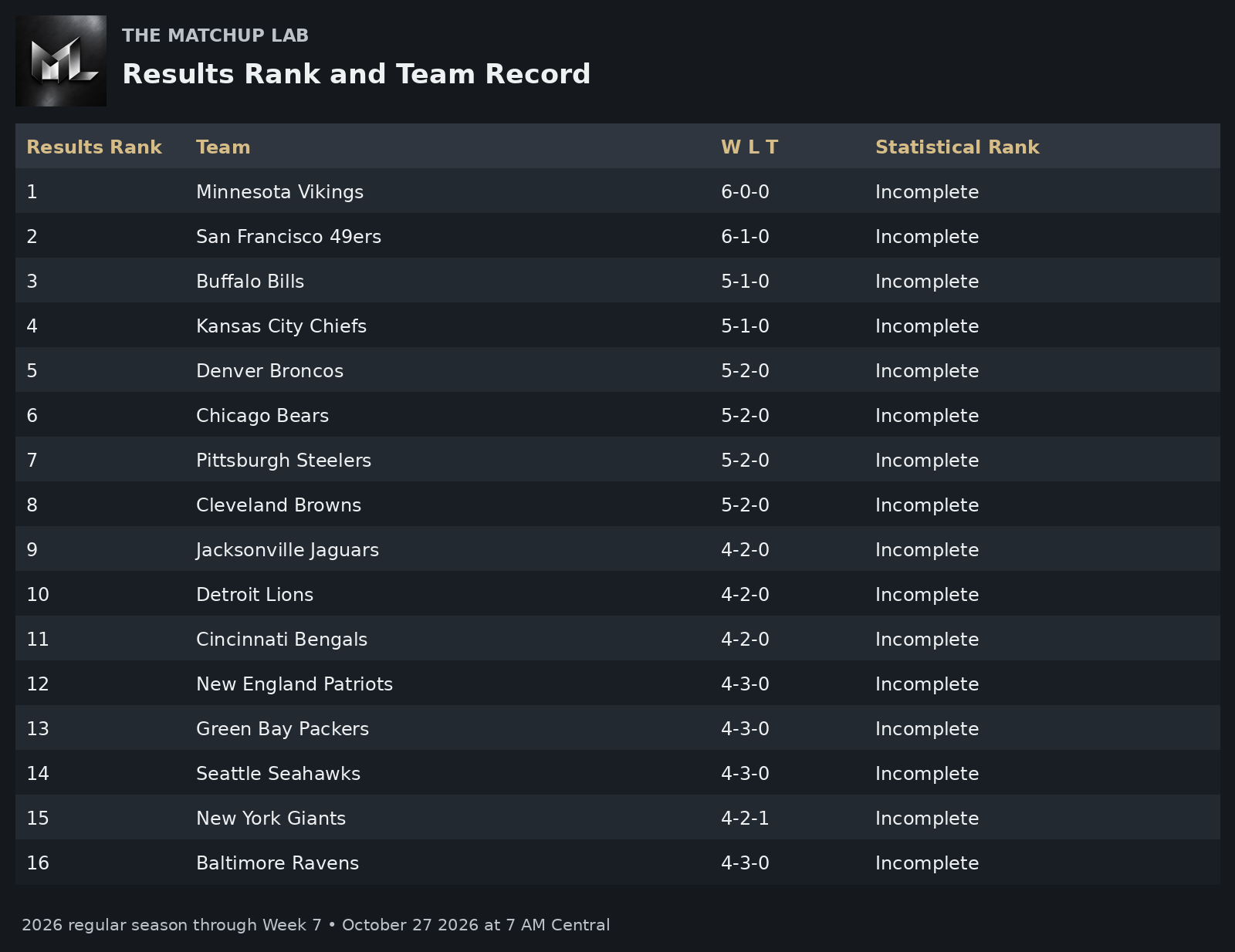
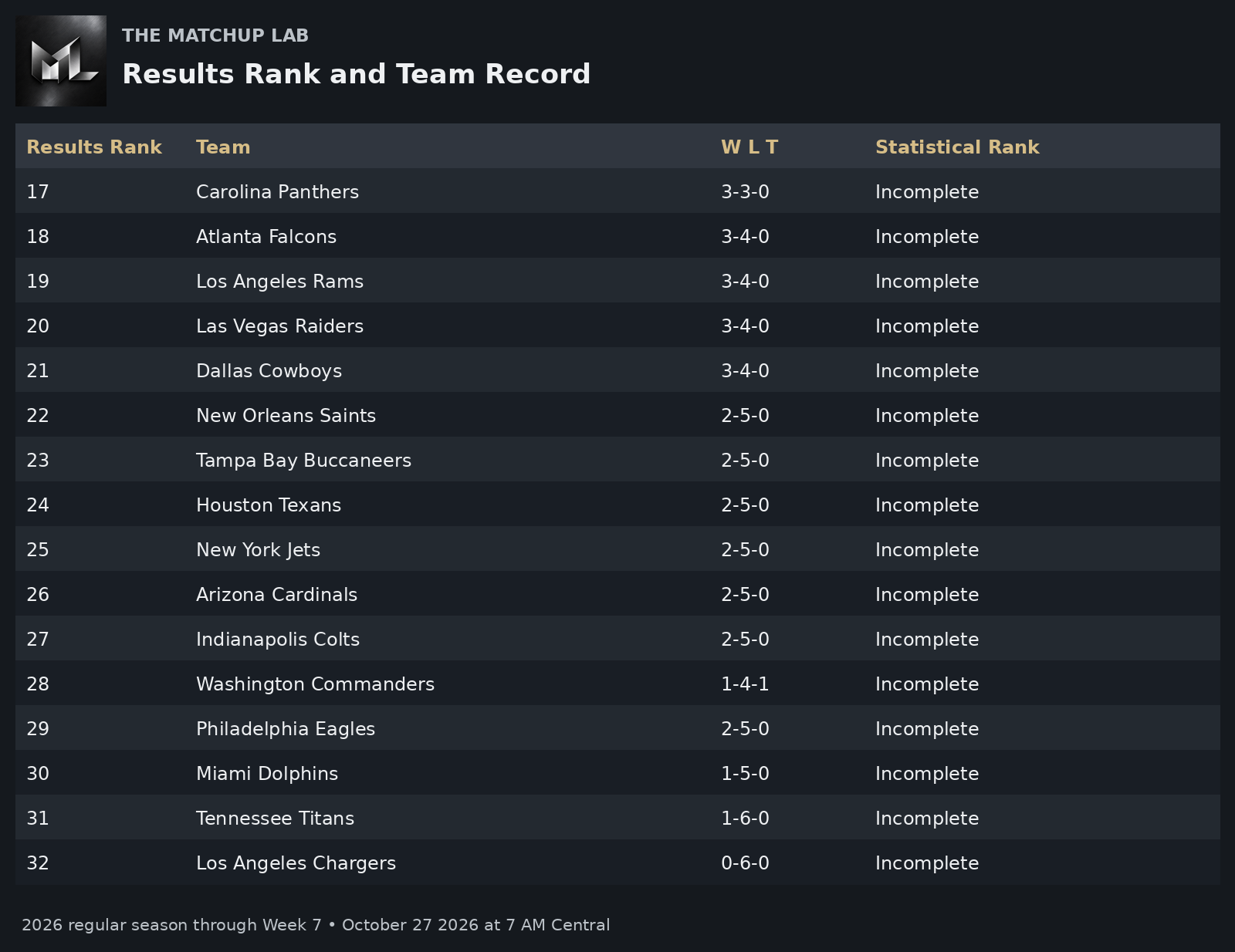
Results Rank is calculated separately using matchup-lab-results-v1.0. Its editorial weights are smoothed record 60%, schedule 15%, strength of victory 15% and loss quality 10%. Each opponent evaluation removes every head-to-head meeting with the assessed team at the same cutoff. Small starting assumptions soften short samples. Repeated opponents count once per actual meeting. It measures results already recorded and is not a betting probability. Only Results Rank and Team Record are shown; opponent records and calculation components remain private.
The Statistical Rank update is incomplete. Its saved NFL calculation remains unchanged, with efficiency 40%, long gains 25%, finishing drives 15%, field position 10% and turnovers 10%. It compares offense and defense, uses league-average priors, standardizes each category and caps extremes. The original executable has not yet been recovered with its required version binding, so this edition does not invent a current index, movement or replacement Statistical Rank. The current Results Rank is not a substitute for that calculation.
Overall Power Rank must put fewer regular-season losses first, then use current Statistical Rank within each loss group. Because that statistical tie-break remains incomplete, a numerical overall Power Rank is not issued here. The team assessments are grouped by actual loss count, with alphabetical presentation inside each group. That presentation is not an invented tie-break or a relabeling of Results Rank. Every team receives its own assessment and current season table.
The eight season statistics use complete team-game counts. Yards and points are divided by actual games played. Third-down percentages divide summed conversions by summed attempts, including the opponent counts for defense. Turnover margin is takeaways minus giveaways per game. Red-zone counts are not substituted for the established model's scoring opportunities. The current five-factor rates, starting-field-position split and Consistent or Uneven classifications remain unavailable until the saved calculation is recovered.
The complete Week 7 scoreboard
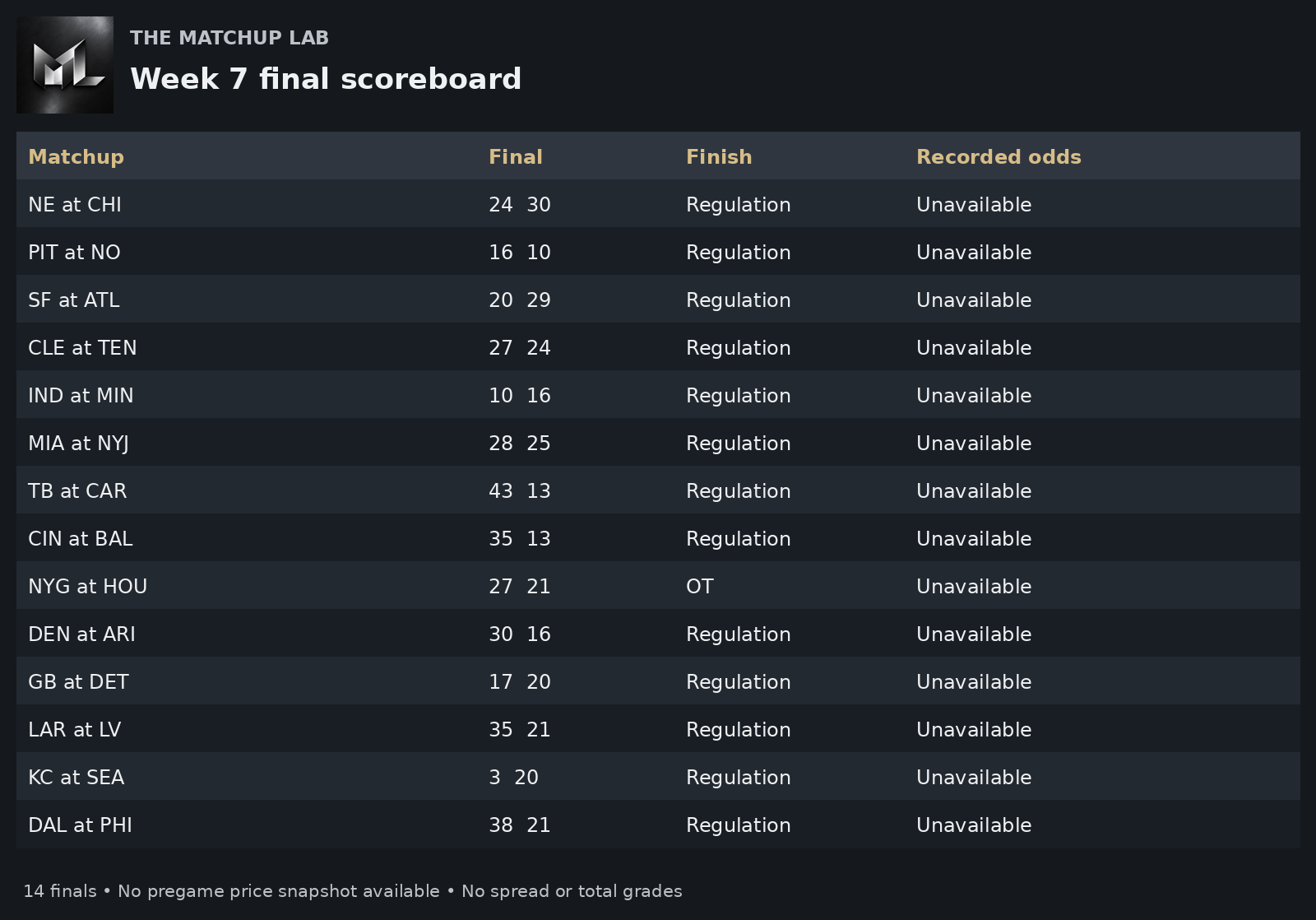
The retained Week 7 preview contained no verified pregame spread or total snapshot. All fourteen games therefore remain ungraded for betting purposes. No favorite or underdog covers, pushes, overs, unders or spread-total combinations are asserted. Any betting price must carry its observation time, can change before kickoff and is informational rather than a guarantee of results. A later price is not a closing line or a replacement for the missing historical snapshot.
Minnesota Vikings
Week 7 win 16-10 against Indianapolis Colts
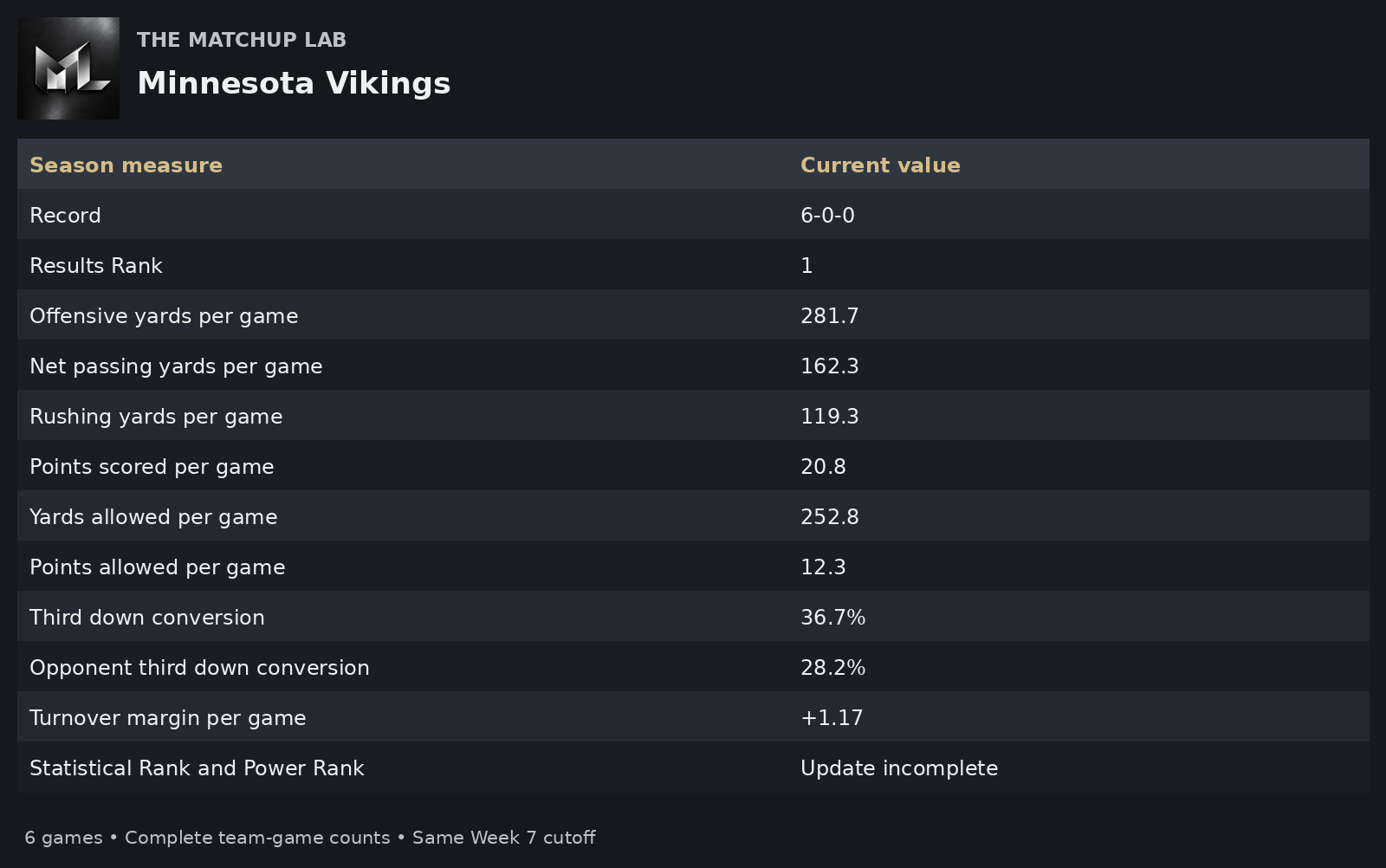
Minnesota is the league's remaining unbeaten team because its defense keeps the required winning score modest. Indianapolis managed 218 yards and no second-half points. That restraint mattered when the Vikings converted only three of eleven third downs. Winning without a giveaway helped, but sixteen points still left the game available late. The offense needs more early progress so a defensive stop can become a longer possession and a wider margin. A 6-0 record earns its position without requiring anyone to pretend every part of the team is equally convincing.
The season defense allows just 12.3 points per game and stops opponents on most third downs, with only 28.2% converted. That gives Minnesota a workable score even when its offense is modest. Its own 36.7% conversion rate leaves room for longer drives that keep the defense's task manageable. The useful balance is a defense that controls the demand and an offense that does more to reduce how often that defense must answer.
Buffalo Bills
Week 7 bye
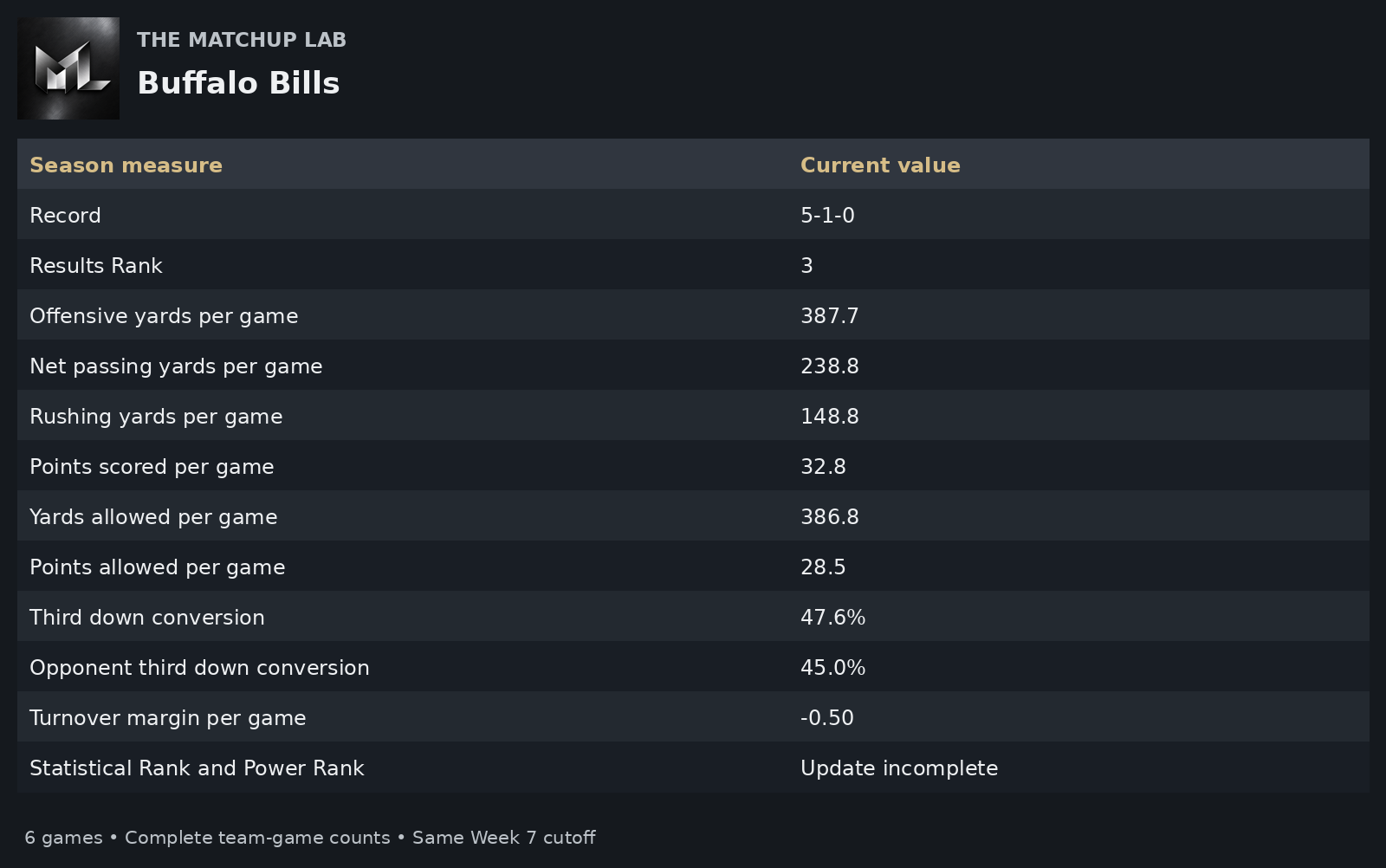
Buffalo's bye preserves a 5-1 record rather than providing fresh evidence of improvement. The offense has scored 197 points across six games, enough to cover for a defense that has allowed 171. That scoring burden makes ball security and the ability to sustain the next series particularly valuable. The Bills do not need to prove that they can win a scoring contest again before examining why opponents remain close. The next step is fewer occasions when a productive drive merely restores the margin that another defensive concession removed.
The Bills average 387.7 yards and concede 386.8, almost the same distance in each direction. Their 32.8 points per game have therefore carried a substantial share of the winning argument. Opponents convert 45.0% of third downs, keeping too many series available. Better defensive endings would give the offense a chance to extend control rather than repeatedly restore it.
Kansas City Chiefs
Week 7 loss 3-20 against Seattle Seahawks
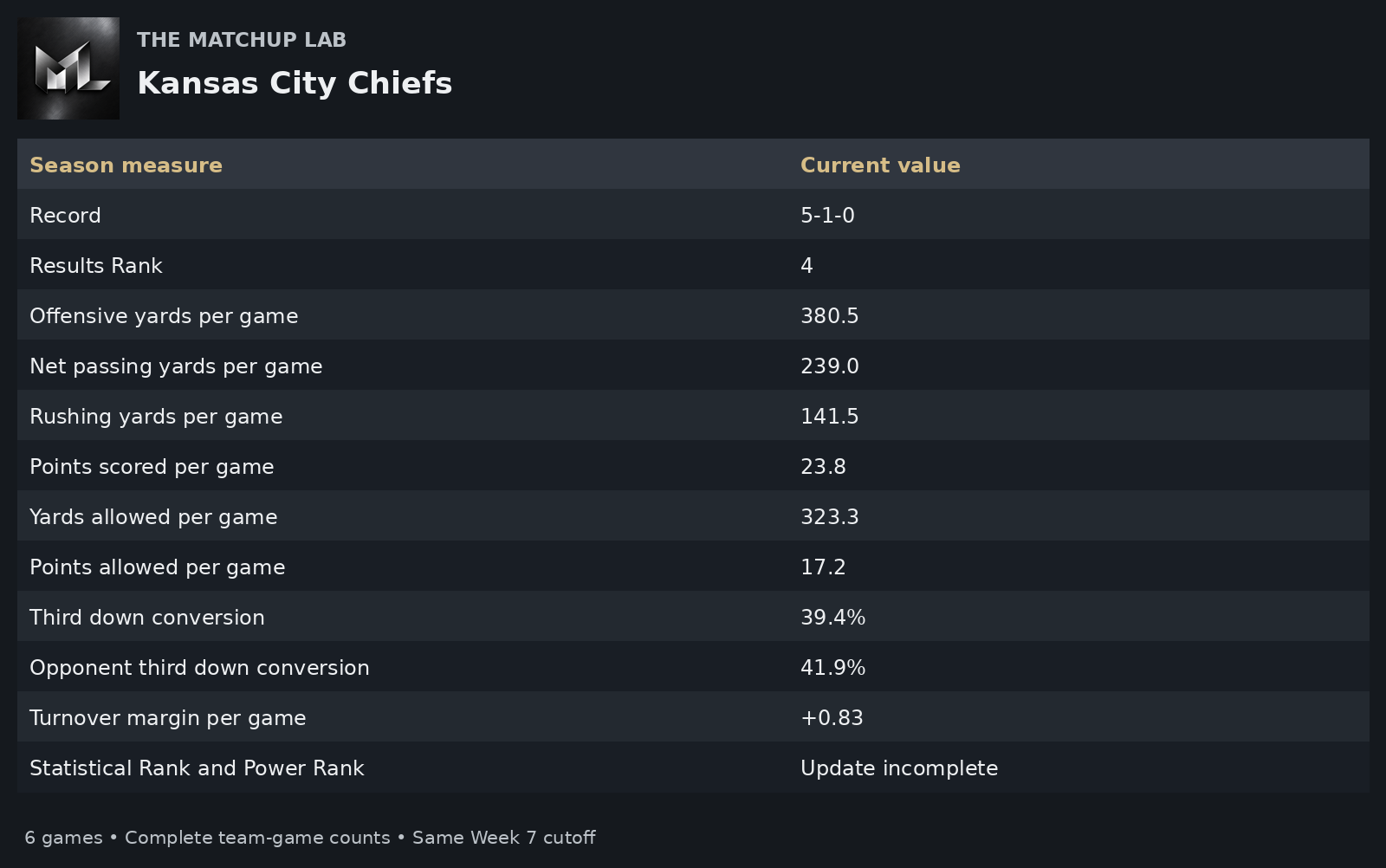
Seattle made Kansas City's first defeat unusually clear. The Chiefs gained 213 yards, rushed for fifty and converted three of eleven third downs. Both teams gave the ball away once, so a turnover imbalance cannot explain the separation. The defense had to face a Seattle offense that extended eleven of sixteen third downs. Kansas City's first five wins remain substantial season evidence. Its response needs to begin with ordinary offensive gains that keep the next snap manageable, while the defense ends possessions before another conversion sends it back to work.
Kansas City's season defense has allowed 17.2 points per game, still a useful foundation after Seattle's win. The offense averages 380.5 yards, substantially more than Sunday's return. That distinction matters when deciding what needs repair. The Chiefs need their ordinary season production to reappear before asking the defense for another exceptionally low scoring target. One failed afternoon should prompt a response without replacing the entire six-game record.
San Francisco 49ers
Week 7 loss 20-29 against Atlanta Falcons
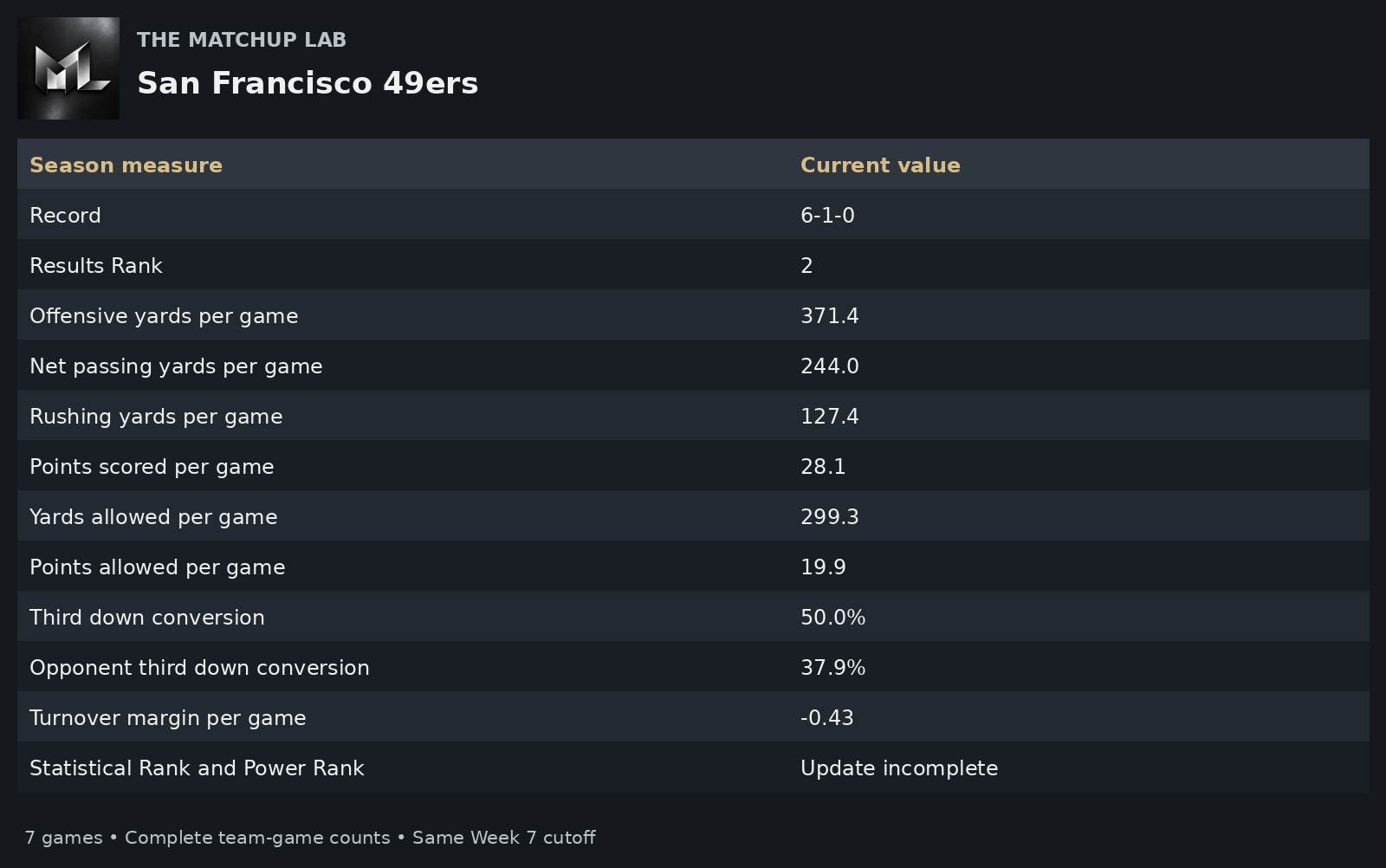
Four giveaways made San Francisco's 400 yards a poor answer to Atlanta's 295. The first defeat exposed the difference between moving the ball and preserving the chance to score. The 49ers still own six wins and a healthy season scoring margin. One messy afternoon does not erase that work, but the defense could not prevent the lost possessions from becoming a nine-point defeat. The useful correction starts with completing drives without gifting another opportunity. Asking the offense for still more yards would miss what actually changed this game.
San Francisco still averages 371.4 yards against 299.3 allowed, with a positive season scoring margin. That broader advantage survives the first loss. The offense's 50.0% third-down conversion rate supports sustained possessions, but useful conversions cannot recover a chance that ends with the ball going the other way. The next improvement is preserving that work through the last decision of the drive.
Chicago Bears
Week 7 win 30-24 against New England Patriots
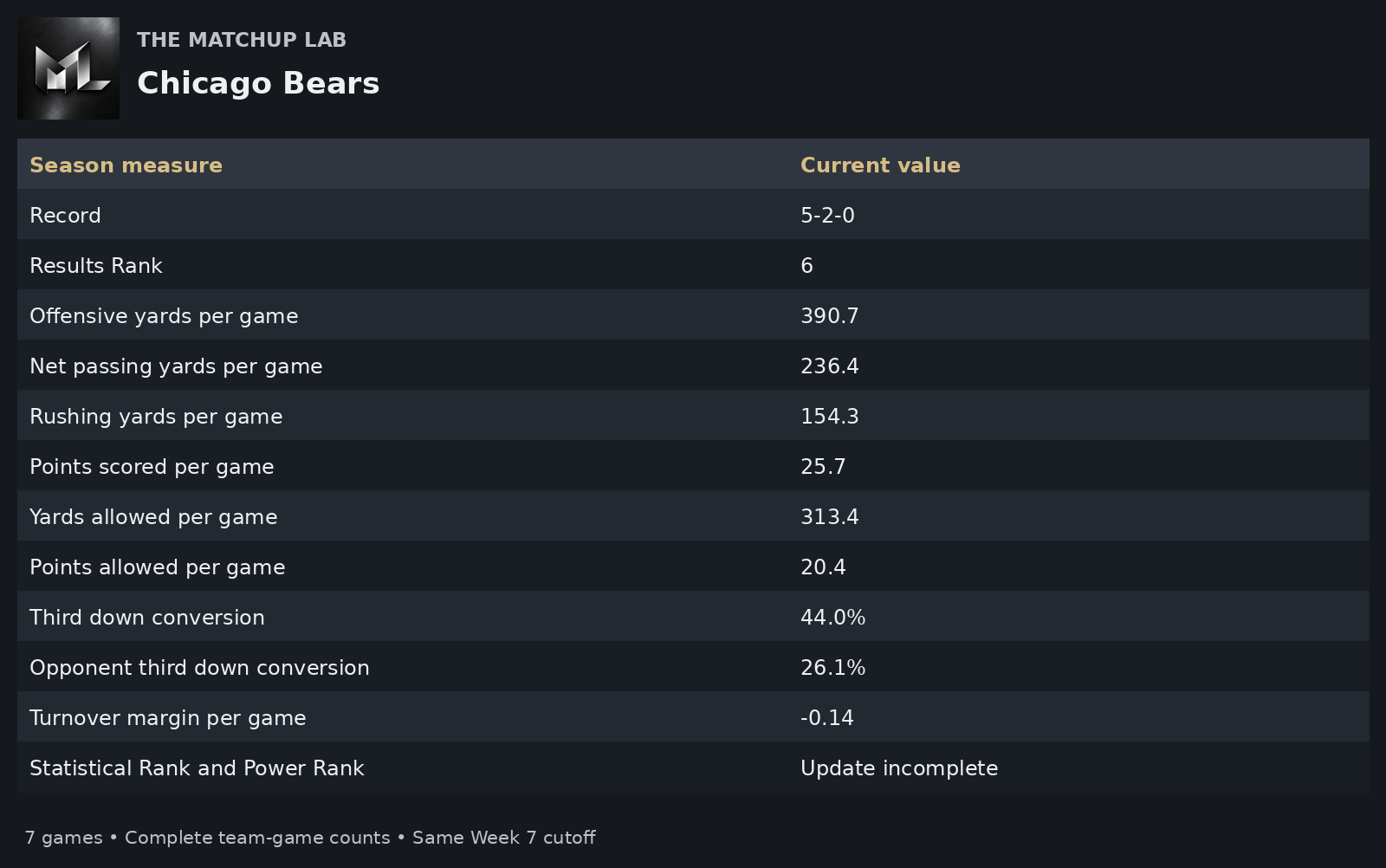
Chicago reached five wins with 405 yards and no giveaways against New England. That clean possession record made thirty points more useful than another impressive offensive total accompanied by a donation. The Bears still converted only four of twelve third downs and allowed 380 yards. There is work to do before the next close finish can be considered comfortable. Their offense needs enough early progress to avoid repeatedly leaning on the next difficult conversion. The defense must make promising stops survive the following play instead of asking the offense to rebuild the lead.
The Bears' season offense averages 390.7 yards and 25.7 points, while the defense allows 20.4 points. That is a useful scoring cushion across seven games. Opponents still convert 26.1% of third downs, so keeping a drive alive is not solely an offensive question. More stops before scoring territory would let Chicago's productive offense build a margin that lasts through the following possession.
Cincinnati Bengals
Week 7 win 35-13 against Baltimore Ravens
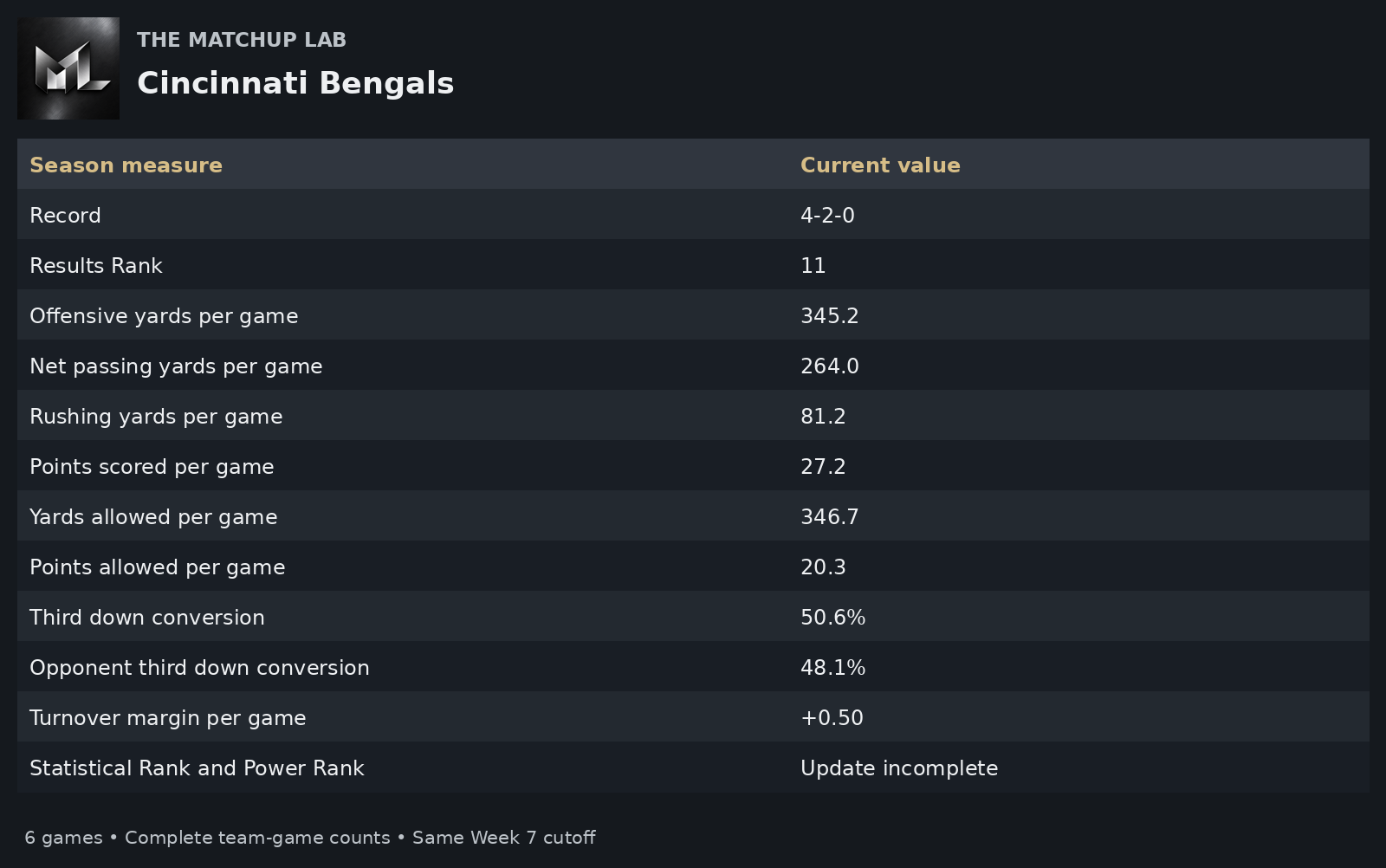
Cincinnati scored all thirty-five of its points after halftime while Baltimore scored none. The full-game yardage was almost identical, 357 to 359, which makes this a poor game to explain through total distance alone. The Bengals protected possession and turned their opportunities into a much larger return. The season now includes four wins and a useful positive scoring margin. The challenge is carrying the productive second-half response into the opening possessions of the next game. A scoreless first half remains a problem even when the recovery is emphatic enough to conceal it.
The Bengals score 27.2 points per game and allow 20.3, giving their 4-2 record a substantial positive scoring balance. Their own third-down conversion rate is 50.6%. The task is turning those season capabilities into a productive opening half as well as a strong response. Cincinnati should not require the opponent to carry a lead before its offense begins producing enough points to take the game away.
Cleveland Browns
Week 7 win 27-24 against Tennessee Titans
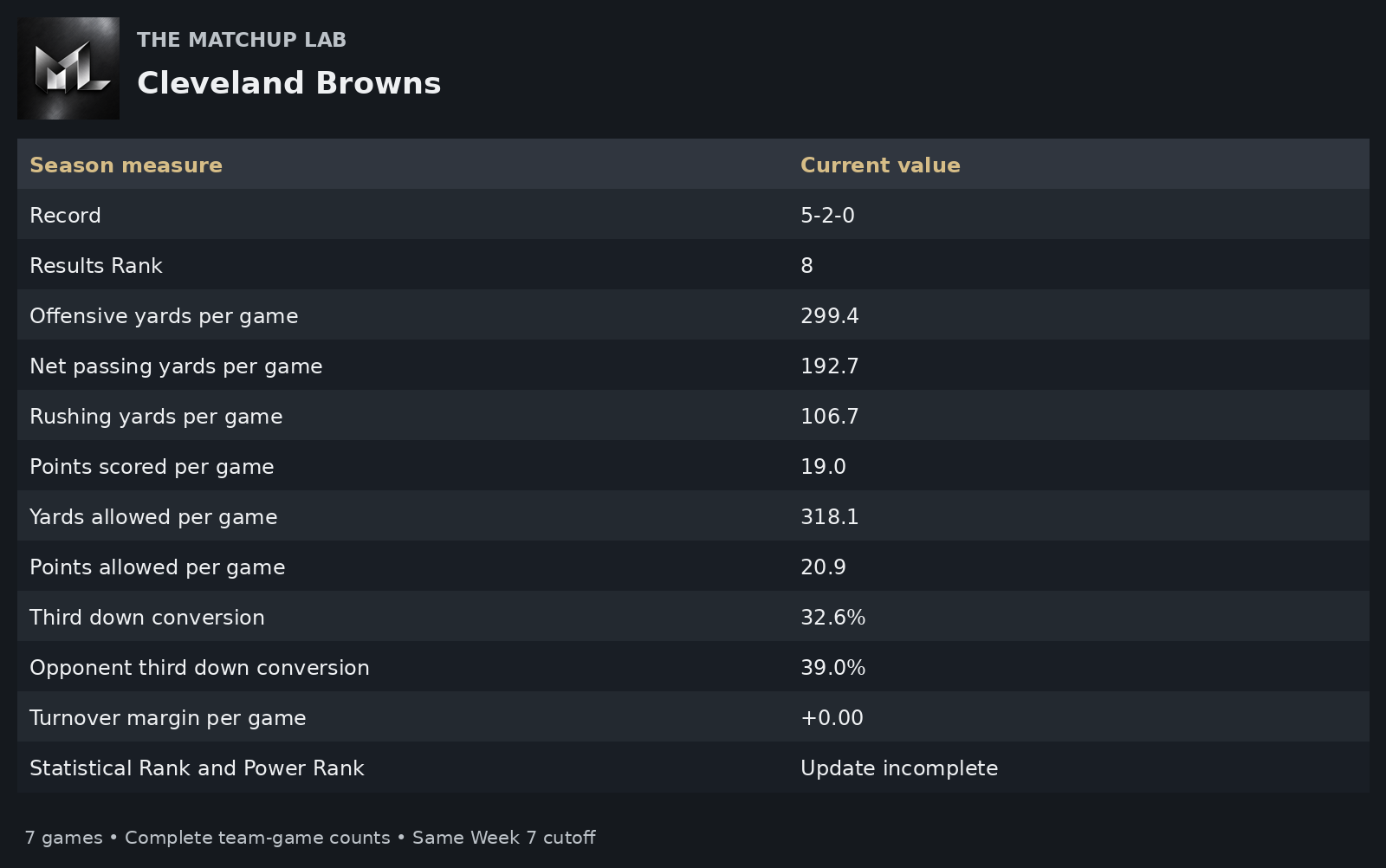
Cleveland's 491 yards gave this victory a stronger offensive foundation than the three-point margin suggests. The Browns ran for 183 yards, but two giveaways surrendered some of that work. Tennessee also lost possession twice, leaving the turnover exchange even rather than a separate explanation for the win. A team with five wins and a negative season scoring margin cannot assume that every narrow contest will keep breaking its way. Cleveland needs useful drives to end in points more consistently and fewer possessions that have to be replaced after a mistake.
The Browns allow 20.9 points per game while scoring 19.0. That negative balance is an appropriate reason to scrutinize a winning team. Their offense averages 299.4 yards, so Sunday's 491-yard performance supplied far more progress than the season baseline. Preserving the useful changes without the two giveaways would give Cleveland a stronger route to separation than relying on another narrow finish.
Denver Broncos
Week 7 win 30-16 against Arizona Cardinals
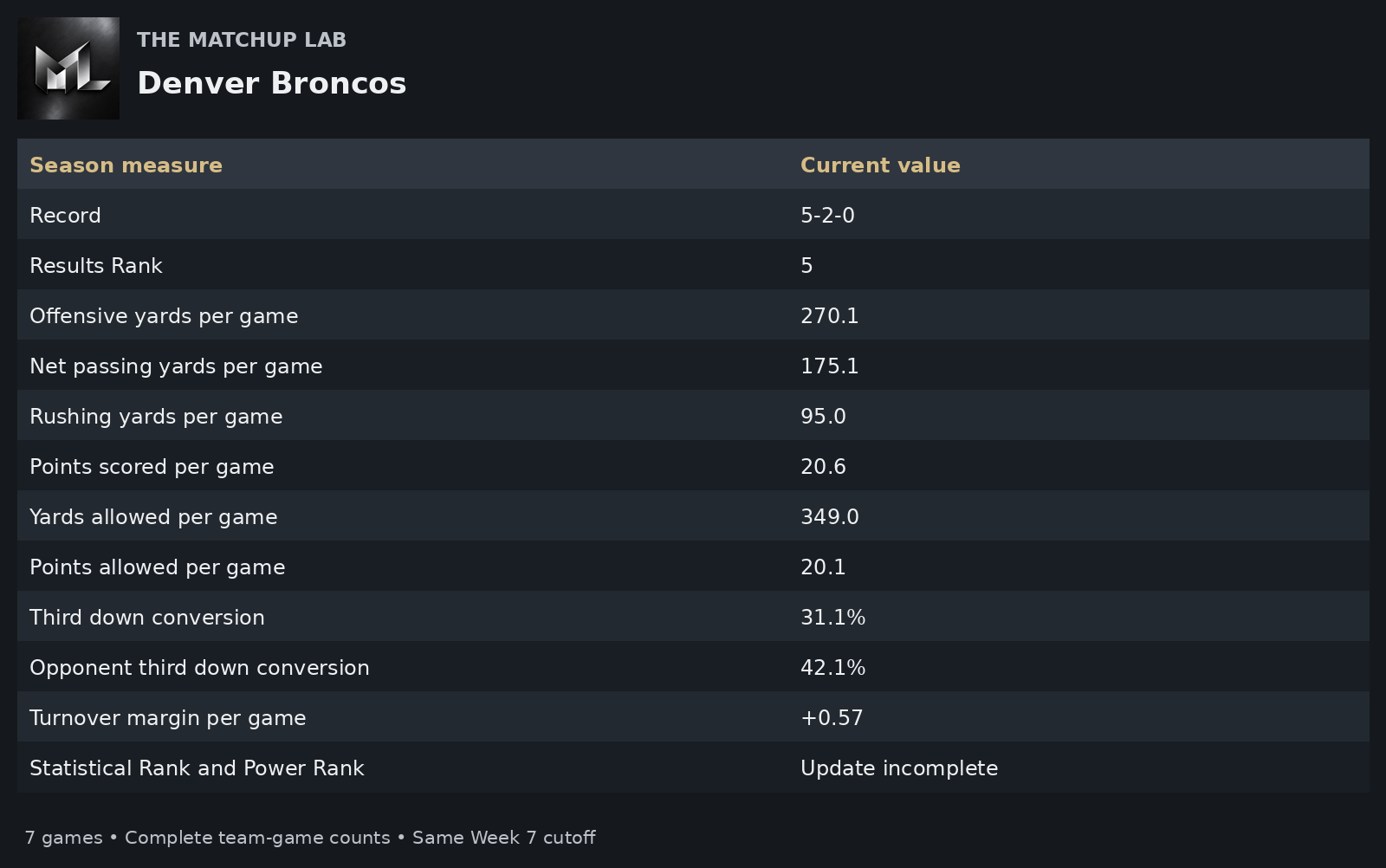
Denver's offense contributed much more directly to this win than a narrow season scoring margin might suggest. The Broncos gained 378 yards and ran for 160 without giving the ball away. Arizona also protected possession, so Denver had to earn its separation. Only three of eleven third downs became conversions, leaving a clear improvement even in a fourteen-point victory. Better early gains would reduce the need to rescue possessions late. Five wins deserve their place in the results assessment, while the season as a whole still asks for a more dependable scoring cushion.
Denver scores 20.6 points per game and allows 20.1, leaving a small scoring margin behind five wins. Its offense gains 270.1 yards per game. That limited season production makes a clean possession especially valuable and another empty series especially costly. The Arizona result offers evidence that the offense can provide more help, provided it does not turn one improved game into an assumed weekly return.
Detroit Lions
Week 7 win 20-17 against Green Bay Packers
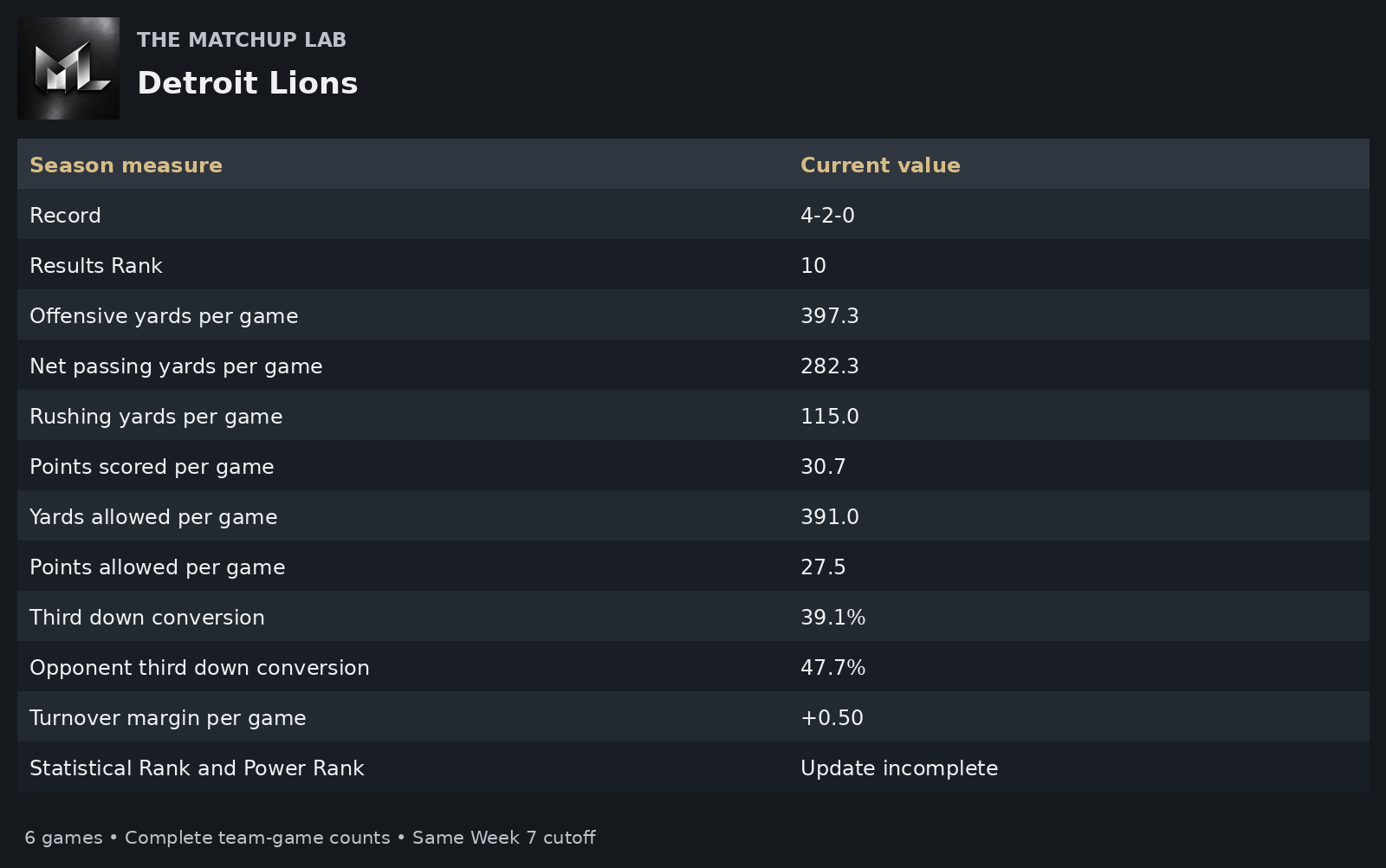
Detroit gained 415 yards against Green Bay and needed nearly all of that work to produce a three-point win. Two giveaways, against one taken from the Packers, kept an otherwise productive afternoon close. Converting five of ten third downs helped the Lions extend their opportunities, but twenty points still left the defense responsible for a narrow finish. The season offense has scored enough to support a good record. The next improvement is preserving productive possessions and making the last stretch of a drive count, instead of merely accumulating enough yards to explain another close game.
Detroit's season offense averages 397.3 yards and 30.7 points, enough to support a good record without pretending the defense is equally secure. Opponents score 27.5 per game. That leaves a recurring demand for another productive offensive possession. Protecting the ball would make the same useful yardage carry further, while more defensive stops would reduce how often the offense has to answer immediately.
Jacksonville Jaguars
Week 7 bye
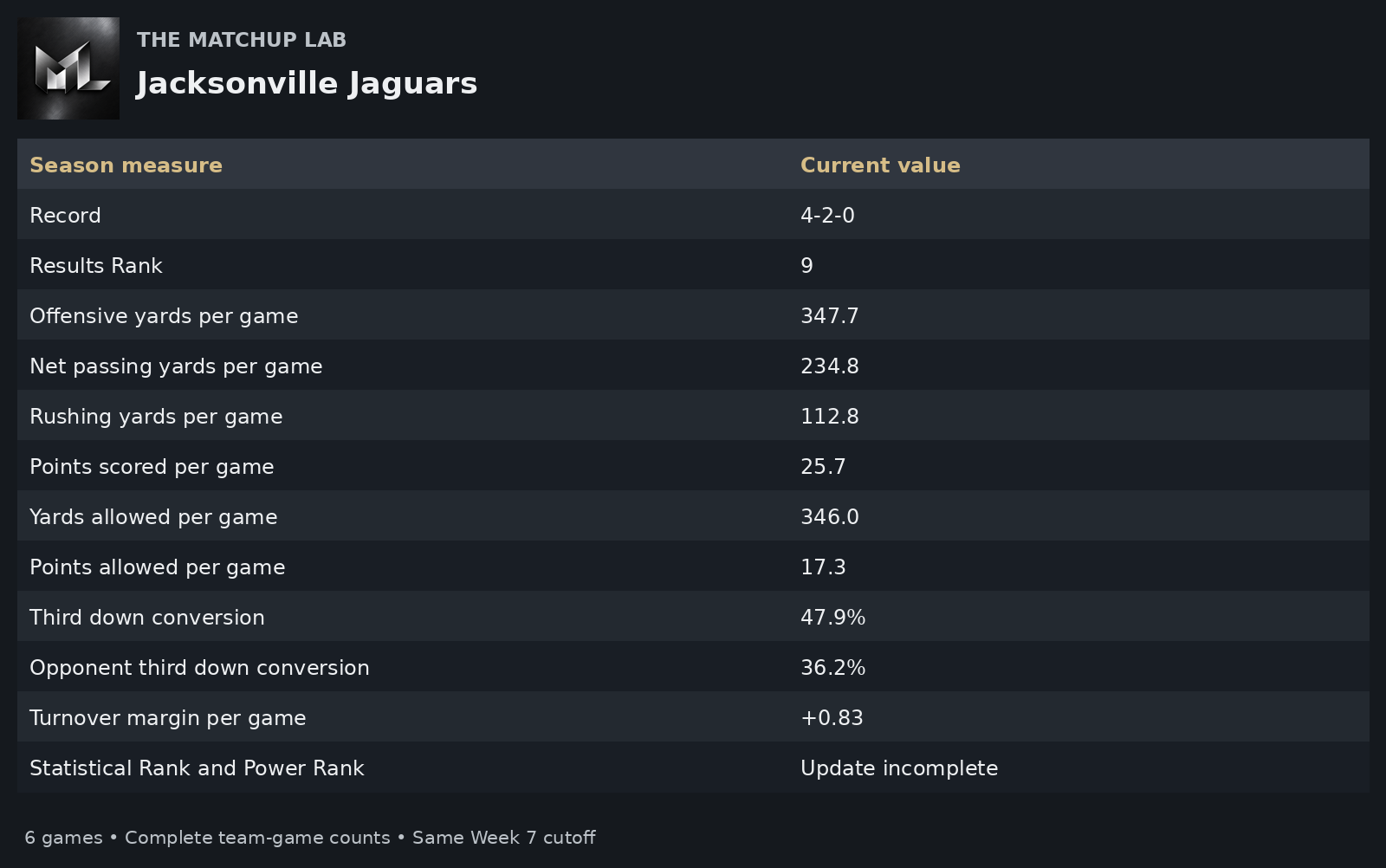
Jacksonville's bye leaves a 4-2 season with 154 points scored and 104 allowed. That fifty-point margin is more useful context than a week with no new result. The Jaguars have kept their overall scoring requirement manageable, and they need their offense to preserve that help rather than demanding a turnover before every comfortable possession. The off week cannot establish a new trend in third-down play or drive finishing. The next game will test whether their existing balance survives a fresh opponent without being carried by one unusually favorable sequence.
Jacksonville allows 17.3 points per game, giving an offense scoring 25.7 a useful season margin. Its third-down rates are 47.9% gained and 36.2% allowed. Those figures explain why maintaining a possession after the first promising gain remains worth attention on both sides. The next game can add evidence of improvement; the bye itself cannot. Jacksonville should preserve the defensive restraint while improving how consistently its offense converts that help into control.
New York Giants
Week 7 win 27-21 against Houston Texans in overtime
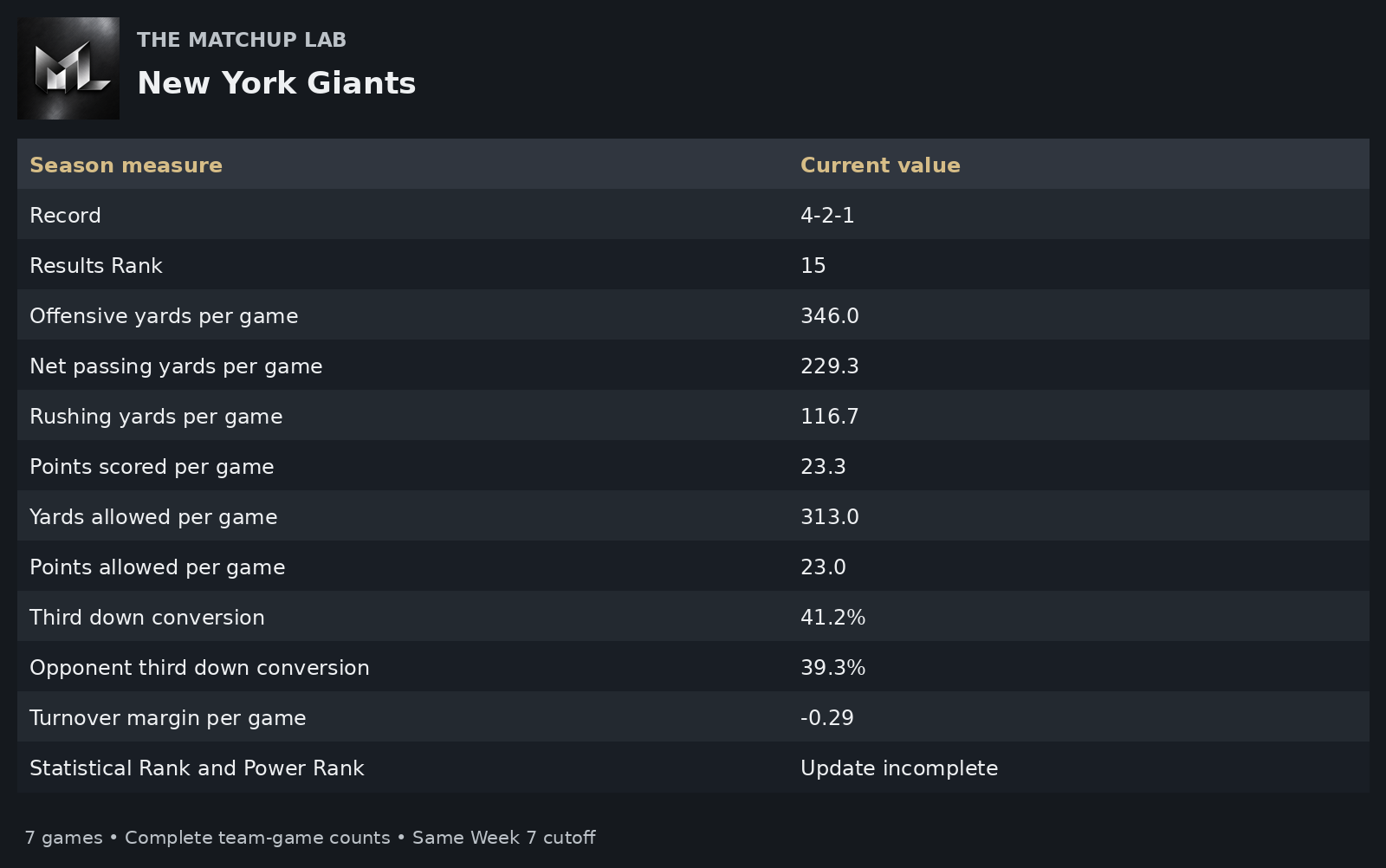
The Giants won in overtime after gaining 420 yards to Houston's 237, with neither side giving the ball away. That makes the underlying opportunity clearer than a six-point margin alone. New York still had to finish the extra period to convert its advantage into a win. Five conversions on thirteen third downs left several possessions short of their potential. The season record includes an actual tie, which remains a tie in every table. The Giants need more scoring value from the ground they earn so another strong yardage afternoon does not depend on the last available possession.
New York scores 23.3 points per game and allows 23.0, leaving a narrow season margin alongside four wins and a tie. The Giants average 346.0 offensive yards. Productive ground must become enough points before a late possession or extra period is required to settle the game. Better early gains would also reduce how often a useful series depends on a difficult third-down conversion.
Pittsburgh Steelers
Week 7 win 16-10 against New Orleans Saints
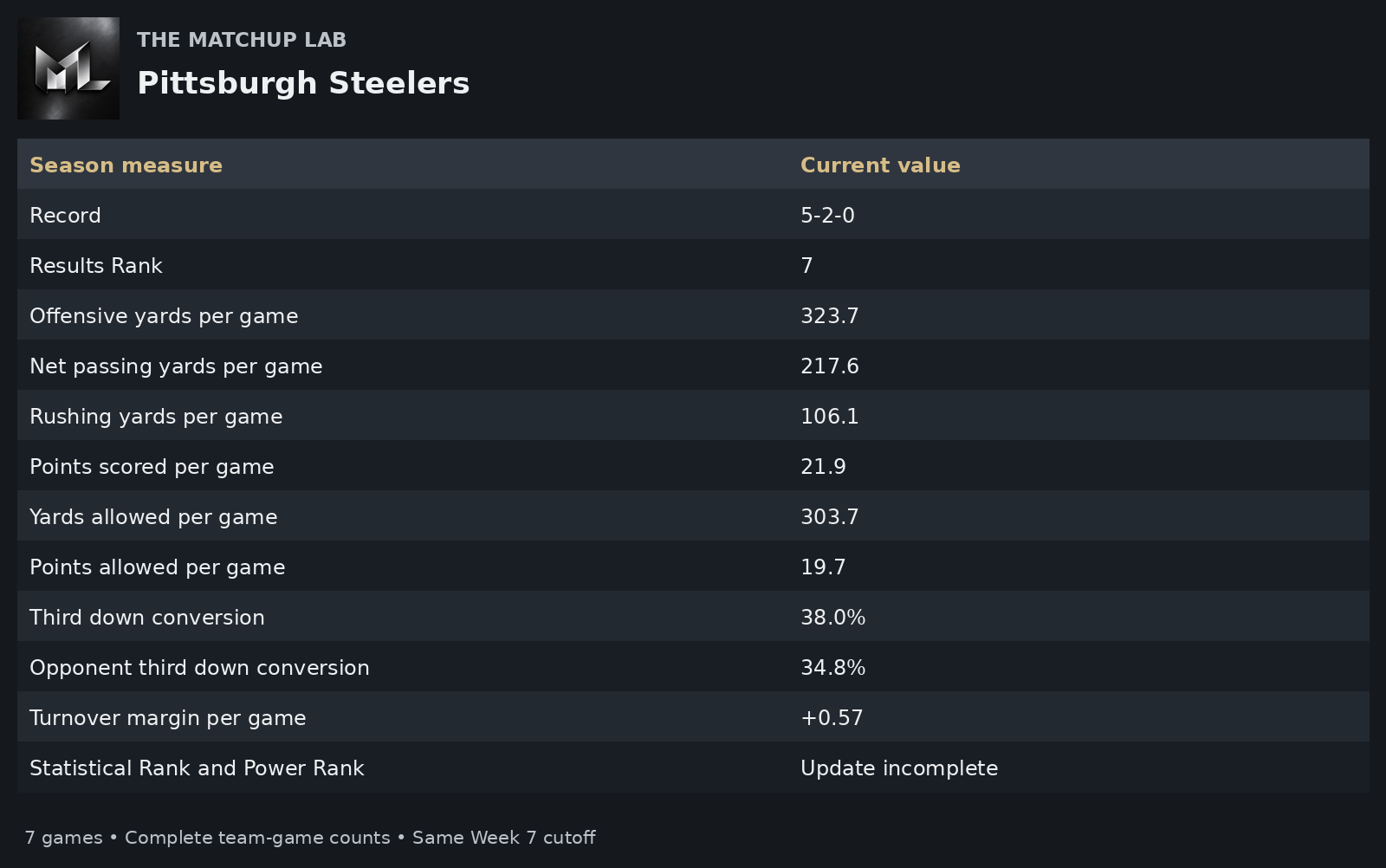
Pittsburgh sustained enough possessions to win in Saint-Denis without making the scoreboard look easy. Ten conversions on sixteen third downs and 148 rushing yards kept the offense involved. Sixteen points from 343 yards still leave room for a better return near the end of drives. The defense's restriction of New Orleans to eighteen rushing yards helped make that modest score sufficient. The Steelers should keep the useful ground work while reducing how often a third-down conversion is required to preserve it. Five wins are earned results, with finishing still an obvious route to a firmer margin.
Pittsburgh's 21.9 points per game exceed the 19.7 it allows, but the margin leaves little room for a wasteful possession. The season offense converts 38.0% of third downs. The Saints game showed how much additional work can be required when so many series reach that down. The Steelers need their useful rushing gains to shorten the next conversion and improve the points returned by an extended drive.
Baltimore Ravens
Week 7 loss 13-35 against Cincinnati Bengals
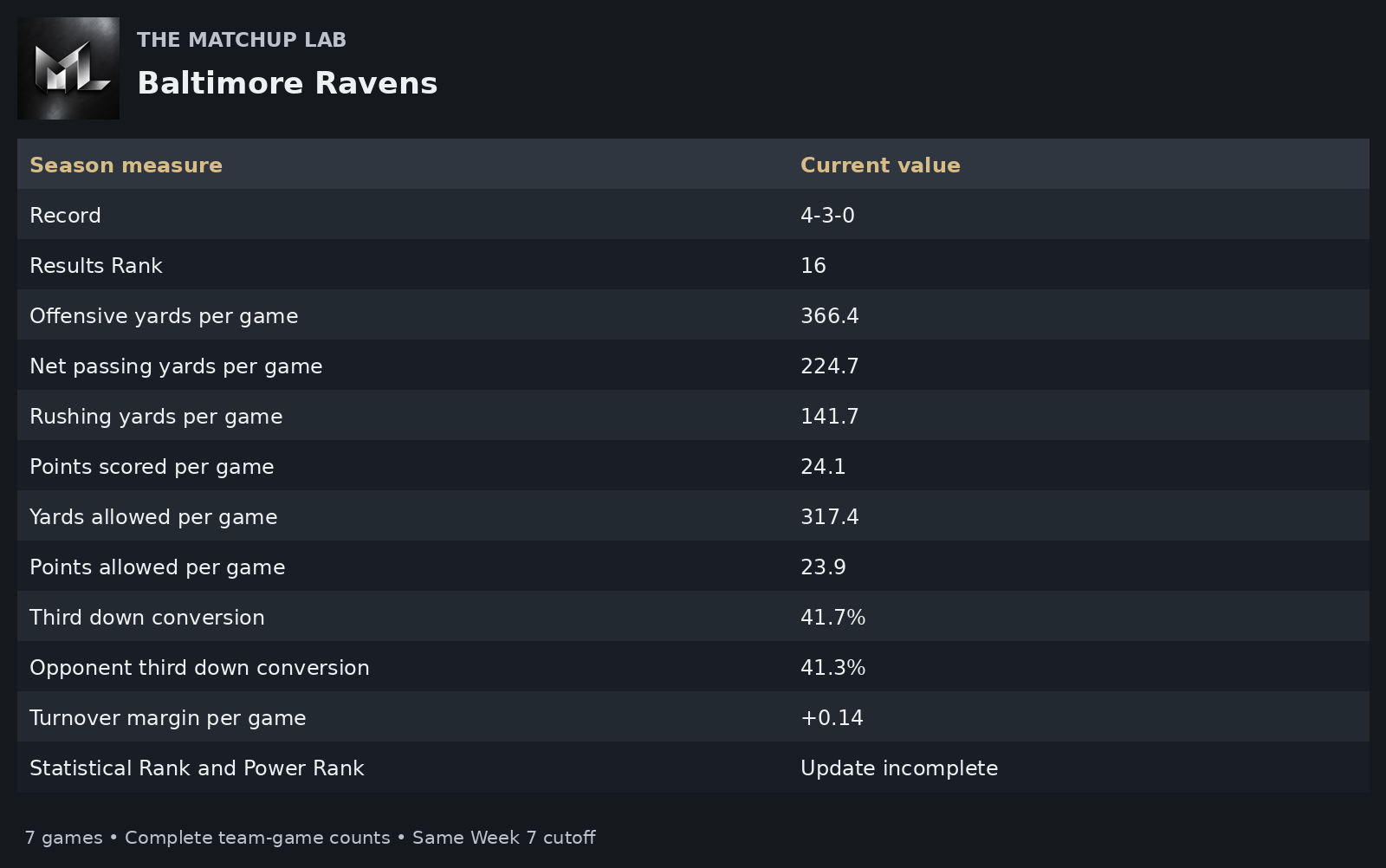
Baltimore's 359 yards and nine third-down conversions were not the same as offensive control. The Ravens scored thirteen before halftime and nothing afterward while Cincinnati scored thirty-five. One giveaway contributed, but it cannot carry the entire explanation for a twenty-two-point defeat. The season scoring margin has narrowed to almost even. Baltimore needs productive possessions after its first successful sequences and defensive stops that prevent an opponent's adjustment from becoming an uninterrupted half. The next response should address how drives end and how the following possession begins, rather than quoting the useful yardage back at the scoreboard.
Baltimore's season points for and against have narrowed to 24.1 and 23.9 per game. The offense still averages 366.4 yards, which makes a simple lack-of-distance explanation inadequate. The Ravens need those gains to survive the final part of a possession and the defense to end the next series. Otherwise useful production keeps appearing in the statistics without providing much room on the scoreboard.
Carolina Panthers
Week 7 loss 13-43 against Tampa Bay Buccaneers
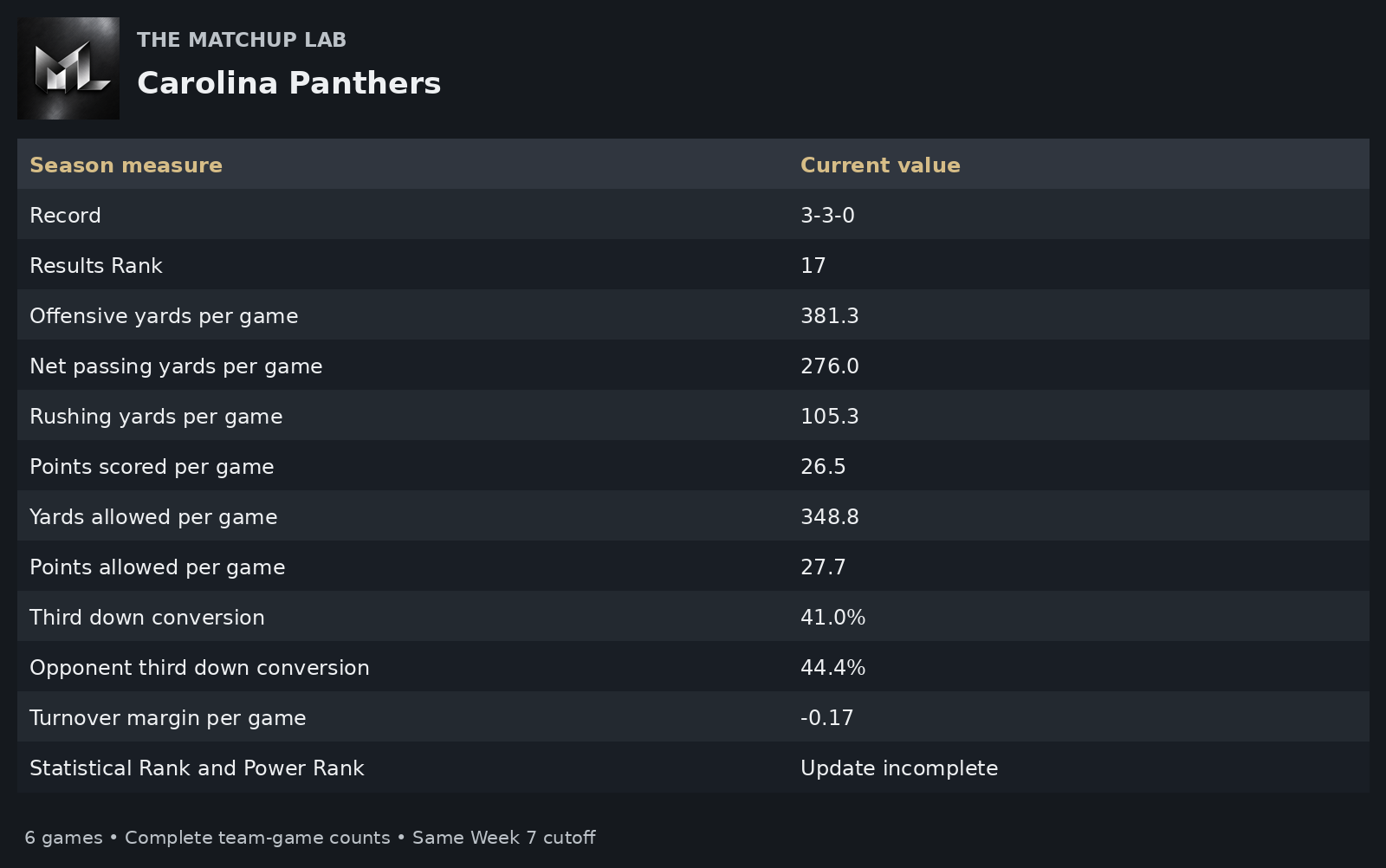
Four giveaways helped turn Carolina's defeat into a thirty-point gap. Tampa Bay gained only fifty-six more yards, yet the Panthers repeatedly removed their own chances and increased the defensive burden. The Buccaneers' 258 rushing yards also deserve a direct response. Avoiding turnovers would not by itself solve that defensive problem. Carolina's season has reached an even record with more points allowed than scored. The correction needs cleaner possessions and better resistance on ordinary rushing plays, so an early mistake does not immediately become another long sequence spent defending.
Carolina's offense averages 381.3 yards and 26.5 points per game, while the defense allows 27.7. The season was already too close to absorb four lost possessions comfortably. Protecting the ball is therefore immediately useful, but it does not replace the need for earlier defensive stops. The Panthers need both repairs to make a promising drive more valuable than the next chance handed to an opponent.
Green Bay Packers
Week 7 loss 17-20 against Detroit Lions
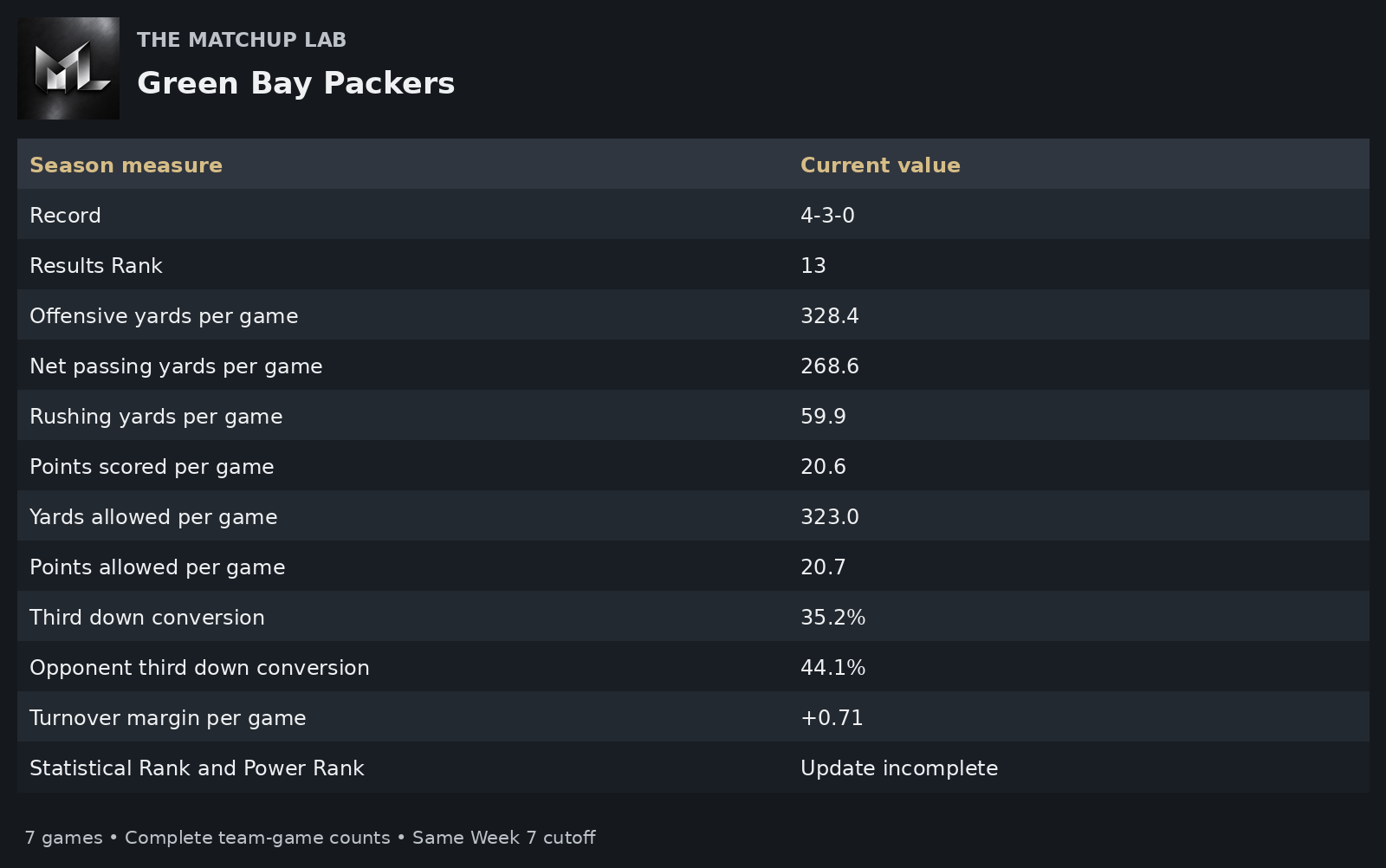
Green Bay kept Detroit within three points despite conceding 415 yards. That result should not hide an offense that rushed for sixty yards and converted five of fifteen third downs. The Packers gained a possession through the turnover exchange but could not turn it into a winning score. Their season points for and against are almost level, fitting a team that repeatedly leaves little room for error. Sustaining a useful opening gain matters more than waiting for the next escape play. Green Bay needs longer productive sequences before the final close possession arrives.
Green Bay scores 20.6 points and allows 20.7 per game, almost an exact balance over seven games. Its offense converts 35.2% of third downs. That gives a concrete reason to seek easier second and third downs before another close finish arrives. The defense can keep a game available, but the offense must supply a possession that changes more than the location of the next punt.
New England Patriots
Week 7 loss 24-30 against Chicago Bears
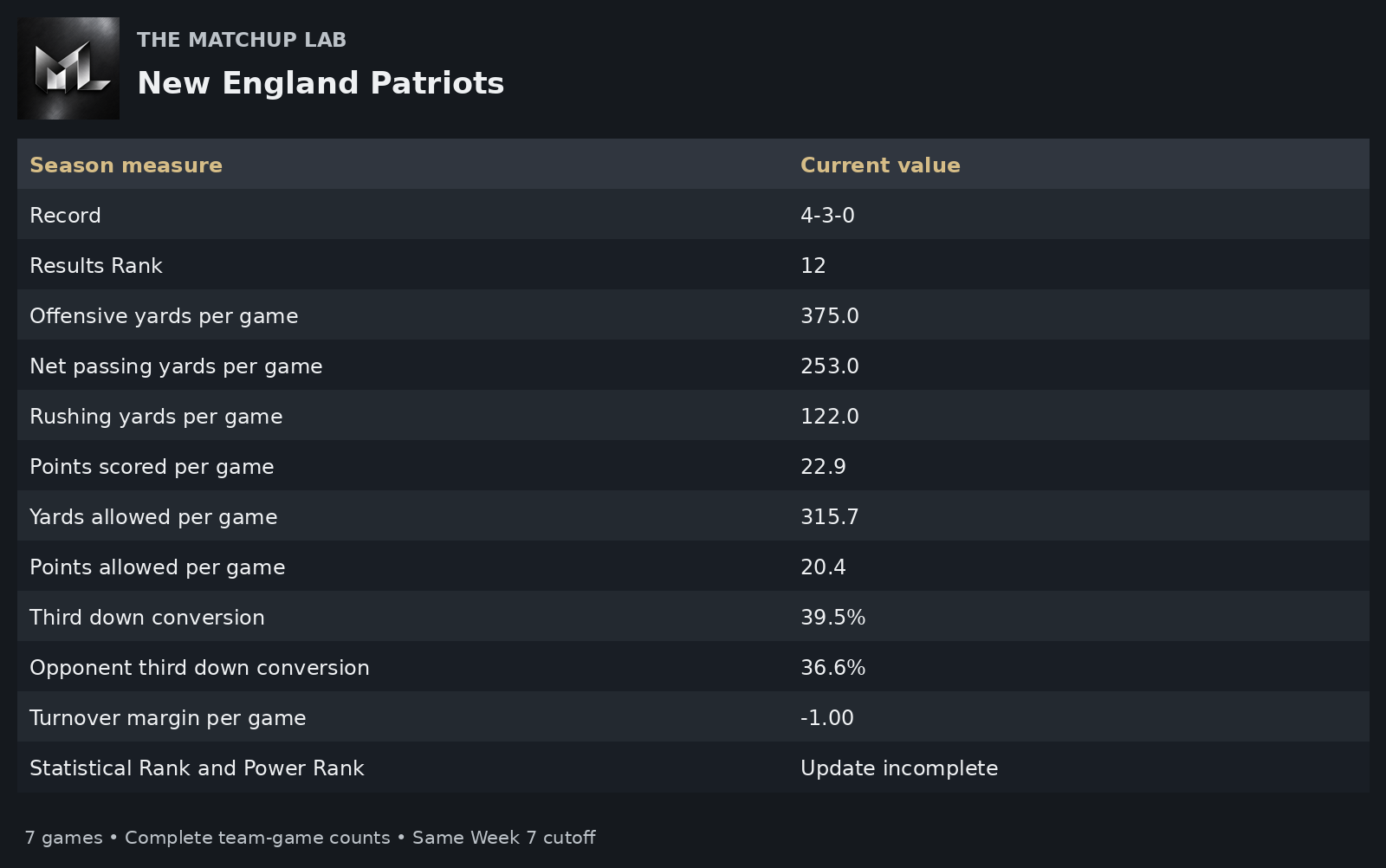
New England gained 380 yards in Chicago and still needed more from its possessions. Two third-down conversions in seven attempts limited the ability to repair a stalled series. The Patriots' one giveaway also cost a chance that Chicago did not return. Their season scoring margin remains positive, but a third defeat makes the difference between productive yardage and controlled possessions more pressing. New England needs early gains that make the next down realistic and a cleaner finish to the drives that survive. The defense cannot expect 380 yards allowed to be harmless merely because the offense can answer.
The Patriots' 375.0 offensive yards per game have produced 22.9 points, while the defense allows 20.4. The season scoring balance remains positive despite a third loss. Possessions lost through mistakes or failed conversions make that broader yardage advantage harder to use. New England needs the ground it earns to survive until a scoring attempt, with the defense preserving the next lead rather than asking the offense to rebuild it.
Seattle Seahawks
Week 7 win 20-3 against Kansas City Chiefs
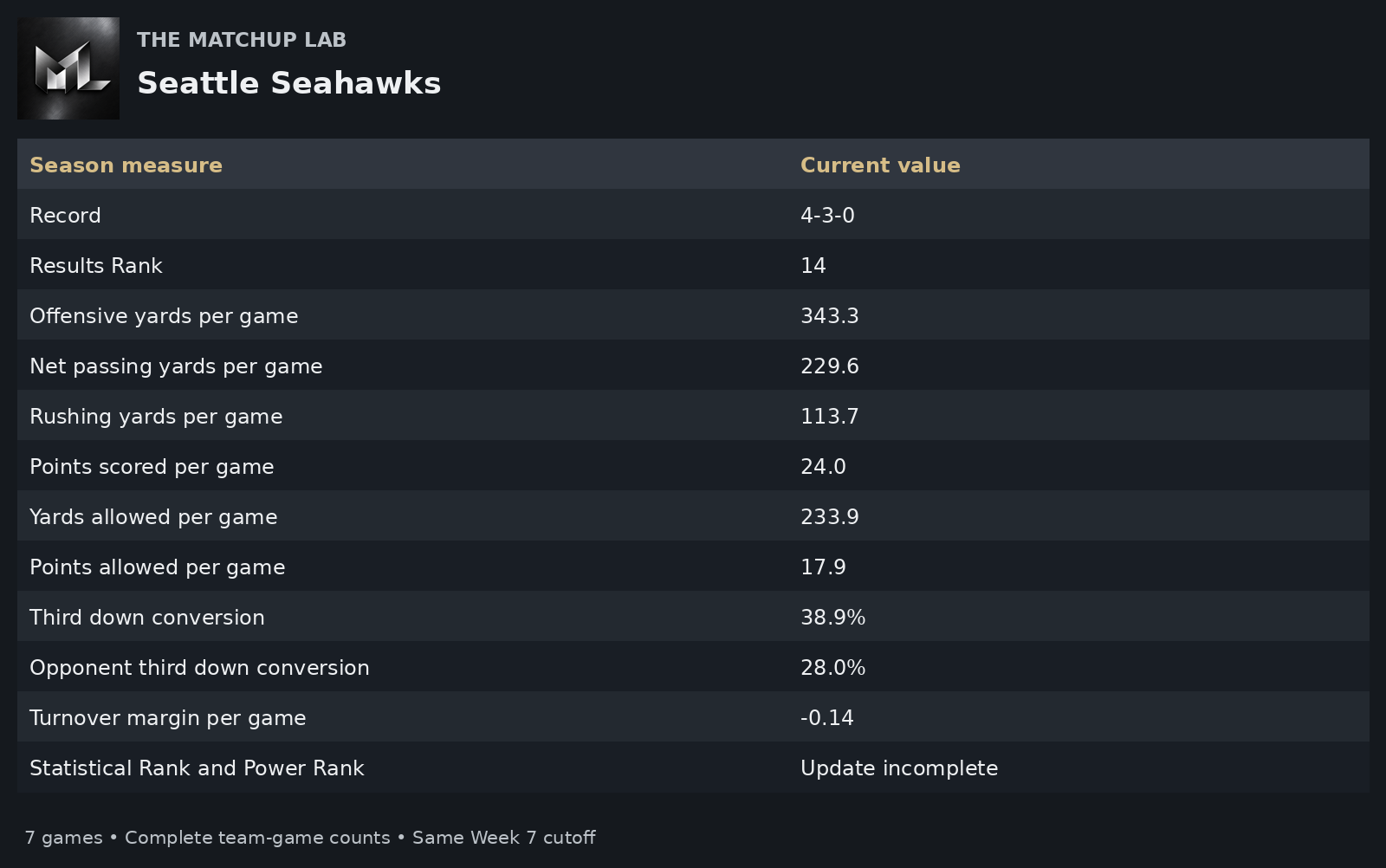
Seattle's defense and offense both supplied convincing work against Kansas City. Holding the Chiefs to 213 yards limited the scoring demand, while eleven third-down conversions in sixteen attempts helped the Seahawks keep possession. Each team committed one turnover, so the seventeen-point margin was not simply a giveaway windfall. The season's positive scoring balance now has another substantial result behind it. Seattle should still seek useful gains before third down rather than treating an exceptional conversion afternoon as the normal plan. The more repeatable aim is making both units' work survive the next series.
Seattle's season defense allows 17.9 points per game against an offense scoring 24.0. That favorable balance gives the latest win a wider foundation. The offense converts 38.9% of third downs, while Sunday's exceptional return went much further. Seattle should retain the ability to sustain a drive without treating eleven conversions in sixteen attempts as a requirement the offense can repeat on command.
Atlanta Falcons
Week 7 win 29-20 against San Francisco 49ers
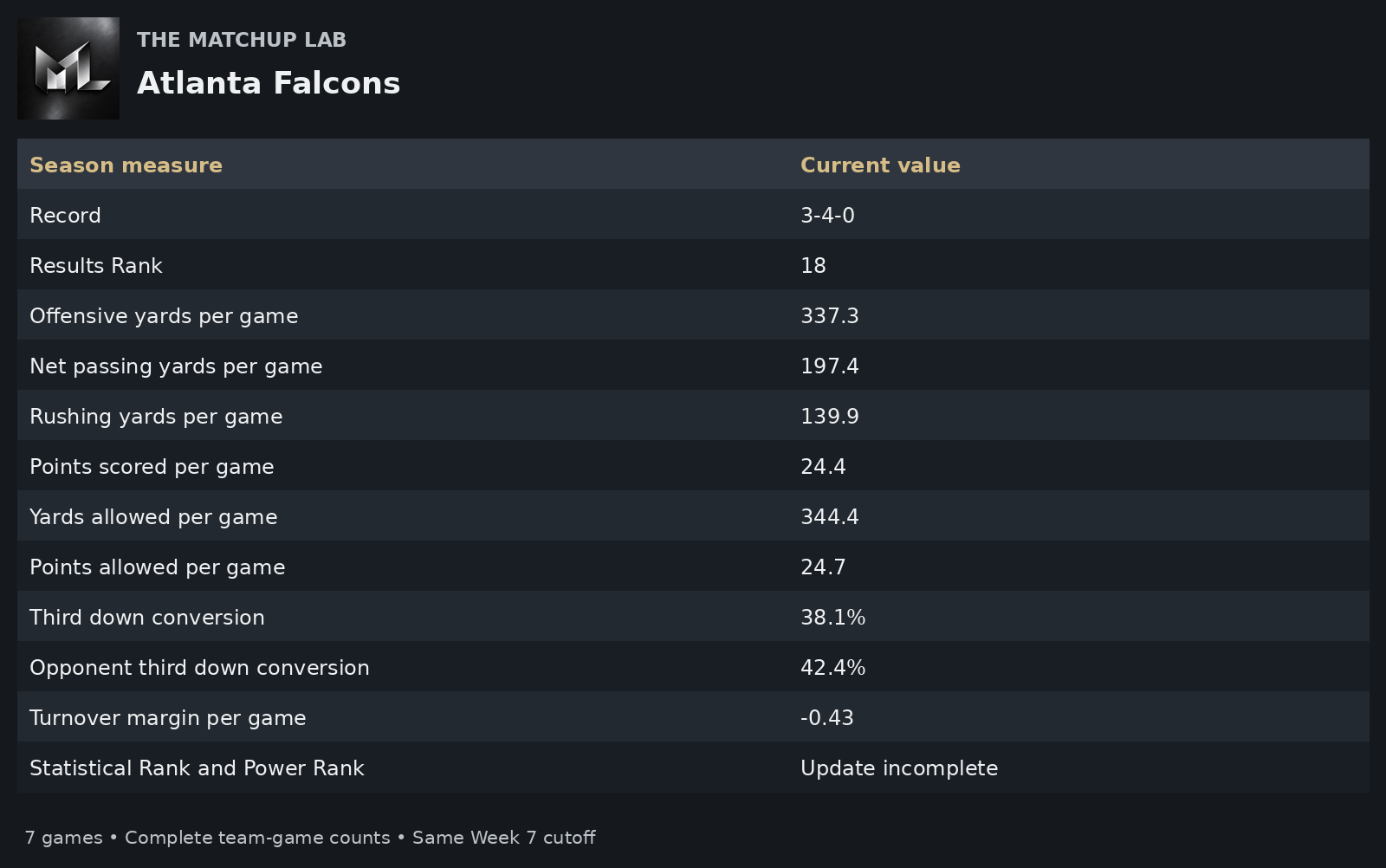
Atlanta beat San Francisco while gaining 105 fewer yards because it kept possession and took the ball away four times. Those are real contributions, not a reason to dismiss the victory. They also explain why the Falcons should resist treating twenty-nine points as a new offensive baseline. Four conversions in twelve third-down attempts left room for steadier progress. Their season scoring margin is close to level. Atlanta needs more chances it creates through its own sustained work, preserving the ball security that made the takeaways valuable without assuming another four will arrive next week.
Atlanta's season scoring is nearly level, 24.4 points per game against 24.7 allowed. That fits a team whose latest win improved the record without establishing a large margin for error. The offense averages 337.3 yards and converts 38.1% of third downs. More sustained production would let the Falcons make a defensive takeaway enlarge an advantage rather than become a necessary source of it.
Dallas Cowboys
Week 7 win 38-21 against Philadelphia Eagles
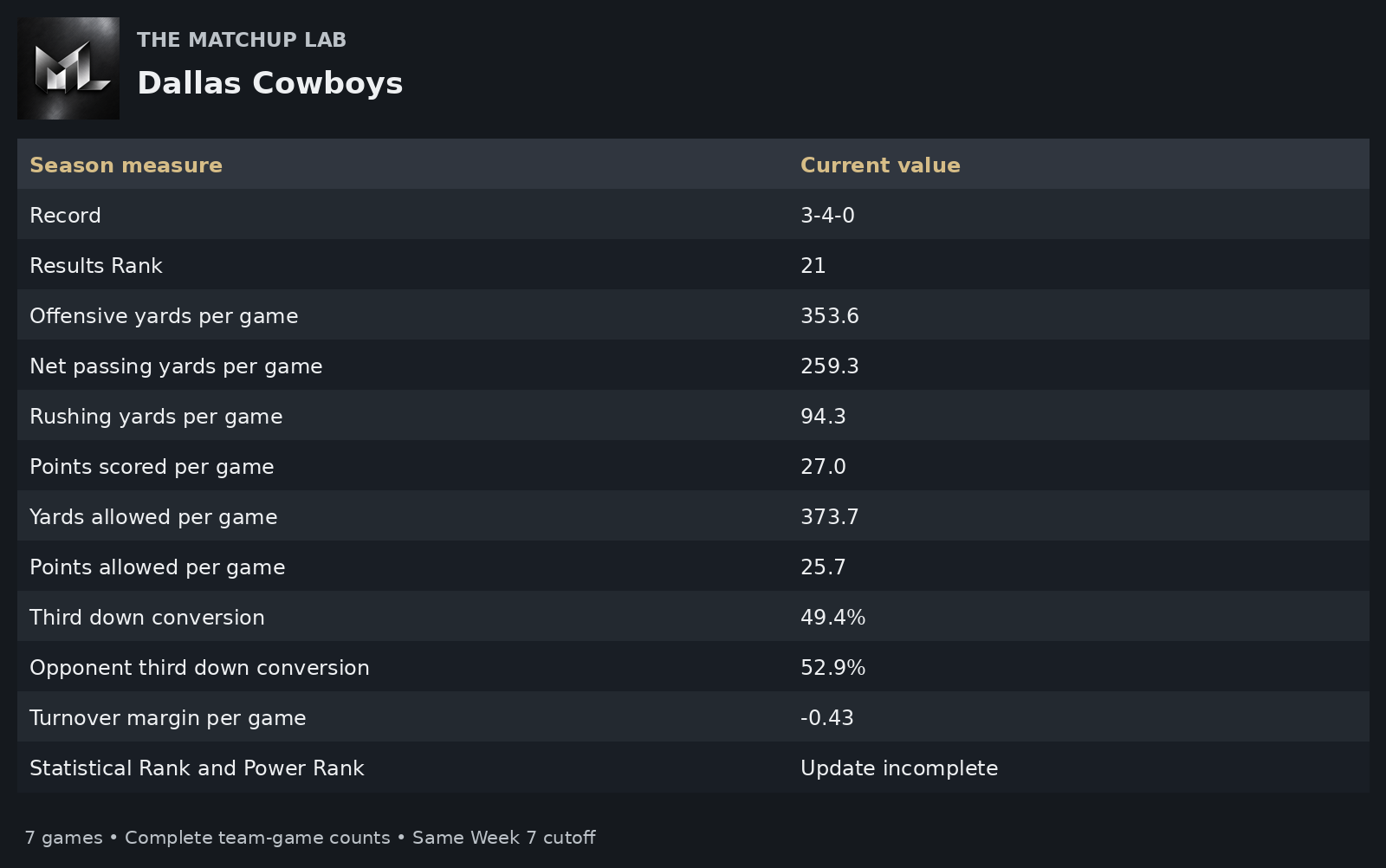
Dallas finally gave a productive offense a clean possession record in Philadelphia. The Cowboys gained 416 yards, ran for 204 and converted eight of thirteen third downs without a giveaway. That made thirty-eight points more than an isolated passing burst. The defense still allowed three touchdowns, so the win does not remove the need for firmer resistance between scoring possessions. Dallas now owns a positive season scoring margin despite four losses. Keeping drives alive without donating the next chance is the practical route to making that broader production appear in the record more often.
Dallas averages 353.6 yards and 27.0 points per game, with 25.7 points allowed. That positive scoring balance makes four defeats worth examining rather than excusing. Monday's clean possessions showed a practical way to make production count. Maintaining that protection and forcing earlier defensive stops would let the offense's useful gains build a margin instead of repeatedly paying for opportunities already lost.
Las Vegas Raiders
Week 7 loss 21-35 against Los Angeles Rams
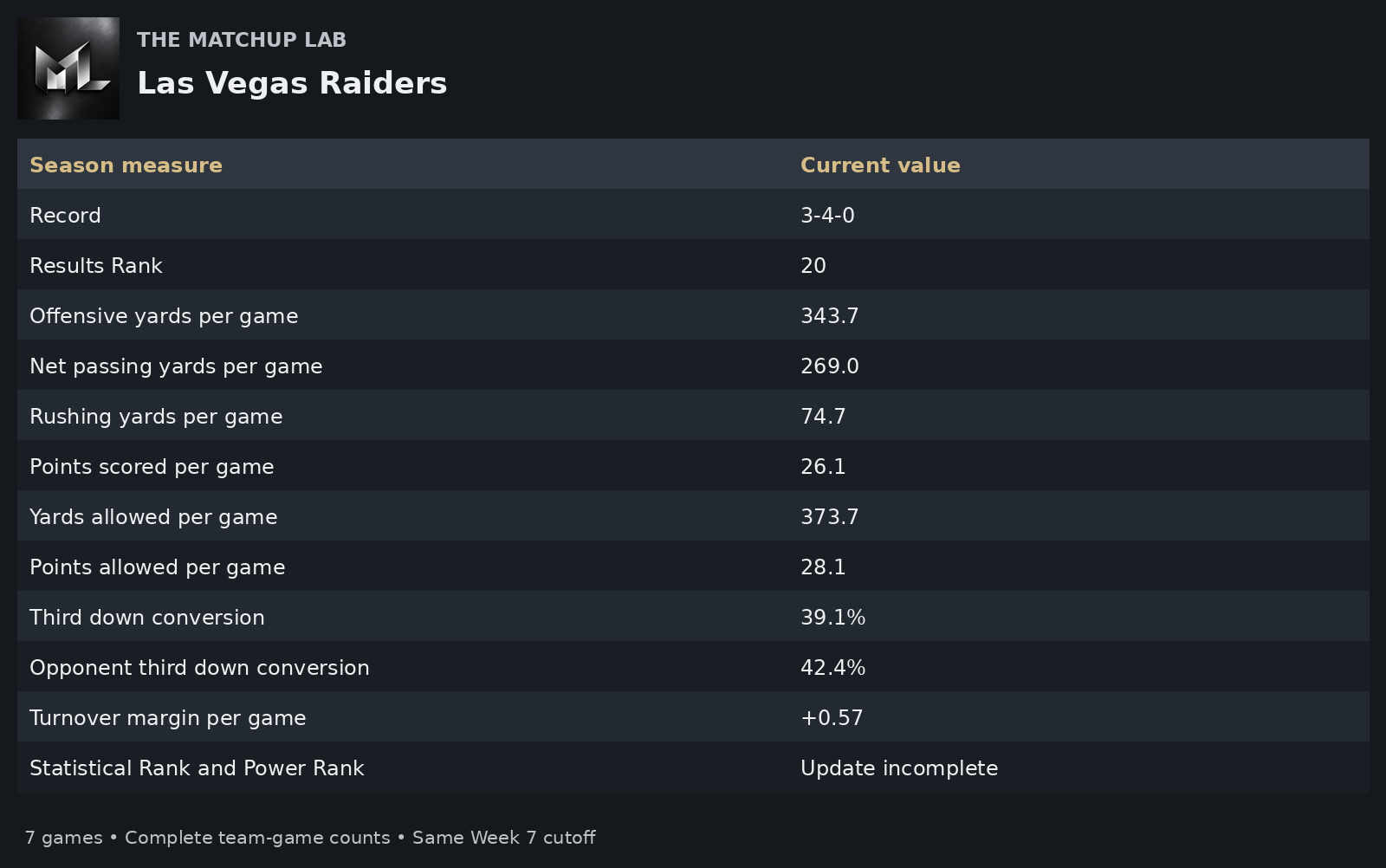
Las Vegas took the ball away twice and did not give it back through a turnover, yet lost by fourteen. Forty-eight rushing yards and three conversions in fourteen third-down attempts explain why the extra opportunities were not enough. The defense conceded 199 rushing yards, allowing the Rams to sustain work without needing a favorable turnover exchange. The Raiders' season has allowed more points than it has produced. They need ordinary offensive gains that let a possession continue and defensive tackles that end a series. Another takeaway would help, but it would not repair either requirement automatically.
The Raiders score 26.1 points per game and concede 28.1. Their offense converts 39.1% of third downs, while opponents convert 42.4%. Those season rates make sustained possession a problem on both sides of the ball. Winning a turnover exchange can provide extra chances, but ordinary defensive stops and an offense that keeps the next series alive are more useful than assuming another favorable mistake.
Los Angeles Rams
Week 7 win 35-21 against Las Vegas Raiders
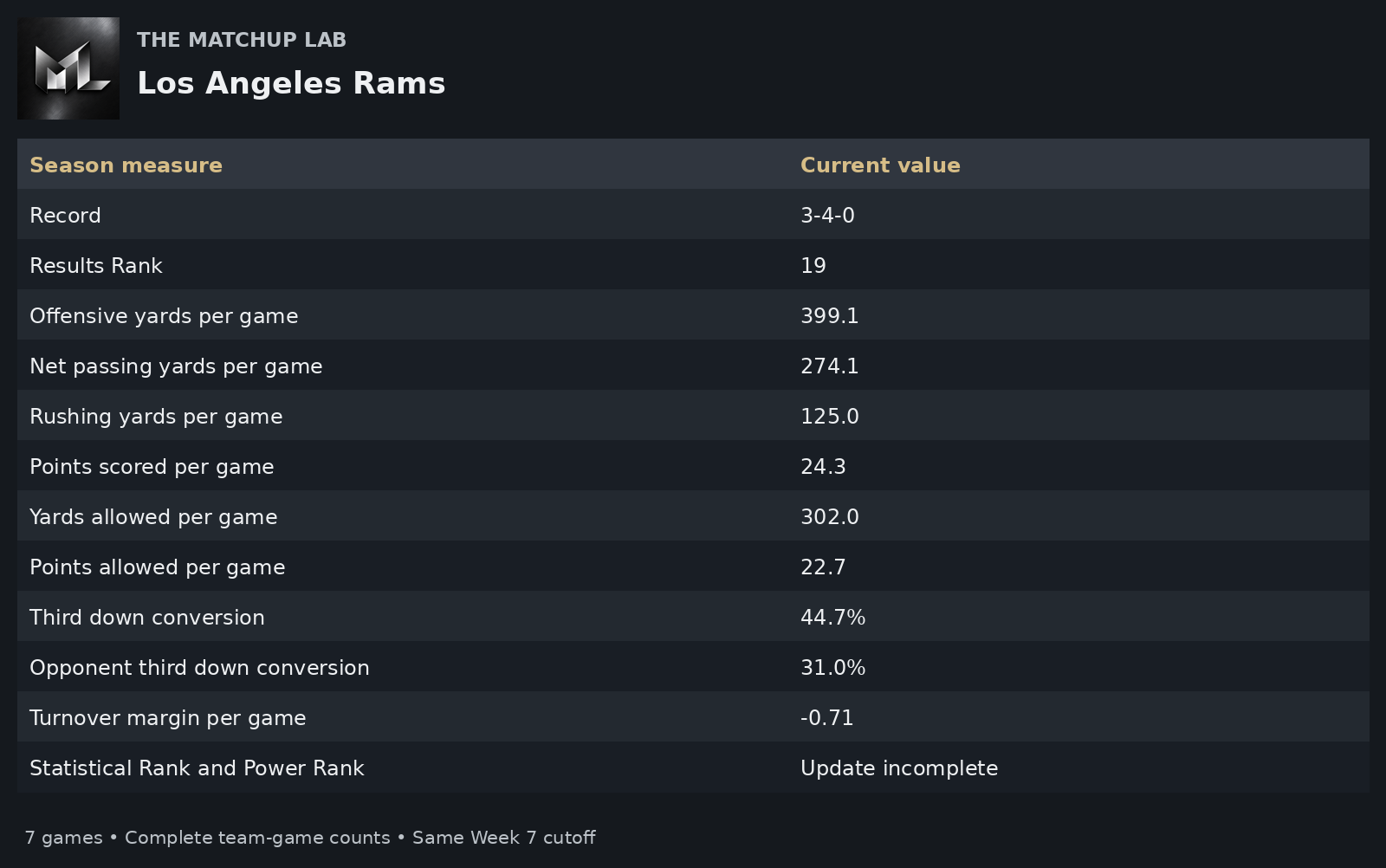
The Rams ran for 199 yards and converted five of ten third downs in Las Vegas. That gave their thirty-five points a substantial offensive foundation even after two giveaways. Winning despite losing the turnover exchange by two is useful evidence that the offense did more than cash in defensive gifts. It is still an unnecessarily expensive way to operate. The Rams' season remains below .500 despite a positive scoring margin. Cleaner possessions would let their productive drives establish control earlier and reduce how much useful work must be repeated just to repair a mistake.
The Rams average 399.1 offensive yards against 302.0 allowed. That favorable season distance comparison still sits beside a 3-4 record. Their 24.3 points per game have not consistently converted the yardage into enough wins. The Las Vegas result is useful because productive rushing and third-down work survived a poor turnover exchange. Removing those giveaways would let the same work create a less expensive route to control.
Washington Commanders
Week 7 bye
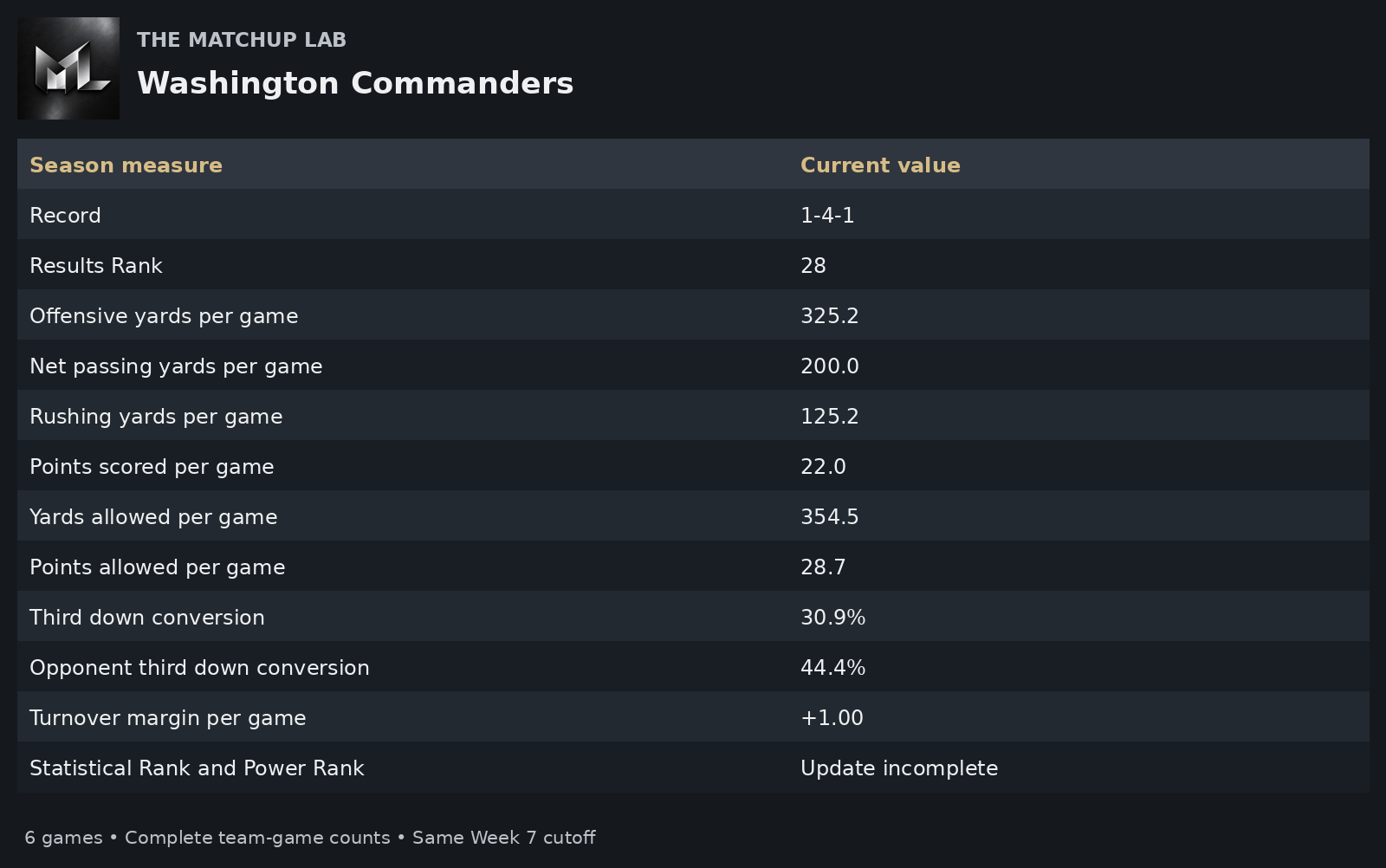
Washington's bye leaves a 1-4-1 record and a forty-point season deficit. The tie is retained rather than forced into a win or loss. The Commanders have given the ball away only twice in six games, so a simple demand for fewer turnovers cannot explain the entire shortfall. The offense needs more scoring value from its opportunities and the defense needs to reduce how often another answer is required. An off week supplies no new proof that either has improved. The next result should be judged against the existing burden, with possession protection kept as useful work already achieved.
Washington averages 325.2 offensive yards and 22.0 points per game, while the defense allows 28.7. Its low giveaway count is useful evidence that possession protection alone cannot repair the scoring gap. The Commanders need more points from the opportunities they preserve and earlier stops on the other side. The bye retains the existing evidence; it does not supply a new game or an automatic improvement.
Arizona Cardinals
Week 7 loss 16-30 against Denver Broncos
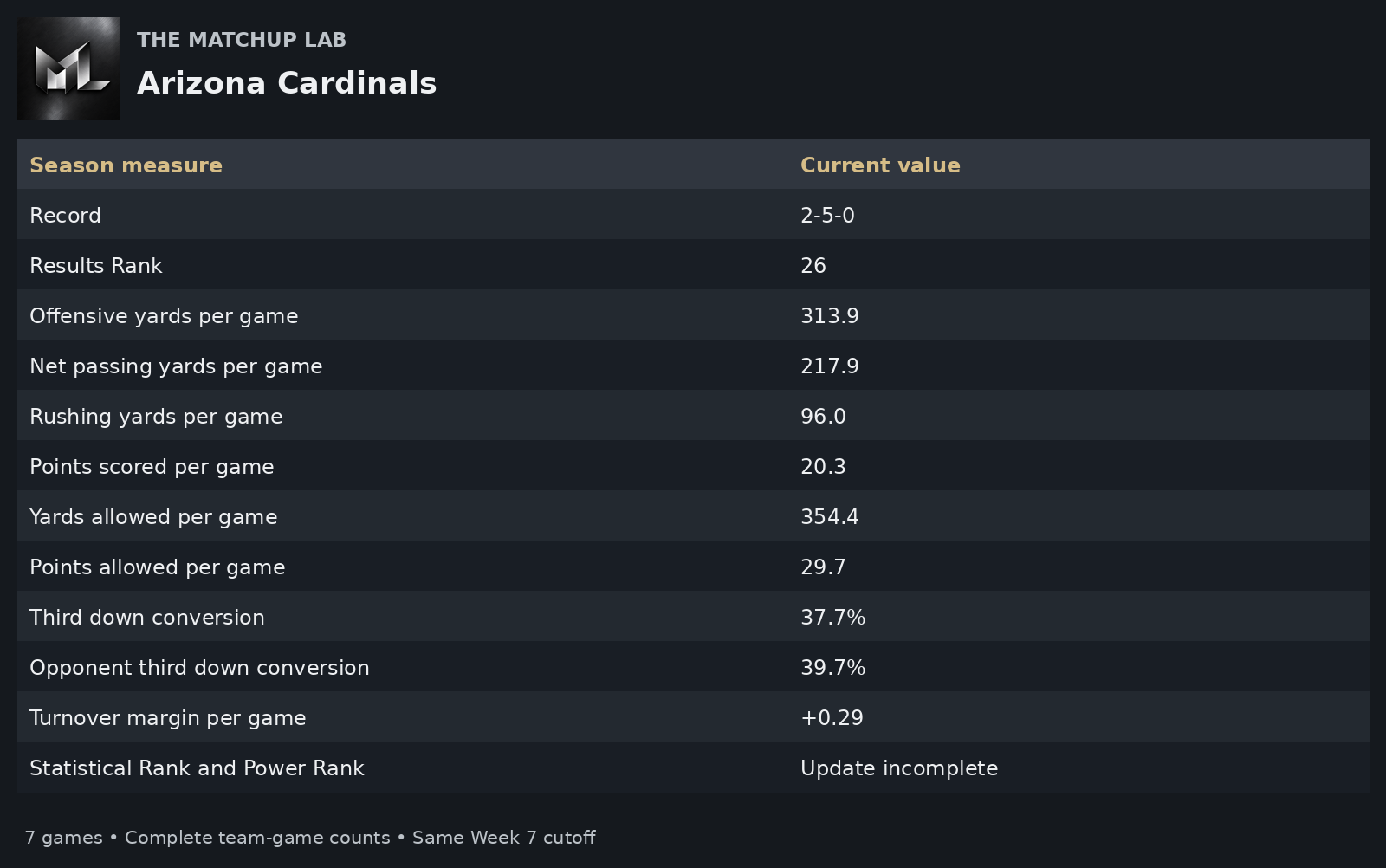
Arizona protected possession against Denver but still lost by fourteen. The Cardinals gained 353 yards and converted only five of seventeen third downs, leaving too many opportunities dependent on another rescue. Denver ran for 160 yards and also avoided giveaways. Arizona therefore needed more from its own sustained possessions rather than a turnover return to change the game. The season has allowed substantially more points than it has scored. Better early gains and a firmer response to the run would make the next scoring chance arrive with less ground and fewer obvious passing downs to negotiate.
Arizona allows 29.7 points per game and scores 20.3, leaving a substantial season burden on its offense. The Cardinals convert 37.7% of third downs. Better gains before that down would give the offense more choices and fewer obvious recovery situations. The defense must also end ordinary drives earlier so an improved possession is not immediately followed by another demand for points.
Houston Texans
Week 7 loss 21-27 against New York Giants in overtime
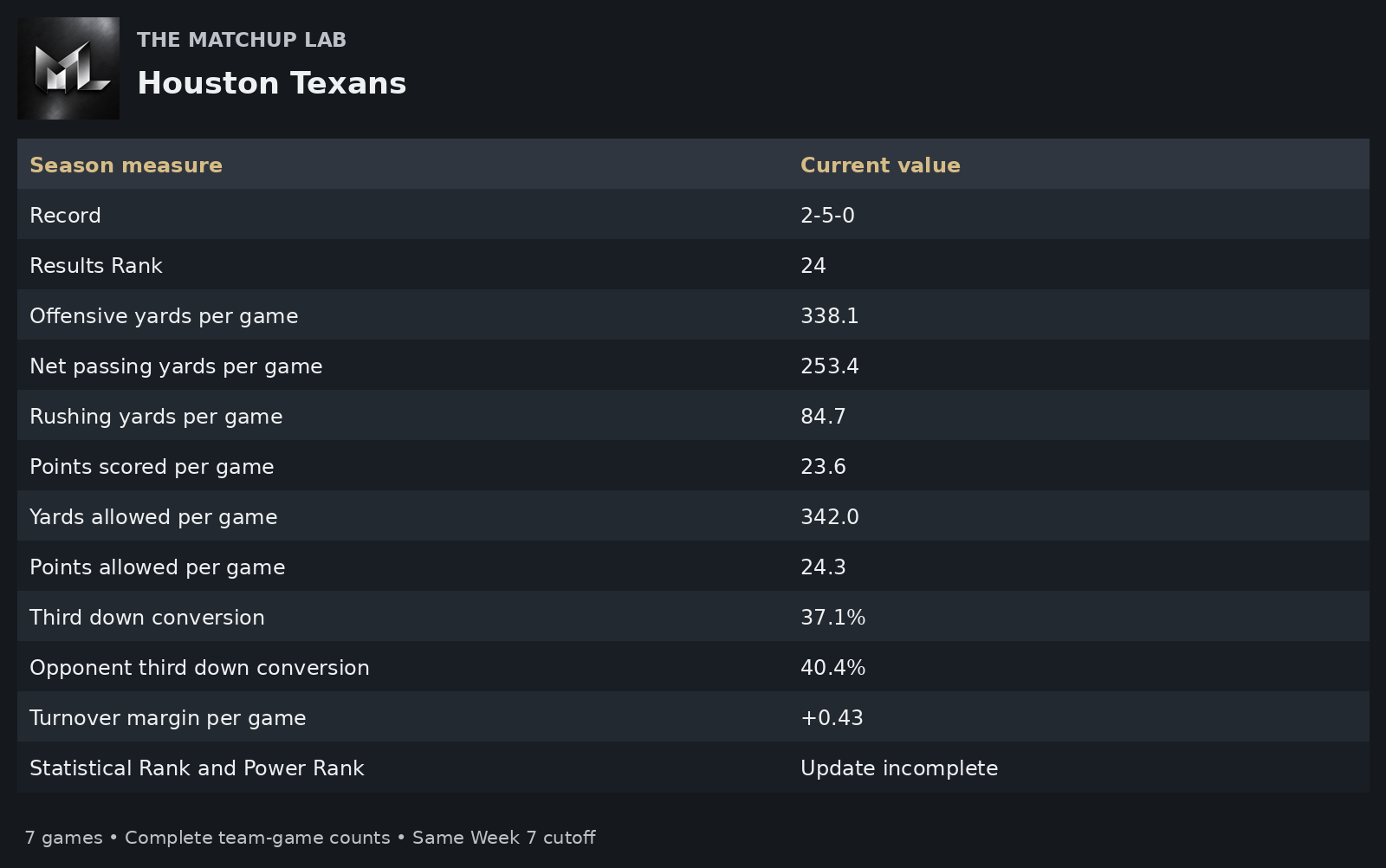
Houston lost in overtime without committing a turnover. That removes an easy explanation and directs attention toward 237 yards and three third-down conversions in twelve attempts. The defense allowed 420 yards, so keeping the game available did not mean it consistently ended New York's possessions. The Texans' season scoring margin remains relatively narrow for a 2-5 team. They need more offense before the final possession rather than another argument about how close the defeat was. Useful first-down gains would make the next conversion less demanding and give defensive stops more value.
Houston scores 23.6 points per game and allows 24.3, a relatively small season deficit alongside five losses. Its offense averages 338.1 yards, more than it produced against New York. The next step is generating enough useful plays before the game reaches its final narrow exchange. The Texans need offensive progress that makes a defensive stop valuable immediately, rather than another close result that still ends as a defeat.
Indianapolis Colts
Week 7 loss 10-16 against Minnesota Vikings
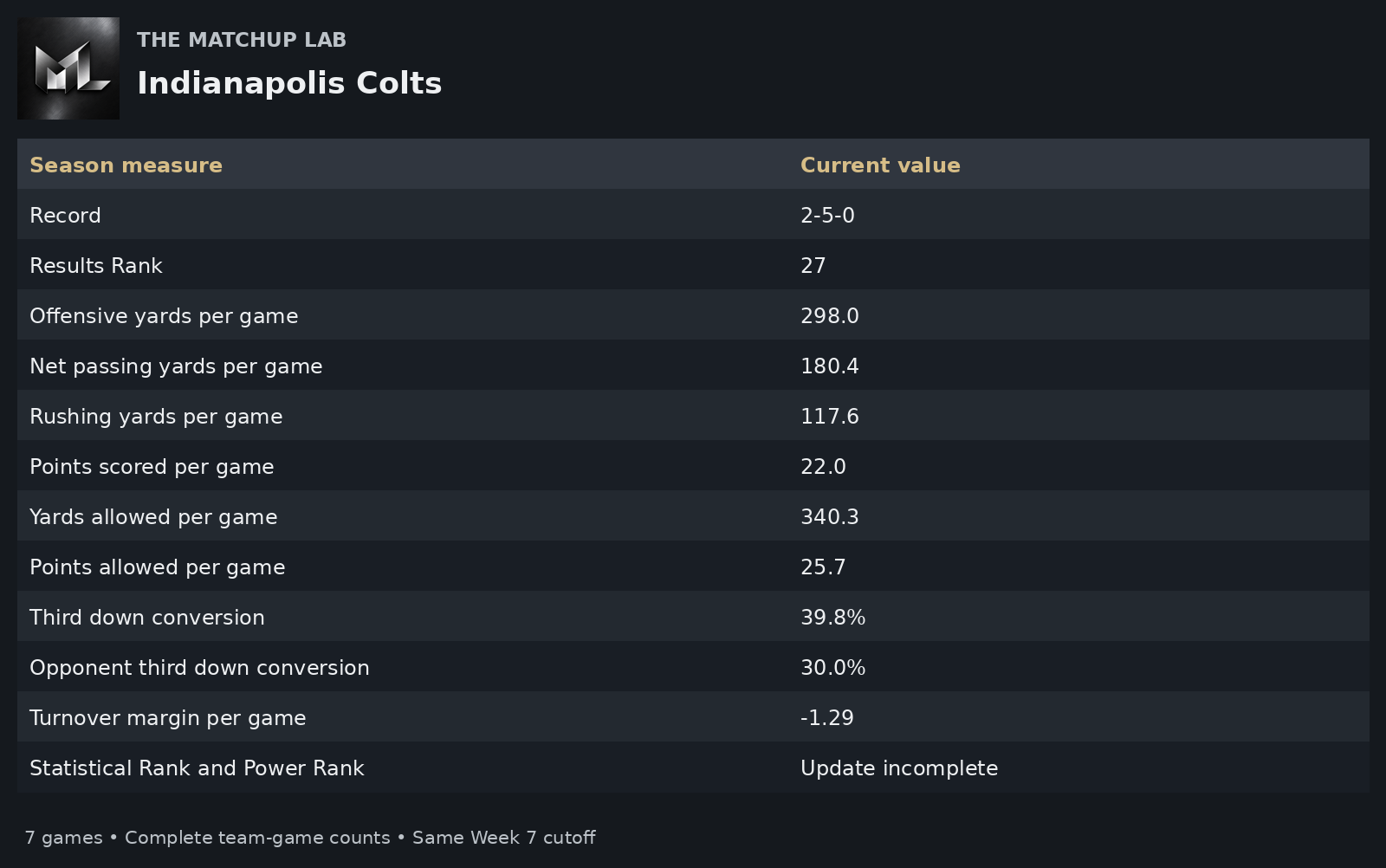
Indianapolis led at halftime and then scored nothing in Minnesota. The Colts rushed for 154 yards and converted eight of fifteen third downs, but their total offense reached only 218 yards. Useful ground work could not supply enough passing progress or enough points. The one giveaway increased the cost of an already limited number of chances. The season's losing record reflects an offense that has not consistently covered its defensive burden. Indianapolis needs its early rushing success to support a complete drive, rather than treating the first ten points as a sufficient afternoon's work.
Indianapolis scores 22.0 points per game and concedes 25.7. The offense averages 298.0 yards, so its useful rushing stretches have not yet established a complete scoring attack. Keeping the ball secure helps preserve the chances that do exist. The next improvement is making early ground gains support passing progress and a finished drive, rather than leaving another promising start stranded before the game is settled.
Miami Dolphins
Week 7 win 28-25 against New York Jets
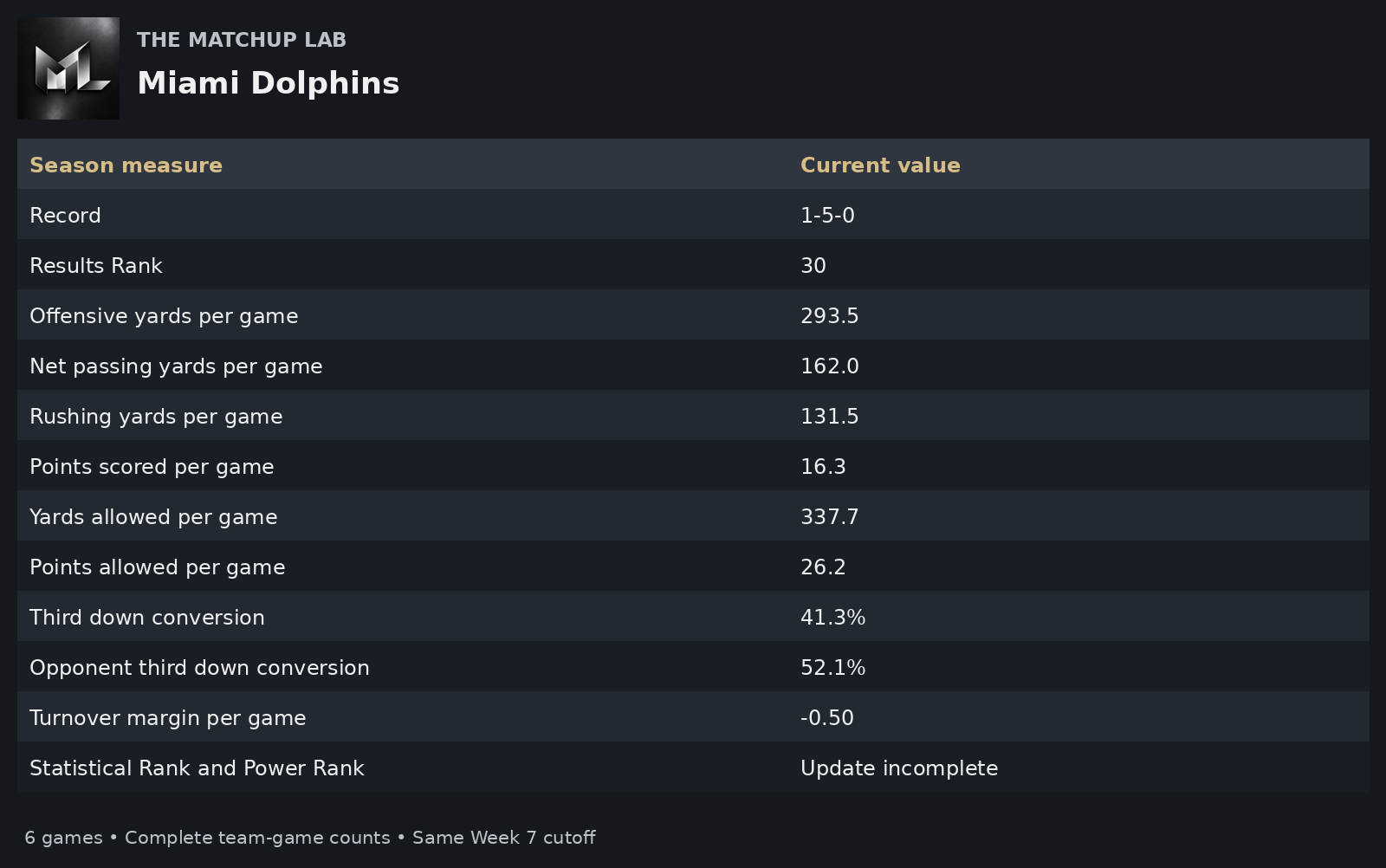
Miami's first win came with 156 rushing yards and no giveaways. Those contributions gave the offense a more useful foundation than a single long completion. The defense still allowed 377 yards and seven conversions on thirteen third downs, leaving the result close enough for another score to matter. The season remains five defeats and one win with a substantial scoring deficit. Miami should preserve the ground production and clean possessions while asking its defense to end more series earlier. A first victory changes the record immediately. Establishing a dependable way to earn the second takes more than repeating the final score.
Miami's offense averages 293.5 yards and 16.3 points per game, while the defense allows 26.2. Those season totals keep the first win in proportion. The Dolphins need cleaner possessions to remain useful without assuming that one improved rushing afternoon has repaired every offensive problem. The defense must contribute earlier stops so the next scoring drive establishes an advantage instead of merely keeping another game within reach.
New Orleans Saints
Week 7 loss 10-16 against Pittsburgh Steelers
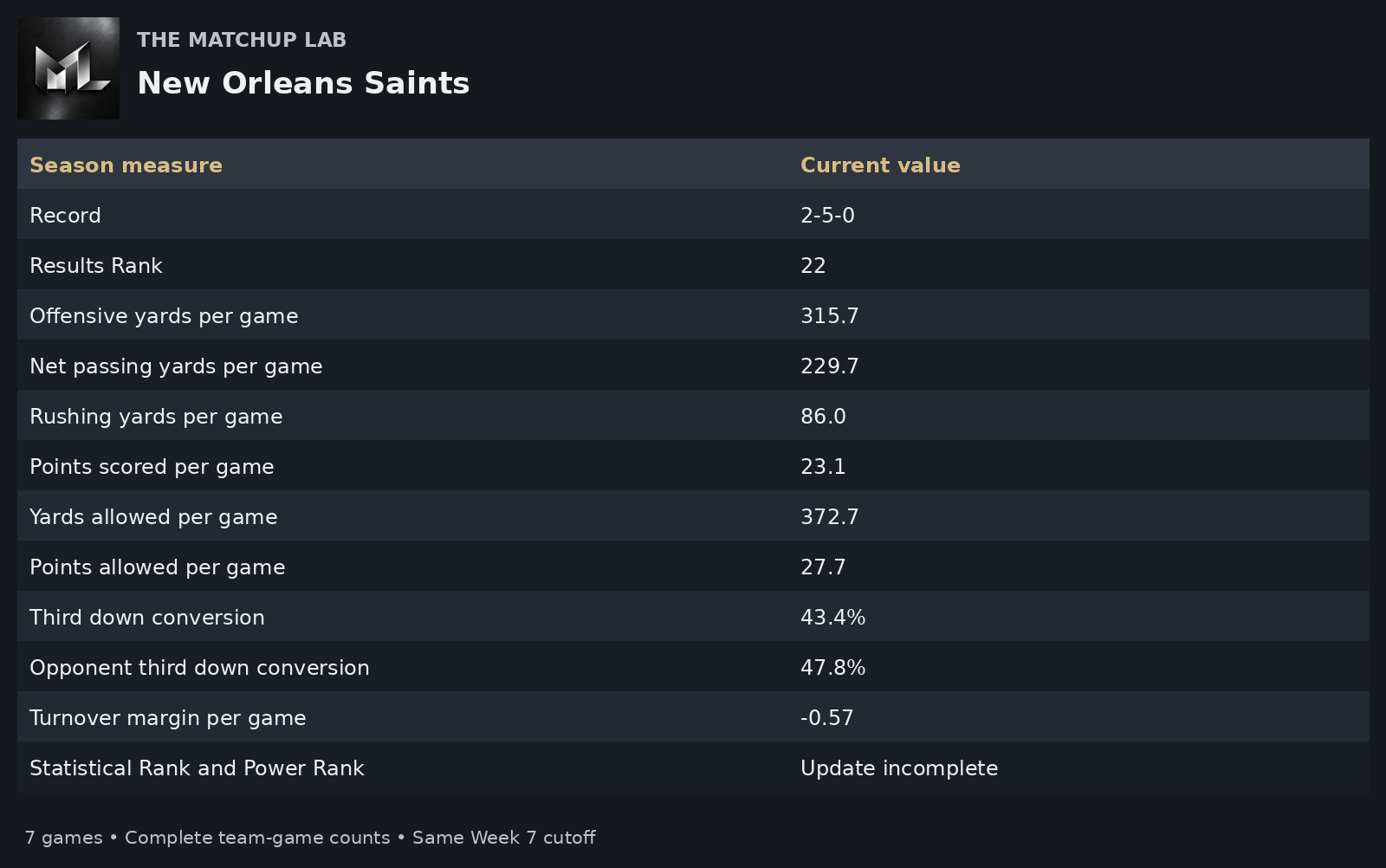
Eighteen rushing yards made New Orleans' offense depend heavily on passing progress against Pittsburgh. The Saints converted half their twelve third downs but produced only ten points. Their one giveaway removed another opportunity in a six-point defeat. The season has required the offense to cover for a defense allowing considerably more than twenty points per game. New Orleans needs useful rushing or short passing gains before the next difficult down, then a better return when the drive reaches scoring territory. Repeating one successful conversion does little if the following series ends with the same modest total.
New Orleans scores 23.1 points per game but allows 27.7. The offense averages 315.7 yards, leaving a difficult scoring burden when a possession stalls. The Saints need more useful early progress and a better finish to the chances that reach dangerous territory. Defensive stops must then hold long enough for that improvement to matter, rather than immediately placing the same demand back on the offense.
New York Jets
Week 7 loss 25-28 against Miami Dolphins
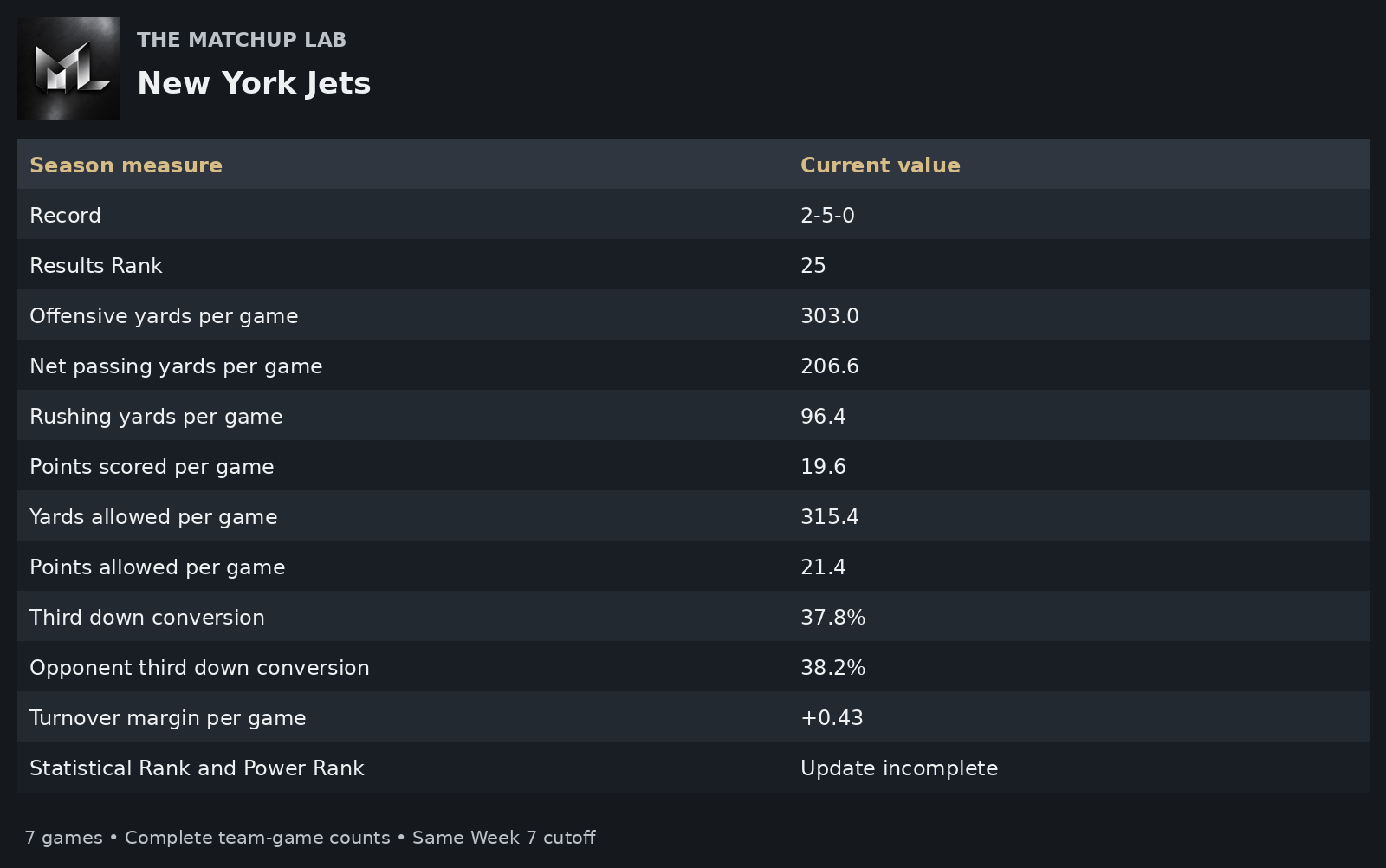
The Jets gained 377 yards and converted seven of thirteen third downs, yet still lost to a previously winless Miami team. New York's one giveaway was not matched by the Dolphins, which made its productive possessions less valuable. The defense allowed 156 rushing yards and could not make twenty-five points sufficient. Across the season, scoring has remained modest enough that an extra lost chance matters. The Jets need to preserve the offensive work that was useful here while ending more of the opponent's ordinary drives. A narrow defeat does not make either requirement optional.
The Jets score 19.6 points per game while conceding 21.4. That modest offensive return makes a lost possession expensive even when the yardage is respectable. Their season third-down conversion rate is 37.8%. Keeping a drive alive matters only if the possession eventually produces a useful score. New York needs cleaner endings to those drives and fewer occasions when its defense allows the next rushing gain to undo the work.
Philadelphia Eagles
Week 7 loss 21-38 against Dallas Cowboys
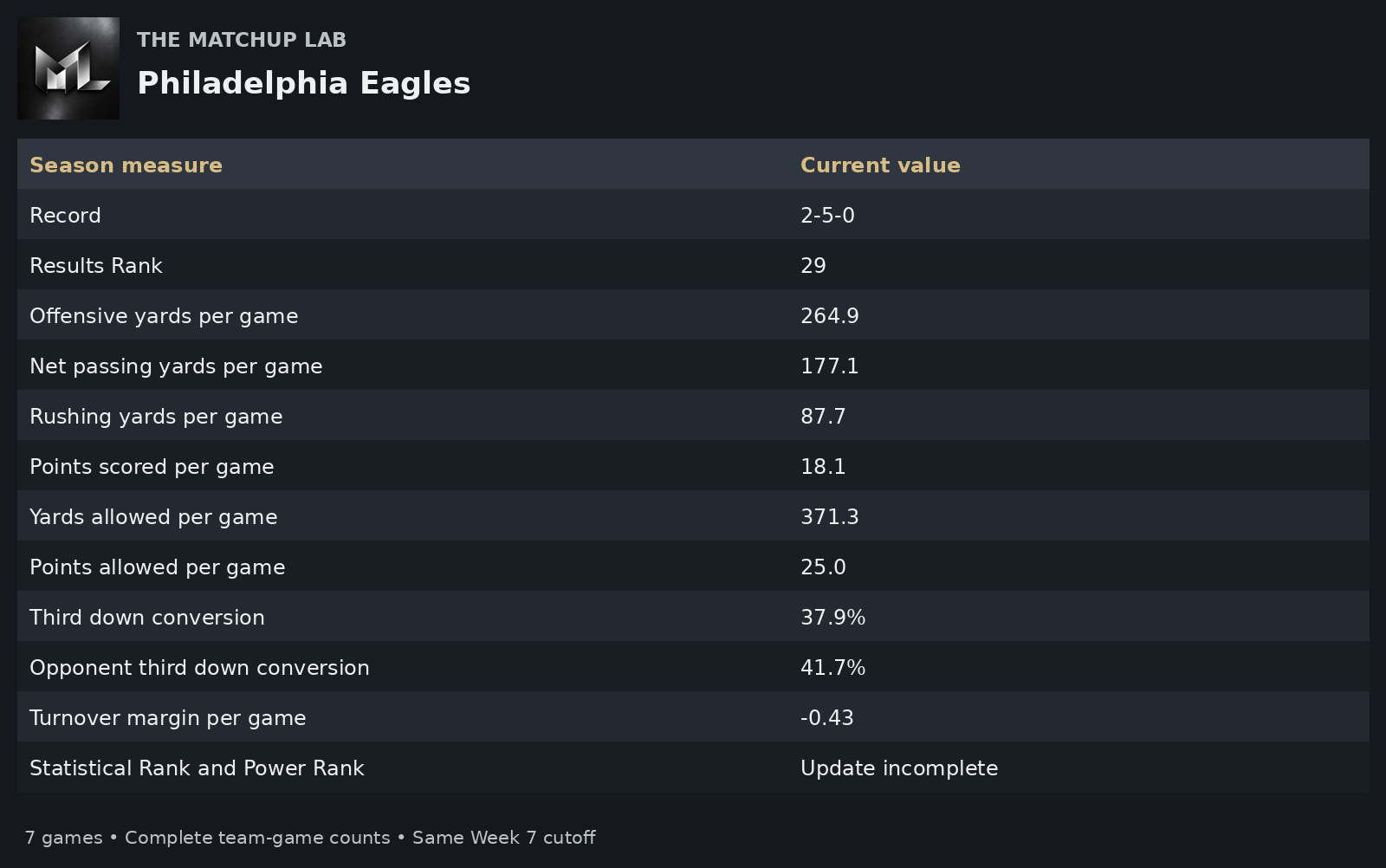
Philadelphia produced 321 yards and three touchdowns but allowed Dallas to rush for 204 yards and extend eight of thirteen third downs. The Eagles' one giveaway added a cost that the Cowboys did not return. Their season offense has scored only 127 points, leaving little room for a defense to concede thirty-eight. The response needs to begin on ordinary downs, where stopping the run can make the next passing situation more predictable. Philadelphia also needs longer productive offensive sequences so its defense is not required to solve every failure with another immediate stop.
The Eagles' season offense averages 264.9 yards and 18.1 points, against 25.0 allowed. That scoring gap makes repeated defensive concessions difficult to absorb. Philadelphia needs useful offensive gains before the next difficult down and defensive resistance that forces an opponent to continue working. Protecting one possession cannot compensate for an afternoon in which the other offense repeatedly sustains its own.
Tampa Bay Buccaneers
Week 7 win 43-13 against Carolina Panthers
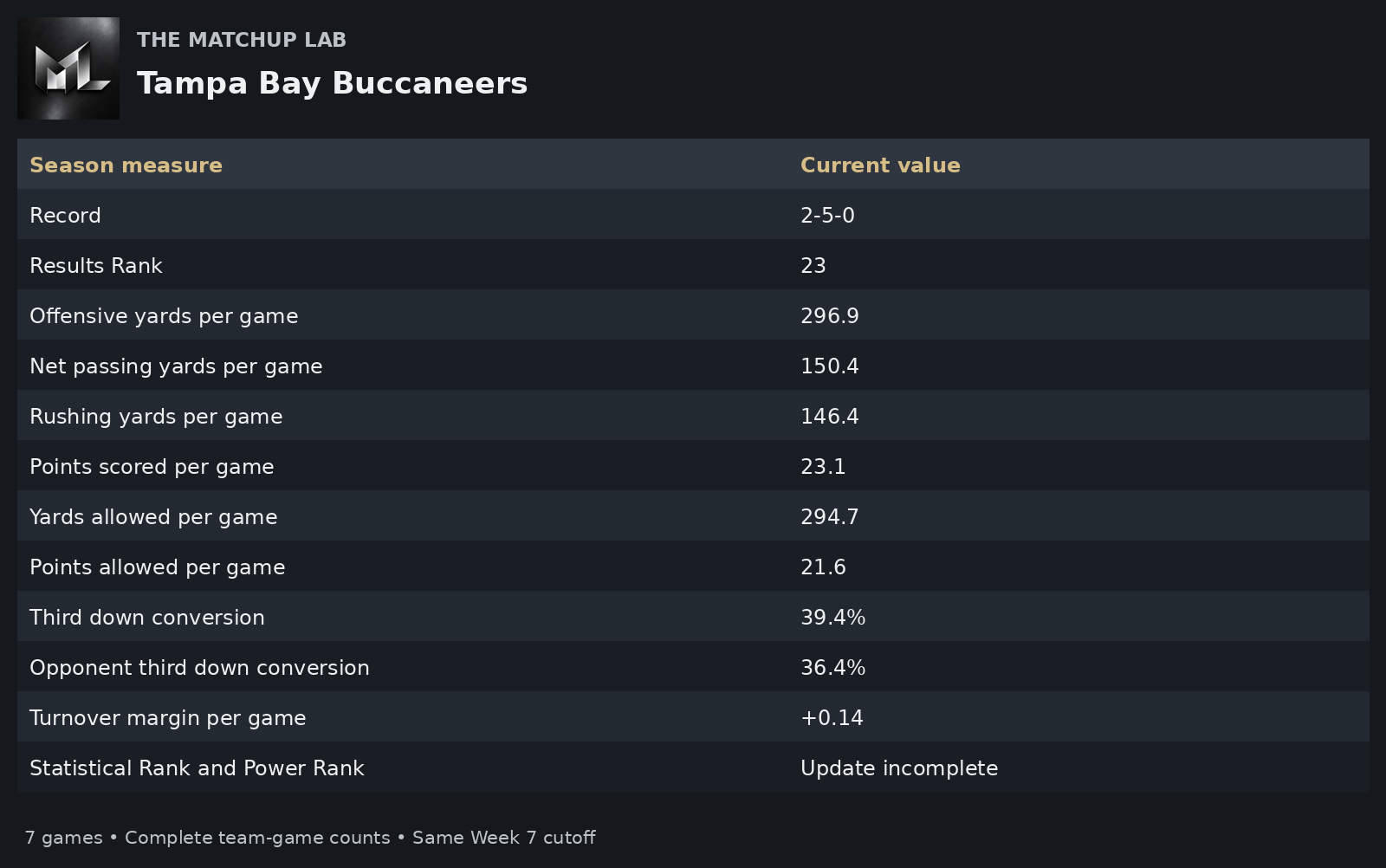
Tampa Bay's 258 rushing yards were a clear offensive improvement, but the forty-three points also arrived with a four-takeaway advantage. Those two contributions should be kept distinct. The Buccaneers did not give the ball away and converted seven of twelve third downs, helping preserve the chances they received. Their season record remains 2-5 even though points scored now exceed points allowed. The next test is whether the ground work and clean possessions can sustain a useful score when the defense does not supply four extra opportunities. This win offers evidence of a repair, not proof that the repair is finished.
The Buccaneers' season scoring now stands at 23.1 points per game against 21.6 allowed. Their record remains 2-5, so that positive balance cannot be treated as evidence of dependable weekly control. The offense averages 296.9 yards. Preserving Sunday's rushing progress without demanding another four-takeaway afternoon would make the improvement more convincing and reduce how often a drive must begin with defensive assistance.
Los Angeles Chargers
Week 7 bye
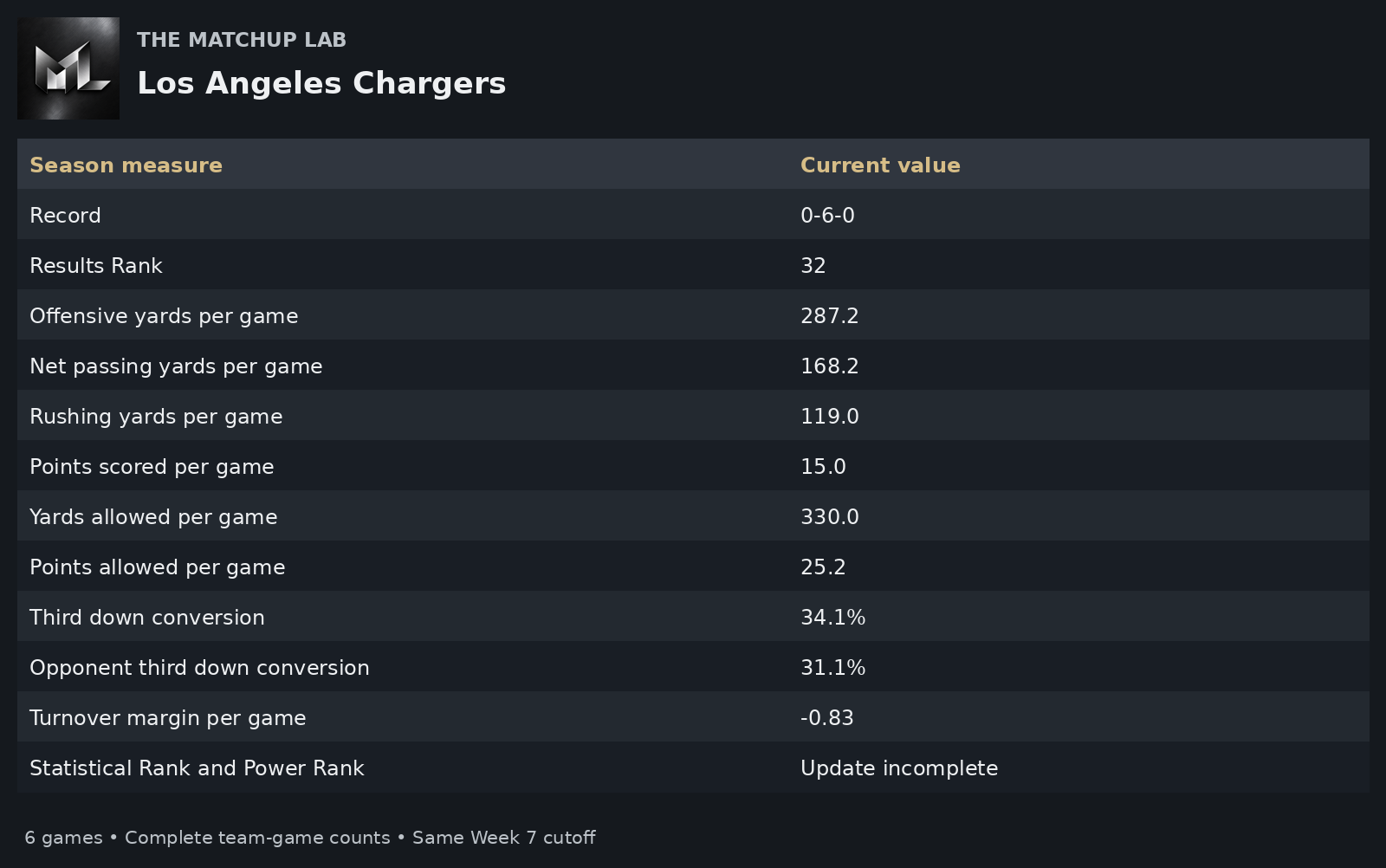
The Chargers' bye cannot soften an 0-6 start built around only ninety points scored. Fifteen giveaways across six games have removed opportunities from an offense already struggling to provide a sufficient score. Their defense has allowed 151 points, which makes every empty possession more expensive. The first repair is protecting the ball while creating manageable downs, rather than expecting one aggressive play to recover the whole season's deficit. No new Week 7 game is included in their totals. The next game must supply fresh evidence that useful offensive work can survive long enough to reach the scoreboard.
The Chargers average 287.2 offensive yards and only 15.0 points per game. Their defense allows 25.2, so improving possession protection is necessary without being sufficient. They also need productive early downs that keep the next series alive and turn preserved opportunities into points. The first win requires useful offense that reaches the scoreboard, not merely a cleaner version of another low-scoring afternoon.
Tennessee Titans
Week 7 loss 24-27 against Cleveland Browns
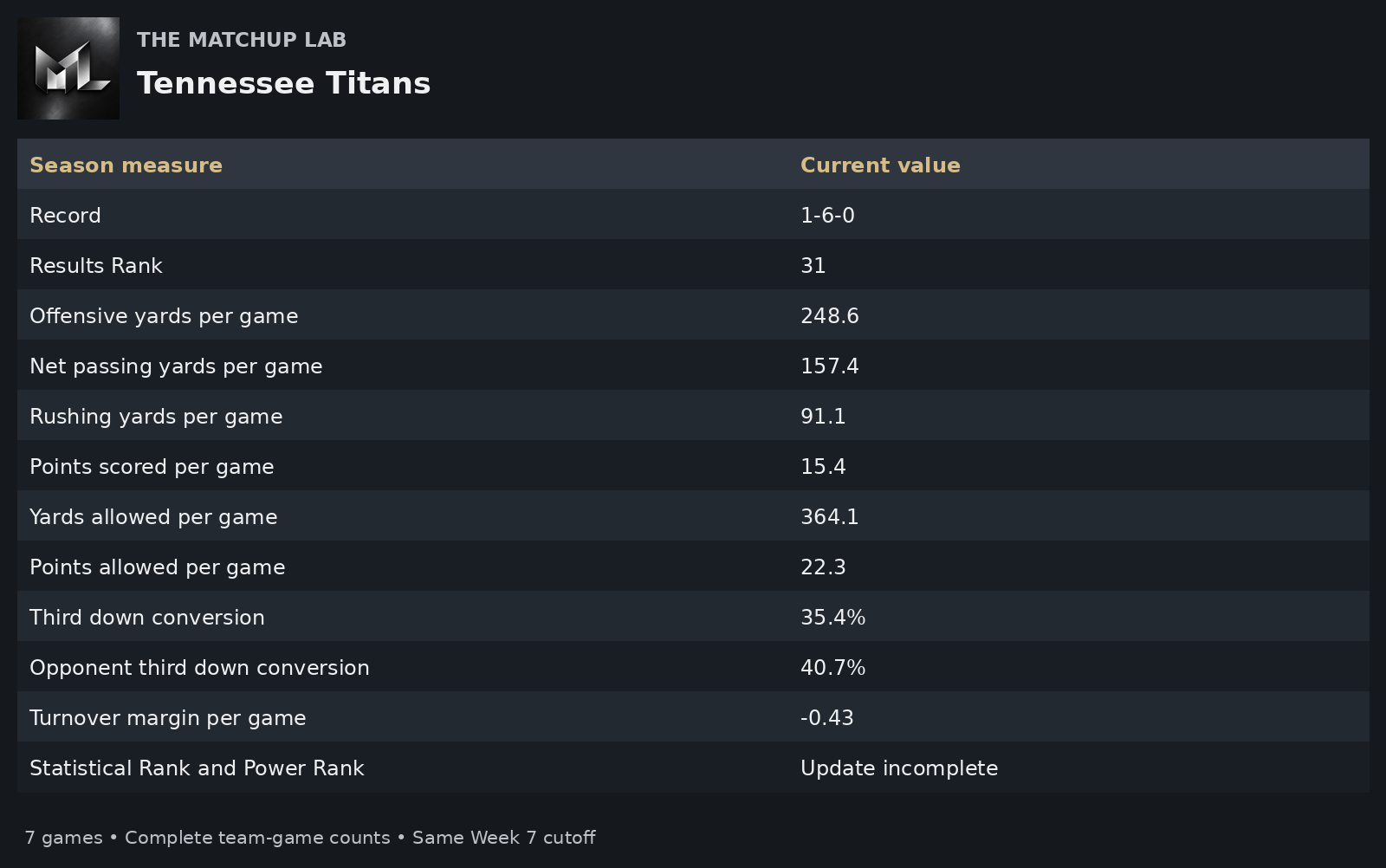
Tennessee's 141 rushing yards helped keep Cleveland within three points, but the defense allowed 491 total yards. Both teams committed two turnovers, so there was no net possession advantage to offset that ground conceded. Five conversions in thirteen third-down attempts left the Titans short of the sustained scoring required. The season's single win and six defeats reflect an offense that has rarely built a comfortable margin. Tennessee needs stops that end drives before they become scoring threats, followed by offensive progress that preserves the value of those stops. Staying close is useful only if another possession improves the score.
Tennessee scores 15.4 points per game and allows 22.3. Its offense averages 248.6 yards, leaving too few chances to treat a giveaway or stalled series as harmless. The Titans need useful gains before third down and defensive stops that reduce the distance their offense must make meaningful. Sunday's narrow margin gives them a specific game to examine, but it does not remove the wider season scoring problem.
Every covered game
- New England Patriots at Chicago Bears 24-30
- Pittsburgh Steelers at New Orleans Saints 16-10
- San Francisco 49ers at Atlanta Falcons 20-29
- Cleveland Browns at Tennessee Titans 27-24
- Indianapolis Colts at Minnesota Vikings 10-16
- Miami Dolphins at New York Jets 28-25
- Tampa Bay Buccaneers at Carolina Panthers 43-13
- Cincinnati Bengals at Baltimore Ravens 35-13
- New York Giants at Houston Texans 27-21 OT
- Denver Broncos at Arizona Cardinals 30-16
- Green Bay Packers at Detroit Lions 17-20
- Los Angeles Rams at Las Vegas Raiders 35-21
- Kansas City Chiefs at Seattle Seahawks 3-20
- Dallas Cowboys at Philadelphia Eagles 38-21