
Schedule and results context is verified against the shared sports feed and retained official NFL schedules. Performance calculations and every matchup assessment are original analysis by The Matchup Lab.

NFL Week 7 Preview
Make the next possession count.
October 22–26, 2026 · Regular season · Performance through completed Week 6
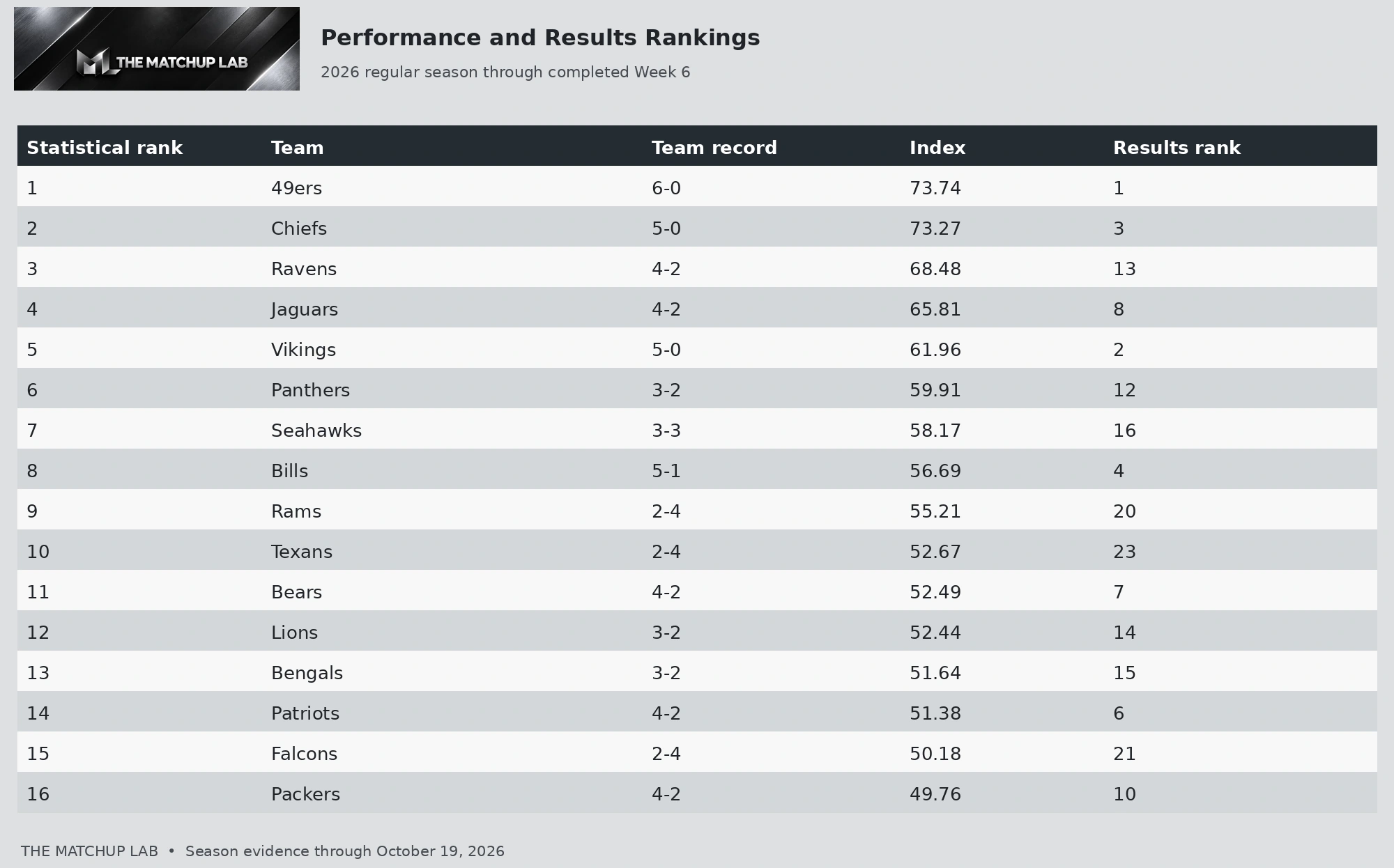
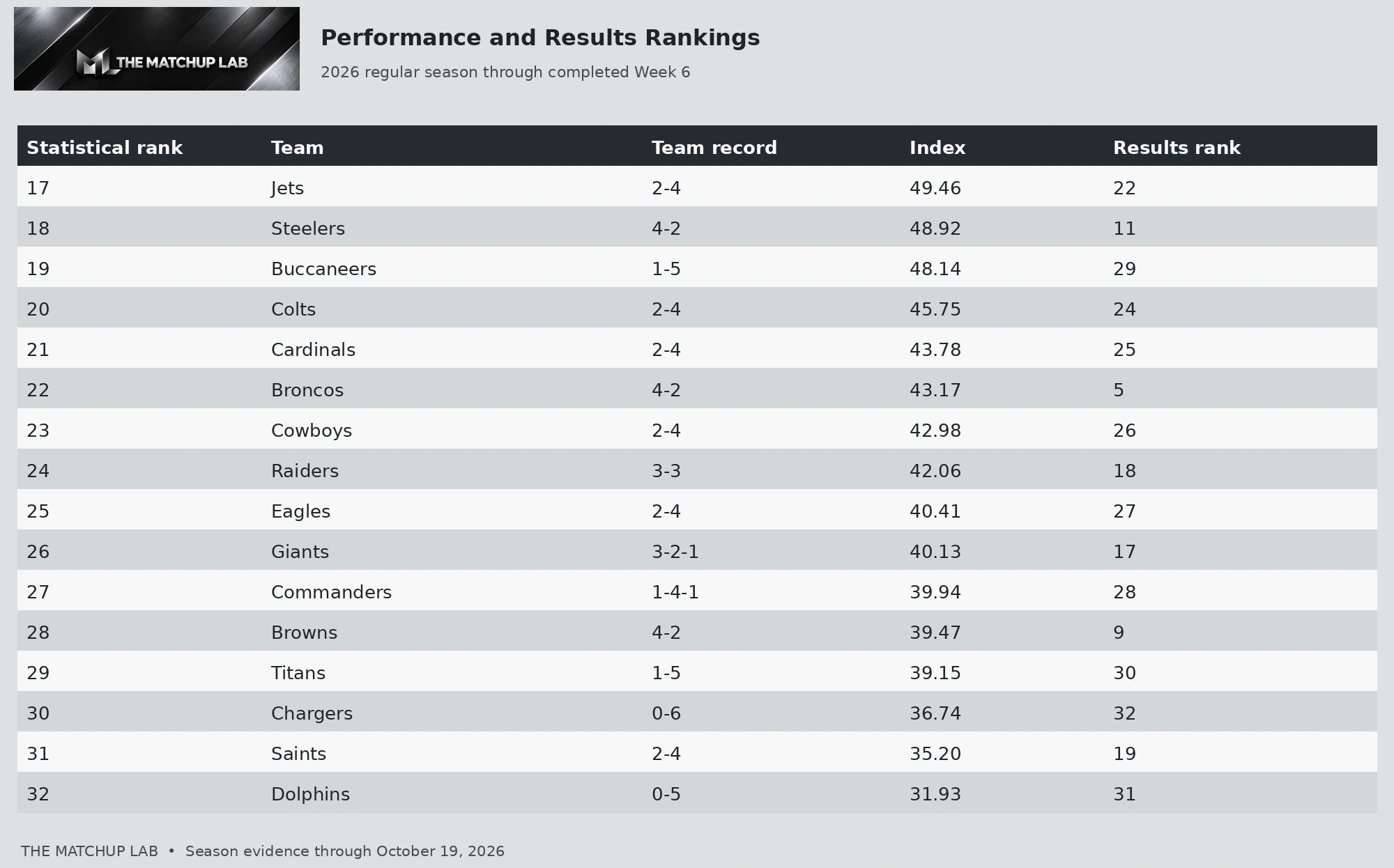
Statistical Rank retains the established NFL model. Success on ordinary downs receives 40%, long gains 25%, finishing scoring opportunities 15%, field position 10% and turnovers 10%. The calculation compares offense with defense, adds league-average starting assumptions to soften small samples, then standardizes and caps each category before combining it. The index measures completed performance, is not opponent-adjusted and is not a prediction or betting probability. Team records show what happened. The statistics help explain how a team can win by thirty and lose by twenty when short fields or turnovers disappear.
Results Rank is a separate assessment with new editorial weights of smoothed record 60%, schedule 15%, strength of victory 15% and loss quality 10%. Every opponent evaluation removes all head-to-head meetings with the assessed team at the same cutoff. The statistical order and scores are unchanged. Both calculations use all 93 completed regular-season games through Week 6. The same cutoff produces the same ranking as the completed Week 6 recap, so no movement is claimed.
The Week 7 picture
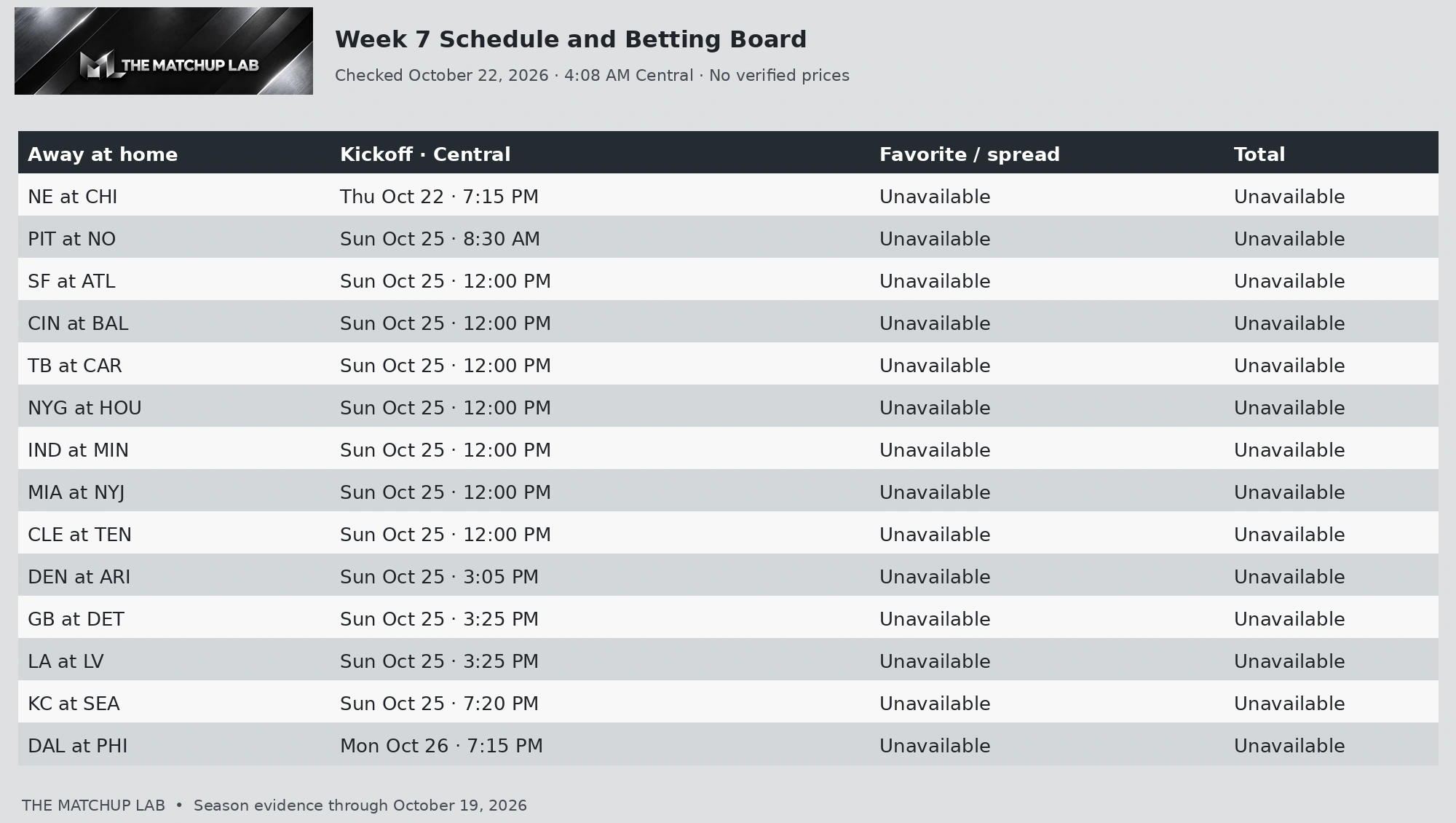
A good record still owes the next possession an answer. San Francisco and Kansas City enter Week 7 unbeaten, while Minnesota has made every opponent work for a modest score. Denver and Cleveland have secured wins without the same broad statistical control. The next week tests which advantages survive an opponent built to challenge them. New England at Chicago opens Thursday, Pittsburgh and New Orleans meet in Paris on Sunday morning, and Dallas visits Philadelphia on Monday night. All fourteen matchups appear below. Buffalo, Jacksonville, the Chargers and Washington are on bye and remain in the full 32-team rankings.
Consistent means a relatively narrow weekly range, not good performance. Uneven is highlighted when the highest and lowest played-week values differ by more than ten percentage points in success rate, five percentage points in explosive rate, five yards in starting position, 1.5 points per scoring opportunity or one turnover in turnover margin. Five or six games remain a limited sample. Byes are excluded from the range. Field position is measured from the offense’s own goal line and excludes turnover-created starts. Scoring opportunities are drives reaching the opponent’s forty or scoring a long touchdown. Turnover margin per game is takeaways minus giveaways divided by games.
Season data run through Monday, October 19, 2026. Schedules and completed results were rechecked October 22 at 4:08 AM Central. This assessment does not assume any unverified injury, quarterback change or starting lineup. The model does not account for availability changes. Betting prices were unavailable in the checked evidence. Any spread or total reflects its stated observation time, can change before kickoff and is informational rather than a guarantee of results.
The complete Week 7 betting board
Patriots at Bears
Thu Oct 22 · 7:15 PM Central · Soldier Field
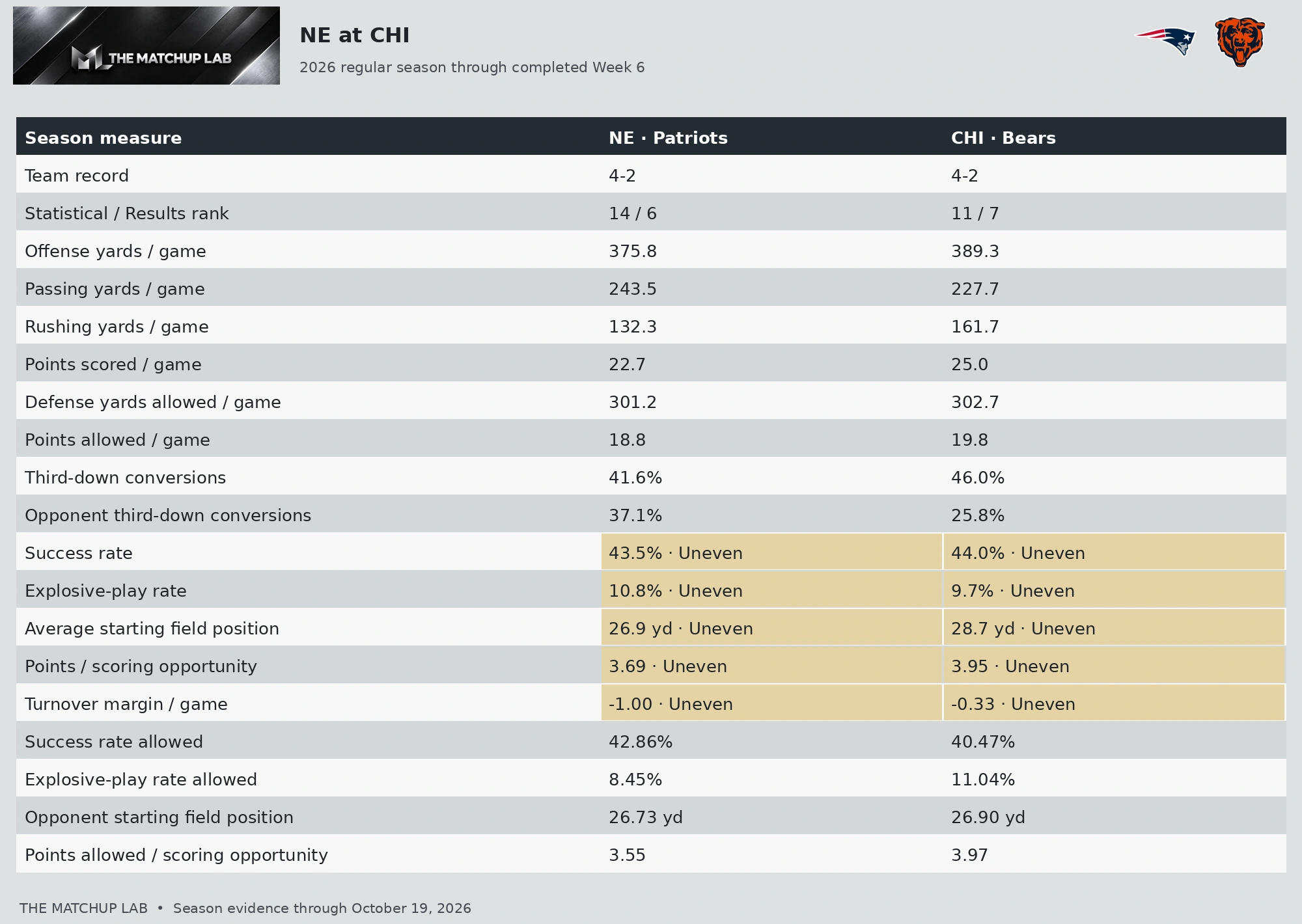
Two 4–2 records arrive in Chicago by different routes. The Bears have been better at preventing routine offensive gains, while New England has kept a more favorable balance between long plays produced and conceded. That creates the game's main tension. Chicago can win several ordinary downs and still give back their value with one loose coverage or missed tackle. New England needs those gains to support a drive, rather than rescue a succession of difficult third downs. A productive first down changes which parts of the field the defense must protect on second down.
Chicago's offensive starting position has been better than the Patriots', but neither team has protected possession well enough to treat that assistance as dependable. New England has given away one more possession per game than it has taken back. The Bears' smaller deficit still matters in a matchup where a single extra chance could decide the result. A defensive stop, a punt return and an interception can all shorten the next possession, but they are different sources of help. The field-position comparison removes turnover-created starts so those mistakes are not counted twice. Neither offense should plan its afternoon around being handed the ball near scoring territory.
The Bears have averaged 25 points and the Patriots 22.7, yet their returns after reaching dangerous territory are fairly close. Sustaining progress is therefore more useful than waiting for one elaborate scoring play. Chicago should make New England convert a full series of downs, keeping the ball in front of its secondary after an early stop. The Patriots need to hold onto possessions and challenge the Bears' vulnerability to long gains without letting that search turn into stalled drives. The decisive test is whether Chicago's ordinary defensive advantage survives the next big-play opportunity. New England can make the record travel by removing the mistakes that have forced it to win possessions back.
Steelers at Saints
Sun Oct 25 · 8:30 AM Central · Stade de France
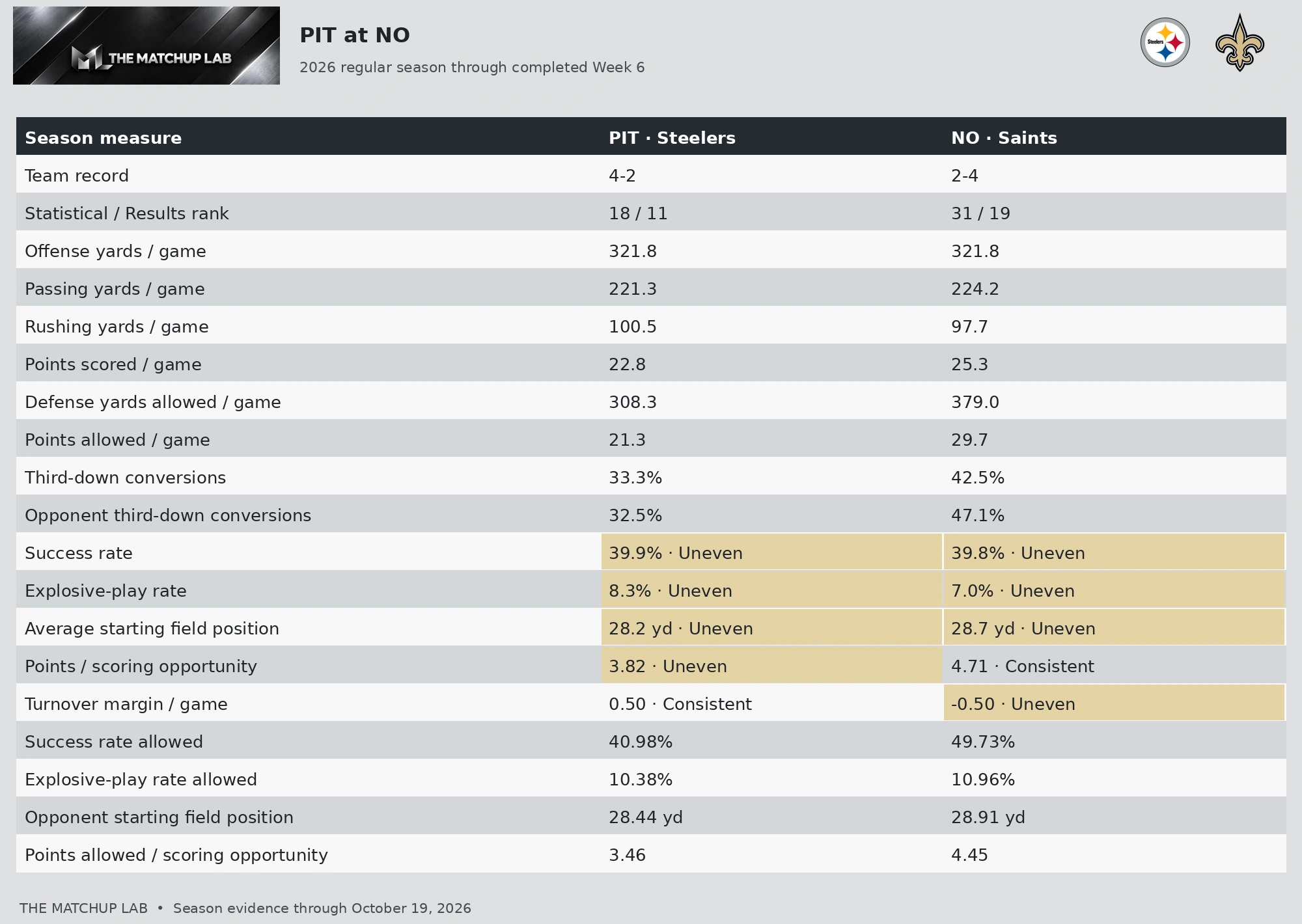
Paris gets a Pittsburgh team that has won more often than its underlying possession work might suggest and a New Orleans team whose scoring has struggled to cover for its defense. The Steelers' 4–2 record deserves credit. Their offense has still produced useful gains less frequently than opponents have, and their long-play comparison also runs the wrong way. The Saints present a clear opportunity to change that. New Orleans has allowed successful ordinary plays on nearly half of its opponents' attempts. Pittsburgh should be able to ask for steady progress before asking for a spectacular solution.
The temptation is to look at New Orleans' 34 points against the Giants and assume the offense can simply outscore another opponent. Across the season, the Saints have been efficient once they reach scoring territory, but reaching it repeatedly is a separate task. They have produced long gains less frequently than they have allowed them. Pittsburgh's defense has held opponents to a lower return from dangerous possessions, and its positive turnover margin has helped provide extra opportunities. Those takeaways are useful work already recorded. They are not an extra possession that can be booked into the Paris itinerary in advance.
Pittsburgh needs early-down gains that leave a realistic run or pass on the next snap. That would turn the Saints' difficulty getting off the field into a sustained burden, rather than letting one stop reset the game. New Orleans needs to force the Steelers to travel the full field and avoid the giveaways that have increased an already demanding scoring requirement. Starting positions are close enough that there is little reason to assume an automatic territorial advantage. The decisive exchange is Pittsburgh's ability to create possessions without turnover assistance against a defense that has conceded too much ordinary ground. The Saints can change that argument by making the next tackle end the drive, then finishing their own chances.
49ers at Falcons
Sun Oct 25 · 12:00 PM Central · Mercedes-Benz Stadium
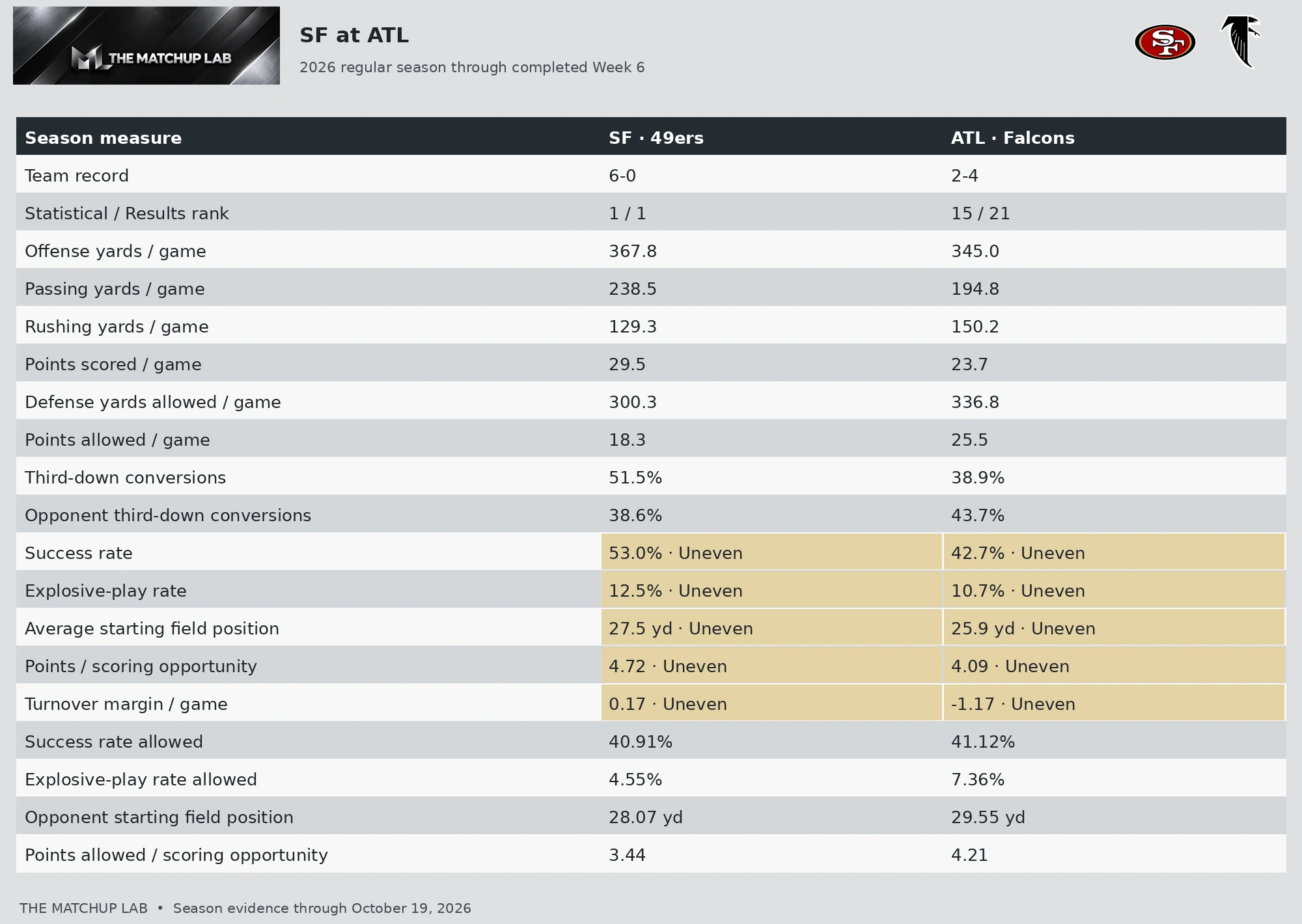
Atlanta's offense has enough useful work to make this more interesting than the records alone imply. The Falcons have produced ordinary gains and long plays more frequently than their opponents. San Francisco has done the same by a much larger margin, with an unbeaten record supported by the strongest statistical performance in this edition. The 49ers have allowed long gains on only 4.5% of qualifying plays. Atlanta cannot assume that one completion will repair an otherwise stalled possession. Its first responsibility is to reach manageable second and third downs without handing the ball back.
That last qualification is substantial. Atlanta's turnover margin is worse than minus one per game. Its non-turnover starting position has also been less favorable than the territory afforded to opponents. Those are separate costs. One makes a possession longer before it begins; the other removes the possession altogether. San Francisco's season return from scoring opportunities is stronger than what its defense has allowed, so gifting it an extra short field would make an already difficult assignment harder. Atlanta needs its useful offensive gains to survive all the way to a scoring attempt instead of disappearing with the next mistake.
Monday's six-point win over Washington still gave San Francisco something to address. A large halftime lead became a late defensive assignment, and the offense cannot treat an early advantage as permission to stop sustaining drives. Atlanta should force the 49ers to keep executing after the first successful series and avoid providing the cheap possession that creates separation. San Francisco should press the Falcons' ordinary defensive weaknesses while keeping its own down-to-down discipline. The decisive test is whether Atlanta can assemble several productive possessions against a defense that has denied both routine progress and escape plays. The Falcons need protection of the ball and a better opening sequence. The 49ers need their offense to remain useful after building the lead.
Bengals at Ravens
Sun Oct 25 · 12:00 PM Central · M&T Bank Stadium
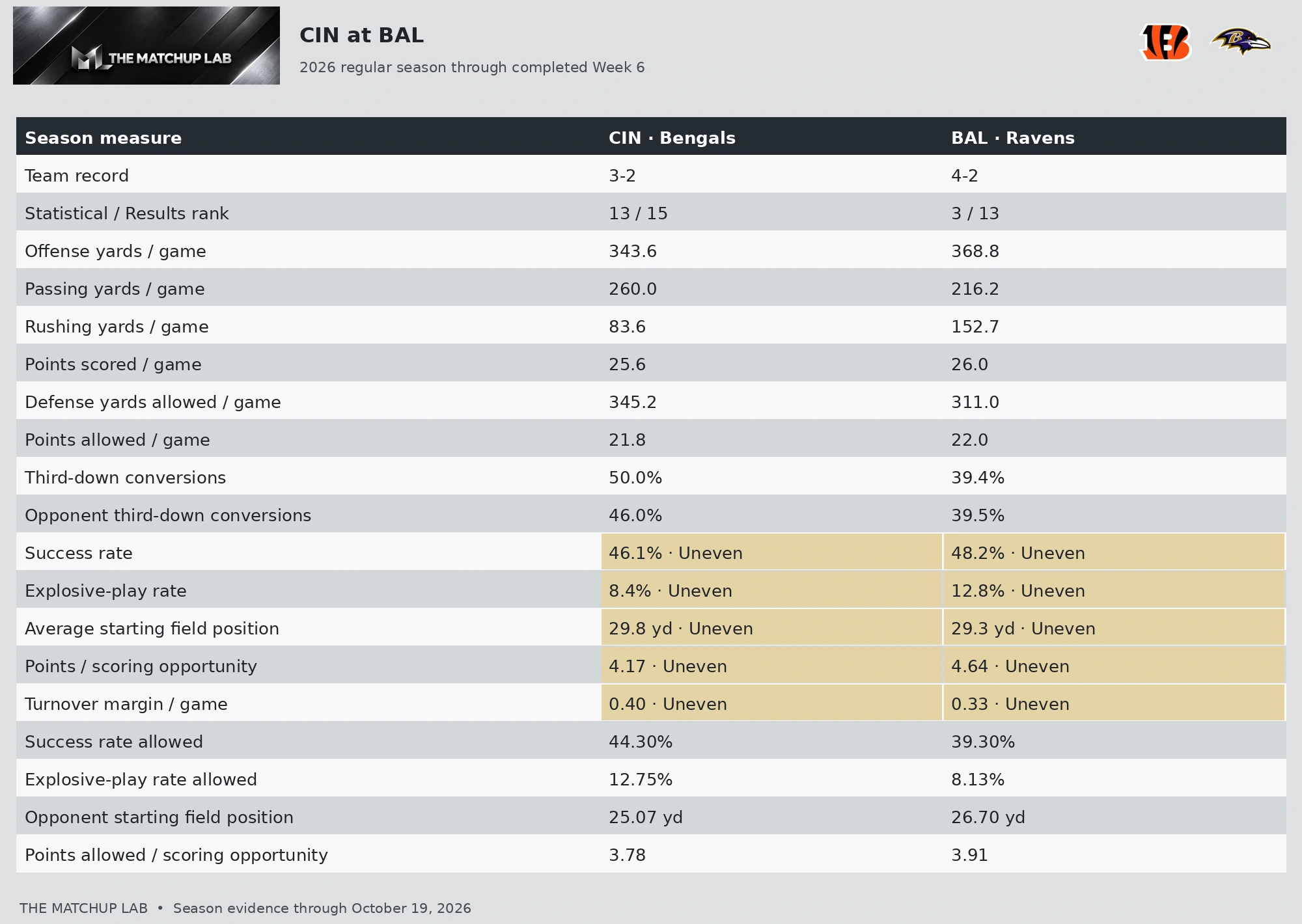
Baltimore's 13–10 loss in Cleveland makes the next offensive response worth examining, but one low-scoring afternoon does not erase a season of productive possessions. The Ravens have gained useful ground and generated long plays more often than their opponents. Cincinnati's defense has allowed long gains at an especially uncomfortable rate. That is the most direct opening for Baltimore. Early-down success can make the Bengals defend the next snap honestly, rather than letting them sit on an obvious passing situation. The danger for Cincinnati is a drive that appears contained until one play removes most of the remaining field.
The Bengals have their own way to make the contest difficult. Their offense has produced ordinary gains at a better rate than their defense has allowed, and their non-turnover starting positions have been favorable. A shorter field lets a competent offense need fewer successful plays before threatening the end zone. Baltimore has also enjoyed useful starting territory, so this is not a matchup in which either side should assume that its opponent must repeatedly travel eighty yards. Both turnover margins are positive. The practical question is which team can create the next scoring possession when neither defense supplies a giveaway.
Baltimore has earned more points from scoring opportunities than Cincinnati, while the Bengals' defense has allowed a lower return than the Ravens'. That combination makes the final stretch of a drive especially important. Cincinnati needs to make Baltimore continue executing after reaching dangerous territory, without conceding the long touchdown that bypasses those decisions. The Ravens need to turn their ability to move the ball into actual points, rather than asking another statistical comparison to explain a narrow defeat. The decisive matchup is Baltimore's long-play threat against Cincinnati's defense between the safeties and the next missed tackle. Cincinnati can stay in control by sustaining its own possessions and forcing another snap. Baltimore needs to finish the productive work it has generally created.
Buccaneers at Panthers
Sun Oct 25 · 12:00 PM Central · Bank of America Stadium
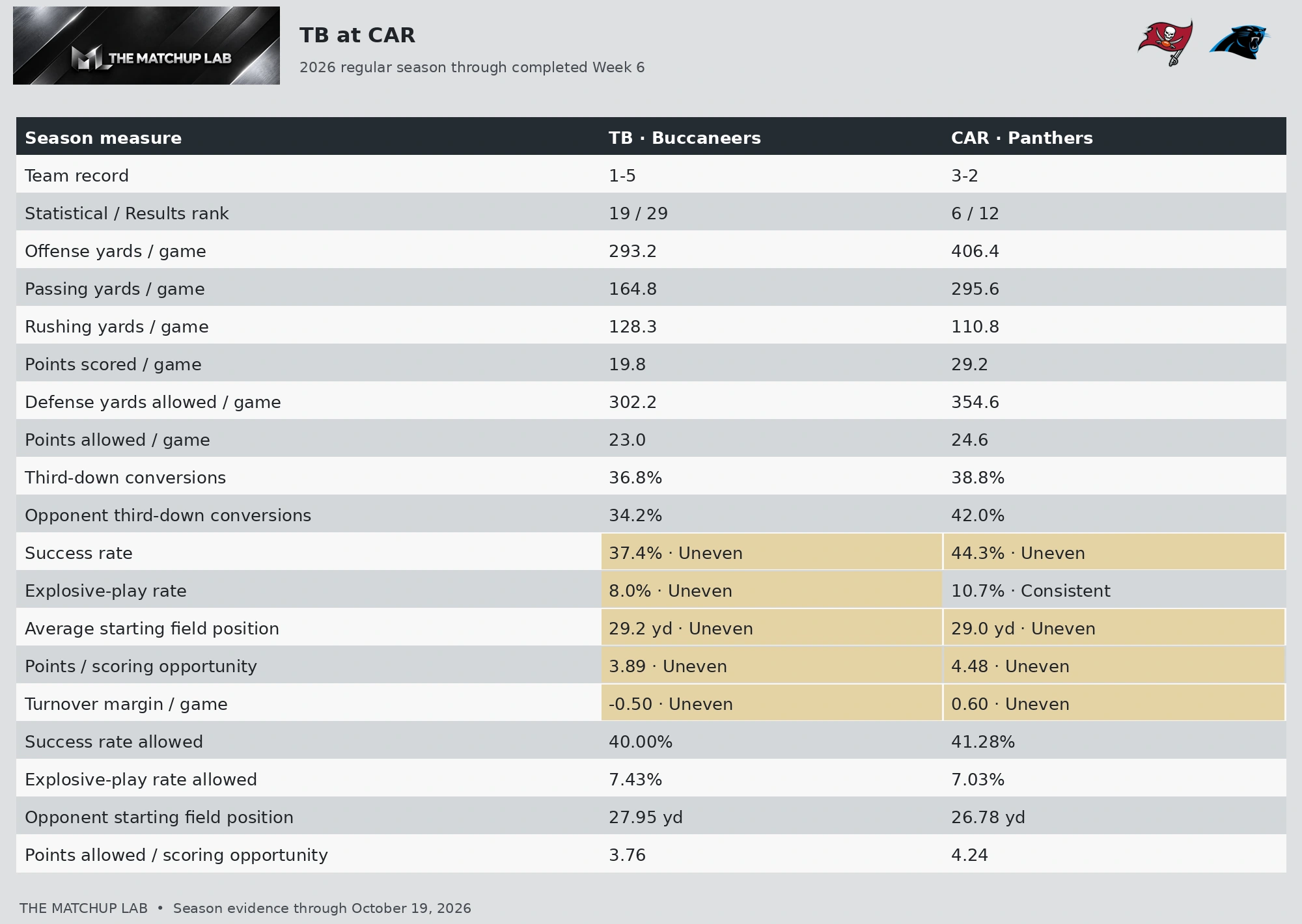
Carolina's season has been more convincing between the scores than Tampa Bay's. The Panthers have made ordinary gains more often than opponents and created long plays at a better rate than they have allowed. Tampa Bay's offense has struggled to maintain the same progress, leaving too many possessions dependent on one late conversion. That is an awkward starting point against a defense that can keep the larger gain from becoming an easy escape. The Buccaneers need useful first and second downs before they can make the Panthers defend a full set of possibilities.
The two teams' non-turnover starting positions are similar, which makes protecting the ball more consequential than expecting a large built-in territorial advantage. Carolina has gained more possessions than it has lost. Tampa Bay has moved in the opposite direction. The Panthers' advantage after entering scoring territory is useful, but their defense has still conceded points when opponents get there. Tampa Bay therefore has an opening if it can carry the ball that far without interruption. A long possession that ends in a giveaway would waste the offensive improvement and immediately increase the burden on a defense that has generally offered more resistance than the record suggests.
The Buccaneers' overtime defeat to Pittsburgh is a recent example of a game that remained available without becoming a completed win. Carolina's victory at Philadelphia showed a more sustainable way to control the afternoon, with enough useful offensive progress to keep pressure on the opponent. The Panthers should insist that Tampa Bay drive repeatedly, while keeping the ball secure and resisting the unnecessary gamble after gaining an advantage. Tampa Bay needs to sustain a lead with another productive possession instead of returning the entire assignment to its defense. The decisive exchange is the Buccaneers' ability to avoid the difficult down against Carolina's capacity to limit long gains. Better possession management gives Tampa Bay a chance to make its stops matter. Carolina needs its broader offensive advantage to remain visible on ordinary snaps.
Giants at Texans
Sun Oct 25 · 12:00 PM Central · Houston
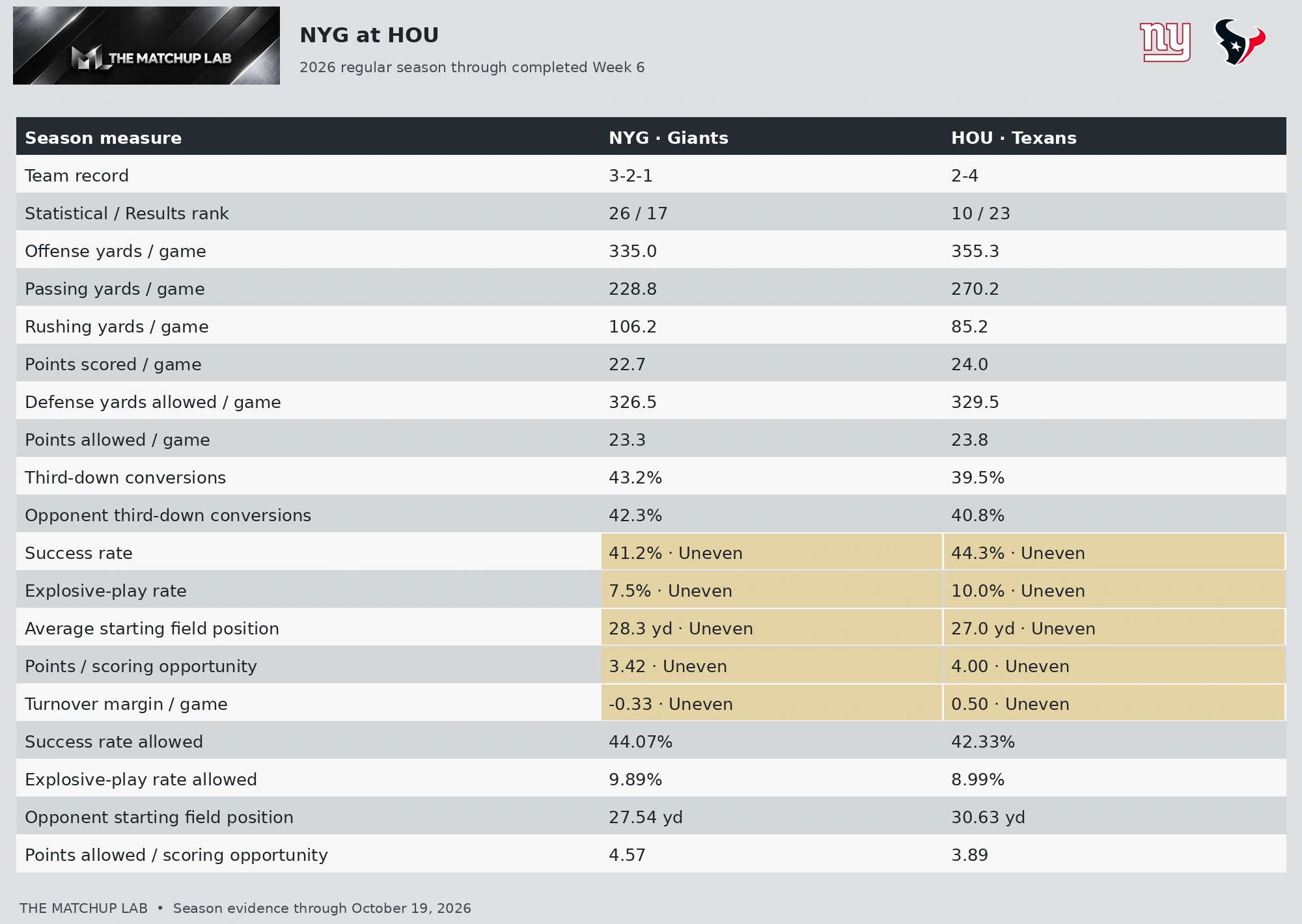
Houston's win over Jacksonville supplied a result its season performance had been promising more often than its record had delivered. The Texans now face a Giants team with a better record but weaker comparisons across sustained progress, long gains and returns from scoring territory. That does not award Houston a win in advance. It identifies the work that should make the next possession manageable. The Texans need useful early gains that keep the playbook open, rather than turning a favorable season comparison into a series of obvious third-down passing situations.
New York's offense has had difficulty matching the ground its defense concedes. Its return after reaching dangerous territory has also been lower than what opponents have extracted. The Giants cannot afford to spend an entire afternoon repairing an early deficit. Houston has still given opponents more favorable starting territory than its own offense has received, even after turnover-created starts are removed. That gives New York a practical route to useful possessions without needing to dominate every yard. The Giants need to convert that position into sustained progress. Houston's positive turnover margin helps, but relying on another takeaway would leave a preventable opening.
Both latest games underline why a productive offense is not the same as a comfortable afternoon. Houston scored 34 and still needed all of them. New York scored 27 and could not cover for conceding 34. The Texans' next improvement should begin with stops that keep a drive from reaching scoring range, not with another demand for the offense to erase it. The Giants need their ordinary gains to add up before a long recovery becomes necessary. The decisive matchup is New York's ability to turn promising territory into points against Houston's opportunity to force an early punt. Houston should preserve the offensive progress it can repeat and make the Giants earn the next field. New York needs protection of possession and a better return from the chances that survive.
Colts at Vikings
Sun Oct 25 · 12:00 PM Central · U.S. Bank Stadium
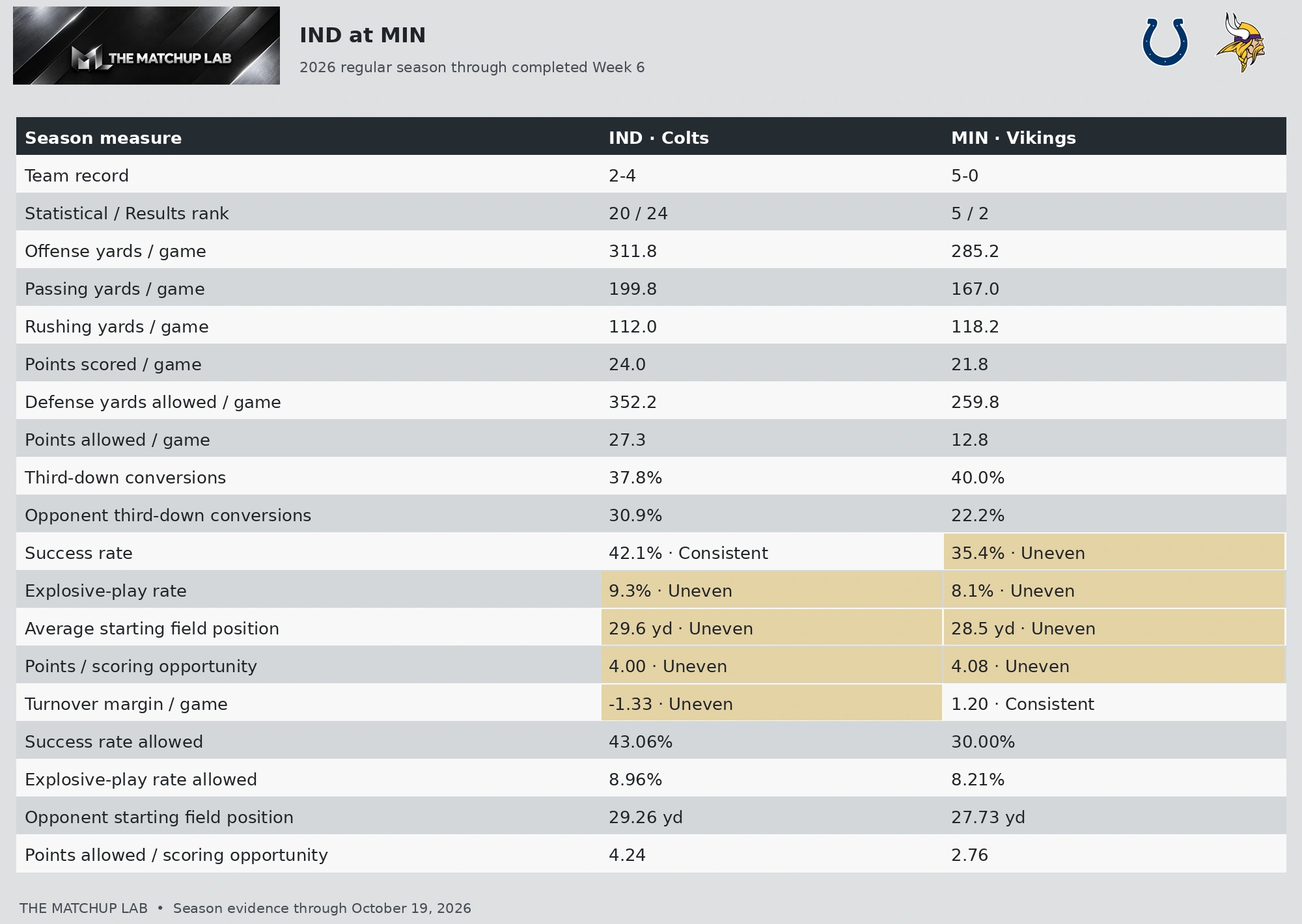
Minnesota's unbeaten start has been built around making offense difficult for the other team. Opponents have made successful ordinary gains on only 30% of qualifying plays. Indianapolis arrives with a narrower offensive margin and a serious possession problem. The Colts have given away 1.33 more possessions per game than they have taken back. An offense facing this defense cannot treat an early-down loss and the next giveaway as separate inconveniences. Together they remove both the useful down and the chance to repair it. Indianapolis needs a series that stays alive before it can ask whether a larger play is available.
The Vikings' offense has not needed to be the league's most productive on every snap because its defense and turnover returns have reduced the scoring burden. That assistance is real, but it can fluctuate. Minnesota needs to create useful possessions even if Indianapolis does not donate another one. The Colts' defense has allowed ordinary gains more frequently than its own offense produces them. That offers Minnesota a route to steady progress without requiring an aggressive search for a long gain. Neither team's non-turnover starting position implies a large automatic territorial advantage, so the decisive possessions should still be built through execution rather than assumed short fields.
Indianapolis' loss after leading Tennessee 13–0 is a warning about allowing an early advantage to become the entire offensive plan. The Colts need productive drives after their first successful series and fewer empty trips that put a recovering opponent back into the game. Minnesota's defense has also held opponents to a low return from scoring opportunities, making a wasted chance particularly expensive. The decisive test is Indianapolis' ball security against a defense that has helped Minnesota win possession exchanges. The Colts can make this a different game by avoiding the damaging mistake and converting the opportunities that remain. The Vikings need to preserve their defensive discipline and show that their offense can lengthen an advantage without waiting for another takeaway.
Dolphins at Jets
Sun Oct 25 · 12:00 PM Central · MetLife Stadium
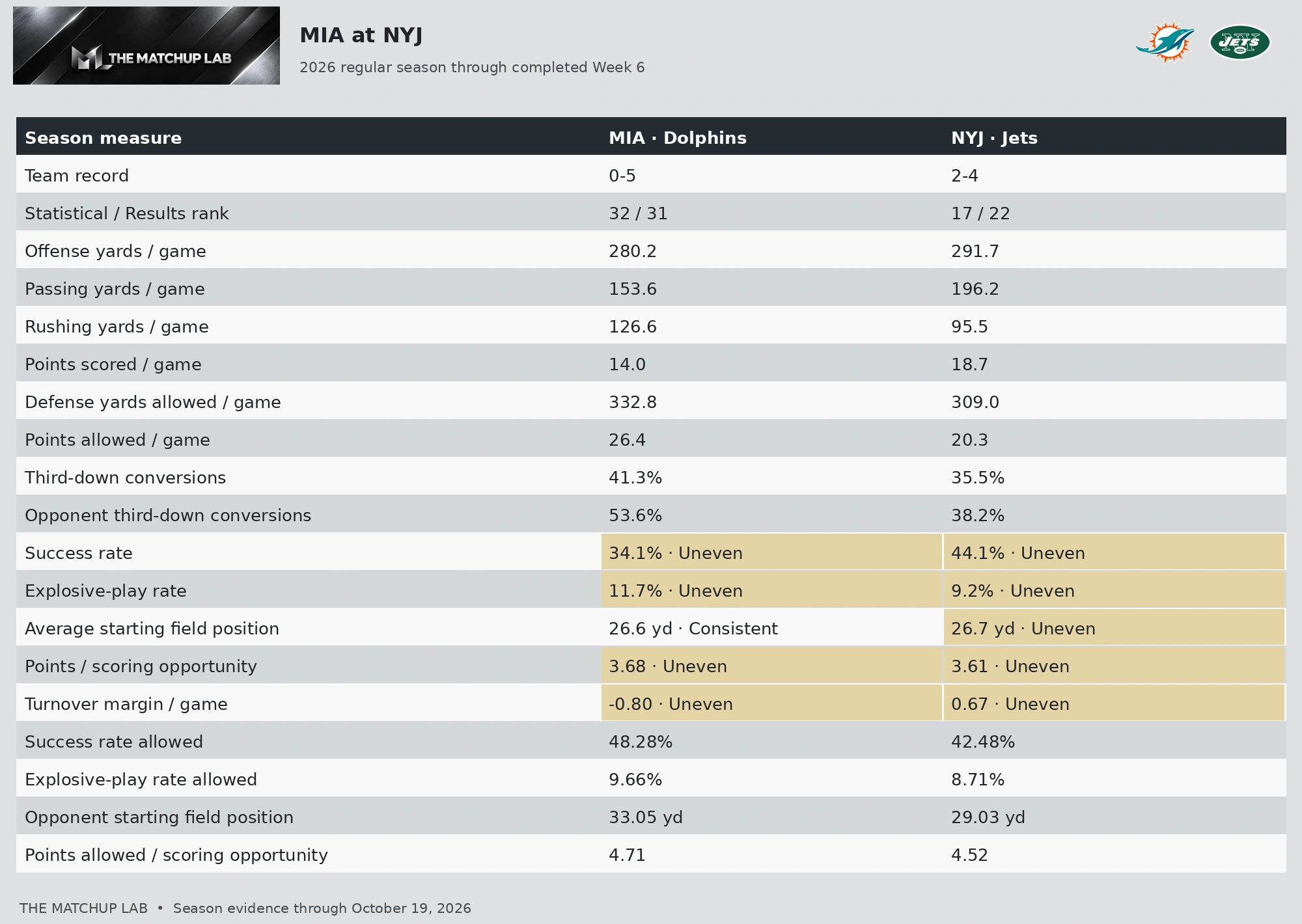
Miami has produced occasional long gains without establishing a dependable offense between them. That is the contradiction the Jets should test. The Dolphins have made successful ordinary plays much less frequently than opponents, while starting farther from scoring territory and losing more possessions than they have gained. One large completion can change a drive. It cannot reliably replace all the useful downs required across an afternoon. Miami needs first and second downs that leave more than one plausible way forward, rather than treating every stalled series as an invitation to attempt a rescue.
New York's defense has kept its scoring burden workable, allowing 20.3 points per game. The offense has averaged only 18.7. Its ordinary-play comparison is slightly favorable, but reaching useful positions has not consistently turned into enough points. Miami's defense has allowed successful plays on 48.3% of qualifying attempts and a high return from threatening possessions. The Jets should be able to ask for steady progress here, provided they do not turn an apparent opening into another wasted drive. Their positive turnover margin is assistance already recorded, not permission to assume the Dolphins will give them an extra chance on schedule.
Starting territory makes the practical requirements different. Miami has had to travel farther than its opponents, and New York has not enjoyed especially short non-turnover starts either. Neither offense should rely on a return or defensive mistake to begin in comfortable range. The Jets need useful gains to accumulate until the defense has to protect the end zone. Miami needs its larger plays to lead into productive sequences rather than isolated highlights between punts. The decisive exchange is the Dolphins' ability to avoid the repeated difficult down against New York's need to finish a possession it should be able to extend. The Jets can make their defensive work count by scoring earlier. Miami needs possession protection and a more stable sequence before the next long-gain attempt.
Browns at Titans
Sun Oct 25 · 12:00 PM Central · Nissan Stadium
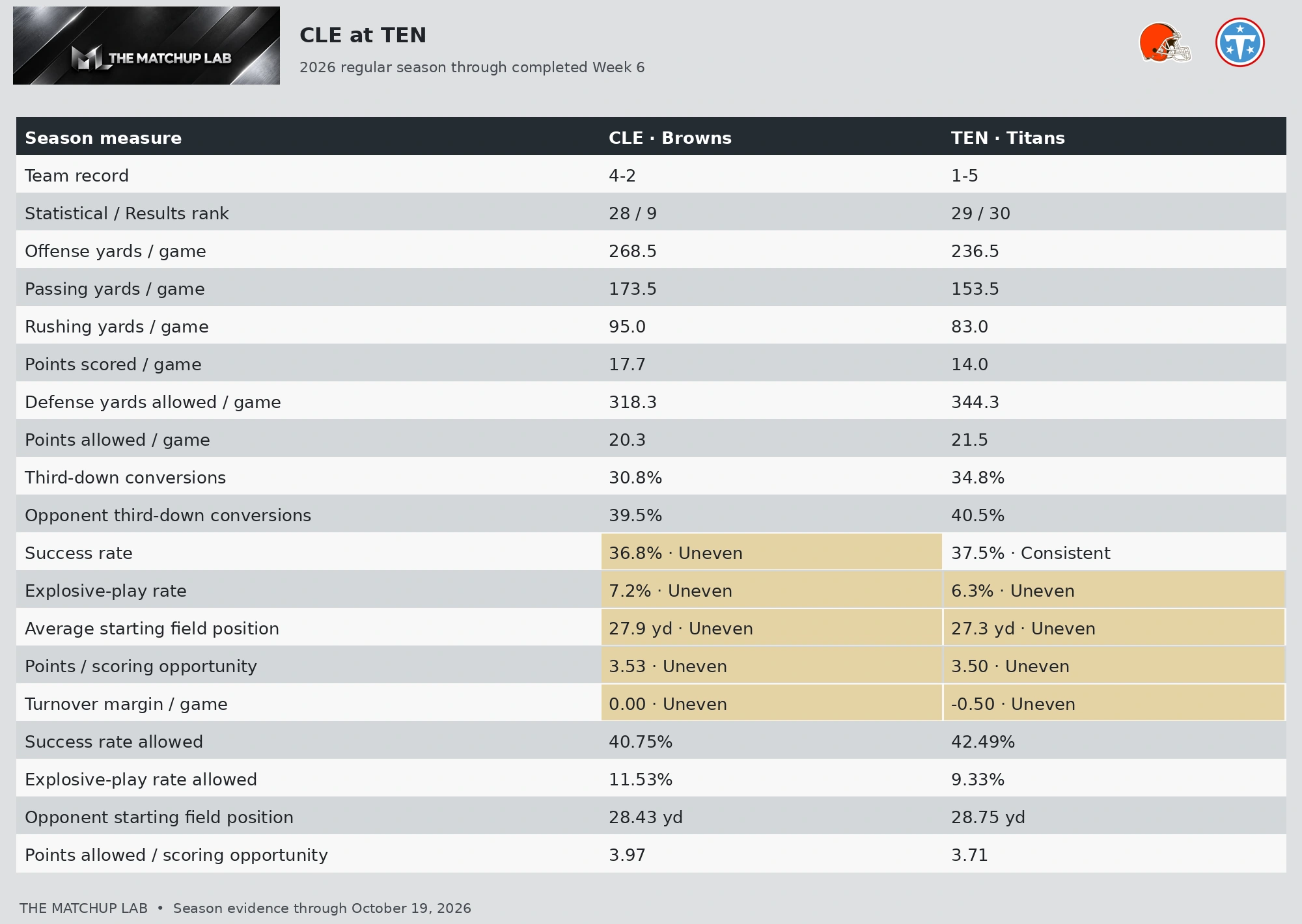
Cleveland and Tennessee have both recently won games that leave their offenses under examination. The Browns beat Baltimore 13–10. The Titans recovered from a scoreless first half to beat Indianapolis 26–20. The results matter, but neither team has built a season of easy offensive progress. Cleveland has averaged 17.7 points and Tennessee fourteen. Both have made successful ordinary gains less frequently than opponents. A productive first down may therefore matter more than the most dramatic isolated play. It gives an offense a realistic way to stay on the field before the next conversion becomes a rescue attempt.
Neither team has generated long gains often enough to assume it can skip the difficult portion of a drive. Both defenses have allowed those gains more frequently than their own offenses have produced them. That leaves an opening for either side, but exploiting it still requires protection and a possession that survives long enough to ask the question. The starting-position comparison is relatively close. Cleveland's season turnover margin is neutral, while Tennessee has lost more possessions than it has gained. The Titans cannot afford to make a low-scoring assignment harder by giving Cleveland the short field its offense has struggled to create for itself.
The Browns deserve credit for preventing Baltimore from scoring again after ten early points. The next improvement is to stop making such a narrow defensive target necessary. Tennessee's comeback showed that its offense can produce a useful half, but repeating the scoreless opening would leave too much recovery work against another defense capable of resistance. Both teams need points from their limited scoring opportunities without confusing one successful finish with control of the afternoon. The decisive matchup is the ordinary down before the obvious passing situation. Cleveland needs enough offense to reward its stops. Tennessee needs ball security and useful possessions earlier, making the next game something it can manage before it has to recover.
Broncos at Cardinals
Sun Oct 25 · 3:05 PM Central · State Farm Stadium
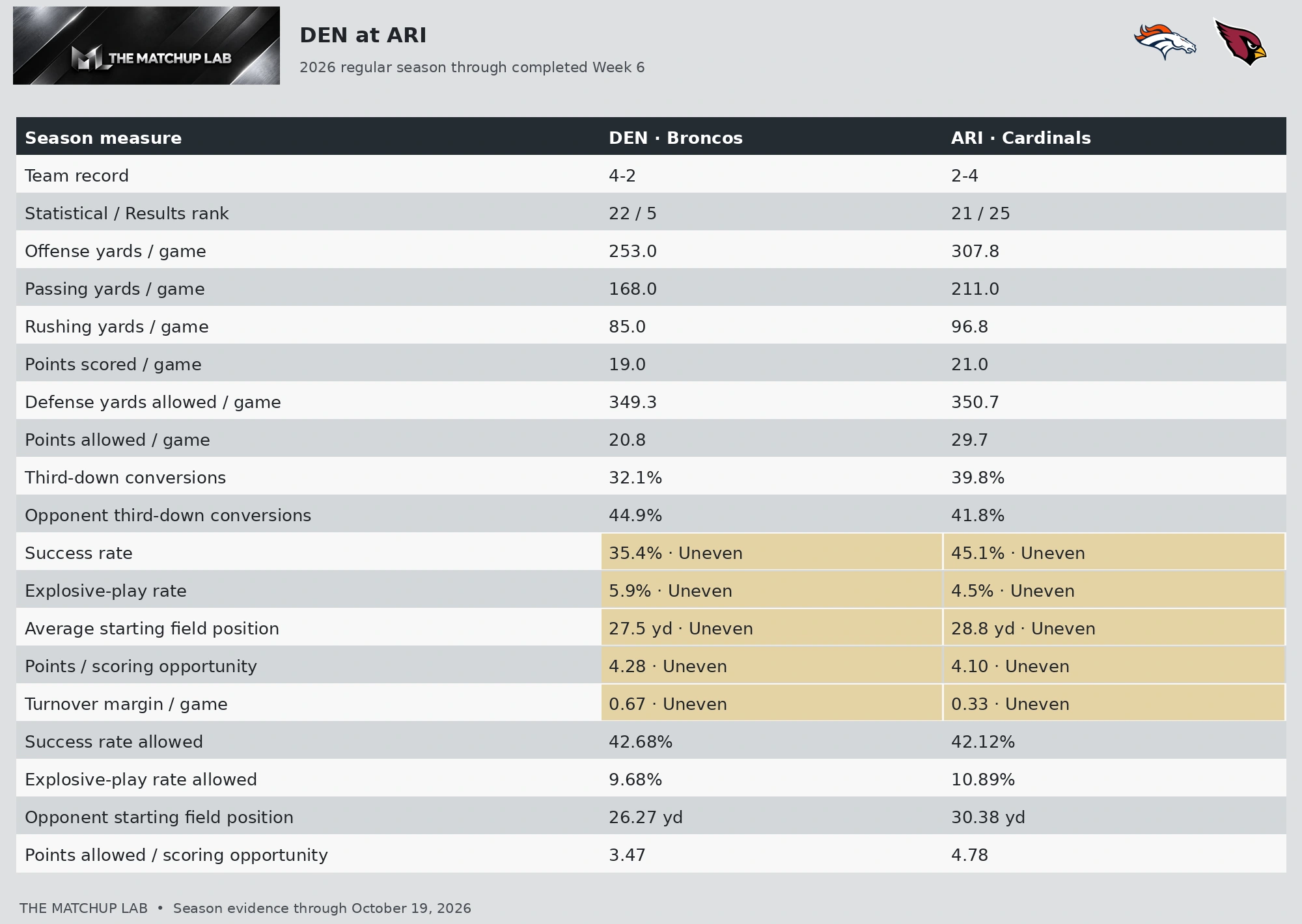
Denver has banked four wins while leaving its offense with a narrow operating margin. The Broncos have produced ordinary gains and long plays less frequently than opponents, yet have extracted a healthier return from selected scoring opportunities. Arizona presents an unusual test because the Cardinals have been more reliable at gaining ordinary ground while producing even fewer long gains. The two offenses therefore need different improvements. Denver must reach useful territory more often. Arizona must make a succession of manageable gains survive long enough to become points, without assuming that one large play will shorten the assignment.
The defensive comparisons offer each side a possible way to escape those constraints. Arizona has allowed long gains at a much higher rate than it has produced them, while Denver's defense has also conceded larger plays more frequently than its own offense creates them. Neither offense should mistake that vulnerability for a completed opportunity. It first needs the ball protected and a workable down. Both turnover margins are positive. That help can change quickly when two teams meet, so neither should build its plan around receiving another extra possession. The non-turnover starting-position numbers also give little support to expecting a large Denver territorial advantage.
The Broncos' overtime win over Seattle and the Cardinals' two-point win over the Rams both showed the value of keeping an opponent's score within reach. They did not remove the full-season offensive questions. Denver needs useful gains before its finishing advantage can matter. Arizona needs the defense to repeat its improved resistance without conceding the larger play that makes an ordinary stop irrelevant. The decisive exchange is Arizona's sustained offense against Denver's ability to prevent a dangerous possession from becoming a touchdown. The Cardinals can change the scoring burden by making their ordinary gains count. Denver needs more chances of its own, with enough ball security to preserve the limited possessions it has generally created.
Packers at Lions
Sun Oct 25 · 3:25 PM Central · Ford Field
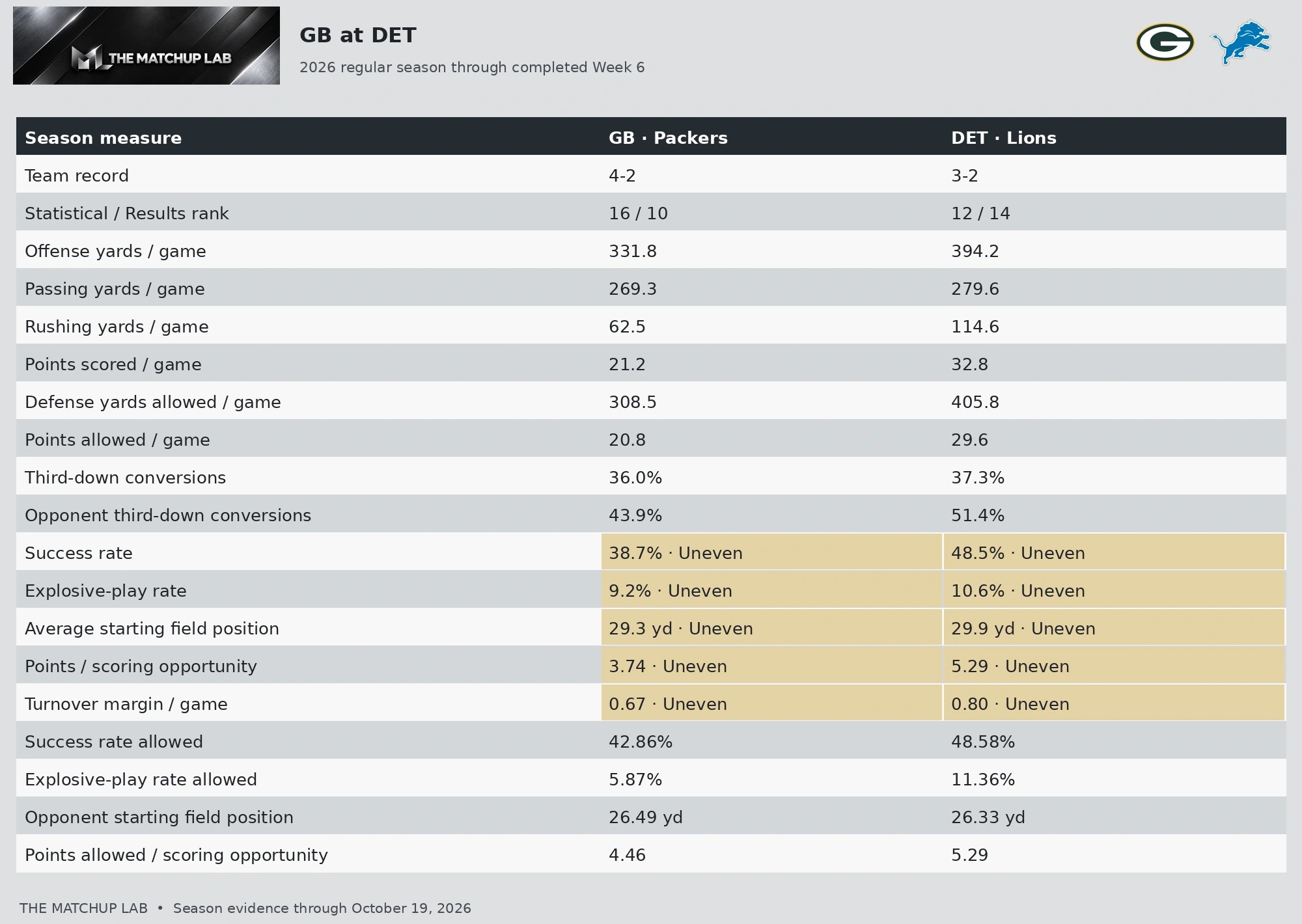
Detroit's offense has been productive enough to make a scoring contest plausible, but the defense has given opponents nearly the same ordinary-play success and the same return from scoring opportunities. The Lions cannot assume that another strong offensive afternoon will create separation. Green Bay offers a direct test of whether Detroit can force an offense to work harder between its occasional long gains. The Packers have struggled to sustain ordinary progress, while creating larger plays more frequently than their defense has allowed. Detroit needs its early stops to survive the next snap instead of becoming the beginning of another quick touchdown drive.
Green Bay's defense has limited long gains well, which could force Detroit to assemble more of its scoring possessions a few useful yards at a time. That does not mean the Lions lack that ability. Their ordinary-play success rate is much stronger than the Packers'. The question is whether Detroit can keep producing manageable downs without the larger gain it might otherwise use to accelerate a drive. Green Bay needs pressure on the next conversion and better resistance after Detroit reaches scoring territory. The Packers' own offense must then do more than produce one useful play before returning the defense to the field.
Both teams have enjoyed positive turnover margins and comparatively favorable non-turnover starting positions. Neither source of help should be assumed when they meet. Detroit should use its offensive reliability to make Green Bay defend another full series, with possession protection preserving the chance to finish. Green Bay should make the Lions travel and force the last scoring decision, then avoid wasting the territory its own defense wins. The decisive contest is Detroit's ability to sustain progress against Green Bay's restraint on long plays. The Packers need an offense that can keep a series productive after the first completion. Detroit needs stops that create an actual margin rather than another invitation for its offense to answer.
Rams at Raiders
Sun Oct 25 · 3:25 PM Central · Allegiant Stadium
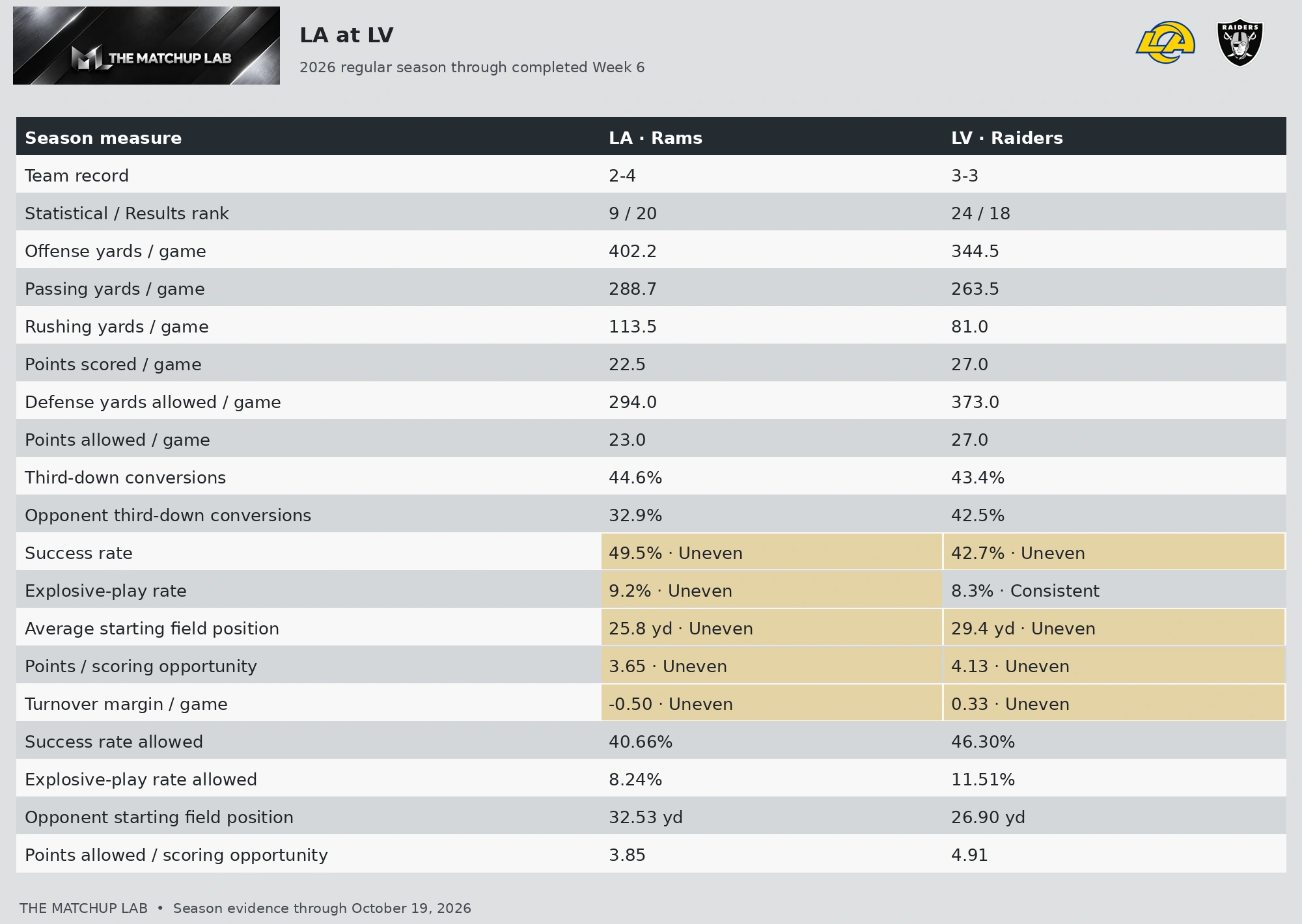
The Rams have a stronger ordinary-play comparison than their 2–4 record suggests. They have moved the ball more reliably than opponents, yet the latest two-point loss to Arizona again showed that useful gains do not automatically become enough points. Las Vegas offers an opening because its defense has conceded ordinary progress and long gains more frequently than its offense has produced them. Los Angeles should be able to ask for steady possessions here. The requirement is to make the last part of the drive as useful as the first, rather than presenting another statistical argument after a narrow defeat.
Starting territory has made that task harder for the Rams. Their non-turnover starts have been much less favorable than those given to opponents. A negative turnover margin adds a separate cost by removing opportunities altogether. Las Vegas has enjoyed better starting positions and a positive possession balance, helping its offense cover for defensive concessions. Those advantages explain how an even record can coexist with a less comfortable season comparison. They also identify what Los Angeles must change. The Rams need possessions that remain alive, while forcing the Raiders to earn distance without an interception or special-teams mistake providing a shortcut.
Las Vegas has scored and allowed exactly 27 points per game. Its 33–30 loss to Buffalo fit that narrow margin, with another productive offensive result unable to erase every defensive concession. The Raiders need early stops that make Los Angeles face a difficult down before reaching scoring territory. The Rams need to resist turning a favorable matchup into a search for an unnecessary play. Their long-gain balance is already healthier than the Raiders', so repeated useful execution is a reasonable starting point. The decisive exchange is the Rams' drive-building ability against Las Vegas' chance to force the mistake that changes the field. Los Angeles needs to finish without donating the next possession. The Raiders need defensive stops that their offense does not immediately have to replace.
Chiefs at Seahawks
Sun Oct 25 · 7:20 PM Central · Lumen Field
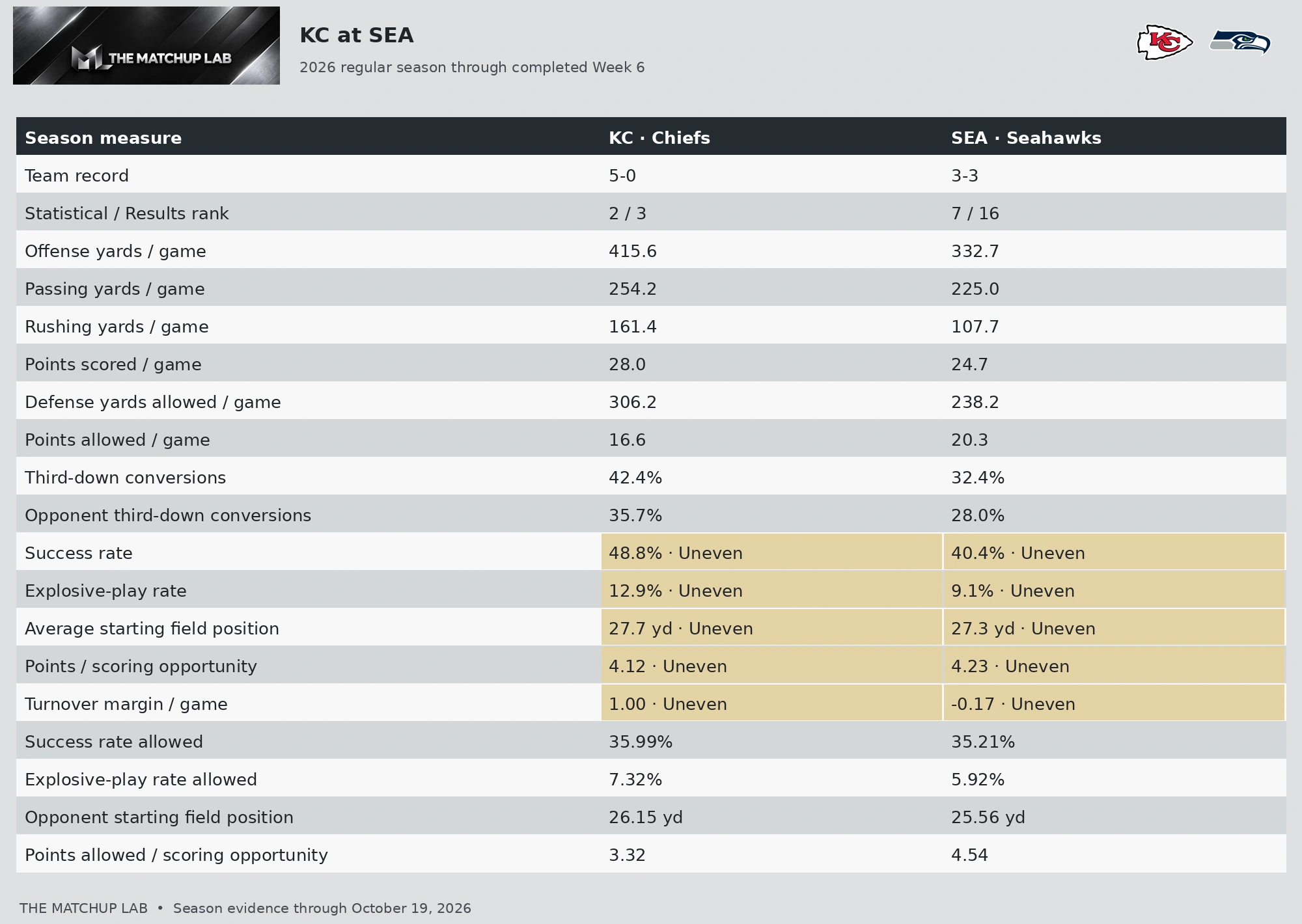
Seattle's defense gives this game a stronger competitive foundation than the records alone suggest. The Seahawks have made ordinary progress difficult and limited long gains, which are precisely the two problems an opponent must solve before Kansas City's offense becomes comfortable. The Chiefs have solved them more often than most teams, creating successful plays on nearly half their qualifying attempts and producing long gains frequently. Seattle needs to keep that first useful play from opening the entire drive. Kansas City needs the next manageable down so its offense can keep asking different questions rather than settling into one obvious answer.
The other side of the matchup carries Seattle's larger burden. Kansas City's defense has prevented ordinary gains at a similarly strong rate, while the Seahawks' offense has been less dependable than the Chiefs'. Seattle has still extracted a useful return from selected scoring chances. It needs to reach those chances often enough for the finishing to matter. Starting positions are close enough that neither team should expect a major automatic territorial advantage. Kansas City's positive turnover margin has supplied additional help; Seattle's has been slightly negative. The Seahawks need to remove that source of separation before asking their defense to win a sequence of narrow possessions.
Kansas City's 22–6 win over the Chargers illustrated how a defense can keep the required offensive score modest. Seattle's overtime defeat at Denver illustrated how a manageable contest can still remain available for the opponent to take. The Seahawks should force the Chiefs to travel, deny the long gain after an early stop and protect the ball when their own possession arrives. Kansas City should make Seattle repeat its useful offensive work across several drives instead of letting one completion define the evening. The decisive contest is Seattle's capacity to sustain a scoring possession against a defense that rarely supplies an easy ordinary down. The Chiefs need their broader offensive reliability to remain visible. Seattle needs enough productive offense to turn its defensive resistance into an actual lead.
Cowboys at Eagles
Mon Oct 26 · 7:15 PM Central · Lincoln Financial Field
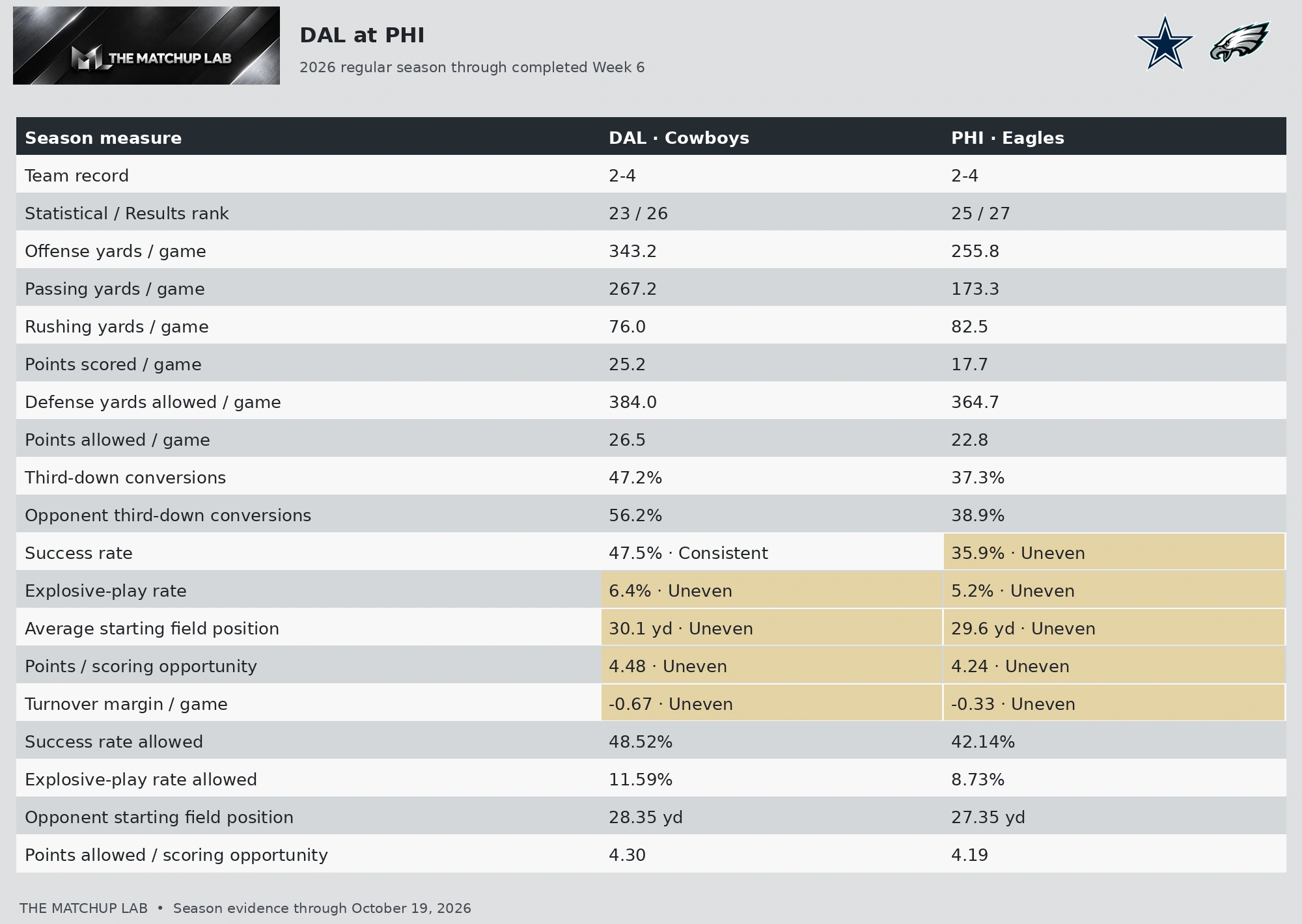
Dallas and Philadelphia arrive with the same 2–4 record and different degrees of offensive trouble. The Cowboys have still made ordinary gains at a much higher rate than the Eagles, but their opponents have produced long plays far more frequently. Philadelphia has struggled both to sustain progress and to find those escape gains. That gives Dallas an opportunity to establish control through useful downs rather than an immediate search for a spectacular play. The Eagles need to make the next tackle end the series, not simply delay the moment their offense has to answer another score.
Neither team has protected possession well enough to make an empty drive a harmless event. Dallas has lost more opportunities than it has gained, while Philadelphia has also operated with a negative turnover margin. Their non-turnover starting positions have been reasonably favorable. The problem is making that territory survive all the way to a scoring attempt. Dallas' full-season scoring rate remains materially higher, but twenty-nine points across the last two games show how quickly earlier production can disappear. Philadelphia's offense has averaged fewer than eighteen points, so another giveaway would place an especially difficult requirement on a unit already struggling to create useful sequences.
The Cowboys' defense must prevent the long gain that lets Philadelphia avoid its sustained-drive problem. The Eagles must force Dallas to keep executing after its first productive series rather than conceding the completion that turns an ordinary possession into an easy scoring chance. Neither team's return from dangerous territory creates an overwhelming advantage by itself. The more useful separation is likely to come before the drive reaches that point. The decisive exchange is Dallas' capacity to turn its stronger ordinary-play production into a clean scoring possession against Philadelphia's need to force another snap. Dallas needs ball security and stops that last. Philadelphia needs early gains, fewer immediate returns to defense and enough possession control to make its own defensive work count.
The four teams on bye
Bills remain 5-1 with no Week 7 game. Their completed-season evidence remains in the statistical and Results rankings above.
Jaguars remain 4-2 with no Week 7 game. Their completed-season evidence remains in the statistical and Results rankings above.
Chargers remain 0-6 with no Week 7 game. Their completed-season evidence remains in the statistical and Results rankings above.
Commanders remain 1-4-1 with no Week 7 game. Their completed-season evidence remains in the statistical and Results rankings above.
Every covered game
- New England Patriots at Chicago Bears · Thu Oct 22 · 7:15 PM Central
- Pittsburgh Steelers at New Orleans Saints · Sun Oct 25 · 8:30 AM Central
- San Francisco 49ers at Atlanta Falcons · Sun Oct 25 · 12:00 PM Central
- Cincinnati Bengals at Baltimore Ravens · Sun Oct 25 · 12:00 PM Central
- Tampa Bay Buccaneers at Carolina Panthers · Sun Oct 25 · 12:00 PM Central
- New York Giants at Houston Texans · Sun Oct 25 · 12:00 PM Central
- Indianapolis Colts at Minnesota Vikings · Sun Oct 25 · 12:00 PM Central
- Miami Dolphins at New York Jets · Sun Oct 25 · 12:00 PM Central
- Cleveland Browns at Tennessee Titans · Sun Oct 25 · 12:00 PM Central
- Denver Broncos at Arizona Cardinals · Sun Oct 25 · 3:05 PM Central
- Green Bay Packers at Detroit Lions · Sun Oct 25 · 3:25 PM Central
- Los Angeles Rams at Las Vegas Raiders · Sun Oct 25 · 3:25 PM Central
- Kansas City Chiefs at Seattle Seahawks · Sun Oct 25 · 7:20 PM Central
- Dallas Cowboys at Philadelphia Eagles · Mon Oct 26 · 7:15 PM Central