
THE MATCHUP LAB · NFL
Centro del partido
Marcadores, estadísticas y la historia del partido.
Buscando actualizaciones…
Cleveland Browns 27, Tennessee Titans 24 in regulation
Complete NFL Week 7 recap and season assessment
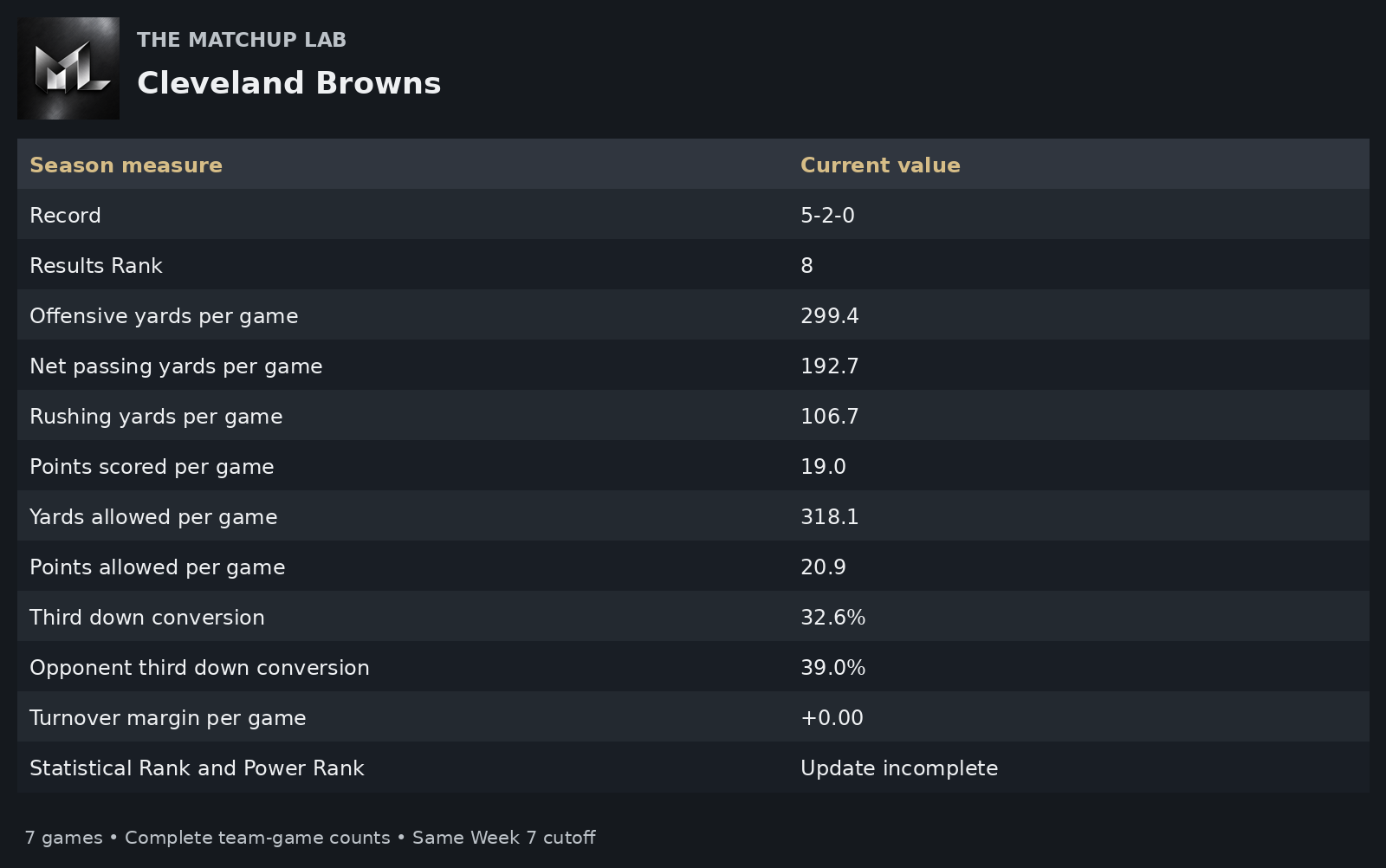
Cleveland's 491 yards gave this victory a stronger offensive foundation than the three-point margin suggests. The Browns ran for 183 yards, but two giveaways surrendered some of that work. Tennessee also lost possession twice, leaving the turnover exchange even rather than a separate explanation for the win. A team with five wins and a negative season scoring margin cannot assume that every narrow contest will keep breaking its way. Cleveland needs useful drives to end in points more consistently and fewer possessions that have to be replaced after a mistake.
The Browns allow 20.9 points per game while scoring 19.0. That negative balance is an appropriate reason to scrutinize a winning team. Their offense averages 299.4 yards, so Sunday's 491-yard performance supplied far more progress than the season baseline. Preserving the useful changes without the two giveaways would give Cleveland a stronger route to separation than relying on another narrow finish.
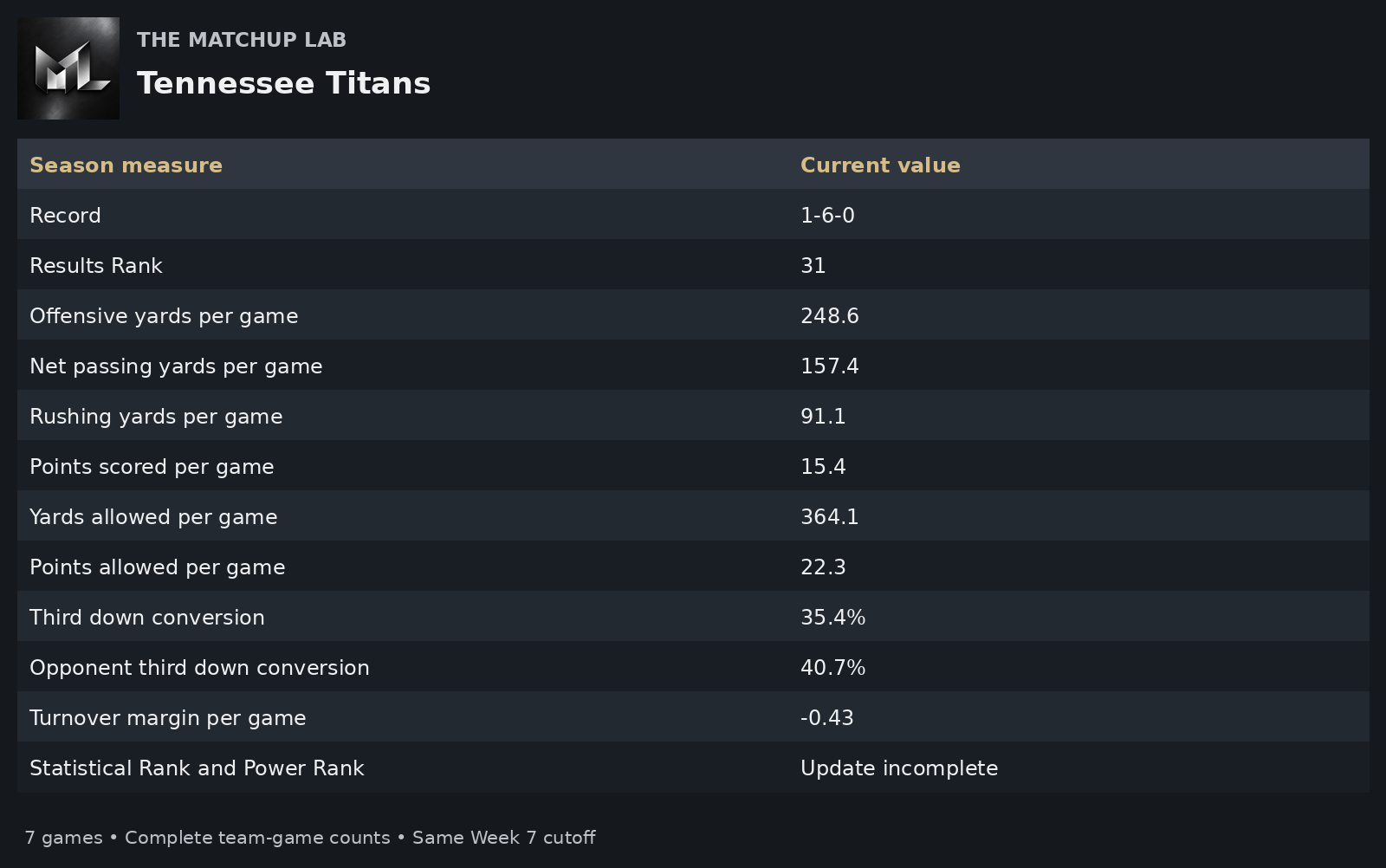
Tennessee's 141 rushing yards helped keep Cleveland within three points, but the defense allowed 491 total yards. Both teams committed two turnovers, so there was no net possession advantage to offset that ground conceded. Five conversions in thirteen third-down attempts left the Titans short of the sustained scoring required. The season's single win and six defeats reflect an offense that has rarely built a comfortable margin. Tennessee needs stops that end drives before they become scoring threats, followed by offensive progress that preserves the value of those stops. Staying close is useful only if another possession improves the score.
Tennessee scores 15.4 points per game and allows 22.3. Its offense averages 248.6 yards, leaving too few chances to treat a giveaway or stalled series as harmless. The Titans need useful gains before third down and defensive stops that reduce the distance their offense must make meaningful. Sunday's narrow margin gives them a specific game to examine, but it does not remove the wider season scoring problem.
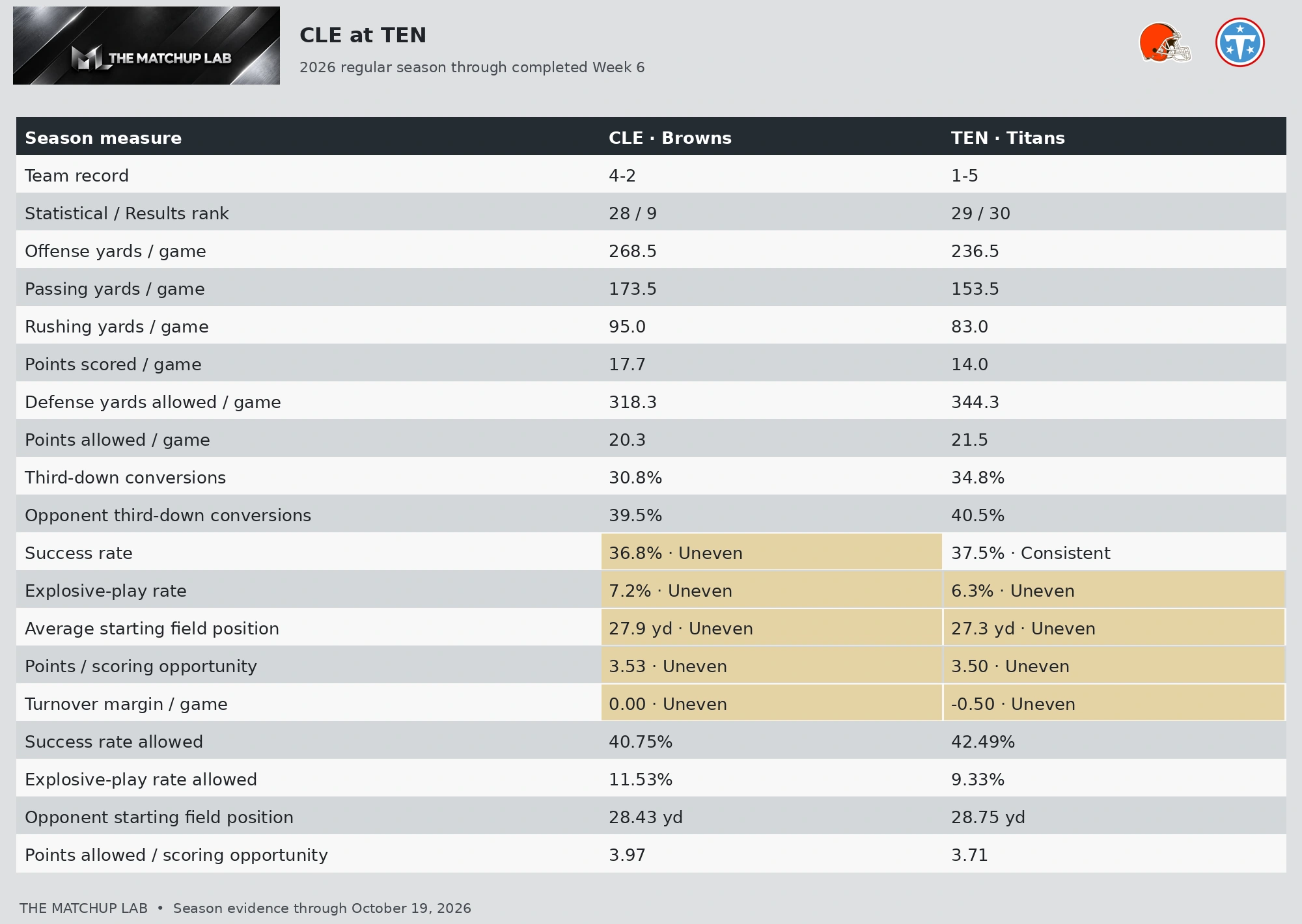
Cleveland and Tennessee have both recently won games that leave their offenses under examination. The Browns beat Baltimore 13–10. The Titans recovered from a scoreless first half to beat Indianapolis 26–20. The results matter, but neither team has built a season of easy offensive progress. Cleveland has averaged 17.7 points and Tennessee fourteen. Both have made successful ordinary gains less frequently than opponents. A productive first down may therefore matter more than the most dramatic isolated play. It gives an offense a realistic way to stay on the field before the next conversion becomes a rescue attempt.
Neither team has generated long gains often enough to assume it can skip the difficult portion of a drive. Both defenses have allowed those gains more frequently than their own offenses have produced them. That leaves an opening for either side, but exploiting it still requires protection and a possession that survives long enough to ask the question. The starting-position comparison is relatively close. Cleveland's season turnover margin is neutral, while Tennessee has lost more possessions than it has gained. The Titans cannot afford to make a low-scoring assignment harder by giving Cleveland the short field its offense has struggled to create for itself.
The Browns deserve credit for preventing Baltimore from scoring again after ten early points. The next improvement is to stop making such a narrow defensive target necessary. Tennessee's comeback showed that its offense can produce a useful half, but repeating the scoreless opening would leave too much recovery work against another defense capable of resistance. Both teams need points from their limited scoring opportunities without confusing one successful finish with control of the afternoon. The decisive matchup is the ordinary down before the obvious passing situation. Cleveland needs enough offense to reward its stops. Tennessee needs ball security and useful possessions earlier, making the next game something it can manage before it has to recover.