

NFL Week 9 Recap and Season Review
All 32 teams and the Week 10 outlook
Buffalo finished Week 9 by holding Minnesota to six points, and San Francisco answered its recent defeat with a 38–17 win over Las Vegas. Both teams stand at 7–1. Their records give the season a clear leading pair, but the group behind them remains crowded. Denver and Chicago have seven wins from nine games, while Minnesota, Jacksonville, Detroit, Pittsburgh, Cincinnati and Kansas City each have six wins from eight.
The Bills' 23–6 Monday night victory carries particular weight because Minnesota has allowed only 14.5 points per game across the season. Jacksonville made its own strong defensive statement in a 33–10 win at Baltimore. At the other end of the scoring range, Green Bay put 45 on New England and Houston scored 44 against the Chargers. Those results deserve attention without turning one productive afternoon into a new description of an entire season.
All 15 Week 9 games are final. Pittsburgh and Tennessee were on bye. This edition covers all 136 completed regular-season games and all 32 teams through November 10 at 8:42 AM Central. The next seven days include the complete 14-game Week 10 schedule. Results Rank has been recalculated from that full population. The separate Statistical Rank and its dependent overall Power Rank remain incomplete because the original calculation's required current play data are not yet available.
Week 9 scoreboard and betting status

No verified retained pregame spread or total snapshot is available for these 15 games. All spread tickets, favorite and underdog cover counts, pushes, totals and spread-total combinations therefore remain ungraded. The scoreboard shows final and combined points only. A later price cannot replace a missing historical snapshot. Betting prices, when recorded, reflect their stated observation time, can change before kickoff and provide information rather than a guarantee of results.
What the season is showing
Buffalo leads the league at 32.0 points and 386.4 yards per game, yet the most useful recent development is on the other side of the ball. Baltimore and Minnesota combined for 16 points against the Bills in the last two games. Buffalo still allows 23.4 points per game over the season. The recent restraint is encouraging; sustaining it would make an already productive offense less responsible for solving every problem.
Jacksonville's 28.6 points scored and 15.1 allowed per game describe a stronger balance than its yardage totals alone might suggest. Seattle presents a different comparison. The Seahawks allow only 243.8 yards per game but have a 5–4 record. Raw yards describe territory, while the scoreboard and game results describe what teams have done with it. That distinction is a reason to assess both sides of every club's season and to keep results and performance rankings separate.
Results Rank and calculation status
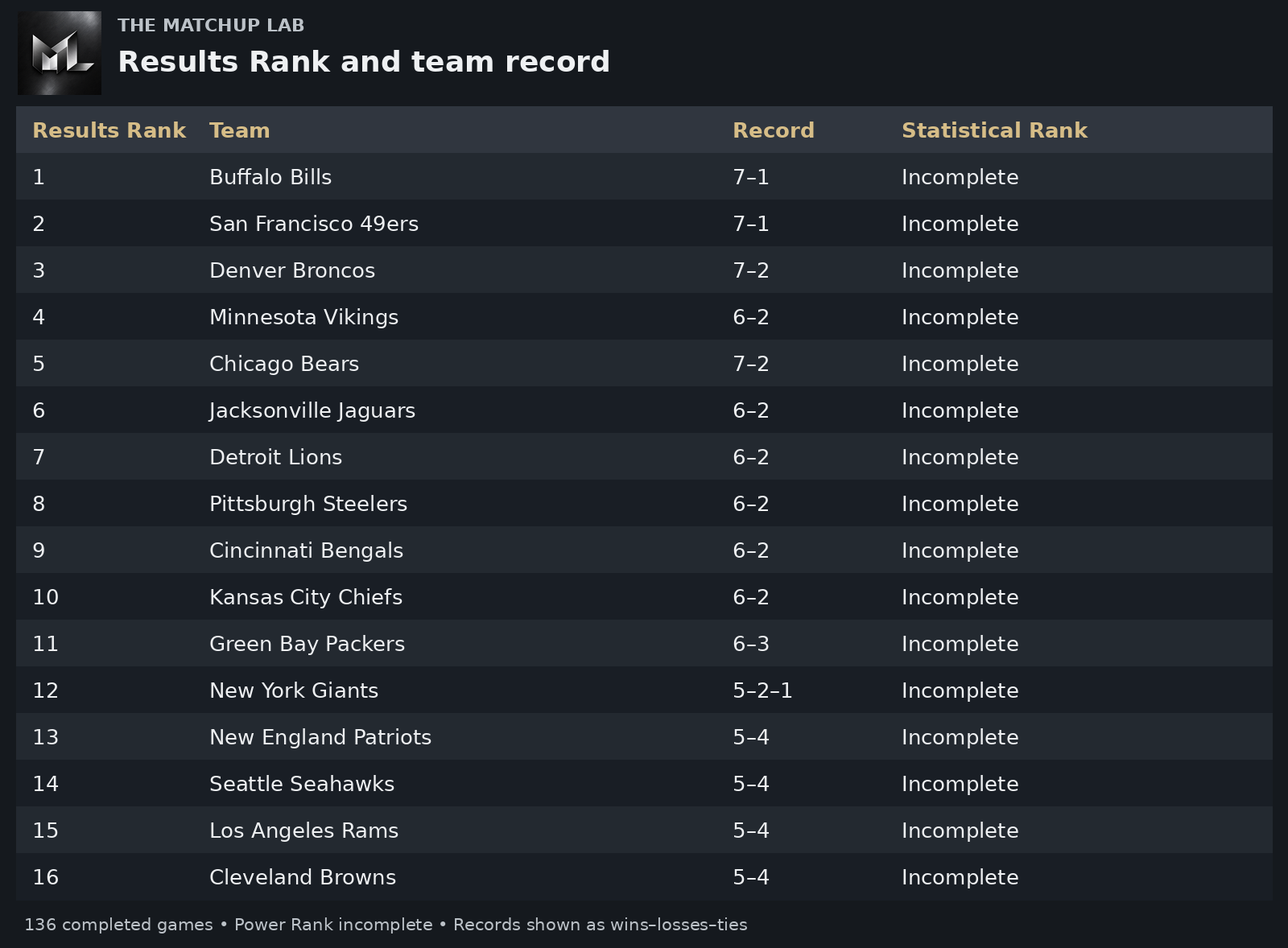
Results Rank evaluates the results already recorded. The unchanged calculation weights smoothed record at 60 percent, schedule at 15 percent, strength of victory at 15 percent and loss quality at 10 percent. Each opponent's evaluation removes every head-to-head game with the assessed team. Ties receive half a win. Small starting assumptions soften short samples, and all 136 completed games share the same cutoff. The table shows only Results Rank and team record; the underlying opponent components remain private.
The NFL Statistical Rank uses the saved five-part calculation, with efficiency at 40 percent, long gains at 25 percent, finishing drives at 15 percent, starting field position at 10 percent and turnovers at 10 percent. It compares offense with defense, smooths short samples toward league averages and limits extreme standardized values. The original executable has now been recovered, but its complete current play-by-play inputs have not. No current Statistical score, movement or substitute ranking is asserted. This performance measure is not opponent-adjusted and is not a betting probability.
Results Rank continued
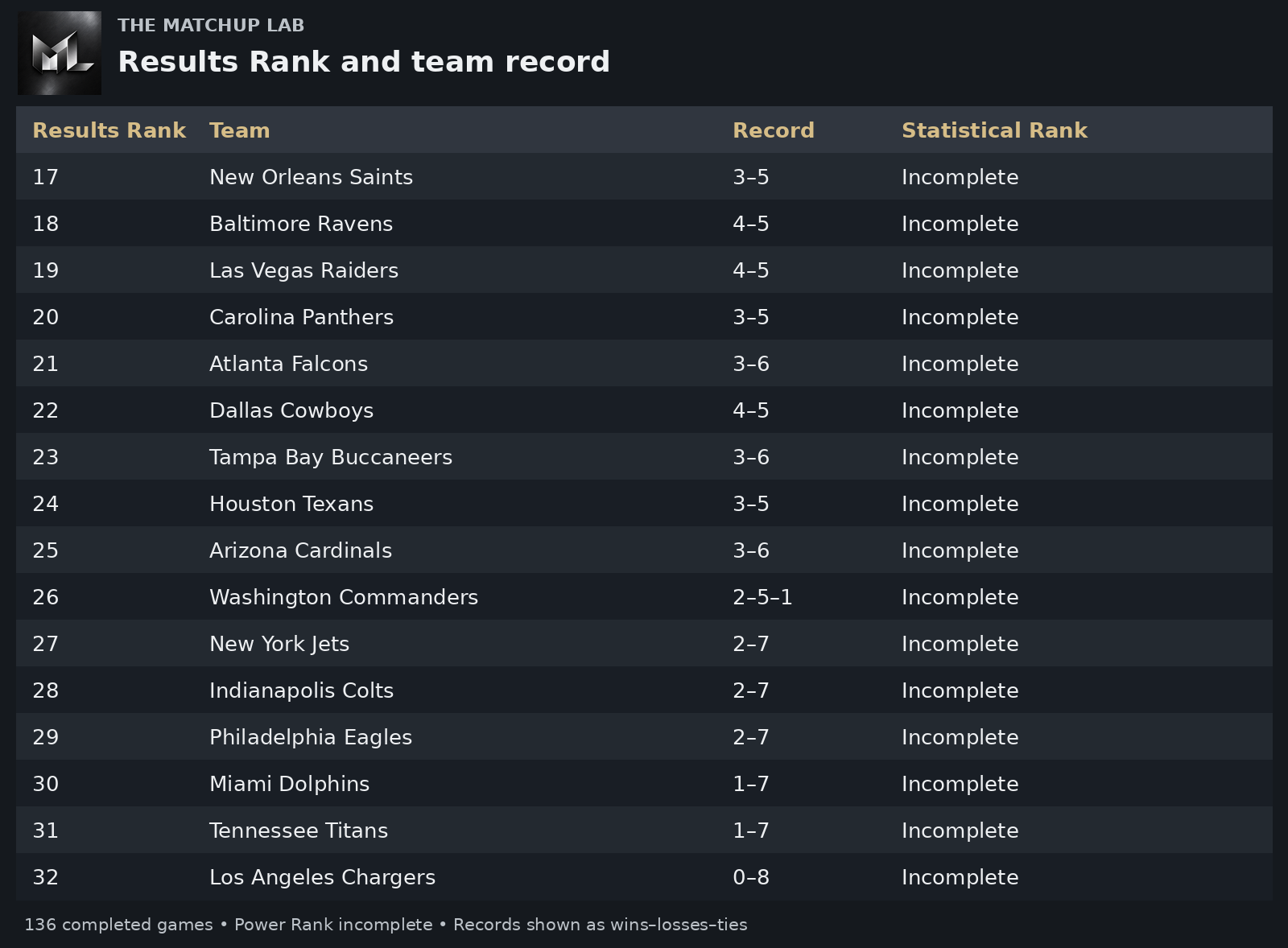
Overall Power Rank is a third ordering. It places fewer regular-season losses first and uses current Statistical Rank to separate teams with the same loss count. That tie-break is unavailable, so this edition does not issue numerical Power ranks. Team assessments appear in loss groups, alphabetically within each group. The sequence inside a group has no ranking meaning.
The eight traditional season statistics come from verified season counts for every team. Yards and points are divided by actual games played; third-down percentages divide total conversions by total attempts. Net passing yards exclude sack yardage. Counts were reconciled across the full league rather than averaging weekly percentages. Current five-factor rates, turnover margin per game and the saved Consistent or Uneven classification are unavailable in this edition. No missing value is treated as zero.
Every Week 9 result
Jacksonville Jaguars 33 and Baltimore Ravens 10
Jacksonville moved to 6–2 with a 33–10 win at Baltimore, leaving the Ravens 4–5. The 23-point margin fits the Jaguars' broader balance. They average 28.6 points while allowing 15.1 per game through Week 9. Their 46.4% third-down conversion rate also contrasts with the 34.0% they allow opponents. Baltimore's season profile is much less comfortable, with 21.0 points scored against 26.2 allowed per game. This result strengthens Jacksonville's case on both sides of the ball and leaves Baltimore needing improvement beyond its productive running game.
Cincinnati Bengals 34 and Atlanta Falcons 17
Cincinnati's 34–17 victory over Atlanta lifted the Bengals to 6–2 and dropped the Falcons to 3–6. The scoring output was consistent with a season offense averaging 30.0 points and 285.5 net passing yards per game. Cincinnati's 53.6% third-down conversion rate supplies another reason to take that production seriously. Atlanta averages 137.2 rushing yards but only 185.4 net passing yards per game, giving its offense a different shape. The Falcons need more scoring from that overall mix; their season average of 20.9 points leaves little room for conceding 34.
Dallas Cowboys 27 and Indianapolis Colts 23
Dallas beat Indianapolis 27–23 to reach 4–5, while the Colts slipped to 2–7. The Cowboys' 27 points were close to their season average of 27.3, but the four-point margin also fits a team allowing 26.2 per game. Dallas converts 45.3% of its third downs while allowing opponents 48.3%, a reminder that its offense carries a heavier burden than the record alone explains. Indianapolis remains vulnerable at 27.7 points allowed per game. This was a useful Dallas win, with its broader defensive questions still unresolved.
Kansas City Chiefs 35 and New York Jets 12
Kansas City reached 6–2 by beating the Jets 35–12, sending New York to 2–7. The Chiefs' season numbers support the breadth of that result. They average 383.6 offensive yards per game against 307.9 allowed, with opponents averaging 17.9 points. Their 35-point output also exceeded their own season scoring average of 25.3. New York averages 20.2 points and converts 35.4% of third downs, leaving limited room for an offensive shortfall. Kansas City has a stronger statistical foundation on both sides, and Week 9 widened the difference in their records.
Detroit Lions 19 and Miami Dolphins 9
Detroit improved to 6–2 with a 19–9 win over Miami, which fell to 1–7. The Lions won despite finishing below their season scoring average of 27.8 points, making the nine points conceded the clearest feature of the scoreline. Miami's season offense averages 15.8 points and 282.3 yards per game, so the low output deepened an existing concern. The Dolphins convert 41.6% of third downs but allow opponents 47.4%. Detroit banked another win without needing its usual scoring volume; Miami still needs more productive possessions across the game.
Week 9 results continued
New Orleans Saints 23 and Cleveland Browns 22
New Orleans edged Cleveland 23–22 in overtime to move to 3–5, while the Browns fell to 5–4. The one-point result should be kept in proportion. The Saints still allow 27.0 points per game and opponents convert 47.2% of third downs. Their own 43.5% conversion rate gives the offense a useful strength, but the overall balance remains uneven. Cleveland averages 17.9 points and 97.3 rushing yards per game through Week 9. Both teams have work beyond this narrow outcome, especially in sustaining enough offense to reduce pressure on their defenses.
New York Giants 19 and Philadelphia Eagles 11
The Giants' 19–11 win at Philadelphia improved their record to 5–2–1 and left the Eagles 2–7. New York allows 301.4 yards per game while producing 333.1, a healthier season balance than this modest scoring total alone might suggest. Philadelphia's offensive problem is more pronounced. Its offense produces 260.2 yards and 16.4 points per game, including 88.6 rushing yards. Eleven points against a division opponent reinforced that weakness. The Giants earned another result with restrained scoring, while Philadelphia needs a much more reliable offensive contribution to change its trajectory.
Los Angeles Rams 20 and Washington Commanders 13
The Rams moved above .500 at 5–4 with a 20–13 win over Washington, now 2–5–1. Los Angeles averages 379.8 yards per game, but its defense helps explain why 20 points can be enough. The Rams allow 302.4 yards and a 31.6% opponent third-down conversion rate. Washington converts only 31.1% of its own third downs and averages 21.5 points. This was another result in which limited Commanders scoring proved costly. For the Rams, the next step is turning substantial season yardage into more consistent scoring separation.
Denver Broncos 26 and Carolina Panthers 21
Denver's 26–21 win over Carolina pushed the Broncos to 7–2 and the Panthers to 3–5. Denver's record continues to outpace what its yardage balance would suggest, with 277.3 yards gained per game against 355.0 allowed. Its scoring balance is better, at 22.0 points for and 20.7 against. Carolina averages 362.4 offensive yards, yet concedes 27.4 points per game, limiting the value of that production. The five-point result added another Denver win while preserving a clear analytical distinction between successful outcomes and a less convincing yardage profile.
Houston Texans 44 and Los Angeles Chargers 22
Houston beat the Chargers 44–22 to improve to 3–5, leaving Los Angeles winless at 0–8. The Texans' 44 points were well above their season average of 26.1. Their offense is heavily weighted toward the pass, averaging 269.4 net passing yards against 87.1 rushing yards per game. Los Angeles produced more than its usual 15.1 points, but conceding 44 intensified a season problem already reflected in 27.4 points allowed per game. Houston gained a substantial result; the Chargers need progress across both scoring and prevention to find their first win.
Week 9 results continued
San Francisco 49ers 38 and Las Vegas Raiders 17
San Francisco's 38–17 win over Las Vegas lifted the 49ers to 7–1 and dropped the Raiders to 4–5. The margin fits a strong season profile. San Francisco averages 29.4 points while allowing 19.5 and converts 51.7% of third downs. Las Vegas averages 26.4 points, but its defense allows 29.8 points and 385.4 yards per game. That imbalance leaves the Raiders vulnerable whenever their scoring falls below its normal level, as it did here. San Francisco paired another decisive result with sustained statistical strength on both sides.
Green Bay Packers 45 and New England Patriots 27
Green Bay beat New England 45–27 to reach 6–3, while the Patriots fell to 5–4. The Packers' 45 points were far above their season average of 24.0 and underline the upside of an offense producing 279.7 net passing yards per game. Their 68.2 rushing yards per game also show how concentrated that production is. New England averages 369.4 total yards and 23.4 points, so offense remains a credible part of its profile. Conceding 45, however, erased the value of a scoring performance above its own average.
Seattle Seahawks 17 and Arizona Cardinals 3
Seattle's 17–3 win over Arizona brought the Seahawks to 5–4 and the Cardinals to 3–6. The defensive result fits Seattle's season foundation, with 243.8 yards and 18.0 points allowed per game, with opponents converting 30.6% of third downs. Its own scoring average is 22.4, so the Seahawks won without reaching their usual output. Arizona averages 19.8 points while allowing 28.3, and scoring three made that imbalance especially costly. Seattle has a clear defensive strength to build around; Arizona needs substantially more scoring to protect its margin for error.
Chicago Bears 27 and Tampa Bay Buccaneers 24
Chicago edged Tampa Bay 27–24 to improve to 7–2, leaving the Buccaneers 3–6. The Bears' broader profile supports the result. They average 383.2 yards per game, convert 45.3% of third downs and allow opponents only 22.8%. Tampa Bay offers a different combination, allowing 292.9 yards per game while generating 163.9 rushing yards and 141.4 net passing yards. Those strengths made this more than a simple comparison of records. Chicago added a narrow win to strong season indicators; Tampa Bay still needs its defensive and rushing production to translate into more victories.
Buffalo Bills 23 and Minnesota Vikings 6
Buffalo won 23–6 at Minnesota to reach 7–1, while the Vikings fell to 6–2. The Bills finished below their own 32.0-point season average but exceeded the 14.5 points Minnesota allows per game. Holding the Vikings to six also exposed the other side of Minnesota's profile. The Vikings average 266.8 offensive yards and 18.3 points per game. Buffalo averages 386.4 yards, including 146.6 on the ground. The result strengthens Buffalo's position and sharpens Minnesota's challenge. A strong defensive season cannot consistently compensate for such limited scoring.
The Week 10 schedule

All times are Central, using America/Chicago. The schedule covers November 10 at 8:42 AM through November 17 at 8:42 AM. Scheduled games can change; the listed times are the verified schedule at the edition cutoff. Chicago, Denver, Philadelphia and Tampa Bay have no Week 10 game. No current spread, total, projected starter or injury designation is asserted without a verified observation.
New England Patriots at Detroit Lions
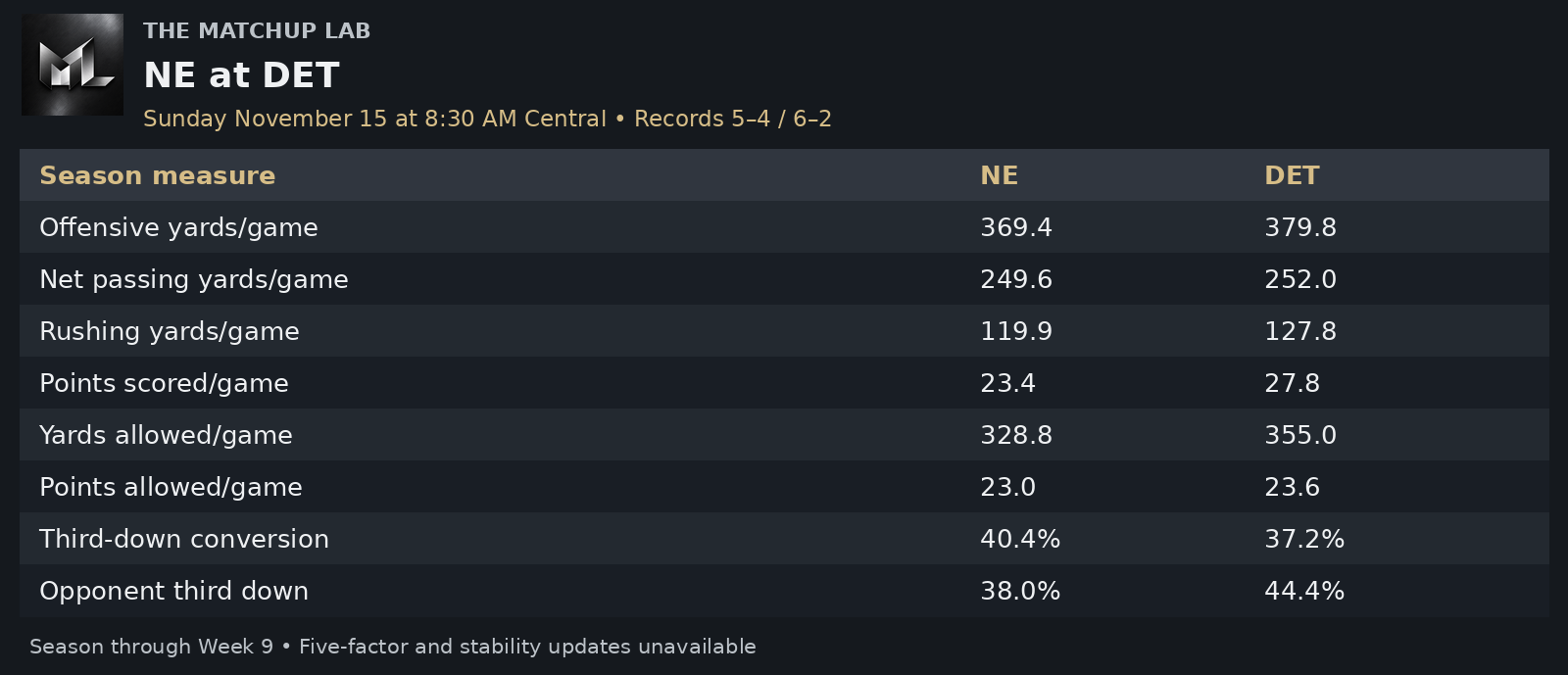
Detroit enters its Sunday morning matchup on November 15 with a 6–2 record; New England is 5–4. The Lions average 379.8 yards and 27.8 points per game, compared with the Patriots' 369.4 yards and 23.4 points. That is a modest yardage gap alongside a more meaningful difference in scoring. Detroit's 252.0 net passing yards and 127.8 rushing yards per game give New England multiple areas to address, even after the Lions won in Miami with only 19 points.
The Patriots have a plausible route through sustained offense. They convert 40.4% of third downs, and Detroit allows opponents 44.4% while conceding 355.0 yards per game. New England's own defense allows 328.8 yards and 23.0 points, but it now has to respond after giving up 45 to Green Bay. The central question is whether the Patriots can turn competitive yardage into enough points to match Detroit. The season figures suggest both offenses can move the ball; Detroit has so far extracted more scoring from its production.
Their recent results sharpen the contrast. New England scored 24, 24 and 27 in its last three games but won only once, beating Miami between losses to Chicago and Green Bay. Detroit won its last three 20–17 over Green Bay, 19–15 over Minnesota and 19–9 over Miami. Those Lions wins show that their recent success has not required matching the season scoring average. New England needs to preserve its own scoring consistency while preventing another large opposing total. Detroit needs to sustain the more restrictive recent results and avoid letting the Patriots' third-down opportunities become a sequence of extended scoring possessions.
Minnesota Vikings at Green Bay Packers
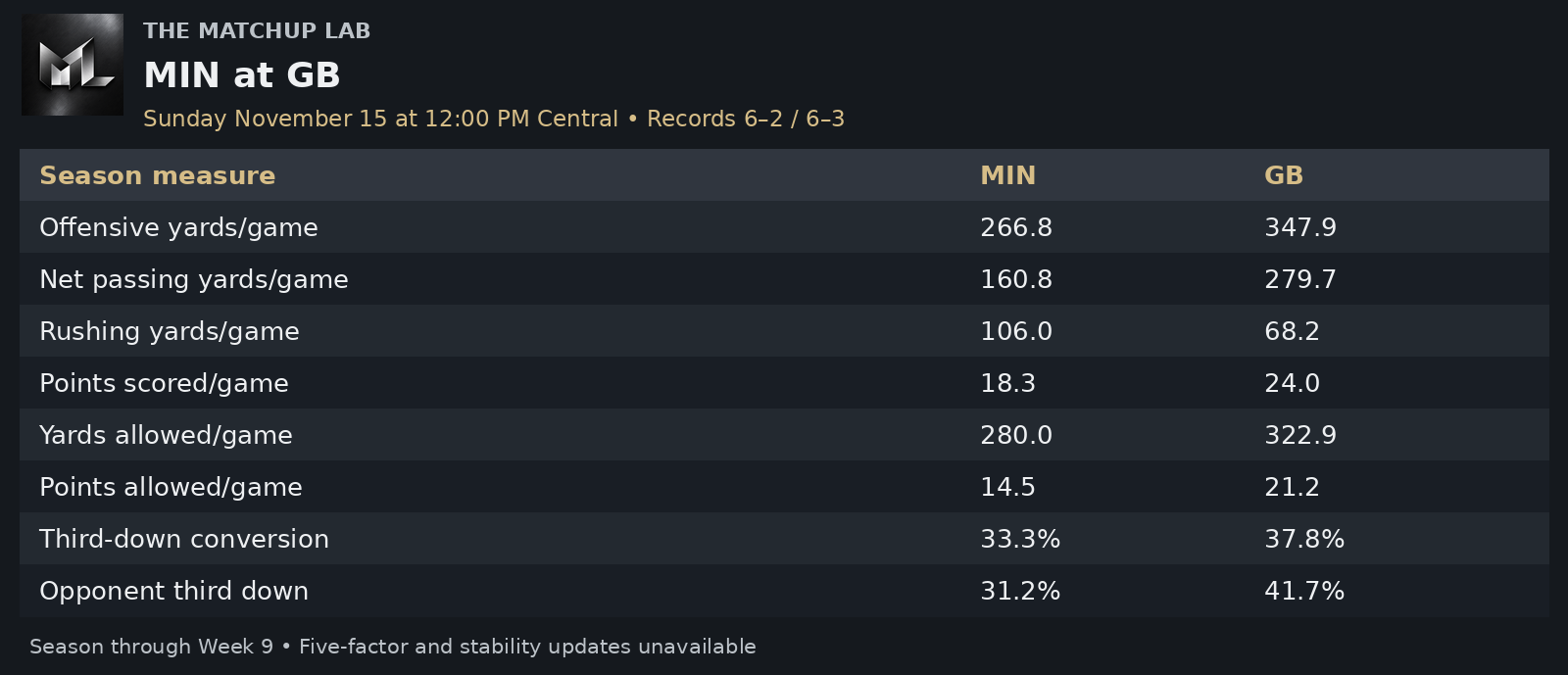
Minnesota visits Green Bay on Sunday, November 15 at noon Central, bringing a 6–2 record against the Packers' 6–3. Green Bay just scored 45 at New England, but its season average is 24.0 points per game against a Minnesota defense allowing 14.5. The Vikings also concede 280.0 yards per game and a 31.2% third-down conversion rate. Green Bay's offense averages 279.7 net passing yards and only 68.2 rushing yards, making its ability to sustain that passing production the most obvious matchup question.
Minnesota has an equally pressing issue with the ball. Its offense averages 18.3 points and 266.8 yards, and converts 33.3% of third downs. Six points against Buffalo made that limitation costly despite a strong defensive season. Green Bay allows 21.2 points and 322.9 yards per game, with opponents converting 41.7% on third down. That offers Minnesota an opening, but the Vikings must take it. The records make this an important divisional meeting; the numbers make Minnesota's offensive response as interesting as its defense against Green Bay's passing game.
The recent scoring paths run in opposite directions. Minnesota beat Indianapolis 16–10 before losing 19–15 at Detroit and 23–6 to Buffalo, leaving it with 16, 15 and six points in its last three games. Green Bay followed a 20–17 loss at Detroit with wins of 27–19 over Carolina and 45–27 at New England. That improvement matters, but the latest 45 should not become an assumed baseline against this defense. Minnesota needs more complete offensive possessions to give its stops value. Green Bay needs to maintain scoring production against a more restrictive season profile while keeping the Vikings' modest offense from finding relief.
San Francisco 49ers at Dallas Cowboys
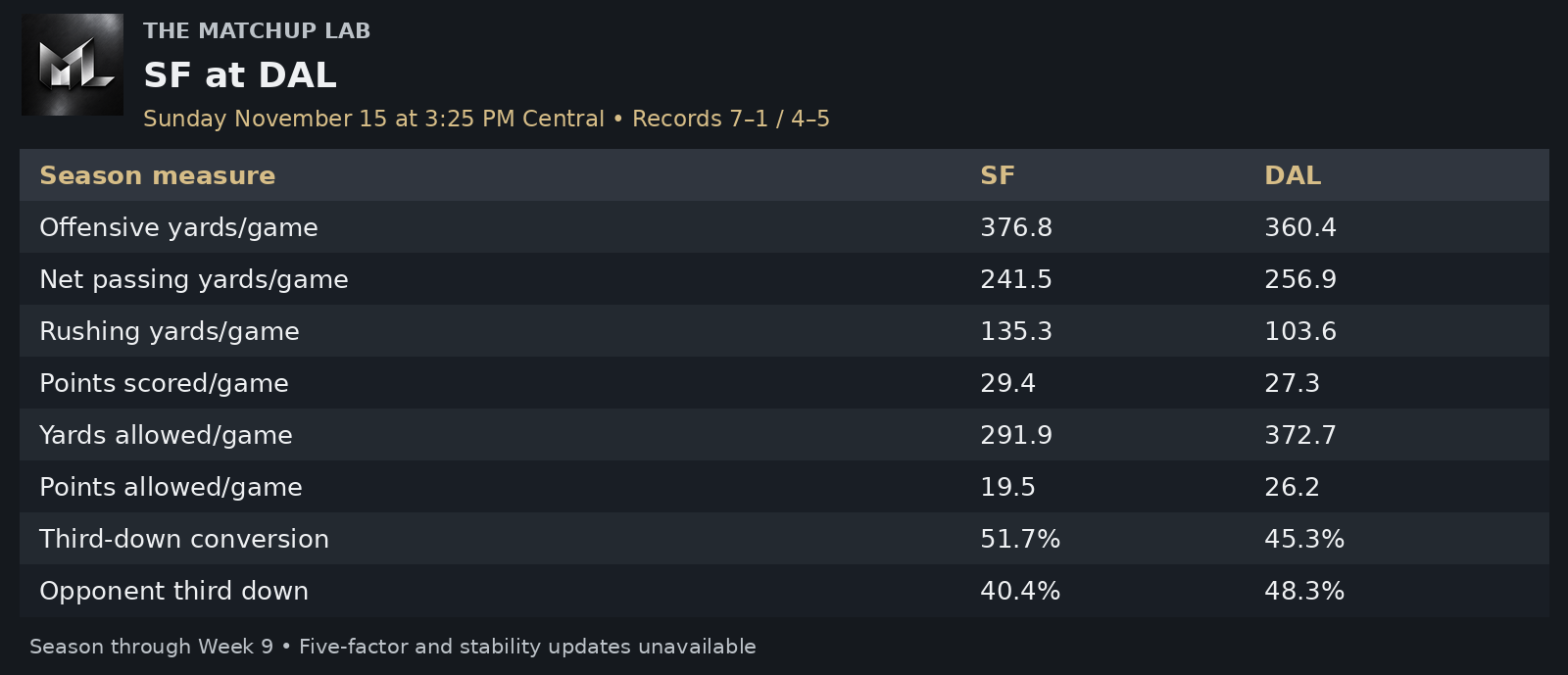
San Francisco takes its 7–1 record to Dallas on Sunday afternoon, November 15, with the Cowboys at 4–5. The clearest numerical matchup is on third down. The 49ers convert 51.7% of their opportunities, while Dallas allows opponents 48.3%. San Francisco also averages 376.8 yards and 29.4 points per game. Against a Cowboys defense conceding 372.7 yards and 26.2 points, those figures place a substantial burden on Dallas to end possessions before they become repeated scoring chances.
Dallas has enough offensive production to make the other side of the matchup relevant. The Cowboys average 27.3 points and 256.9 net passing yards per game and convert 45.3% of third downs. San Francisco allows 19.5 points and 291.9 yards, so maintaining that Dallas production will be a tougher task than its own averages imply. The 49ers' 135.3 rushing yards per game also give them a substantial complement to their passing offense. Dallas's route is to keep scoring while improving its defensive stops; San Francisco can lean on a stronger balance between production and prevention.
The recent results also discourage reading the records as a complete forecast. San Francisco beat Washington 23–17, lost 29–20 at Atlanta and then, after its bye, beat Las Vegas 38–17. Dallas has scored at least 27 in each of its last three, beating Philadelphia 38–21, losing 33–30 to Arizona and beating Indianapolis 27–23. Its offense has therefore supplied points even when the result has gone against it. Dallas needs that contribution to survive a stronger defensive matchup while reducing the opponent's possession extensions. San Francisco needs to preserve its offensive balance and avoid giving Dallas enough scoring freedom to offset the larger season differences.
Pittsburgh Steelers at Cincinnati Bengals
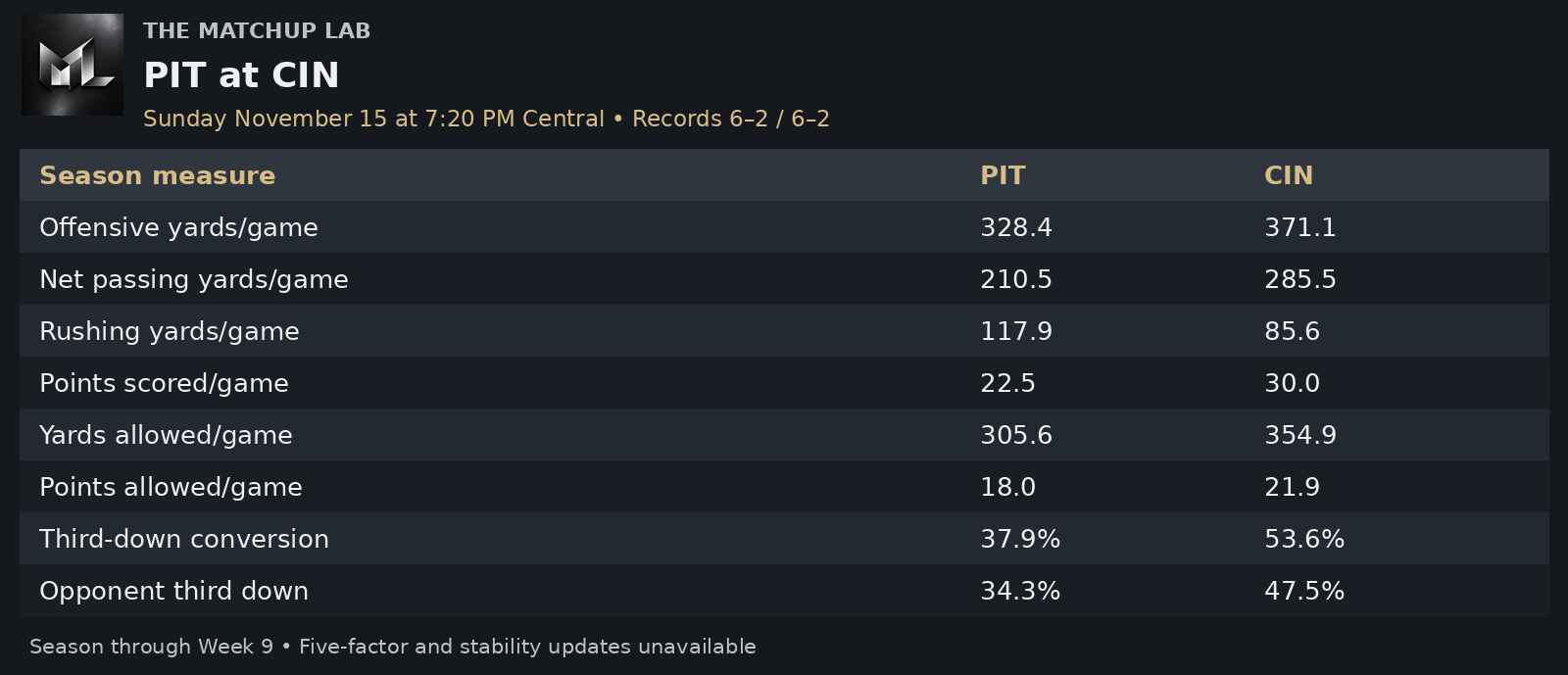
Pittsburgh and Cincinnati meet at 6–2 on Sunday evening, November 15. Cincinnati averages 30.0 points and converts 53.6% of third downs; Pittsburgh allows 18.0 points and a 34.3% opponent conversion rate. That contrast makes possession extension a useful focus without treating either season rate as a forecast. The Bengals average 285.5 net passing yards against 85.6 rushing yards per game, so sustaining their passing production against a defense allowing 305.6 total yards will matter to their usual scoring output.
Pittsburgh has a different opportunity when it has the ball. Its offense averages 22.5 points and 328.4 yards per game, with a 37.9% third-down conversion rate. Cincinnati permits 354.9 yards and a 47.5% opponent conversion rate, leaving the Steelers room to improve on their normal offensive efficiency. The two records are identical, but the routes to success differ. Cincinnati can press its scoring advantage, while Pittsburgh can combine stronger prevention with a more productive offensive day. Whether either defense can disrupt the other's preferred pattern is the matchup's central question.
Both teams have won their last four completed games, although the scoring patterns differ. Pittsburgh beat Indianapolis 34–22, Tampa Bay 26–19, New Orleans 16–10 and Cleveland 27–6 before its Week 9 bye. Cincinnati's corresponding run was 31–24 over Miami, 35–13 over Baltimore, 43–36 over Tennessee and 34–17 over Atlanta. The Bengals have repeatedly supplied a large scoring total, while Pittsburgh has recently won with much less. Cincinnati needs to preserve that offensive consistency without asking it to cover every defensive concession. Pittsburgh needs enough offensive support to make its stronger defensive averages meaningful against an opponent capable of exceeding 30 points.
All 32 team assessments
Buffalo Bills
Week 9 win 23–6 against Minnesota Vikings
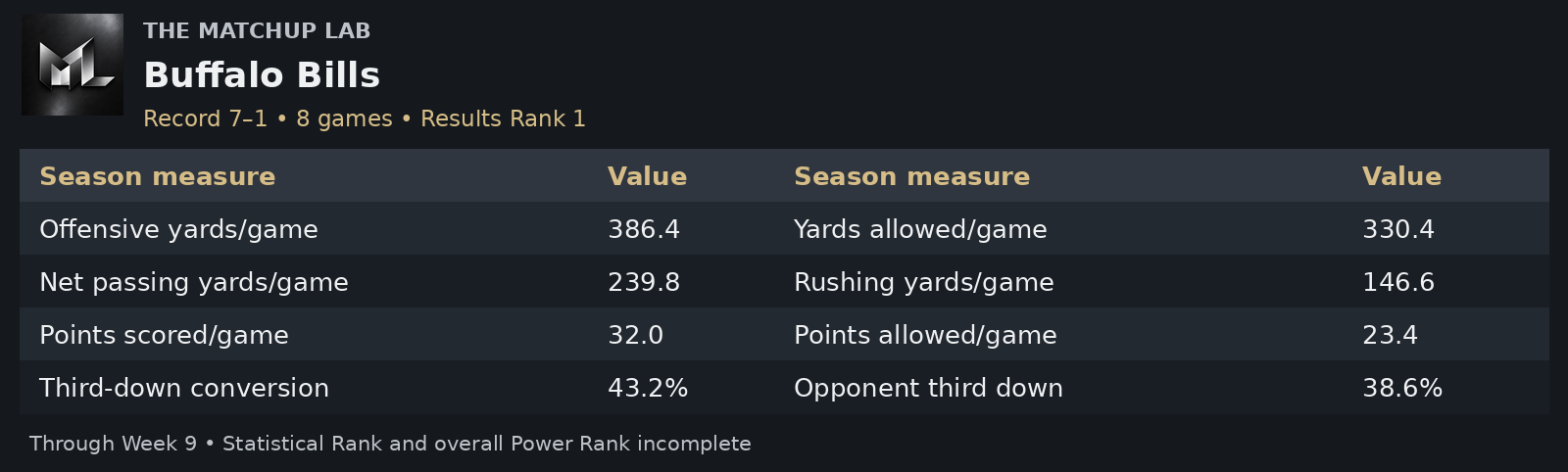
Buffalo's 7–1 season has acquired a more convincing defensive finish to go with its scoring. The Bills followed a 36–10 win over Baltimore with Monday's 23–6 victory over Minnesota, allowing just 16 points across those two games. Their full-season allowance remains 23.4 points per game, so that recent stretch represents improvement rather than a description of every week. An offense averaging 386.4 yards and 32.0 points gives Buffalo room to win in several ways, with 146.6 rushing yards per game providing substantial support for the passing attack.
The next assignment is the Jets, whose opponents convert 42.3 percent of third downs. Buffalo converts 43.2 percent itself, making extended possessions an obvious route to maintaining control. New York's 2–7 record does not remove the need to finish those possessions. The Bills have built a strong position by combining scoring capacity with recent restraint on the other side, and carrying both into another divisional game matters more than chasing a louder score.
San Francisco 49ers
Week 9 win 38–17 against Las Vegas Raiders
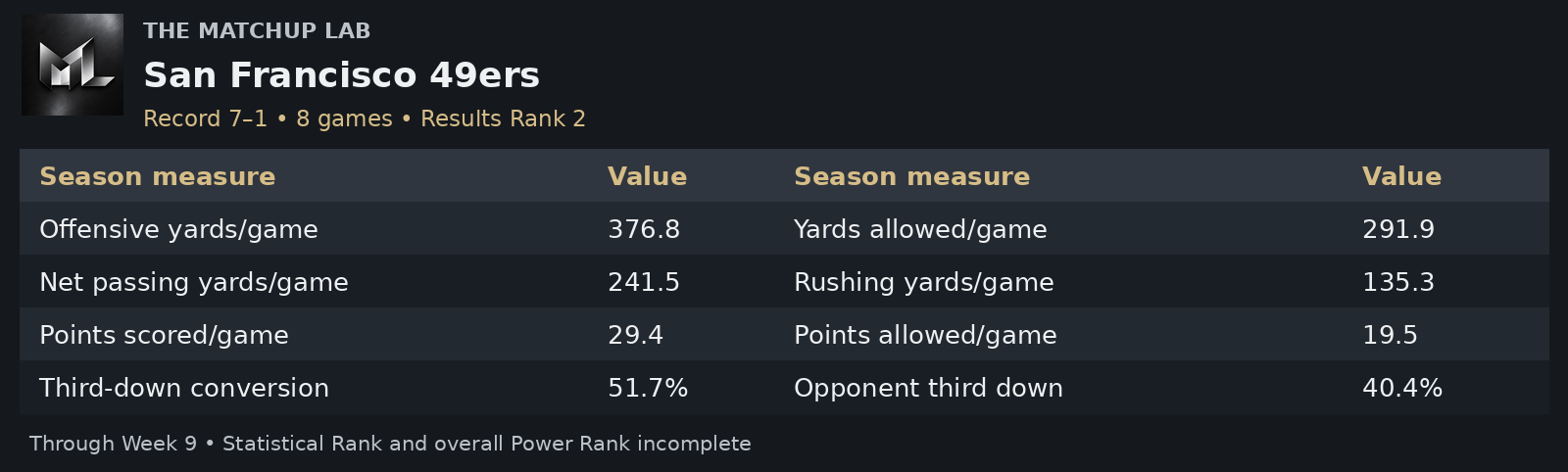
San Francisco returned from its break with a 38–17 win over Las Vegas and moved to 7–1. The shape of the season supports that record. The 49ers average 376.8 yards and 29.4 points while allowing 291.9 yards and 19.5 points. Their 51.7 percent third-down conversion rate gives the offense a strong way to keep possessions alive, and 135.3 rushing yards per game means that production is not confined to the passing totals. The earlier loss to Atlanta still belongs in the assessment, but the response against the Raiders was emphatic.
Dallas offers a particularly relevant next test because its defense allows opponents to convert 48.3 percent of third downs. San Francisco's ability to continue drives should put that weakness under scrutiny. The Cowboys also score 27.3 points per game, so the 49ers cannot evaluate the matchup solely through what their offense might produce. Sustaining possessions and limiting Dallas's scoring chances are complementary tasks, with neither guaranteed by the difference in records.
Chicago Bears
Week 9 win 27–24 against Tampa Bay Buccaneers
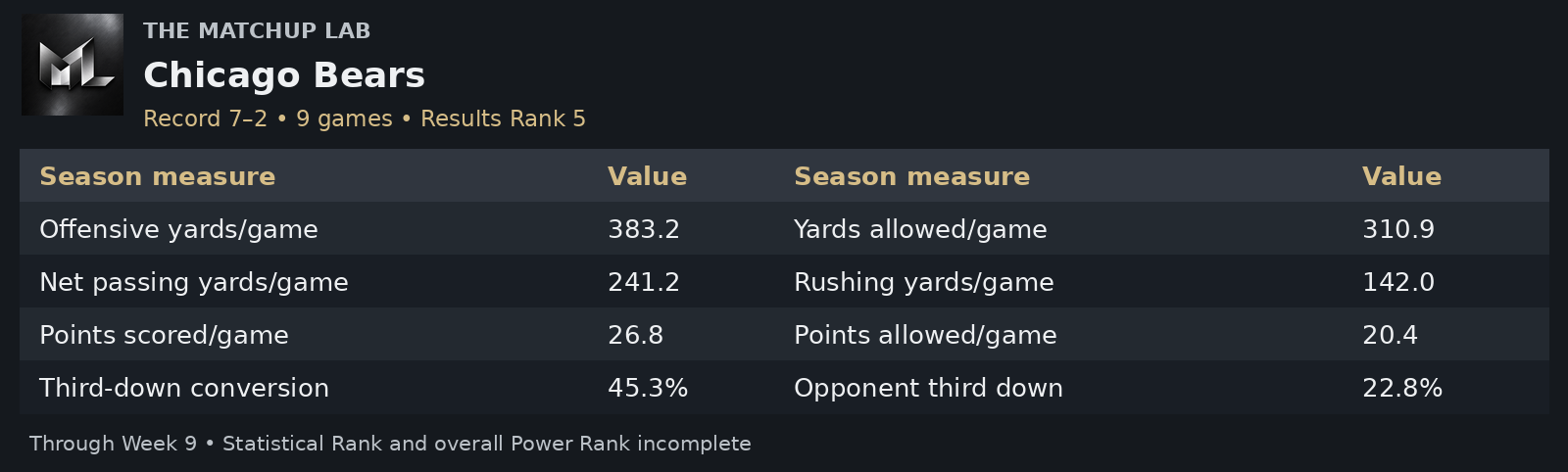
Chicago's 27–24 win over Tampa Bay was tighter than the previous victory over Seattle, but it still moved the Bears to 7–2. Their season has more behind it than a collection of narrow escapes. Chicago averages 383.2 yards, including 142.0 on the ground, and converts 45.3 percent of third downs. The defense allows 310.9 yards per game and has held opponents to a 22.8 percent third-down conversion rate. Those are distinct ways of extending Chicago possessions and ending the other side's, even though they do not make every game comfortable.
Chicago enters its Week 10 break on a four-game winning streak, scoring 30, 34 and 27 points in the latest three. That scoring has been sufficient, but Tampa Bay's 24 points show why the defense still needs attention alongside the celebrations. The useful standard after the break is to preserve the offense's balance while maintaining those third-down stops. Chicago has earned its strong record; keeping opponents away from easy scoring opportunities remains the work that protects it.
Cincinnati Bengals
Week 9 win 34–17 against Atlanta Falcons
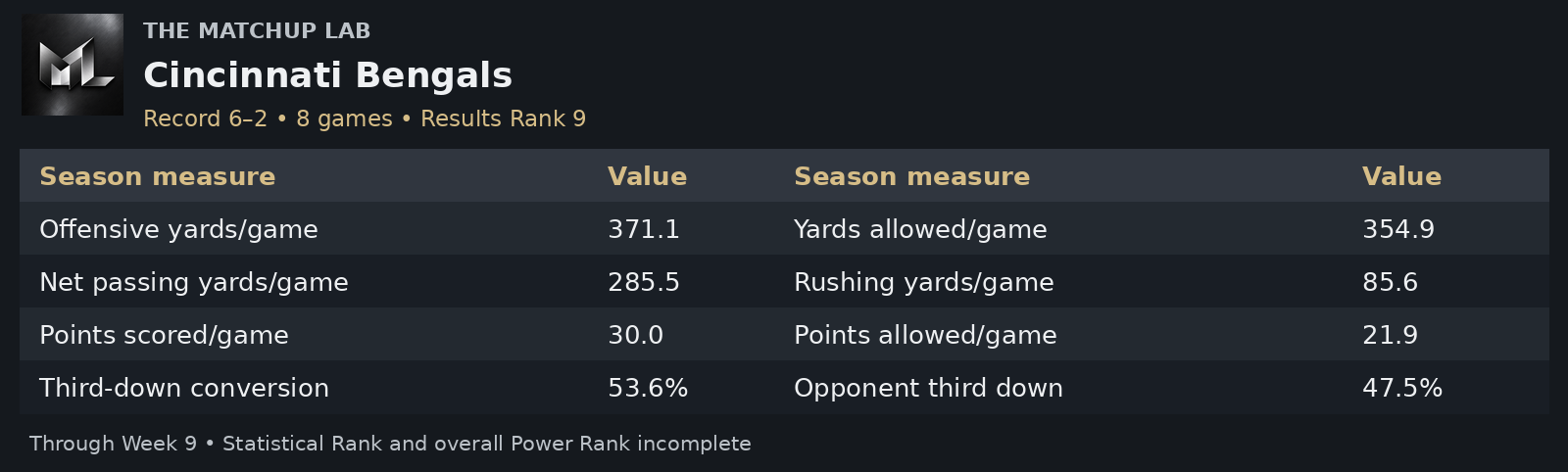
Cincinnati keeps giving itself enough offense to survive very different games. A 34–17 win over Atlanta followed the 43–36 victory over Tennessee, leaving the Bengals 6–2 with a season average of 30.0 points. Passing production of 285.5 yards per game and a 53.6 percent third-down conversion rate explain why defenses struggle to get them off the field. The running total is much smaller at 85.6 yards per game, so Cincinnati's production is concentrated heavily in the passing side of its attack.
The defense supplies the caution. Opponents convert 47.5 percent of third downs, leaving an avenue for a less explosive opponent to stay involved through repeated possessions. Pittsburgh comes next with an allowance of 18.0 points per game and a 34.3 percent opponent conversion rate. That is a useful examination of whether Cincinnati can sustain its scoring against a defense with a stronger season record of getting stops. Matching Pittsburgh's discipline on the other side would reduce the burden on the passing game.
Denver Broncos
Week 9 win 26–21 against Carolina Panthers
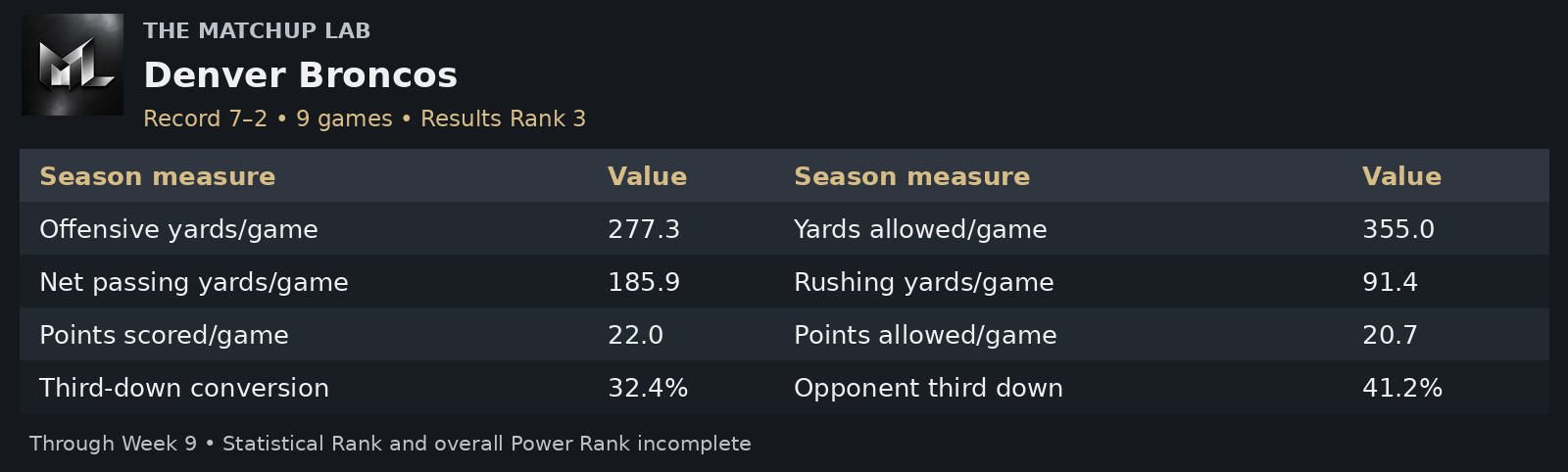
Denver's 26–21 win over Carolina extended a successful run and lifted the Broncos to 7–2, but the season statistics still ask harder questions than the record. Denver gains 277.3 yards per game while allowing 355.0, and its offense converts 32.4 percent of third downs against an opponent rate of 41.2 percent. Those figures describe a team that has not consistently controlled the amount of offense on offer. The scoring gap is narrower and more favorable, with 22.0 points scored and 20.7 allowed per game.
The Broncos enter their Week 10 break after wins over Arizona, Kansas City and Carolina. Those results count fully, and the latest two demonstrate that Denver has been able to come through close games. The next step is to make the offense less dependent on surviving with limited yardage and relatively few third-down conversions. More sustained possessions would give the defense less repeated work. The record supplies confidence; the underlying production supplies a clear list of improvements to pursue during the break.
Detroit Lions
Week 9 win 19–9 against Miami Dolphins
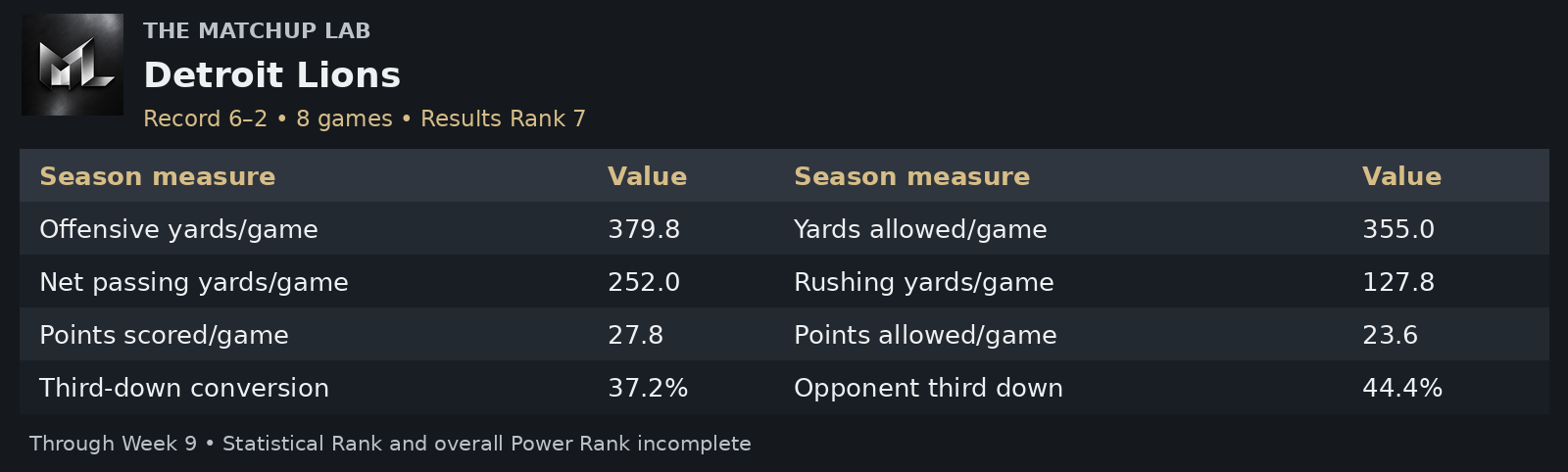
Detroit has reached 6–2 through a recent sequence that looks different from its broad offensive profile. The Lions beat Green Bay 20–17, Minnesota 19–15 and Miami 19–9, winning three games without reaching 21 points. Across the season they still average 379.8 yards and 27.8 points. The latest results therefore show an ability to win when the scoring is more restrained, rather than proving that the offense has become permanently smaller. Miami's nine points made the most recent version considerably less stressful.
New England is next, bringing 369.4 offensive yards per game and a 40.4 percent third-down conversion rate. Detroit allows opponents to convert 44.4 percent, an opening the Patriots can try to exploit even after their heavy loss to Green Bay. The Lions should want their own passing and running production to translate into more scoring while making New England work through fewer successful third downs. Those three wins are part of a four-game streak, but the Lions still have room for a cleaner performance.
Jacksonville Jaguars
Week 9 win 33–10 against Baltimore Ravens
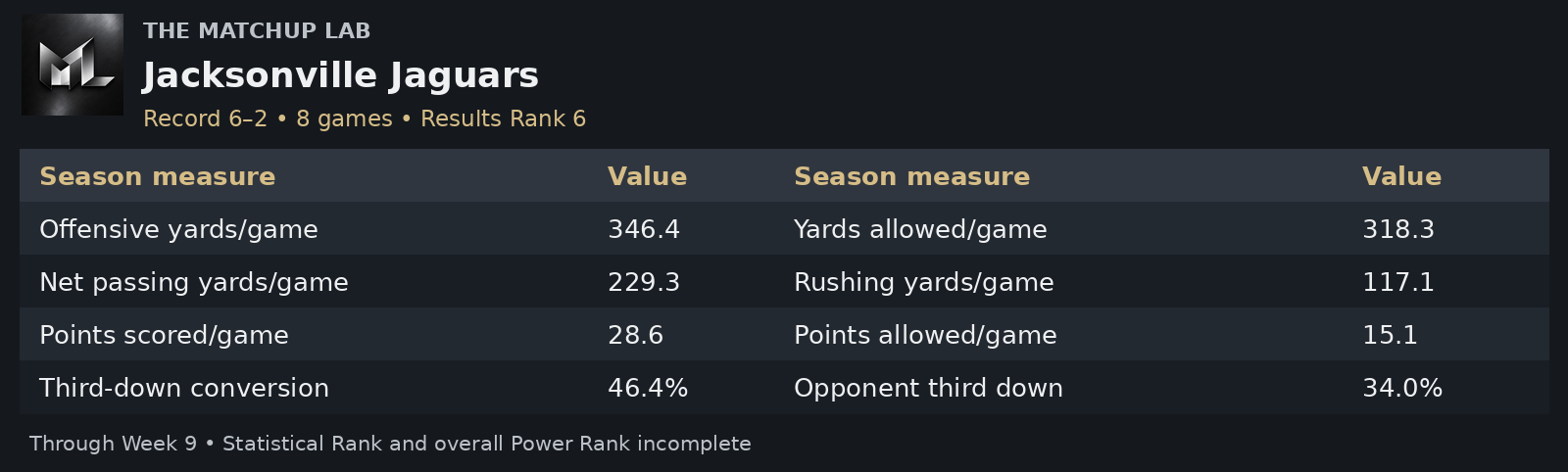
Jacksonville has answered its loss to Houston with two results that leave little ambiguity about the direction of travel. The Jaguars beat Indianapolis 42–7 and Baltimore 33–10, improving to 6–2 while reinforcing a season allowance of just 15.1 points per game. Their offense averages 28.6 points and converts 46.4 percent of third downs. Opponents convert only 34.0 percent. That separation offers a practical basis for staying on offense and ending opposing possessions, an advantage worth preserving even when the latest game is less comfortable.
Tennessee returns from a bye as the next opponent. The Titans allow 382.4 yards per game and have conceded 43.6 percent on third down, which makes Jacksonville's ability to extend drives a clear point of pressure. Tennessee's last game nevertheless produced 36 points, so treating its 1–7 record as an offensive guarantee would be careless. Jacksonville's task is to maintain its defensive standards while taking the opportunities a struggling defense presents, rather than assuming the previous two comfortable wins will repeat themselves.
Kansas City Chiefs
Week 9 win 35–12 against New York Jets
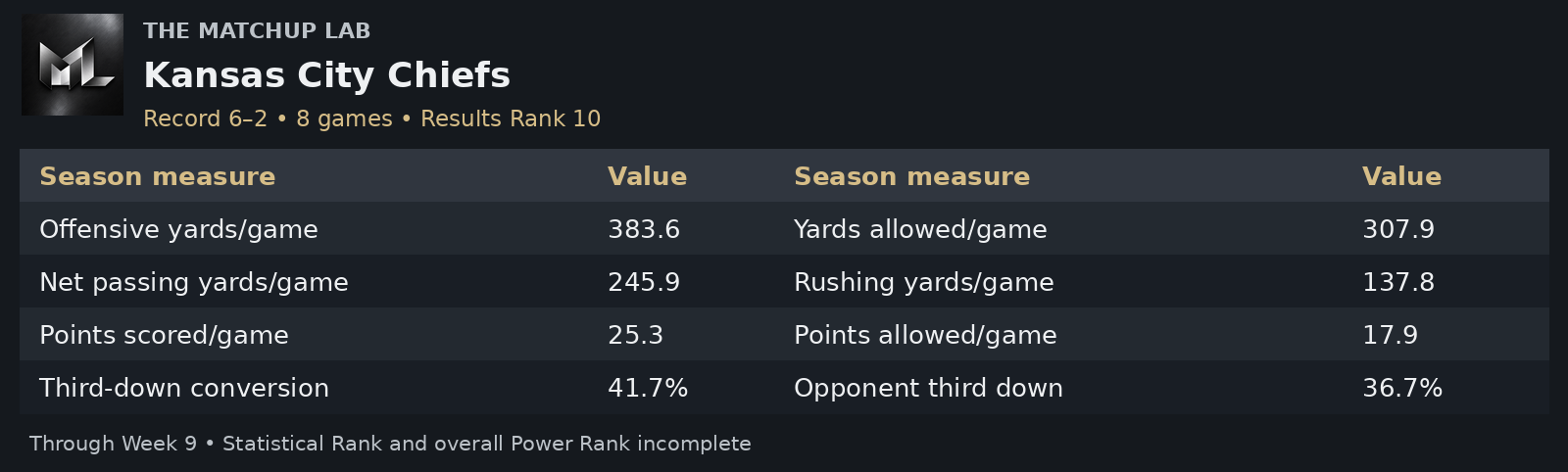
Kansas City needed a stronger response after losses to Seattle and Denver, and the 35–12 win over the Jets supplied one. The Chiefs are 6–2 with a season profile that remains substantial on both sides. Their offense averages 383.6 yards, with 137.8 coming on the ground, while the defense allows 307.9 yards and 17.9 points. The Week 9 result fits that broader defensive record more comfortably than the preceding 28-point allowance against Denver. It also restored scoring after the three-point outing against Seattle two games earlier.
Kansas City brings a larger passing contribution than Atlanta while maintaining a similar rushing output. The Falcons allow a 42.6 percent opponent third-down conversion rate, giving Kansas City an area to test through patient possession as well as bigger gains. Atlanta also ran up 29 points against San Francisco before its recent losses, so dismissing its ceiling would be unwise. The Chiefs should use their range of production to avoid becoming predictable while keeping the defense's improved Week 9 result from becoming a one-game response.
Minnesota Vikings
Week 9 loss 6–23 against Buffalo Bills
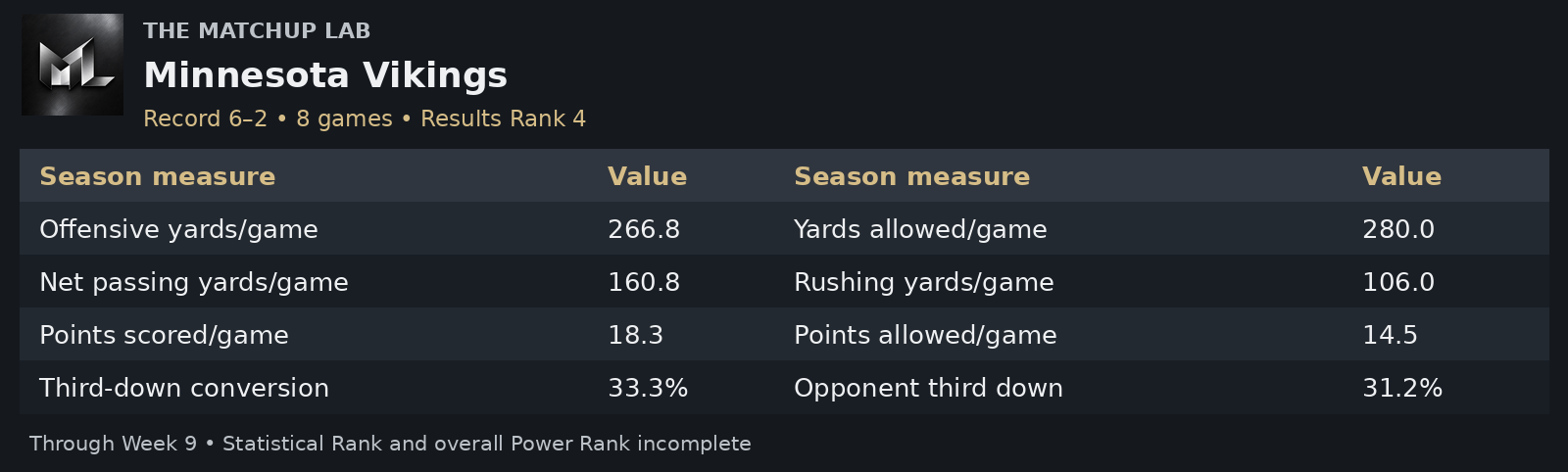
Minnesota's defense has carried considerable weight in a 6–2 start, and the last two games show what happens when the offense gives it too little help. The Vikings lost 19–15 to Detroit and 23–6 to Buffalo. They still allow only 14.5 points and 280.0 yards per game across the season, but their offense produces 18.3 points and 266.8 yards. A 33.3 percent third-down conversion rate leaves too many possessions vulnerable to ending before that defense has been properly rewarded.
Green Bay is next after scoring 45 against New England. The Packers generate 279.7 passing yards per game, giving Minnesota a substantial passing attack to measure against its own 31.2 percent opponent third-down rate. The Vikings need to preserve those stops while asking more from an offense averaging only 160.8 passing yards. Another low-scoring contest might suit their defensive strengths, but it would still require enough offensive production to turn those strengths into a result.
New York Giants
Week 9 win 19–11 against Philadelphia Eagles
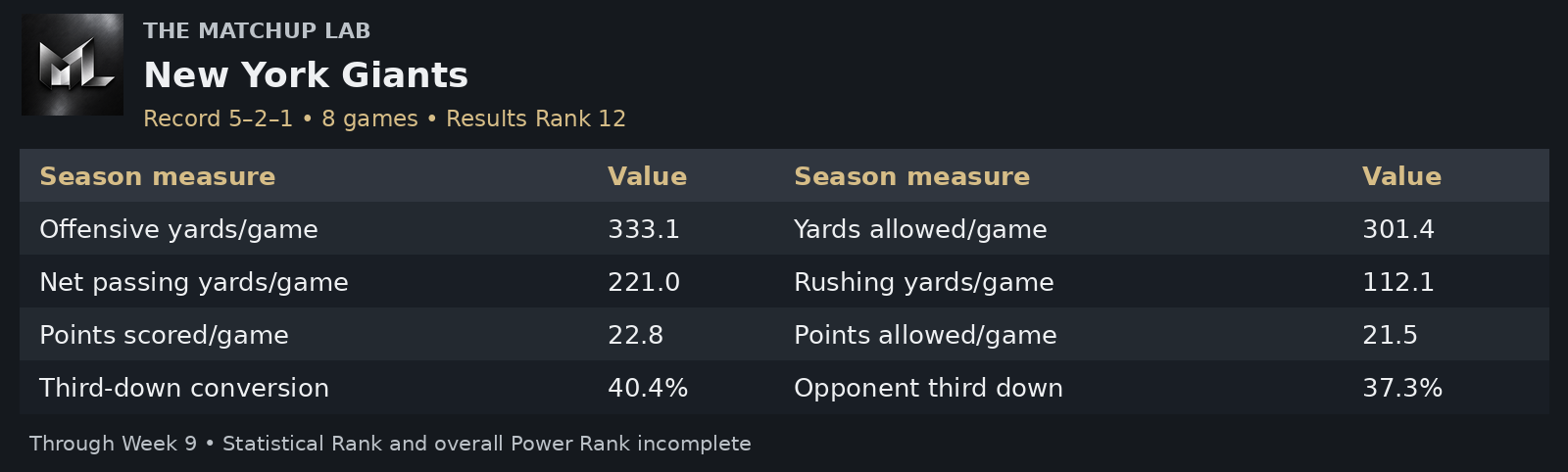
The Giants moved to 5–2–1 by beating Philadelphia 19–11, adding another win to a season built on reasonably controlled games. They allow 301.4 yards per game and opponents convert 37.3 percent of third downs. The offense is less overwhelming than the record might initially suggest, averaging 333.1 yards and 22.8 points against 21.5 points allowed. That modest scoring separation leaves a continued premium on completing possessions and avoiding unnecessary opportunities for the other side. Sunday's eight-point margin was useful, but it did not change that broader requirement.
Washington arrives for Thursday's next assignment with a 31.1 percent offensive third-down conversion rate. The Giants have an opportunity to turn that weakness into short possessions for the Commanders, then make their own 40.4 percent conversion rate count. Washington's tie remains part of its 2–5–1 record, just as New York's does. The Giants can strengthen their position by winning the routine exchanges that their season numbers suggest they are equipped to manage.
Pittsburgh Steelers
Week 9 bye
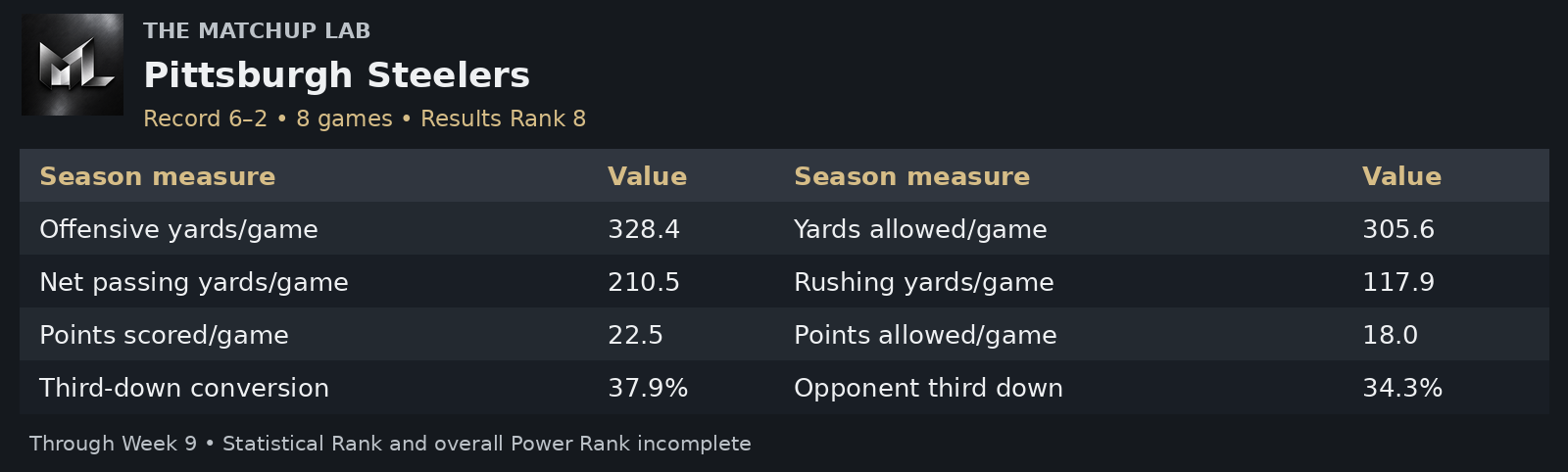
Pittsburgh's Week 9 bye left the Steelers 6–2 with an encouraging three-game sequence behind them. Wins over Tampa Bay, New Orleans and Cleveland ended with a 27–6 result against the Browns. The defense allows 18.0 points and 305.6 yards per game, and its 34.3 percent opponent third-down conversion rate offers a concrete explanation for why those games have been manageable. The offense contributes 22.5 points per game, enough to support that defense without making Pittsburgh a team that needs a high score every week.
Cincinnati will test that arrangement. The Bengals score 30.0 points per game and convert 53.6 percent of third downs, bringing sustained passing production as well as recent wins. Pittsburgh's own 37.9 percent conversion rate leaves room to improve its share of possession. Returning from the bye, the Steelers need to deny Cincinnati repeated chances while extending their own drives. That is a more demanding assignment than simply reproducing the final score from the Cleveland game.
Green Bay Packers
Week 9 win 45–27 against New England Patriots
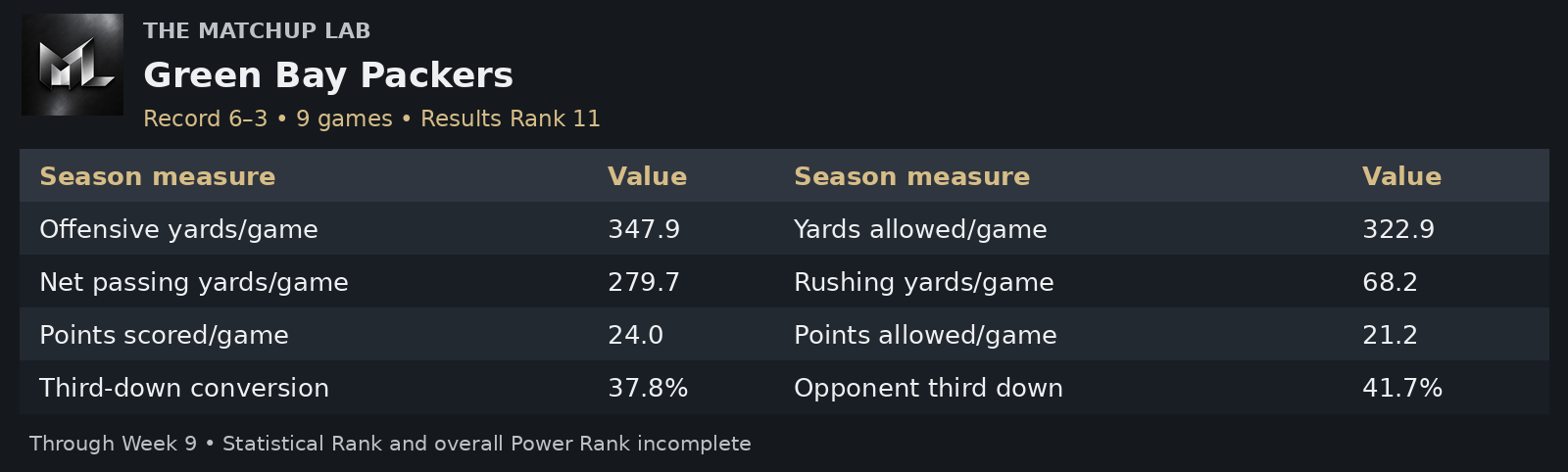
Green Bay's 45–27 win over New England supplied a forceful offensive answer and improved the Packers to 6–3. It also highlighted the area in which their season production is concentrated. Green Bay averages 279.7 passing yards against just 68.2 rushing yards per game. The total offense reaches 347.9 yards, but the ground contribution leaves less balance to fall back on when the passing game faces resistance. Scoring 45 is an excellent result; it does not make that imbalance disappear from the nine-game assessment.
Minnesota brings precisely the kind of defensive record that warrants a closer look. The Vikings allow 14.5 points per game and a 31.2 percent opponent third-down conversion rate. Green Bay converts 37.8 percent, so keeping possessions alive may be more difficult than the previous score suggests. The Packers also need a better defensive finish after allowing New England 27 points. A repeat of Sunday's offensive production would help, but requiring that much scoring each week would be an unnecessarily expensive habit.
Cleveland Browns
Week 9 loss 22–23 against New Orleans Saints
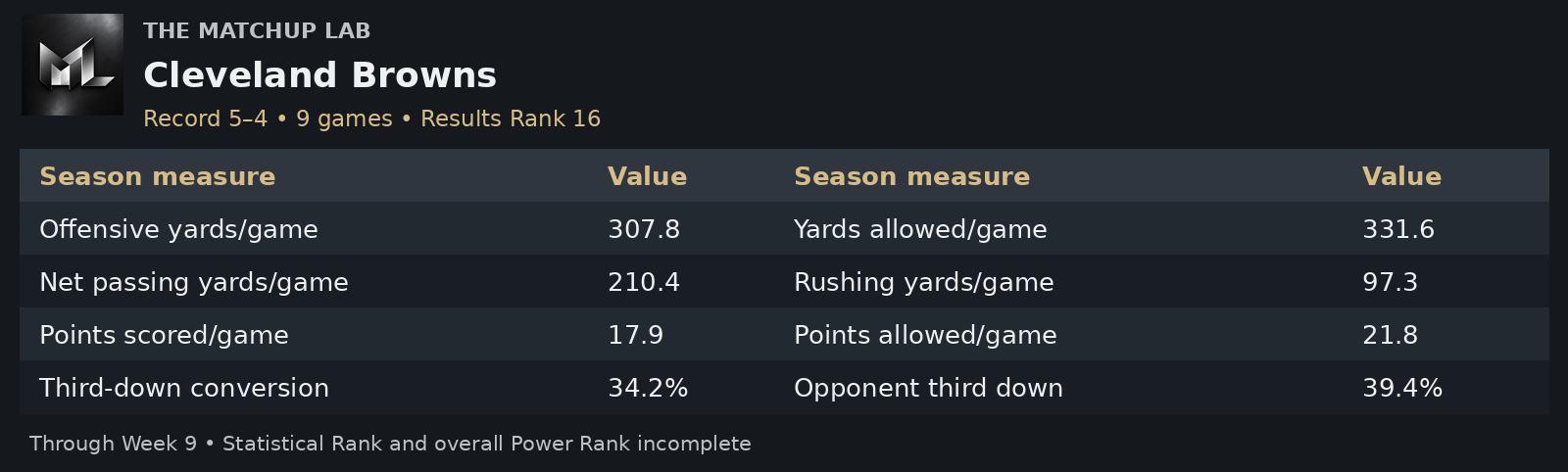
Cleveland remains above .500 at 5–4, although the season's scoring account is much less comfortable. The Browns have scored 161 points and allowed 196. Their 23–22 loss to New Orleans was close, but it followed a 27–6 defeat against Pittsburgh, leaving consecutive losses with very different margins. An offense averaging 307.8 yards and 17.9 points has limited room to waste possessions. Its 34.2 percent third-down conversion rate is an especially clear obstacle to turning occasional productive stretches into enough sustained scoring.
Houston comes next after scoring 44 against the Chargers. The Texans average 269.4 passing yards and 26.1 points per game, so Cleveland cannot plan around another opponent remaining within reach indefinitely. The Browns allow 331.6 yards per game, a defensible total that still needs support from their offense. Improving possession length and scoring returns would ease that burden. The immediate question is whether Cleveland can make its winning record more convincing through the way it plays, rather than relying on the record to explain away the totals.
Los Angeles Rams
Week 9 win 20–13 against Washington Commanders
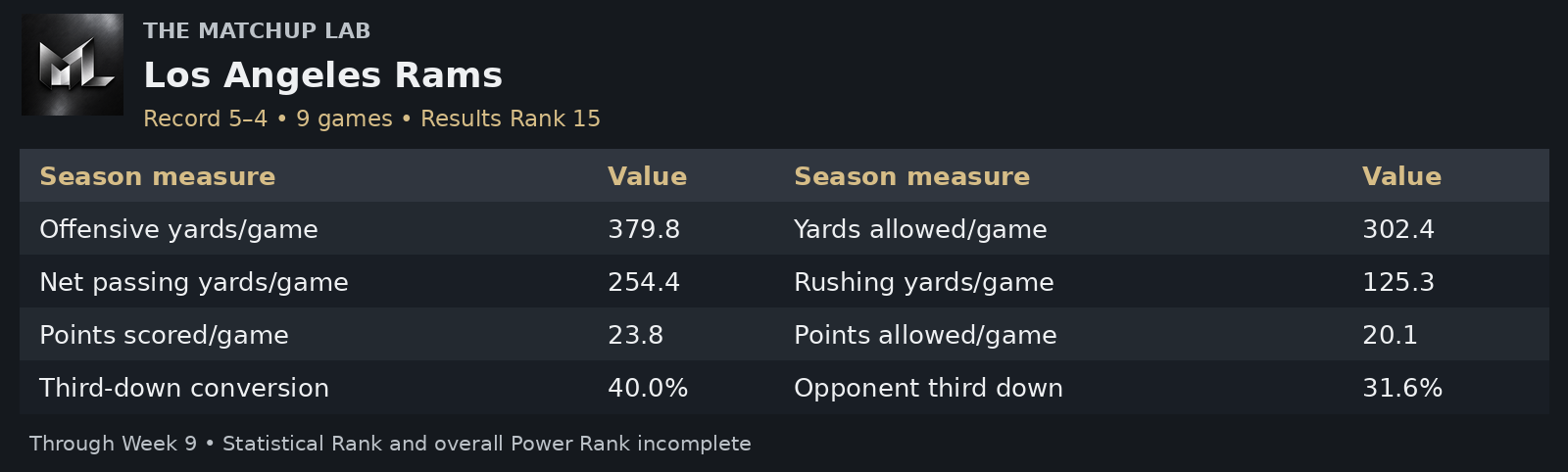
The Rams have moved to 5–4 through three consecutive wins, with Sunday's 20–13 result over Washington following victories against the Raiders and Chargers. Their season offense averages 379.8 yards, combining 254.4 through the air with 125.3 on the ground. That gives Los Angeles a broader base than the latest 20-point score alone conveys. The defense has also supplied a useful foundation, allowing 302.4 yards and 20.1 points per game while restricting opponents to a 31.6 percent third-down conversion rate.
Arizona is the next opponent after scoring three points against Seattle. The Cardinals' season average of 19.8 points gives the Rams an opportunity to continue limiting the scoreboard, provided they maintain their standards beyond one favorable matchup. Los Angeles converts 40.0 percent of its own third downs, and making that advantage count would help turn its yardage into firmer control. The recent wins have corrected the record; the next challenge is to preserve their defensive substance while extracting more scoring from a productive offense.
New England Patriots
Week 9 loss 27–45 against Green Bay Packers
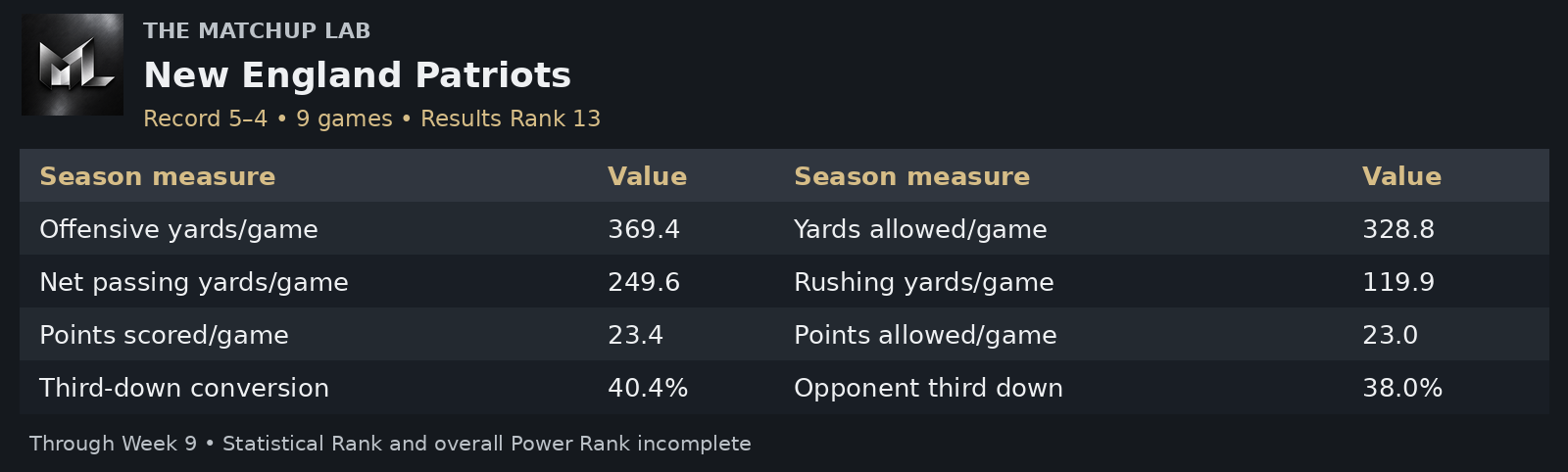
New England's 45–27 loss to Green Bay leaves a 5–4 team with enough offense to remain competitive and a recent defensive result it cannot dismiss. The Patriots average 369.4 yards, including 249.6 passing and 119.9 rushing, while converting 40.4 percent of third downs. Those figures offer a workable foundation. The season scoring averages, however, are almost level at 23.4 for and 23.0 against. Allowing 45 points overwhelmed what was otherwise a useful 27-point offensive contribution and exposed how little protection that narrow overall scoring gap provides.
Detroit is next after three wins with relatively restrained scores. The Lions allow 355.0 yards per game and a 44.4 percent opponent third-down conversion rate, leaving New England a plausible route to longer possessions. That opportunity has to be matched by a better defensive result. The Patriots cannot make an offense of this size responsible for answering every opposing score. Keeping Detroit's passing and running production from becoming a steady sequence of scoring chances is central to a more complete response.
Seattle Seahawks
Week 9 win 17–3 against Arizona Cardinals
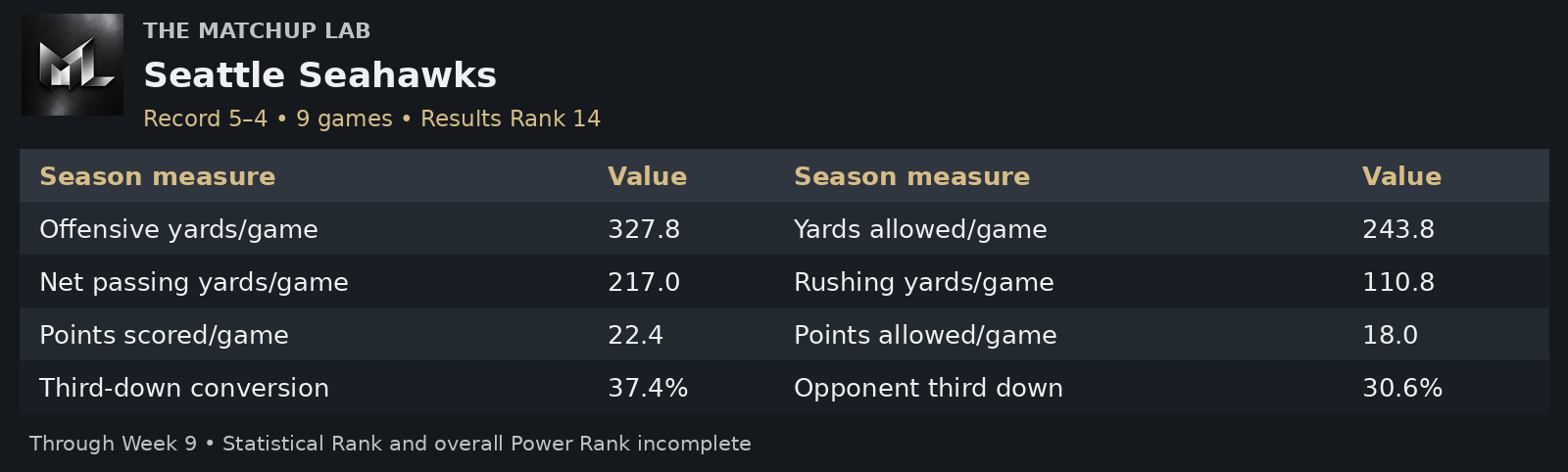
Seattle's defense gives a 5–4 team a substantial argument for optimism, even after an uneven recent sequence. The Seahawks beat Kansas City 20–3, lost 34–17 to Chicago, then held Arizona to three points in a 17–3 win. Across the season they allow 243.8 yards and 18.0 points per game, with opponents converting 30.6 percent of third downs. The Chicago result prevents the recent defensive story from becoming too tidy, but the full-season numbers remain strong evidence of Seattle's ability to restrict opposing offenses.
The next opponent, Las Vegas, allows 385.4 yards and 29.8 points per game. That presents an opportunity for a Seattle offense averaging 327.8 yards and 22.4 points to provide more comfortable support. The Raiders still generate 259.7 passing yards per game, so the defensive assignment is not empty simply because their record is worse. Seattle should be looking for a fuller offensive contribution while carrying its third-down stops into another game, rather than asking the defense to hold everyone to three.
Baltimore Ravens
Week 9 loss 10–33 against Jacksonville Jaguars
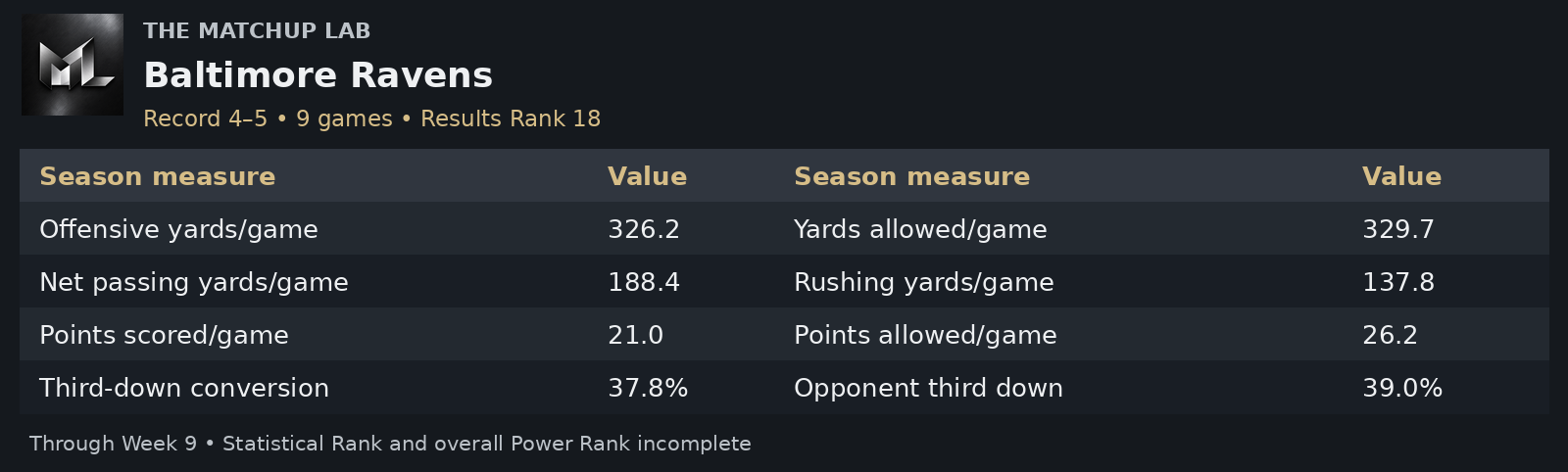
Baltimore's recent problem has become too large to hide inside a 4–5 record. The Ravens have lost to Cincinnati, Buffalo and Jacksonville by a combined 104–33, scoring 13, 10 and 10 points. Their season offense still averages 21.0 points, but the latest stretch falls well below that already modest level. Rushing production of 137.8 yards per game supplies a strength, while 188.4 passing yards leaves a smaller aerial contribution. The defense's 26.2 points allowed per game means Baltimore has not been able to protect the offense while it struggles.
The Chargers come next at 0–8, offering an opportunity without supplying a solution in advance. Los Angeles averages 15.1 points per game but scored 22 in its latest loss, so Baltimore still has to perform the defensive work. Offensively, converting more than its current 37.8 percent of third downs would help turn rushing production into longer possessions. The Ravens need a complete response, rather than simply a more accommodating opponent after three severe defeats.
Carolina Panthers
Week 9 loss 21–26 against Denver Broncos
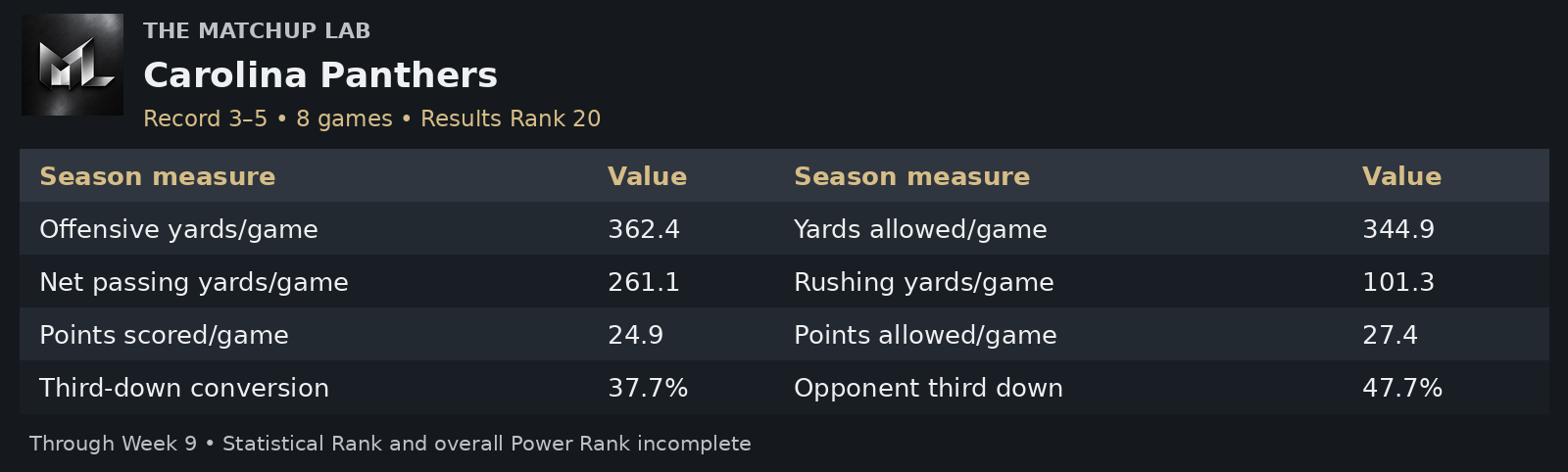
Carolina's last three defeats have narrowed from 30 points against Tampa Bay to eight against Green Bay and five against Denver. Sunday's 26–21 loss was more competitive, but it still left the Panthers 3–5. The offense averages 362.4 yards and 24.9 points, with 261.1 passing yards providing most of its production. The larger concern is what Carolina permits. Opponents score 27.4 points per game and convert 47.7 percent of third downs, giving too many attacks another chance after the defense has nearly ended a possession.
New Orleans presents a matchup between two teams with substantial defensive questions. The Saints allow 370.5 yards per game and a 47.2 percent opponent third-down conversion rate. Carolina has an opening to build possessions, although its own conversion rate is only 37.7 percent. Making better use of that opening would help, but the Panthers also need stops that survive third down. A smaller losing margin is progress of a kind; it still leaves the decisive improvement unfinished.
Dallas Cowboys
Week 9 win 27–23 against Indianapolis Colts
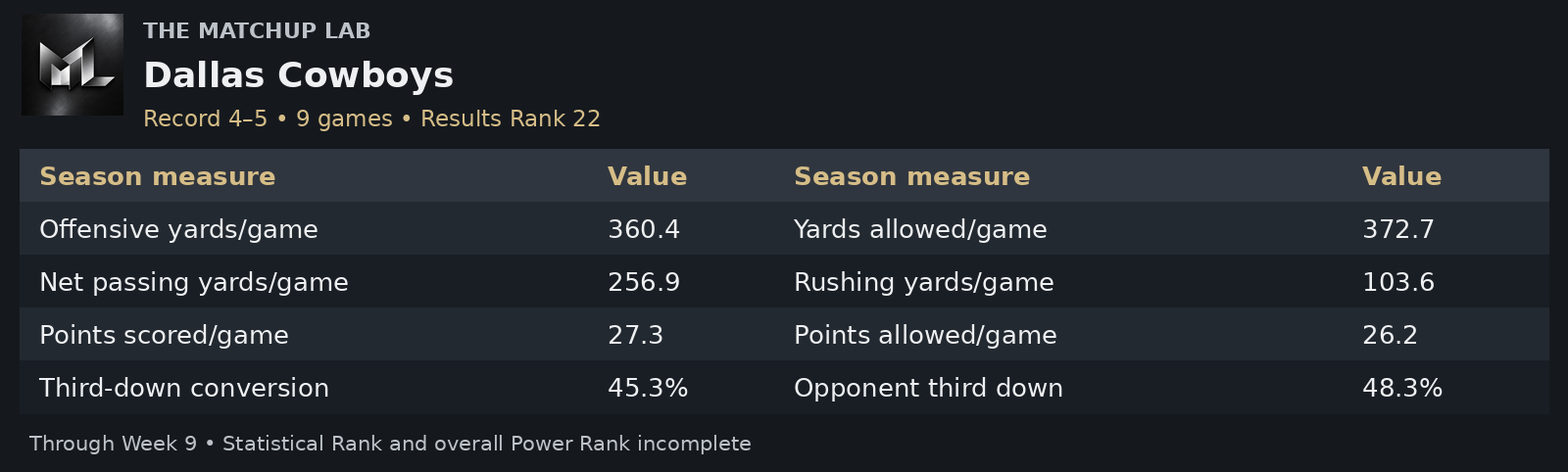
Dallas has enough offense to keep giving itself chances, but a 4–5 record shows how often those chances remain uncomfortable. The Cowboys beat Indianapolis 27–23 after scoring 30 in a loss to Arizona and 38 in a win over Philadelphia. Their season average of 27.3 points is supported by 360.4 yards and a 45.3 percent third-down conversion rate. The defense allows 372.7 yards per game and opponents convert 48.3 percent of third downs. That leaves Dallas asking its offense to answer repeated opportunities rather than enjoy frequent defensive stops.
San Francisco is next with a 51.7 percent third-down conversion rate and 29.4 points per game. That is a direct examination of Dallas's most obvious defensive weakness. The Cowboys should be capable of contributing points themselves, but matching every productive 49ers possession would create another demanding afternoon. Their best route to a more convincing performance is to end drives before the scoreboard requires another response. The Indianapolis win supplied a result; it did not settle that season-long defensive question.
Houston Texans
Week 9 win 44–22 against Los Angeles Chargers
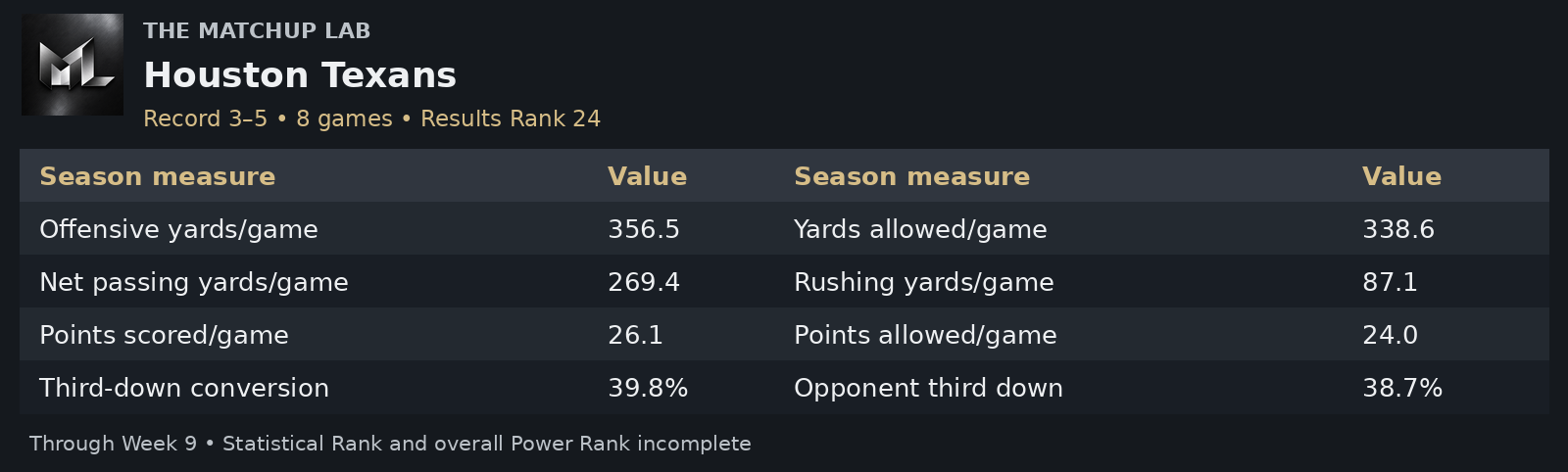
Houston's 44–22 win over the Chargers showed how much scoring the Texans can produce, even though their season record remains 3–5. They average 26.1 points while allowing 24.0, a favorable overall scoring balance that has not translated into more wins than losses. The offense is driven chiefly by 269.4 passing yards per game, alongside 87.1 rushing yards. That combination has produced strong results against Jacksonville and Los Angeles around a 27–21 loss to the Giants, illustrating why one large score cannot describe the whole season.
Cleveland offers a different next assignment. The Browns allow 21.8 points per game and produce only 17.9 themselves, making controlled possessions valuable for Houston on both sides. The Texans convert 39.8 percent of third downs, a rate they can try to improve against a defense allowing 39.4 percent. Sustaining offense without expecting another 44 points would be a useful standard. Houston has demonstrated a scoring ceiling; turning ordinary games into more dependable results is the remaining challenge.
Las Vegas Raiders
Week 9 loss 17–38 against San Francisco 49ers
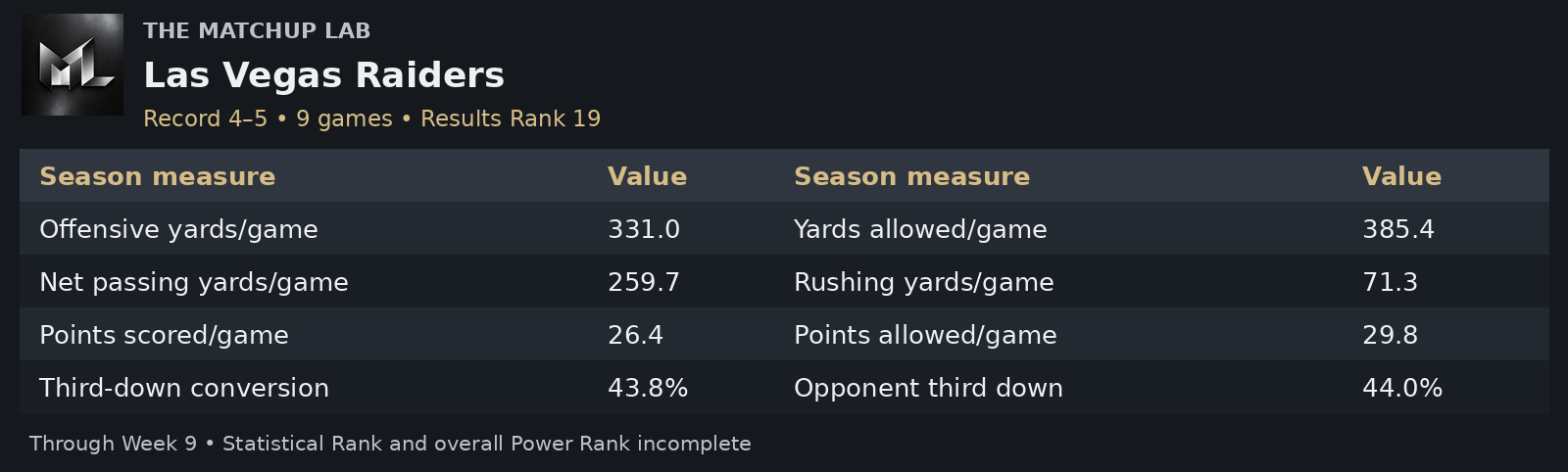
Las Vegas has allowed 35, 33 and 38 points in its last three games, a sequence that puts the burden on an offense already doing considerable work. The 38–17 loss to San Francisco leaves the Raiders 4–5 with 29.8 points and 385.4 yards allowed per game. Their own offense averages 26.4 points, but the production is heavily tilted toward 259.7 passing yards against 71.3 rushing yards. Even useful scoring totals become difficult to defend when the other side keeps receiving productive possessions.
Seattle is an awkward next opponent for a team that may need its passing game to carry the scoring. The Seahawks allow 243.8 yards and 18.0 points per game, and opponents convert just 30.6 percent of third downs. Las Vegas cannot assume its 43.8 percent offensive conversion rate will continue without resistance. The Raiders need to make Seattle work harder for its own points while finding enough offensive variety to keep drives moving. Another high allowance would leave little room for the attack to recover.
New Orleans Saints
Week 9 win 23–22 against Cleveland Browns
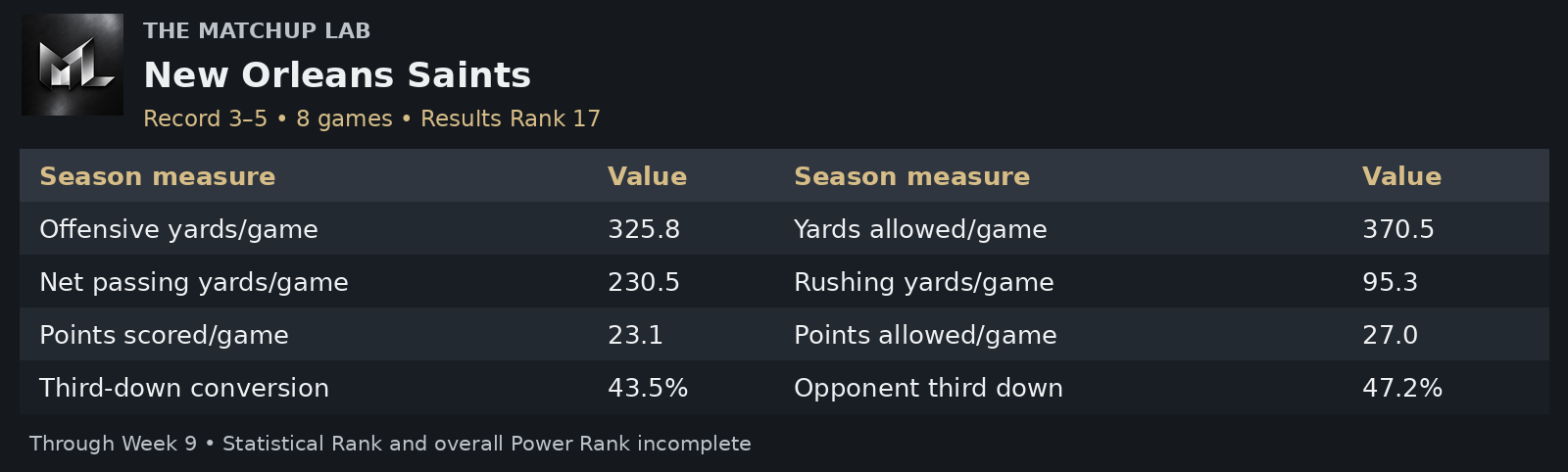
New Orleans returned from its bye with a 23–22 win over Cleveland, a welcome result for a team now 3–5. The narrow margin fits a season in which the offense has had to compensate for substantial defensive allowances. The Saints score 23.1 points per game while conceding 27.0 and 370.5 yards. Their offense converts 43.5 percent of third downs, giving it a useful way to extend possessions, but opponents convert 47.2 percent. Too many third-down chances to end possessions are becoming another set of downs for the opponent.
Carolina brings a similar problem to the next matchup, allowing opponents to convert 47.7 percent of third downs. New Orleans should be able to test that weakness, although the Panthers also generate 362.4 offensive yards per game. The Saints need to make their own sustained drives count while finding stops that do not disappear at the final hurdle. Winning by one against Cleveland was sufficient for the standings. A clearer defensive contribution would make the next result less dependent on such a narrow margin.
Washington Commanders
Week 9 loss 13–20 against Los Angeles Rams
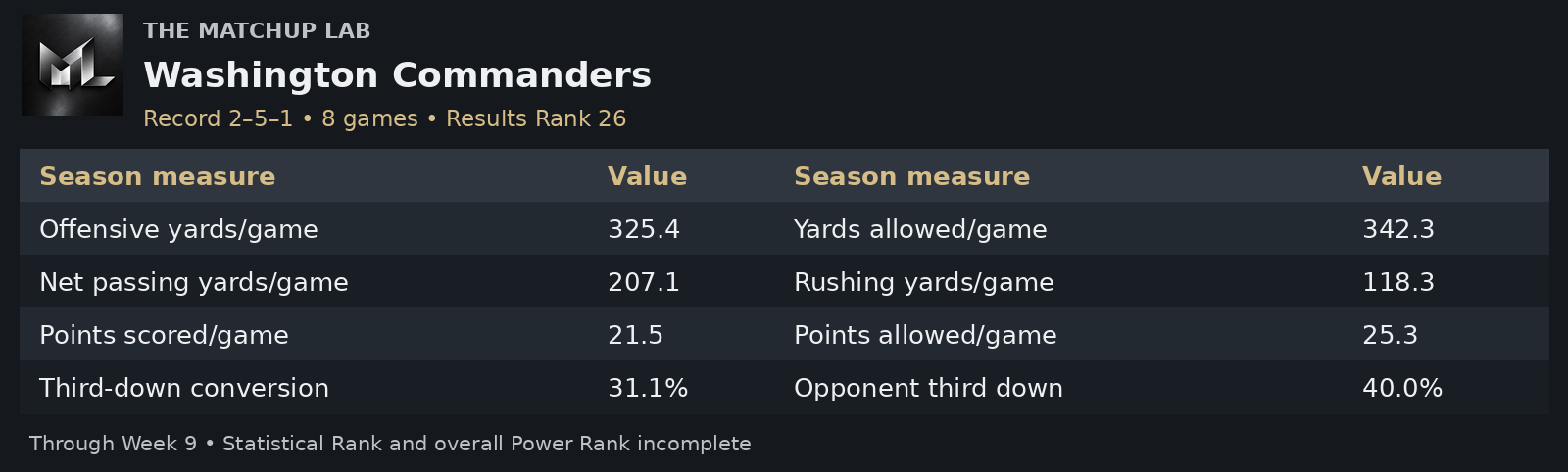
Washington's 20–13 loss to the Rams interrupted the improvement shown in its previous 27–10 win over Philadelphia. The Commanders are 2–5–1, with an offense averaging 325.4 yards and 21.5 points per game. Their 118.3 rushing yards provide useful production, but a 31.1 percent third-down conversion rate makes it difficult to carry enough possessions forward. The defense allows 25.3 points per game, so Washington rarely has the luxury of treating a limited offensive total as an acceptable target.
The quick return against the Giants puts that possession problem under immediate examination. New York allows 301.4 yards per game and a 37.3 percent opponent third-down conversion rate, while its own offense converts 40.4 percent. Washington needs to reduce the number of possessions that end before a scoring chance develops and force the Giants to face the same difficulty. The earlier win over Philadelphia showed a better result was possible. Reproducing that kind of scoreboard requires more sustained work than the Rams game provided.
Arizona Cardinals
Week 9 loss 3–17 against Seattle Seahawks
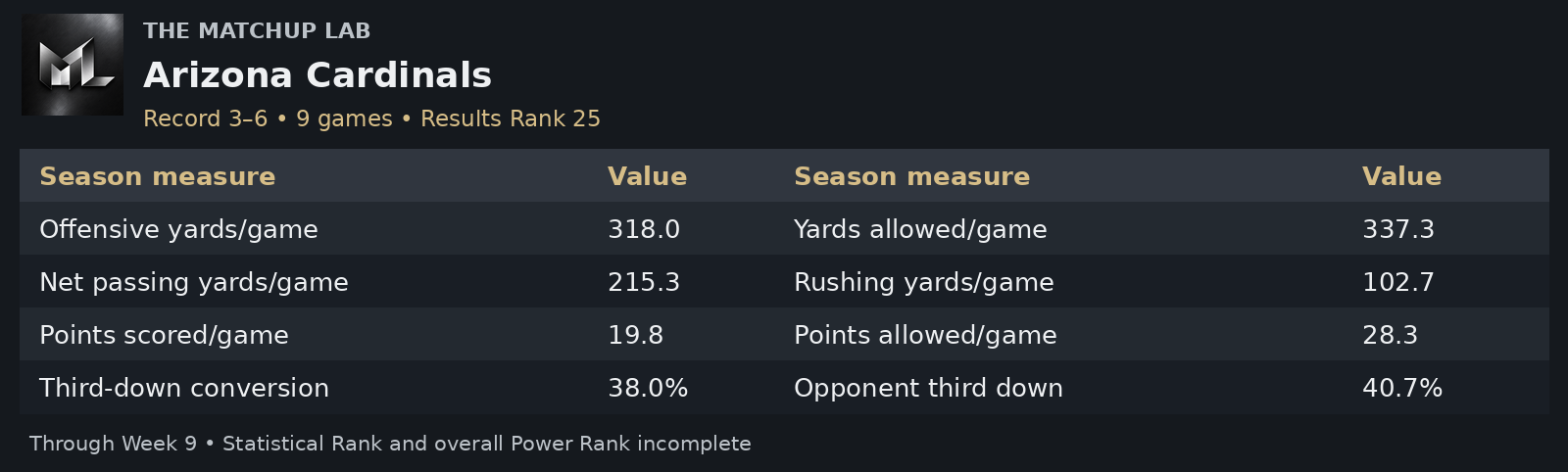
Arizona went from scoring 33 against Dallas to three against Seattle, a sharp reversal that left the Cardinals 3–6. The larger season picture is less flattering than the Dallas win. Arizona averages 318.0 yards and 19.8 points while allowing 28.3 points per game. Its 38.0 percent third-down conversion rate provides some ability to continue possessions, but the offense has not consistently produced enough to offset that scoring burden. The Seattle result was an extreme example of a problem already visible in the season totals.
The Rams arrive next with a defense allowing 302.4 yards per game and a 31.6 percent opponent third-down conversion rate. Arizona needs more sustained offense against that resistance while limiting a Los Angeles attack averaging 379.8 yards. Simply recovering the points missing from the Seattle game would address only part of the task. The Cardinals need both sides to contribute to a more manageable contest, rather than asking an offense below 20 points per game to repair another large defensive allowance.
Atlanta Falcons
Week 9 loss 17–34 against Cincinnati Bengals
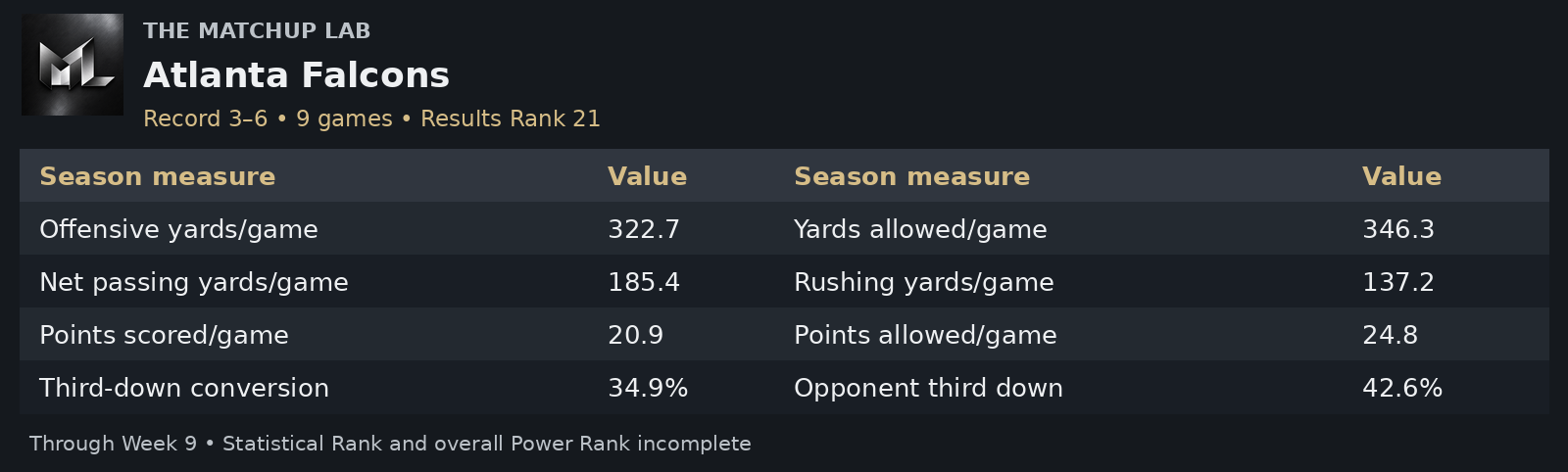
Atlanta's win over San Francisco remains a reminder of what the Falcons can produce, but the two games since have ended in losses of 16–0 and 34–17. At 3–6, they need more than an occasional favorable result to change the season's direction. The running game supplies 137.2 yards per outing, compared with 185.4 passing yards, and the offense converts 34.9 percent of third downs. That leaves too many possessions short of the sustained work required to support a defense allowing 24.8 points per game.
Kansas City is next after a 35-point performance against the Jets. The Chiefs average 383.6 yards and allow 17.9 points per game, presenting a demanding assignment on both sides. Atlanta needs to build on its rushing production without allowing the passing contribution to remain too limited, then improve a defensive third-down allowance of 42.6 percent. The San Francisco result established that the Falcons can compete with a successful opponent. The recent losses establish how much more consistently they need to do it.
Tampa Bay Buccaneers
Week 9 loss 24–27 against Chicago Bears
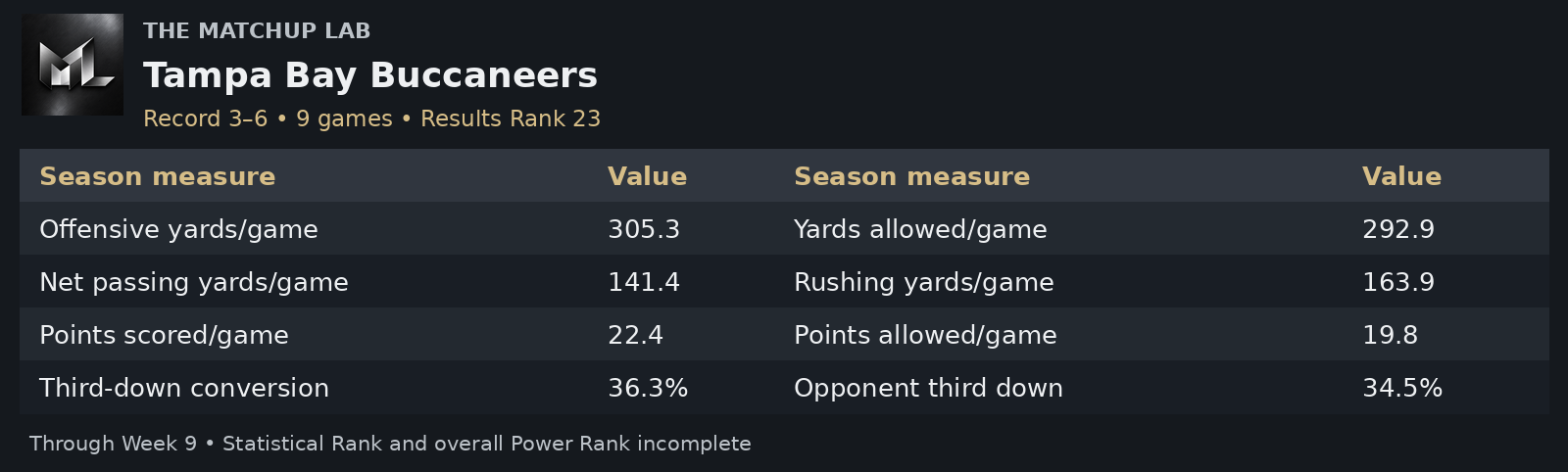
Tampa Bay's 3–6 record sits beside a positive season scoring balance, with 22.4 points scored and 19.8 allowed per game. The 27–24 loss to Chicago shows how that broader balance can coexist with another disappointing result. The Buccaneers had previously beaten Carolina 43–13 and Atlanta 16–0. Their offense remains unusually concentrated on the ground, averaging 163.9 rushing yards against 141.4 passing yards. That strength gives Tampa Bay a clear identity, but the smaller passing contribution leaves less variety when it needs a different route to points.
The Week 10 break offers a chance to work on that limitation without abandoning the productive part of the attack. Tampa Bay's defense allows 292.9 yards per game and a 34.5 percent opponent third-down conversion rate, enough substance to support improvement in results. The offense converts 36.3 percent of its own third downs. Turning more of those possessions into continued opportunities would help the Buccaneers convert a favorable scoring balance into a record that better reflects it.
Indianapolis Colts
Week 9 loss 23–27 against Dallas Cowboys
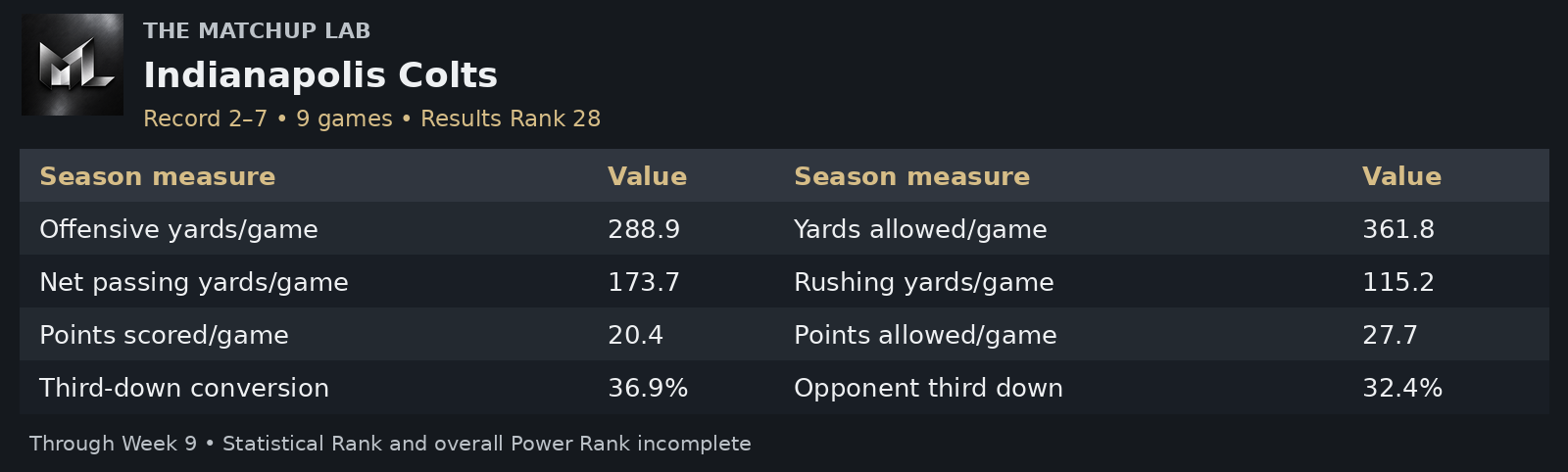
Indianapolis improved its scoring considerably after the 42–7 defeat against Jacksonville, but a 27–23 loss to Dallas still left the Colts 2–7. The season offense averages 288.9 yards and 20.4 points, with 173.7 passing yards limiting the overall reach of the attack. Defensively, Indianapolis allows 361.8 yards and 27.7 points per game despite holding opponents to a 32.4 percent third-down conversion rate. Success in that particular situation has not produced equivalent protection across the full game, and the scoring allowance remains a substantial burden.
Miami is next with an offense averaging 15.8 points per game, giving Indianapolis an opportunity to establish a more controlled defensive result. The Dolphins also allow opponents to convert 47.4 percent of third downs. That offers the Colts a way to improve on their own 36.9 percent conversion rate and extend possessions. The Dallas game showed a better offensive return than the previous week. Indianapolis now needs improvement that changes the result as well as the appearance of the score.
Miami Dolphins
Week 9 loss 9–19 against Detroit Lions
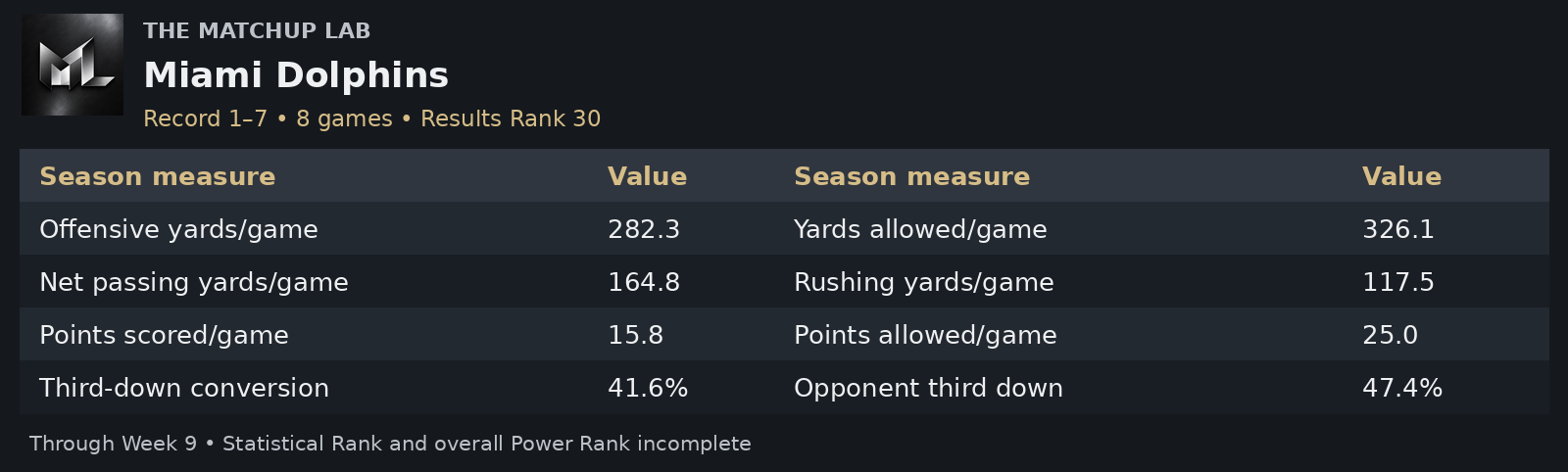
Miami's scoring has fallen from 28 in its win over the Jets to 19 against New England and nine against Detroit. The Dolphins are 1–7, averaging 282.3 yards and 15.8 points per game. Their 41.6 percent third-down conversion rate shows that the offense can extend some possessions, but the overall return remains too small. Passing production of 164.8 yards per game leaves limited support alongside 117.5 rushing yards. The defense allows 25.0 points, making the gap between what Miami needs and what it scores difficult to ignore.
Indianapolis presents another struggling opponent, but its 32.4 percent opponent third-down conversion rate challenges one of Miami's more useful offensive measures. The Dolphins need to generate production without assuming those conversions will remain available. On defense, their own 47.4 percent third-down allowance gives the Colts an obvious area to attack. A better result requires Miami to shorten opposing possessions and earn more from its own, with the recent nine-point total offering little room to debate that priority.
New York Jets
Week 9 loss 12–35 against Kansas City Chiefs
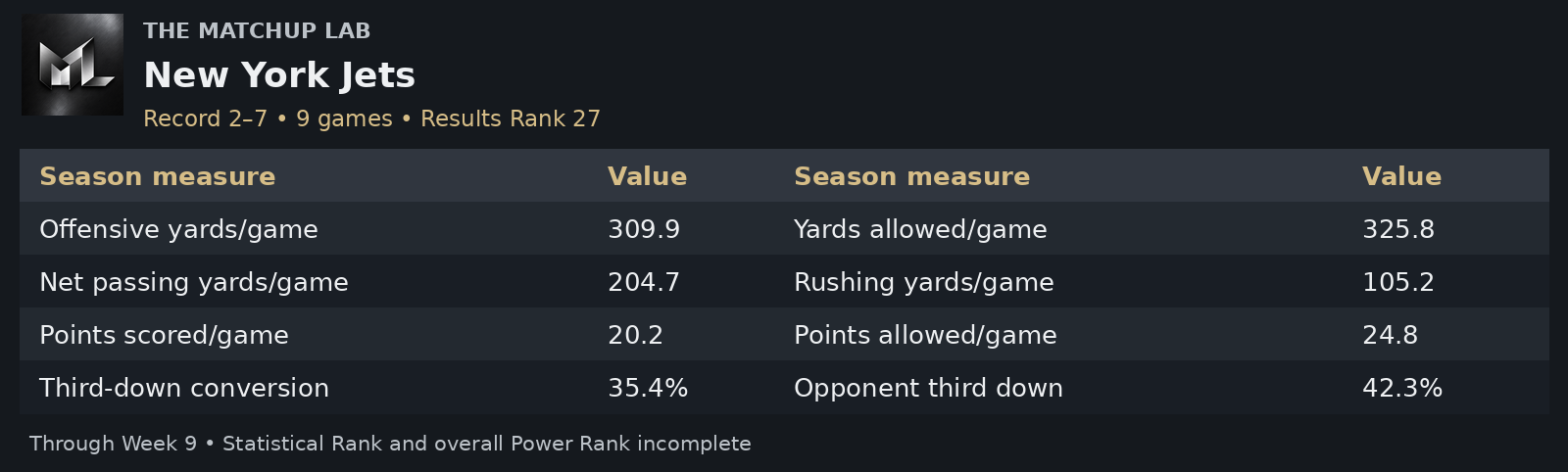
The Jets have lost four straight games. The latest three brought 25 points against Miami, 33 against Las Vegas and a 35–12 defeat against Kansas City. Their 2–7 record reflects problems beyond one bad offensive afternoon. New York averages 309.9 yards and 20.2 points while allowing 24.8 points per game. A 35.4 percent third-down conversion rate limits the offense's ability to keep working, and opponents convert 42.3 percent. That difference repeatedly puts the Jets on the wrong side of the possession exchange.
Buffalo is next at 7–1, averaging 386.4 yards and 32.0 points. The Jets therefore need a response on both sides, rather than counting on a modest improvement from the latest 12-point score to be sufficient. Keeping Buffalo from extending drives would reduce the number of scoring opportunities New York has to answer. The offense also needs its passing and rushing production to lead to more continued possessions. Competing with the Bills begins with those routine demands before any larger upset argument can become credible.
Philadelphia Eagles
Week 9 loss 11–19 against New York Giants
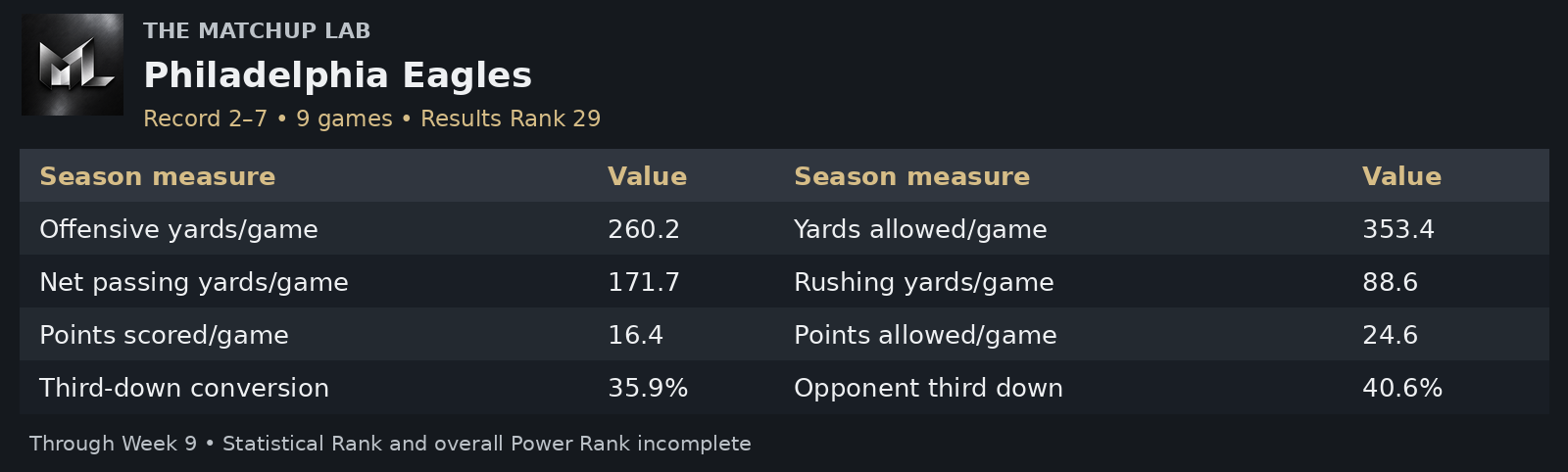
Philadelphia has lost seven straight games, with the latest three defeats coming against division opponents. Sunday's 19–11 loss to the Giants followed defeats against Dallas and Washington. The Eagles are 2–7 and have scored only 16.4 points per game. Their offensive production is limited through both routes, averaging 171.7 passing yards and 88.6 rushing yards for a total of 260.2. A 35.9 percent third-down conversion rate makes it difficult to sustain enough possessions to compensate. The latest defensive allowance was more manageable, but 11 points left that improvement without a useful result.
The Eagles are off in Week 10 with a season defensive allowance of 353.4 yards and 24.6 points per game. There is work on that side as well, although the offense remains the clearest immediate obstacle. More productive possessions would reduce the demand for the defense to manufacture a low-scoring contest every week. The break provides time to address a problem repeated across several games. It does not turn the Giants loss into a satisfactory defensive outcome by itself.
Tennessee Titans
Week 9 bye
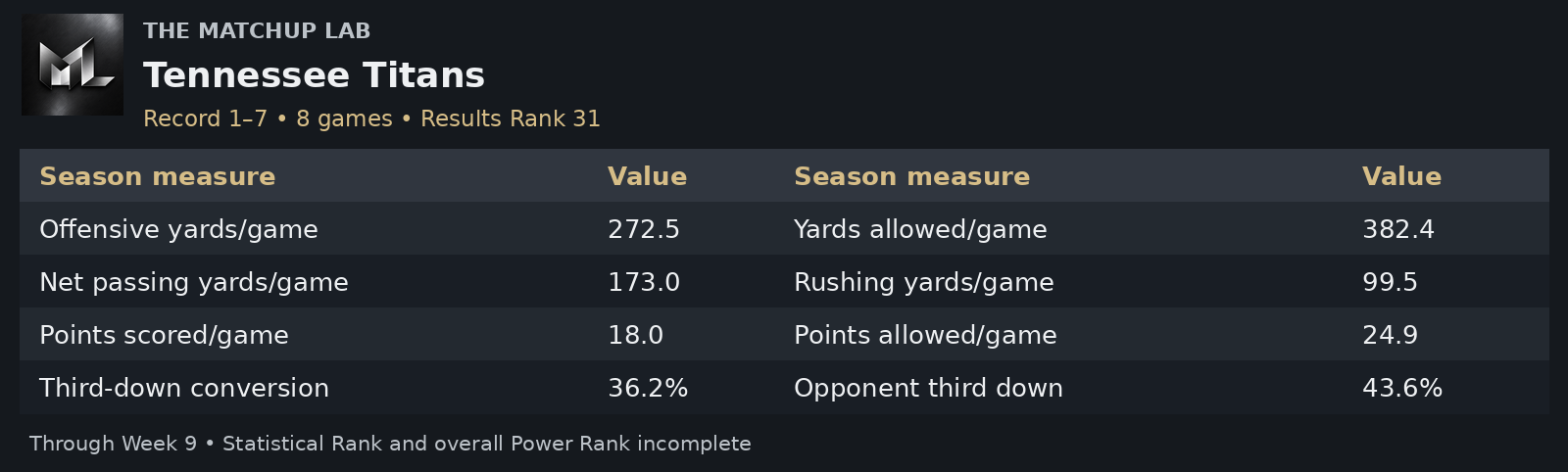
Tennessee returns from its Week 9 bye at 1–7, carrying an unusual final result into the break. The Titans scored 36 against Cincinnati and still lost by seven. That scoring output was twice their season average of 18.0 points per game, making it an encouraging offensive example without establishing a new weekly expectation. Across the season Tennessee gains 272.5 yards and allows 382.4. The defense's 43.6 percent opponent third-down conversion rate gives opposing offenses repeated chances to stretch that gap.
Jacksonville brings a much more restrictive defensive record to the next matchup, allowing 15.1 points per game while scoring 28.6. Tennessee cannot simply budget for another 36 points against that opponent. Improving its own 36.2 percent third-down conversion rate would help, as would reducing the continued possessions it permits Jacksonville. The Jaguars have scored 42 and 33 in their latest two games. The Titans need their offensive improvement to survive stronger resistance and their defense to keep the task within a manageable range.
Los Angeles Chargers
Week 9 loss 22–44 against Houston Texans
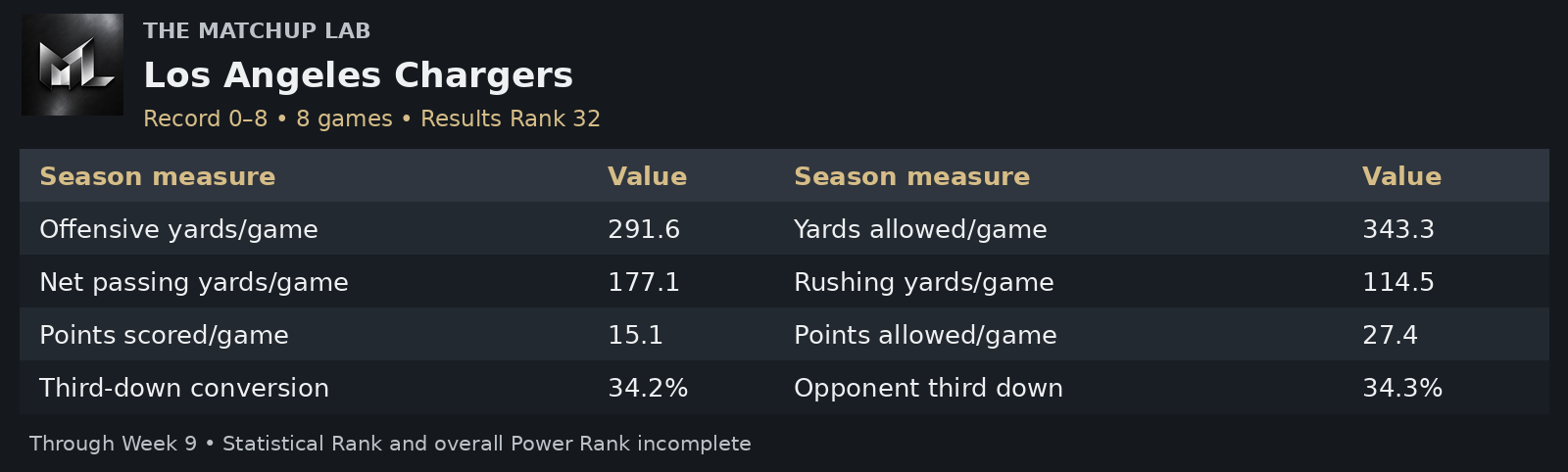
The Chargers scored more against Houston than in their previous two games combined, yet the 44–22 defeat left them 0–8. That is the difficulty of improving only one part of a struggling team. Los Angeles averages 15.1 points and 291.6 yards per game while allowing 27.4 points. Its 34.2 percent third-down conversion rate limits offensive persistence. The defense's 34.3 percent opponent conversion rate is a more encouraging individual measure, but it has not prevented too much scoring across complete games, particularly in the latest loss.
Baltimore is next after three heavy defeats of its own. The Ravens have scored 13, 10 and 10 in that sequence, offering the Chargers a chance to improve their defensive result against an offense currently struggling for points. Los Angeles still has to produce more of its own. Rushing output of 114.5 yards per game provides something to build from, but the passing contribution is only 177.1. Turning both into sustained possessions is a practical place to begin the search for a first win.