
THE MATCHUP LAB · NFL
Game Center
Scores, statistics and the story behind the game.
Checking for updates…
Complete NFL Week 9 recap and all 32 team assessments
Week 9 win 19–11 against Philadelphia Eagles
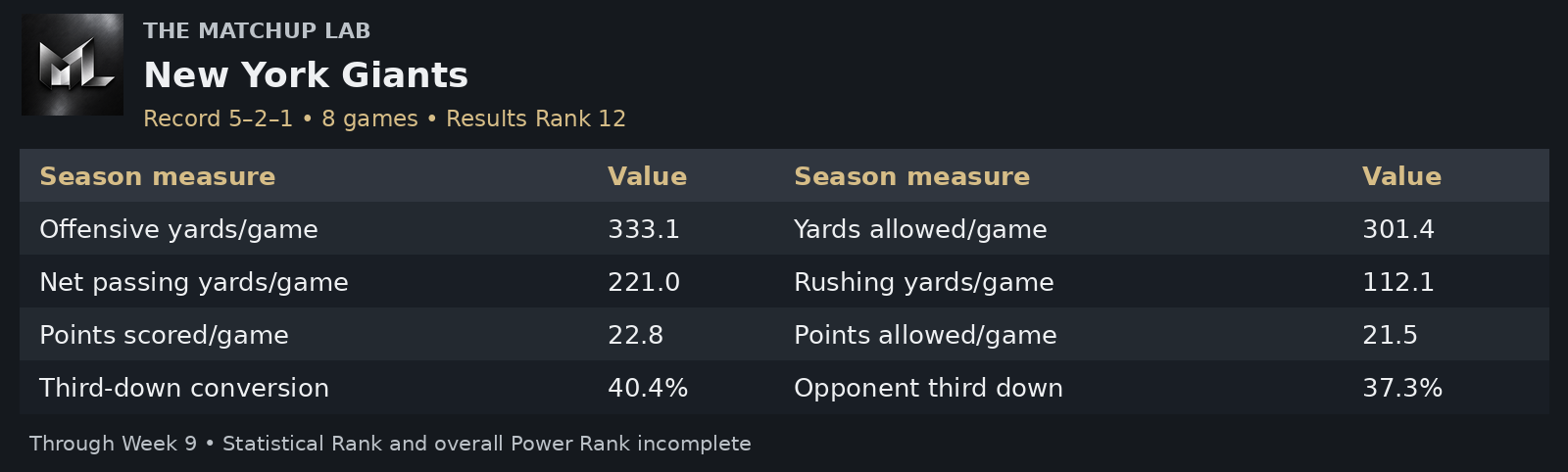
The Giants moved to 5–2–1 by beating Philadelphia 19–11, adding another win to a season built on reasonably controlled games. They allow 301.4 yards per game and opponents convert 37.3 percent of third downs. The offense is less overwhelming than the record might initially suggest, averaging 333.1 yards and 22.8 points against 21.5 points allowed. That modest scoring separation leaves a continued premium on completing possessions and avoiding unnecessary opportunities for the other side. Sunday's eight-point margin was useful, but it did not change that broader requirement.
Washington arrives for Thursday's next assignment with a 31.1 percent offensive third-down conversion rate. The Giants have an opportunity to turn that weakness into short possessions for the Commanders, then make their own 40.4 percent conversion rate count. Washington's tie remains part of its 2–5–1 record, just as New York's does. The Giants can strengthen their position by winning the routine exchanges that their season numbers suggest they are equipped to manage.
Week 9 loss 11–19 against New York Giants
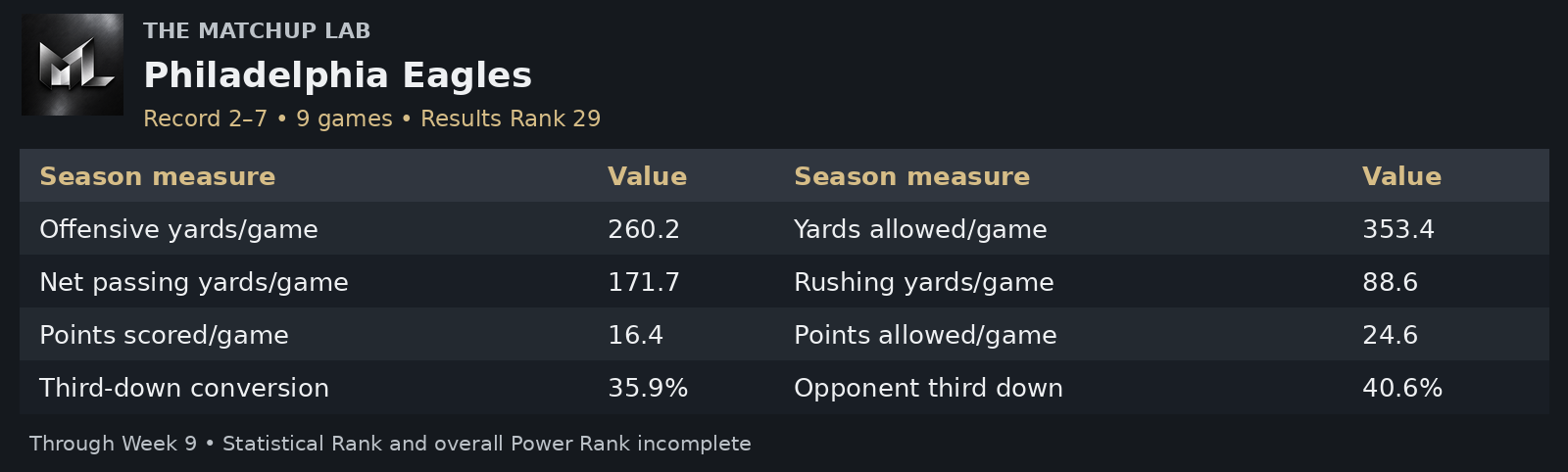
Philadelphia has lost seven straight games, with the latest three defeats coming against division opponents. Sunday's 19–11 loss to the Giants followed defeats against Dallas and Washington. The Eagles are 2–7 and have scored only 16.4 points per game. Their offensive production is limited through both routes, averaging 171.7 passing yards and 88.6 rushing yards for a total of 260.2. A 35.9 percent third-down conversion rate makes it difficult to sustain enough possessions to compensate. The latest defensive allowance was more manageable, but 11 points left that improvement without a useful result.
The Eagles are off in Week 10 with a season defensive allowance of 353.4 yards and 24.6 points per game. There is work on that side as well, although the offense remains the clearest immediate obstacle. More productive possessions would reduce the demand for the defense to manufacture a low-scoring contest every week. The break provides time to address a problem repeated across several games. It does not turn the Giants loss into a satisfactory defensive outcome by itself.
The Giants' 19–11 win at Philadelphia improved their record to 5–2–1 and left the Eagles 2–7. New York allows 301.4 yards per game while producing 333.1, a healthier season balance than this modest scoring total alone might suggest. Philadelphia's offensive problem is more pronounced. Its offense produces 260.2 yards and 16.4 points per game, including 88.6 rushing yards. Eleven points against a division opponent reinforced that weakness. The Giants earned another result with restrained scoring, while Philadelphia needs a much more reliable offensive contribution to change its trajectory.
Complete NFL Week 8 recap and all 32 team assessments
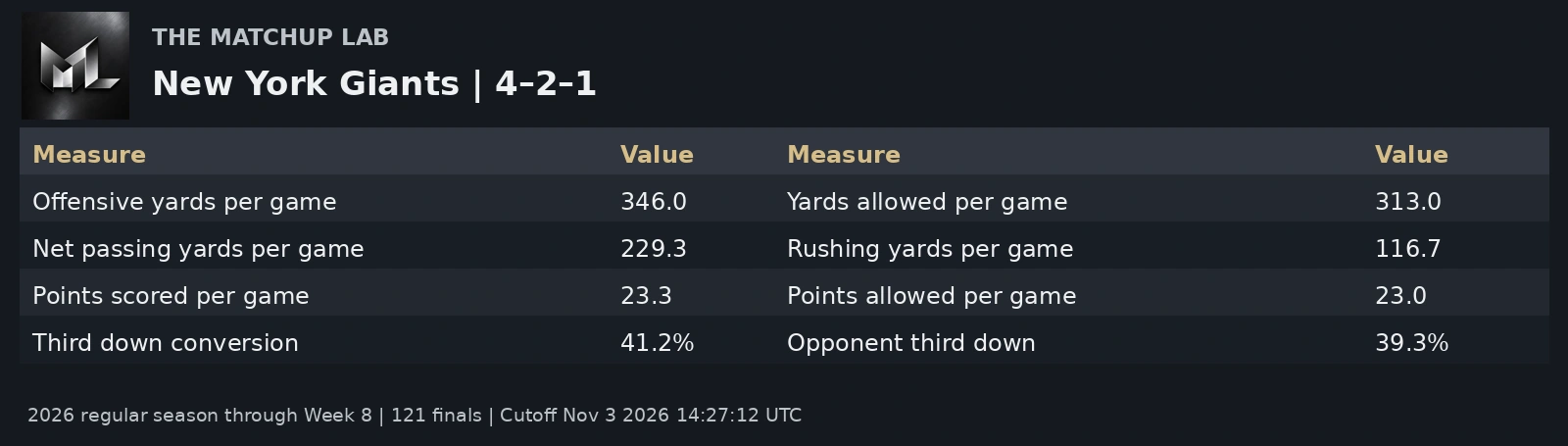
The Giants return from their bye at 4–2–1, with a two-point season scoring advantage that argues for a measured reading of the record. They average 346.0 yards and allow 313.0, a more encouraging territorial balance than the near-even scoring totals. Their offense converts 41.2% of third downs; opponents convert 39.3%. New York has useful ingredients for control, but its 23.3 points a game have not created much separation from 23.0 conceded. The tie remains a tie, and the record should not disguise how narrow the aggregate margins are.
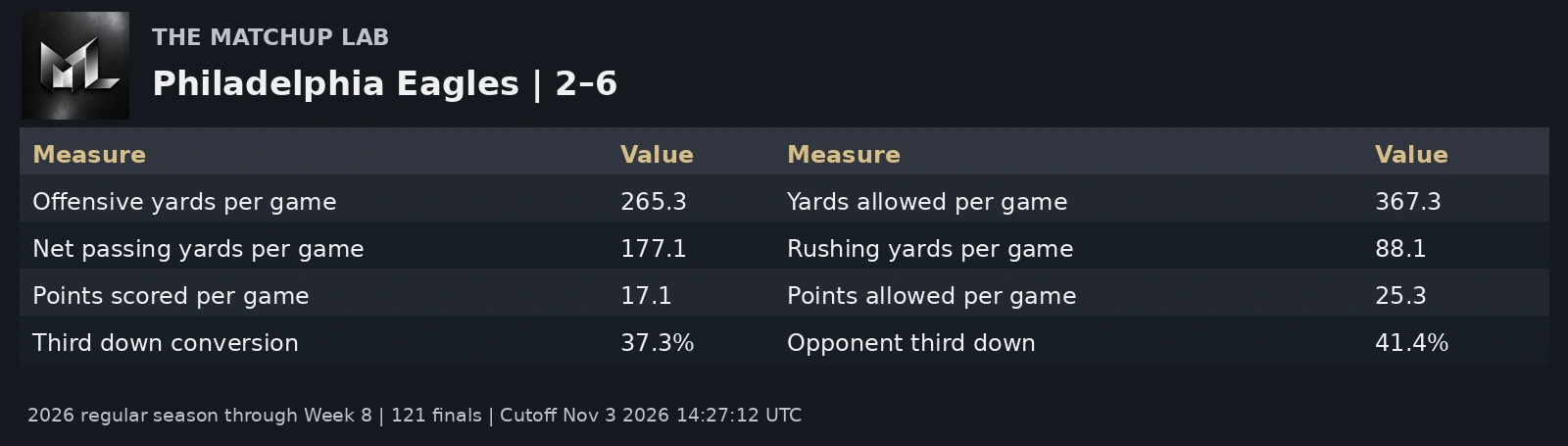
Philadelphia’s 27–10 loss at Washington left the Eagles 2–6 and reinforced an offensive shortfall that extends through the season. They average 265.3 yards and 17.1 points, with only 88.1 rushing yards a game. Third downs provide no escape route: the offense converts 37.3%, while opponents convert 41.4%. A defense allowing 367.3 yards and 25.3 points has its own work to do, but the offense must generate more than occasional responses. Ten points in a divisional game leaves too much repair to the other side.