
THE MATCHUP LAB · NFL
Game Center
Scores, statistics and the story behind the game.
Checking for updates…
Complete NFL Week 10 recap and all 32 team assessments
A two-turnover advantage and a touchdown run by Fernando Mendoza gave Las Vegas enough to stay in the game, but the Raiders needed 17 third-down attempts to make seven conversions. Seattle made the same seven in just 12 attempts. Drew Lock connected with Cooper Kupp for a 34-yard touchdown and hit Jaxon Smith-Njigba for a 71-yarder. Las Vegas could take possessions away. It could not make Seattle string enough plays together on the possessions the Seahawks kept.
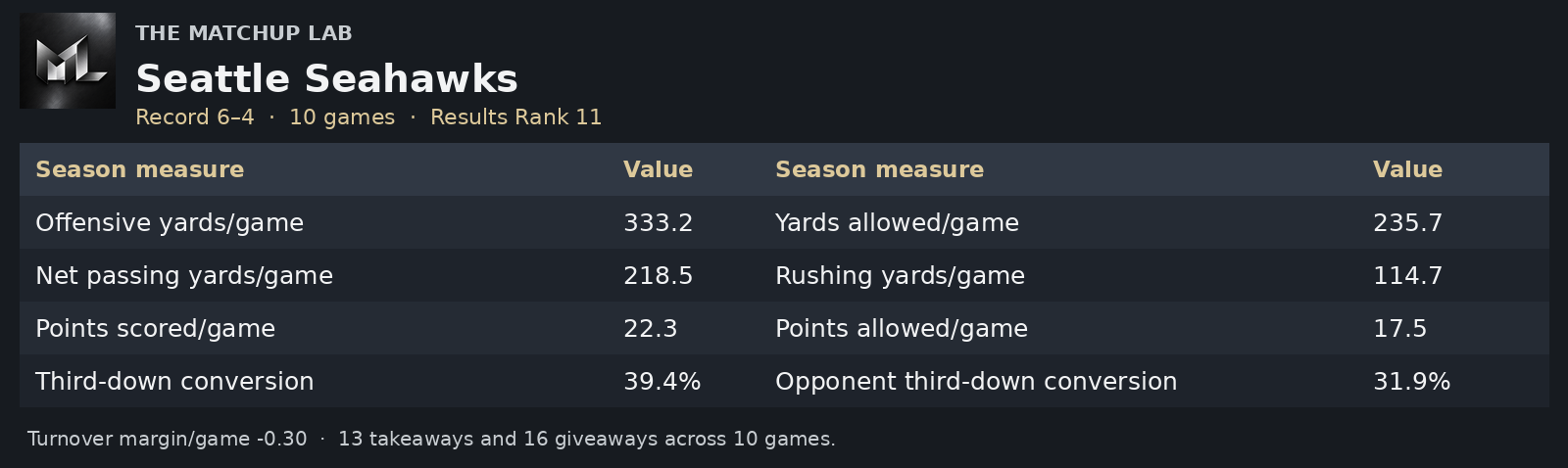
Holding the Raiders to 163 yards fits a defense allowing only 235.7 a game. Seattle needed that margin because its offense gave the ball away twice. Lock completed 14 of 17 passes and got 171 receiving yards from Smith-Njigba, 71 on one scoring play. There is a useful question for the bye. Which throws would keep moving the chains if the next defense denies the deep ball? Sunday’s seven third-down conversions offer more places to look than the highlight alone.
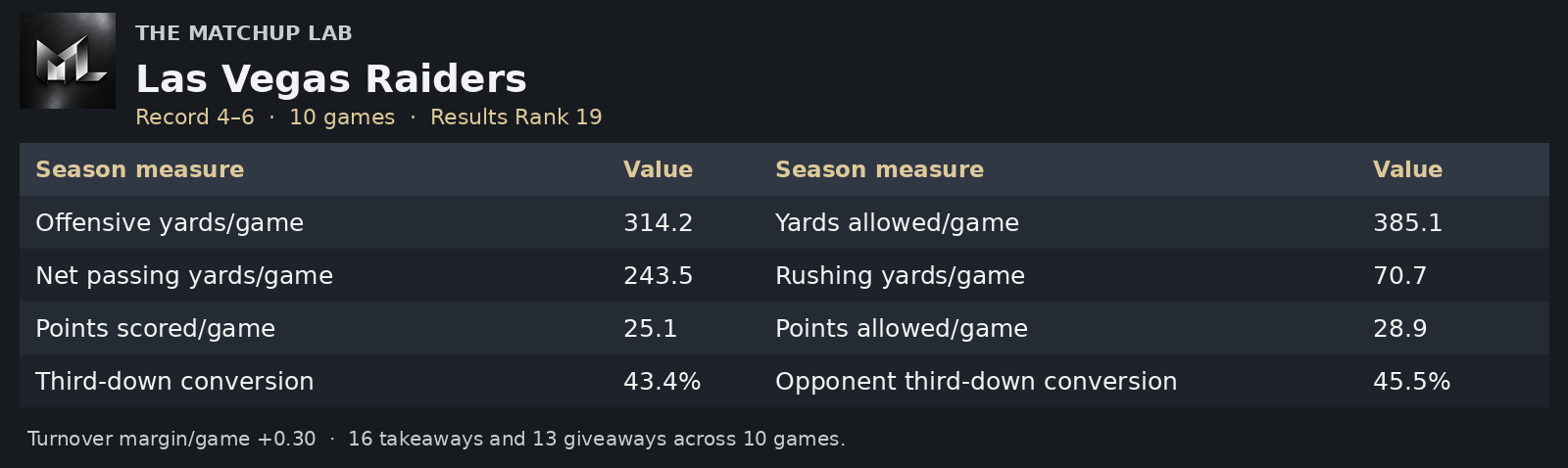
The Raiders’ first touchdown came on a run by their quarterback. Their offense finished with 65 rushing yards, close to its season average of 70.7, and just 98 net passing. Two takeaways gave Las Vegas chances that its offense struggled to extend. Denver has allowed 355 yards per game despite its 7–2 record. The Raiders have to take some of that yardage before third down if they want more than field goals for it.
Sun Nov 15 · 3:05 p.m. Central | Results Rank 14 and 19
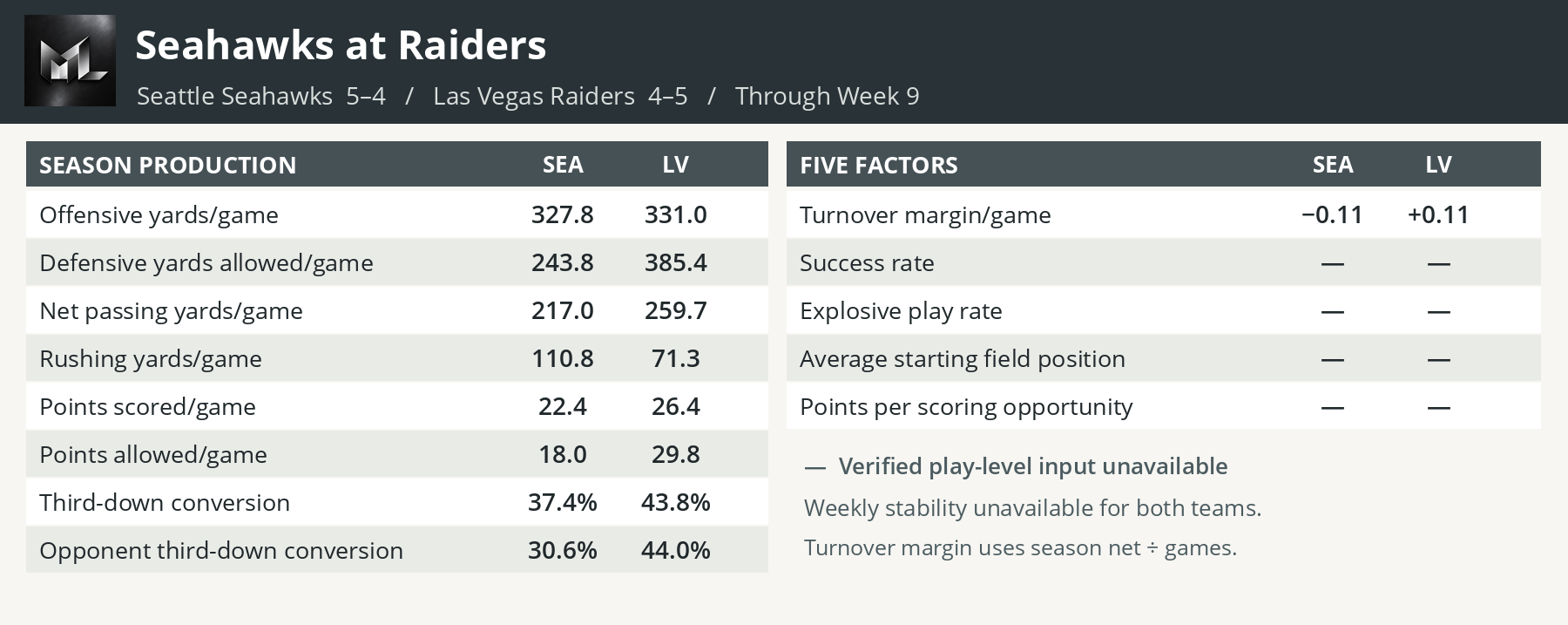
Las Vegas has the larger passing average. Seattle has the defense that can make an opponent’s passing average look irrelevant. The Raiders gain 259.7 net passing yards per game and only 71.3 on the ground. The Seahawks allow 243.8 total yards, with opponents converting 30.6 percent on third down. Las Vegas must find a way to use its strength early, while a short throw can still count as a good gain. Waiting until third down to start throwing would let Seattle defend exactly the play it expects.
There is reason for the Raiders to believe that they can complete those drives. They convert 43.8 percent of third downs and score 26.4 points a game, more than Seattle’s 22.4. That offense carried some genuine production into last week’s 38–17 loss to San Francisco. The difficulty is how often it must answer. Las Vegas allows 385.4 yards and 29.8 points per game. A defense carrying that burden can turn an otherwise respectable afternoon from its own offense into another multi-score defeat.
Seattle won 17–3 against Arizona, a result that fits its defensive identity more comfortably than it settles questions about its offense. The Seahawks convert 37.4 percent on third down. The Raiders concede 44.0 percent, so there is room for Seattle to extend possessions and spare its defense an extra trip onto the field. Keeping drives alive also allows Seattle to call another run against a defense that would prefer an obvious pass. For Las Vegas, making the Seahawks finish a long field is only half the job. It has to get the ball back before Seattle has turned that long field into a short kick.
Seattle gave six away from home on Tuesday. That asks its offense to create some separation along with its defense. Without an extra set of downs or a shorter field, holding the Raiders below their scoring average could still leave a one-possession contest.
Complete NFL Week 9 recap and all 32 team assessments
Week 9 win 17–3 against Arizona Cardinals
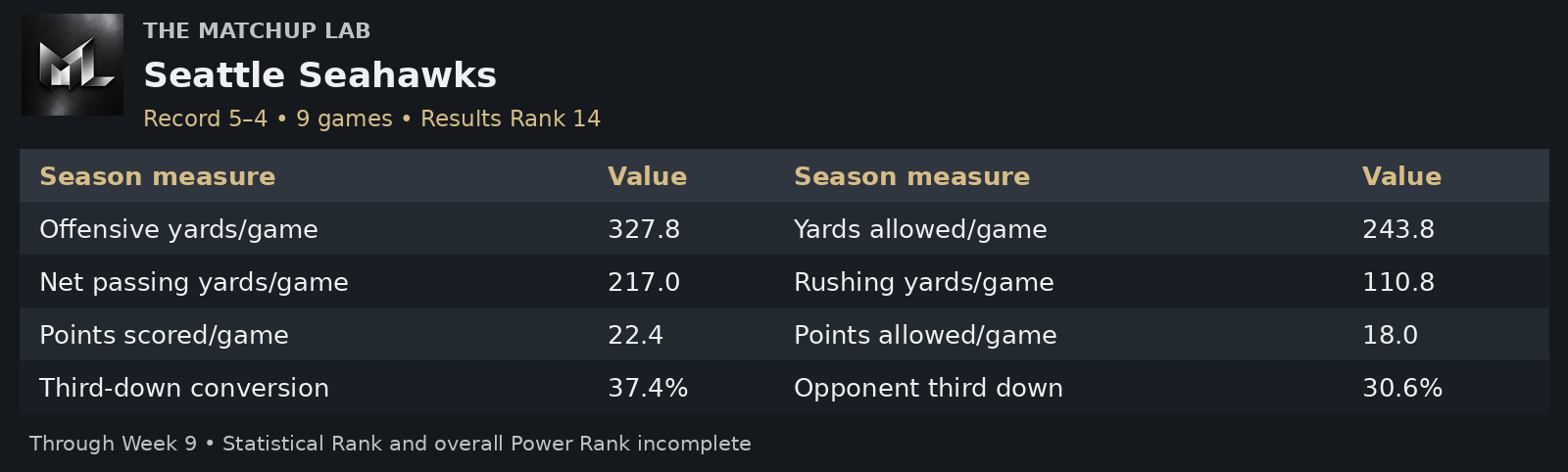
Seattle's defense gives a 5–4 team a substantial argument for optimism, even after an uneven recent sequence. The Seahawks beat Kansas City 20–3, lost 34–17 to Chicago, then held Arizona to three points in a 17–3 win. Across the season they allow 243.8 yards and 18.0 points per game, with opponents converting 30.6 percent of third downs. The Chicago result prevents the recent defensive story from becoming too tidy, but the full-season numbers remain strong evidence of Seattle's ability to restrict opposing offenses.
The next opponent, Las Vegas, allows 385.4 yards and 29.8 points per game. That presents an opportunity for a Seattle offense averaging 327.8 yards and 22.4 points to provide more comfortable support. The Raiders still generate 259.7 passing yards per game, so the defensive assignment is not empty simply because their record is worse. Seattle should be looking for a fuller offensive contribution while carrying its third-down stops into another game, rather than asking the defense to hold everyone to three.
Week 9 loss 17–38 against San Francisco 49ers
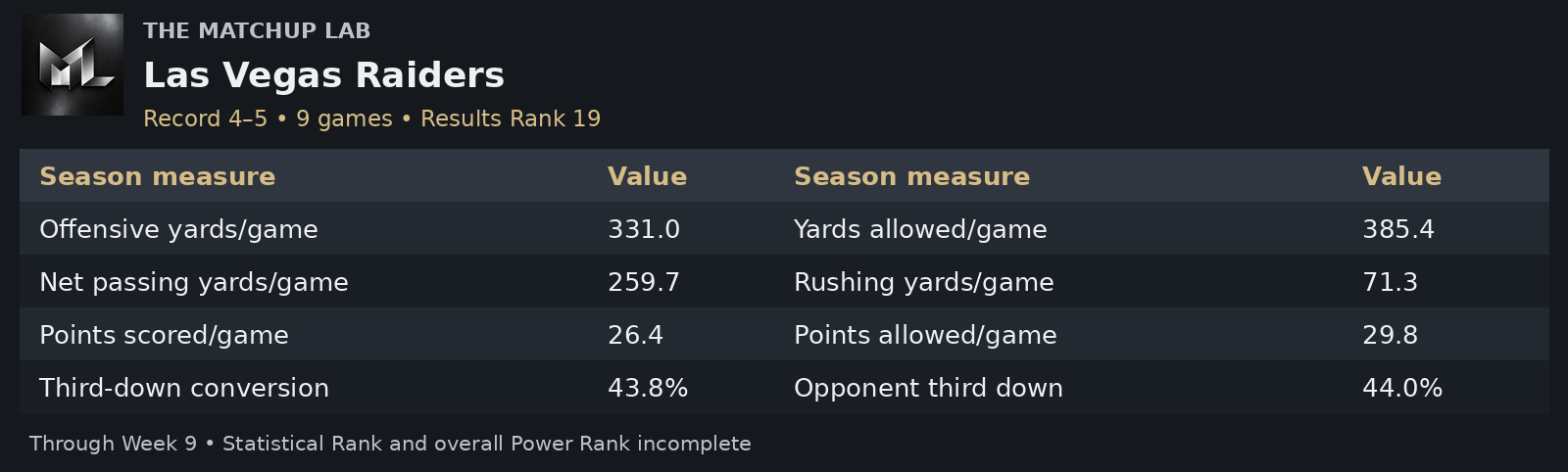
Las Vegas has allowed 35, 33 and 38 points in its last three games, a sequence that puts the burden on an offense already doing considerable work. The 38–17 loss to San Francisco leaves the Raiders 4–5 with 29.8 points and 385.4 yards allowed per game. Their own offense averages 26.4 points, but the production is heavily tilted toward 259.7 passing yards against 71.3 rushing yards. Even useful scoring totals become difficult to defend when the other side keeps receiving productive possessions.
Seattle is an awkward next opponent for a team that may need its passing game to carry the scoring. The Seahawks allow 243.8 yards and 18.0 points per game, and opponents convert just 30.6 percent of third downs. Las Vegas cannot assume its 43.8 percent offensive conversion rate will continue without resistance. The Raiders need to make Seattle work harder for its own points while finding enough offensive variety to keep drives moving. Another high allowance would leave little room for the attack to recover.