
THE MATCHUP LAB · NFL
Game Center
Scores, statistics and the story behind the game.
Checking for updates…
Complete NFL Week 10 recap and all 32 team assessments
Ja’Marr Chase caught 11 passes for 231 yards and none of Joe Burrow’s four touchdowns. Chase carried the ball down the field. Drew Sample, Chase Brown and Dohnte Meyers got the scoring catches, three of them from four yards or closer. Cincinnati scored five touchdowns on six trips inside the 20 and made 30 first downs while facing third down just seven times. Pittsburgh protected the football all day. Winning the turnover count was never a prerequisite for the Bengals to pull away.
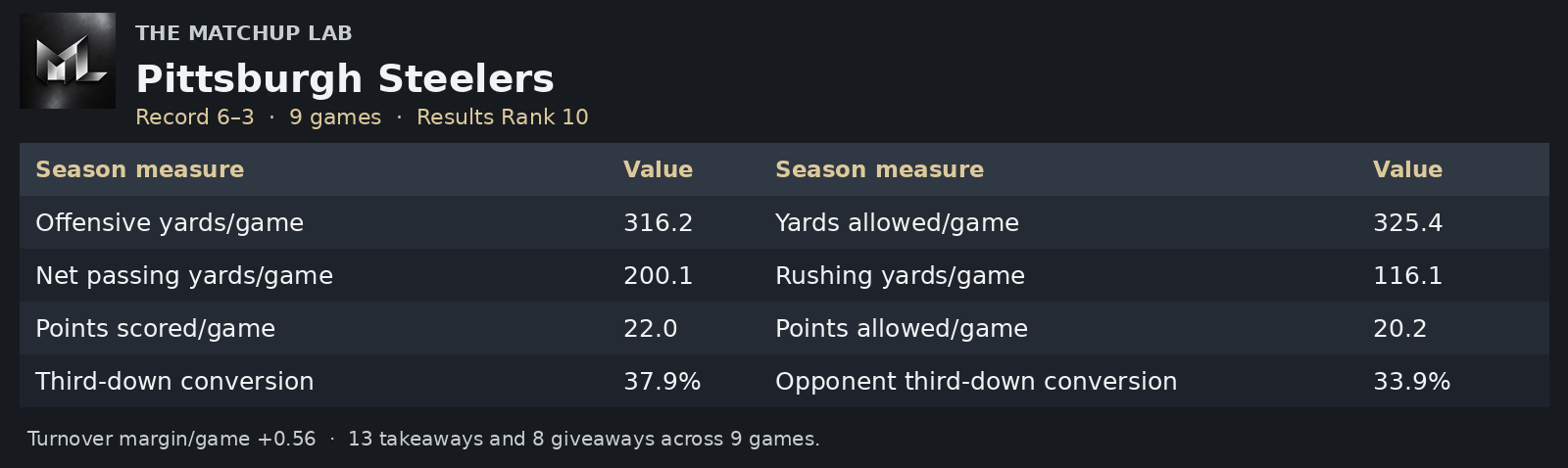
The Steelers left Cincinnati with no giveaways and a 20-point loss. Their defense normally allows opponents to convert 33.9 percent of third downs. Burrow made that strength largely irrelevant by facing only seven. On offense Aaron Rodgers found two fourth-quarter touchdown passes, after Cincinnati already had firm control. Against Philadelphia, a more valuable early throw would be one that keeps a first-half possession alive long enough to give Pittsburgh’s defense a lead to protect.
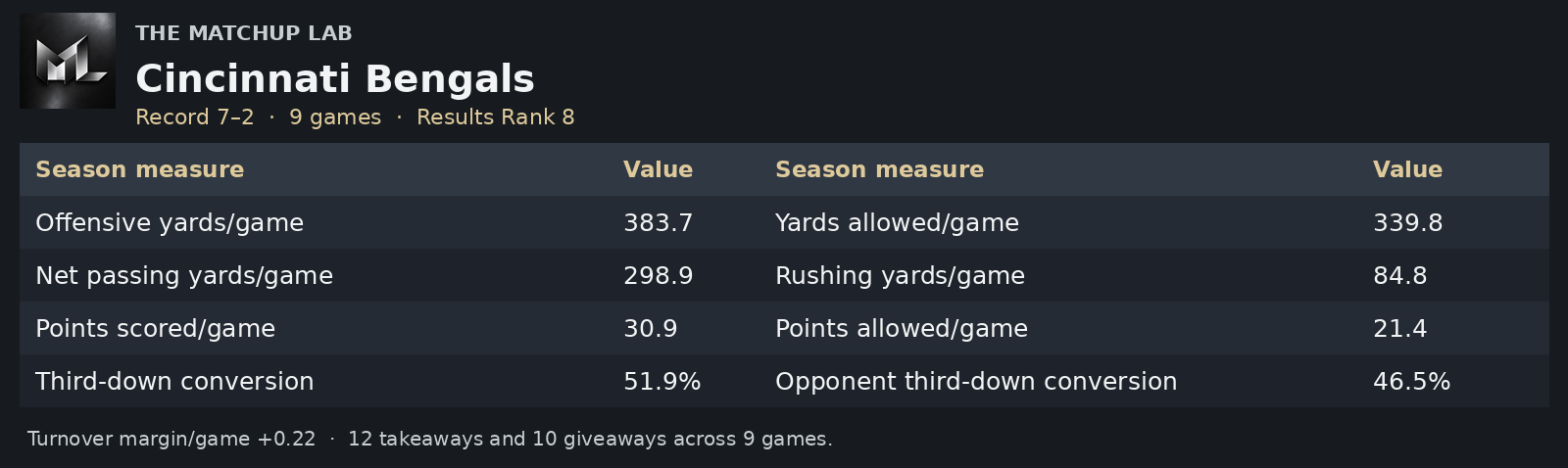
Burrow finished with 409 passing yards and four touchdowns without throwing an interception. The important detail for Washington is where the ball went after Chase’s catches had moved the chains. Brown caught two short scoring passes. Bracketing Chase deep will accomplish little if it leaves those underneath throws uncontested. Cincinnati averages 298.9 net passing yards a game and converts 51.9 percent of third downs. A defender who tackles the checkdown short of the sticks has done real work.
Sun Nov 15 · 7:20 p.m. Central | Results Rank 8 and 9
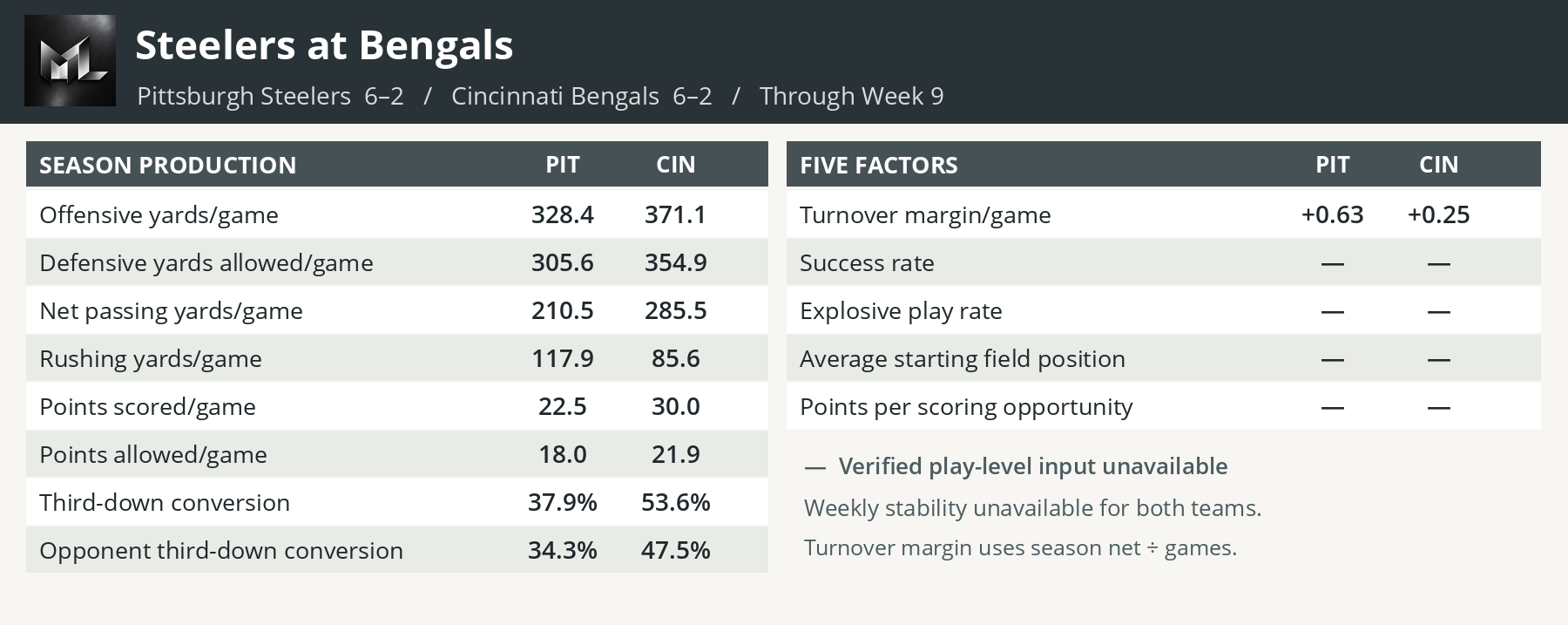
Pittsburgh and Cincinnati arrive at 6–2, adjacent in Results Rank, with very different ideas about the score they would like to see in the fourth quarter. Pittsburgh allows 18.0 points a game. Cincinnati scores 30.0. The Bengals’ passing offense, at 285.5 net yards per game, can threaten the whole field. More important for this opponent, it has converted 53.6 percent of third downs. The Steelers usually end that argument in their own favor, allowing just 34.3 percent.
How those third downs arise matters. Cincinnati averages only 85.6 rushing yards a game. Pittsburgh can ask its front to hold up against the run while keeping enough defenders available to tackle a short completion before the marker. The Bengals can answer by taking the easy pass earlier in the series and saving a manageable third down for the choice the defense has left open. Cincinnati’s 34–17 win over Atlanta and its earlier 43–36 win over Tennessee are evidence of its scoring range. They do not require Pittsburgh to accept that same pace.
The Steelers return from a bye. Their last outing, a 27–6 win over Cleveland, let the defense make a workable lead decisive. Cincinnati’s defense offers an avenue for keeping a similar game within reach. It allows a third-down conversion 47.5 percent of the time, against Pittsburgh’s offensive rate of 37.9 percent. A few extra completions would buy Pittsburgh additional snaps for a running game averaging 117.9 yards. The Bengals want those chances to belong to their own quarterback. The difference between a third-down tackle a yard short and one a yard beyond the marker could decide which offense spends the evening dictating the terms.
Cincinnati gave 3.5 at home when the market was observed. For Pittsburgh that difference puts a premium on a possession that reaches the red zone. Settling for three twice while the Bengals find one touchdown would leave the Steelers behind even after two productive drives.
Complete NFL Week 9 recap and all 32 team assessments
Week 9 bye
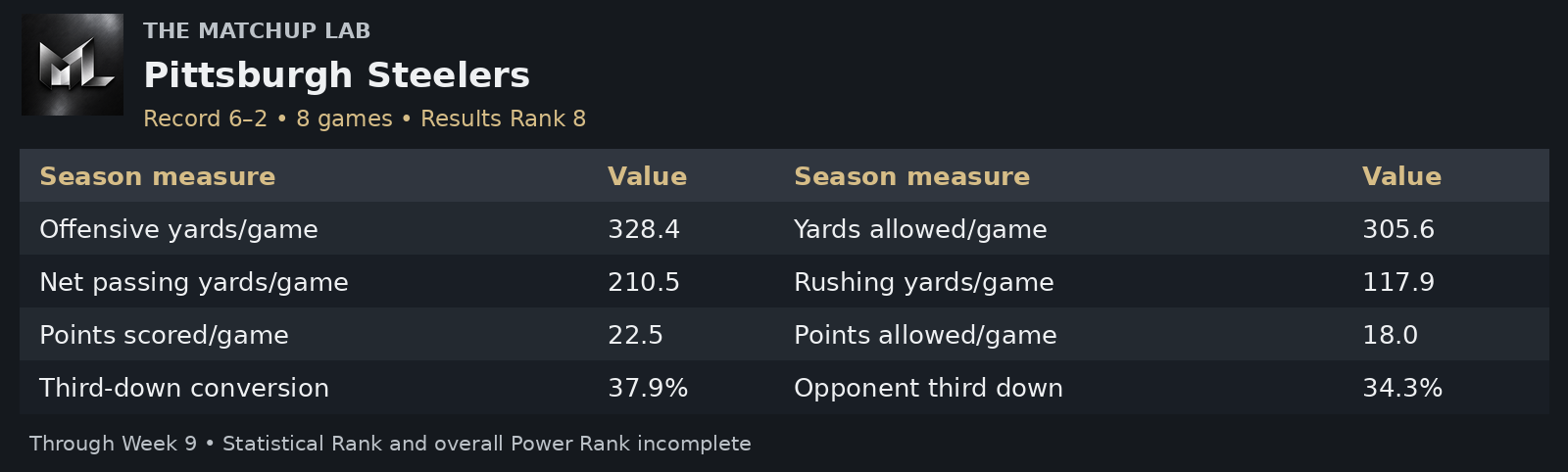
Pittsburgh's Week 9 bye left the Steelers 6–2 with an encouraging three-game sequence behind them. Wins over Tampa Bay, New Orleans and Cleveland ended with a 27–6 result against the Browns. The defense allows 18.0 points and 305.6 yards per game, and its 34.3 percent opponent third-down conversion rate offers a concrete explanation for why those games have been manageable. The offense contributes 22.5 points per game, enough to support that defense without making Pittsburgh a team that needs a high score every week.
Cincinnati will test that arrangement. The Bengals score 30.0 points per game and convert 53.6 percent of third downs, bringing sustained passing production as well as recent wins. Pittsburgh's own 37.9 percent conversion rate leaves room to improve its share of possession. Returning from the bye, the Steelers need to deny Cincinnati repeated chances while extending their own drives. That is a more demanding assignment than simply reproducing the final score from the Cleveland game.
Week 9 win 34–17 against Atlanta Falcons
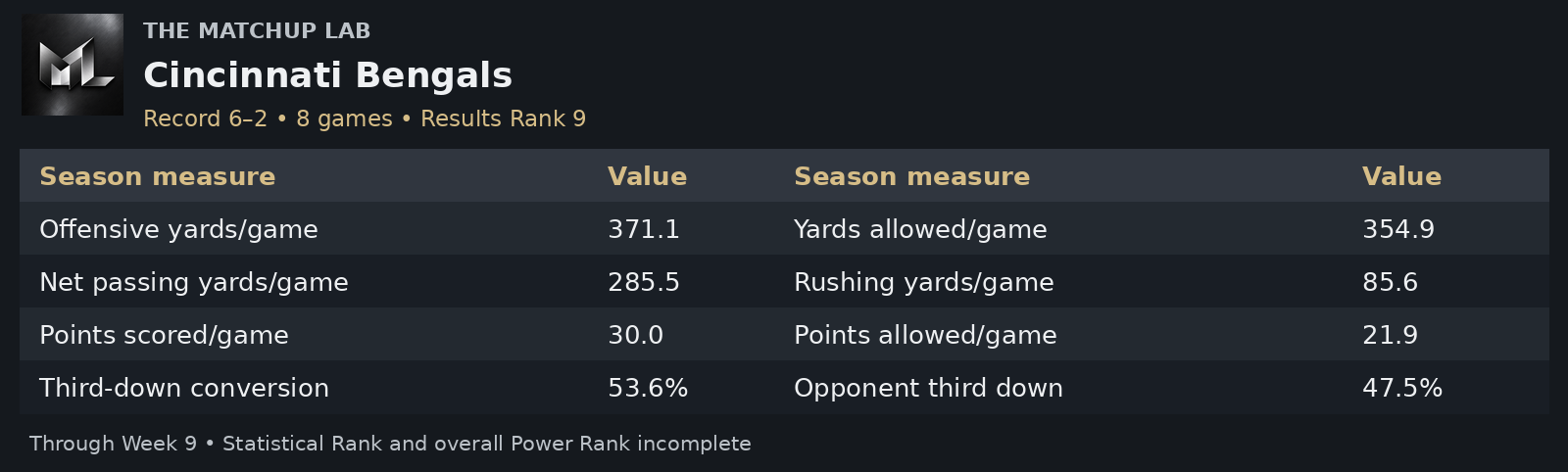
Cincinnati keeps giving itself enough offense to survive very different games. A 34–17 win over Atlanta followed the 43–36 victory over Tennessee, leaving the Bengals 6–2 with a season average of 30.0 points. Passing production of 285.5 yards per game and a 53.6 percent third-down conversion rate explain why defenses struggle to get them off the field. The running total is much smaller at 85.6 yards per game, so Cincinnati's production is concentrated heavily in the passing side of its attack.
The defense supplies the caution. Opponents convert 47.5 percent of third downs, leaving an avenue for a less explosive opponent to stay involved through repeated possessions. Pittsburgh comes next with an allowance of 18.0 points per game and a 34.3 percent opponent conversion rate. That is a useful examination of whether Cincinnati can sustain its scoring against a defense with a stronger season record of getting stops. Matching Pittsburgh's discipline on the other side would reduce the burden on the passing game.
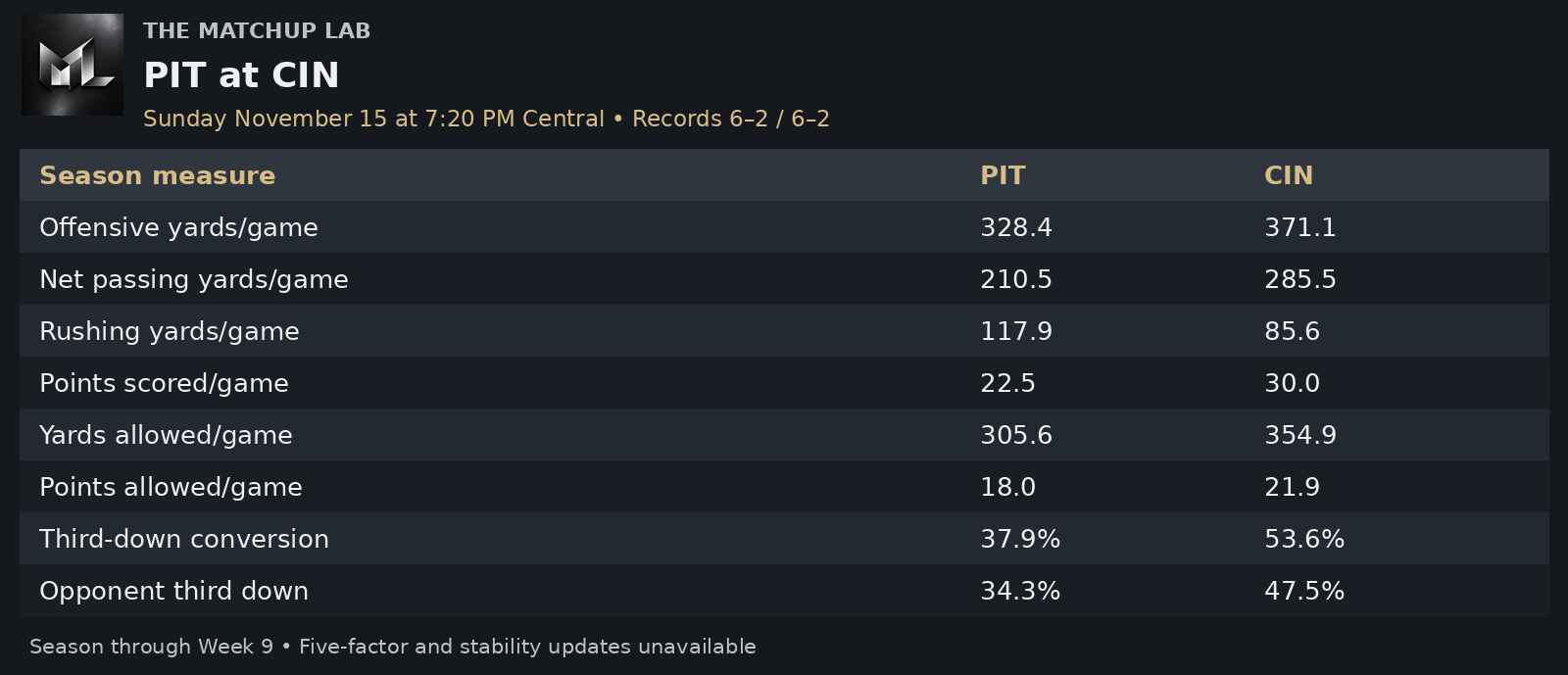
Pittsburgh and Cincinnati meet at 6–2 on Sunday evening, November 15. Cincinnati averages 30.0 points and converts 53.6% of third downs; Pittsburgh allows 18.0 points and a 34.3% opponent conversion rate. That contrast makes possession extension a useful focus without treating either season rate as a forecast. The Bengals average 285.5 net passing yards against 85.6 rushing yards per game, so sustaining their passing production against a defense allowing 305.6 total yards will matter to their usual scoring output.
Pittsburgh has a different opportunity when it has the ball. Its offense averages 22.5 points and 328.4 yards per game, with a 37.9% third-down conversion rate. Cincinnati permits 354.9 yards and a 47.5% opponent conversion rate, leaving the Steelers room to improve on their normal offensive efficiency. The two records are identical, but the routes to success differ. Cincinnati can press its scoring advantage, while Pittsburgh can combine stronger prevention with a more productive offensive day. Whether either defense can disrupt the other's preferred pattern is the matchup's central question.
Both teams have won their last four completed games, although the scoring patterns differ. Pittsburgh beat Indianapolis 34–22, Tampa Bay 26–19, New Orleans 16–10 and Cleveland 27–6 before its Week 9 bye. Cincinnati's corresponding run was 31–24 over Miami, 35–13 over Baltimore, 43–36 over Tennessee and 34–17 over Atlanta. The Bengals have repeatedly supplied a large scoring total, while Pittsburgh has recently won with much less. Cincinnati needs to preserve that offensive consistency without asking it to cover every defensive concession. Pittsburgh needs enough offensive support to make its stronger defensive averages meaningful against an opponent capable of exceeding 30 points.