
THE MATCHUP LAB · NFL
Centro del partido
Marcadores, estadísticas y la historia del partido.
Buscando actualizaciones…
Complete NFL Week 10 recap and all 32 team assessments
Both defenses scored a touchdown. Indianapolis recovered a fumble in the end zone and Miami answered later with Chris Johnson’s 59-yard interception return. The Colts still had a way to build drives without asking Daniel Jones, who threw two interceptions, to force another throw. They ran for 172 yards on 34 carries. Kyle McCord’s three-yard touchdown brought Miami within two early in the fourth. The conversion pass failed, leaving two teams that each went three for 11 on third down to spend the rest of the quarter chasing the same two points.
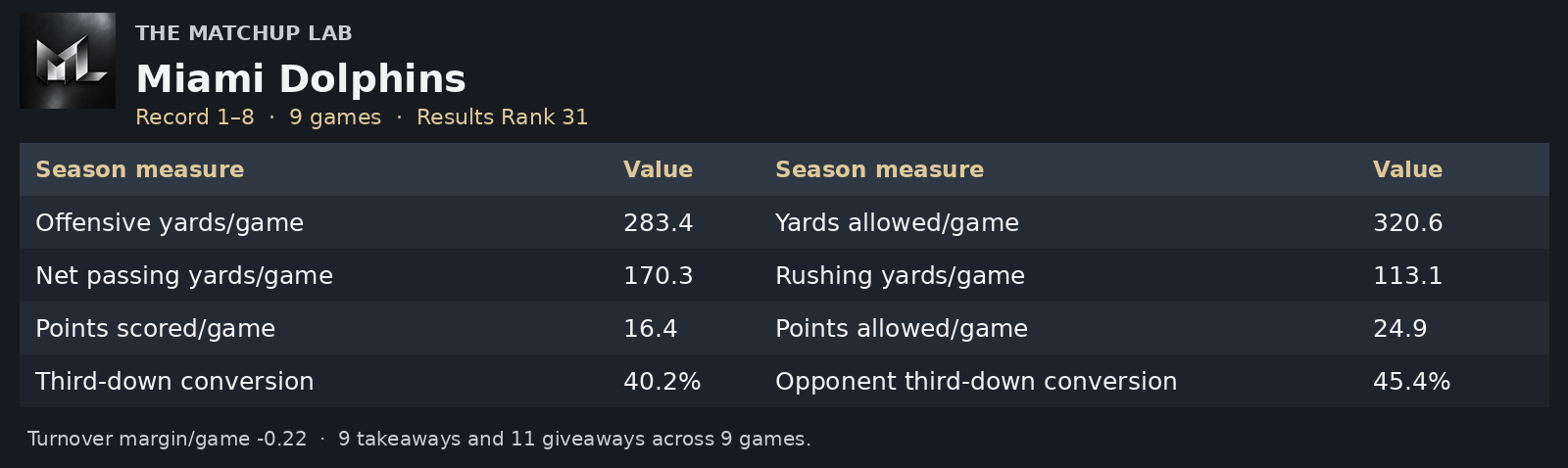
Miami came within a two-point conversion of tying Indianapolis despite getting only 78 rushing yards. A defensive touchdown and a touchdown pass from receiver Malik Washington gave the Colts different problems from the ones posed by the base offense. At 16.4 points per game that offense needs a more frequent source of touchdowns. Buffalo can score from a yard away or from the other side of midfield, a difficult opponent to match if Miami needs a return or a trick play to reach the end zone.
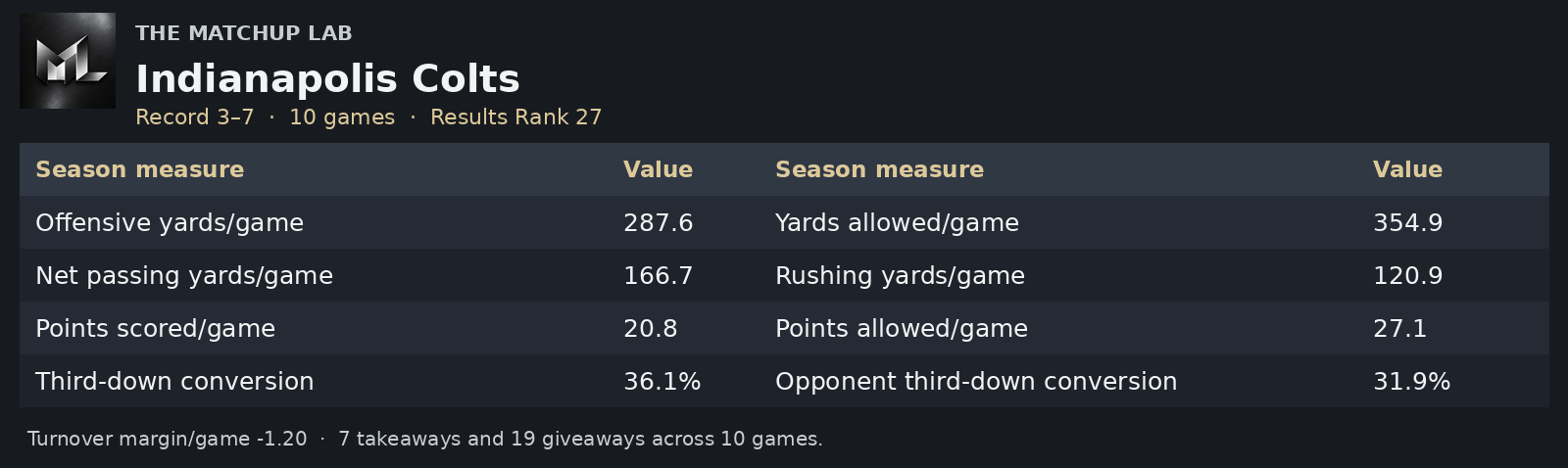
The Colts rushed for 172 yards while their passing game produced 104 net, and they needed a recovery in the end zone to beat Miami by two. Jonathan Taylor gained 83 on 16 carries, an efficient way to keep an offense averaging 166.7 net passing yards out of obvious passing situations. Houston was perfect in the red zone last week. Indianapolis cannot build its Thursday game plan around getting another score from its own defense.
Sun Nov 15 · noon Central | Results Rank 30 and 28
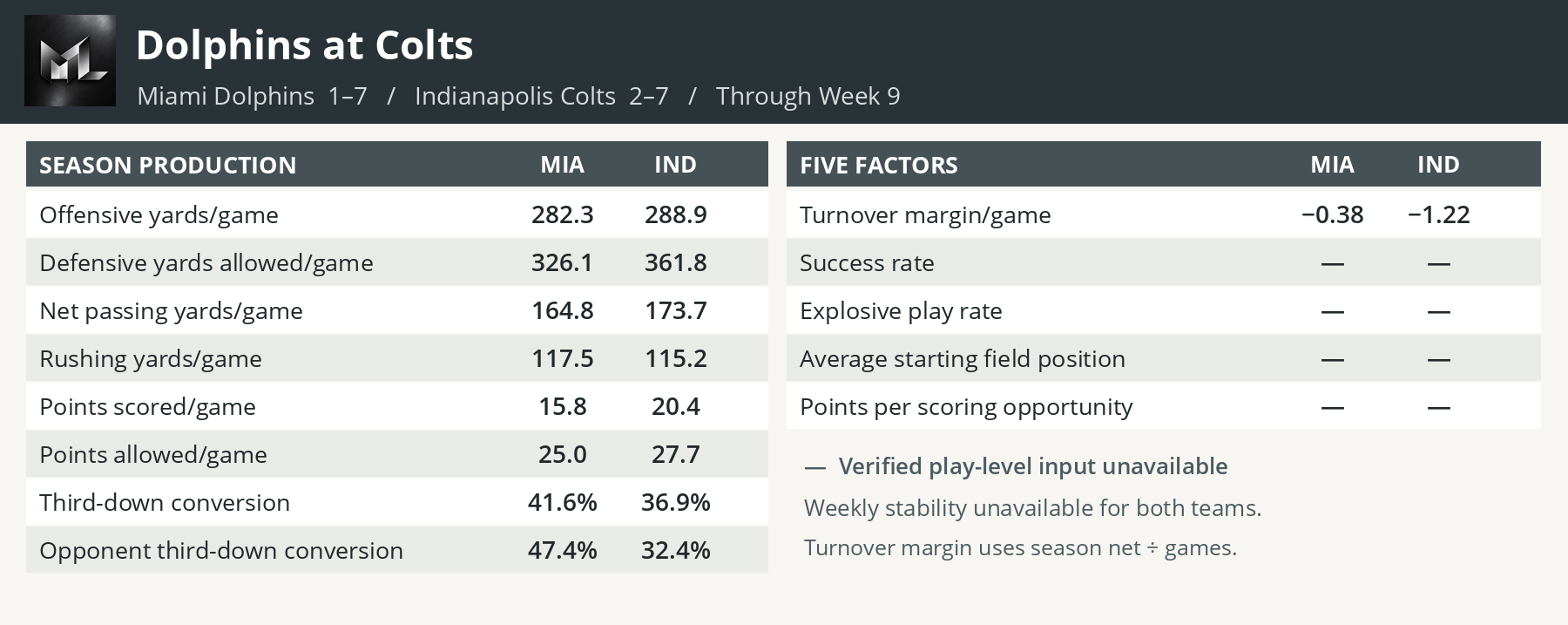
Indianapolis has one number Miami should take seriously. Opponents have converted just 32.4 percent of third downs against the Colts. That is an impressive way to end a series for a team that nevertheless allows 361.8 yards and 27.7 points per game. Both things can be true if an opponent does its damage elsewhere in the drive. Miami will want to make second down the important snap, especially when a run or short completion has kept the whole playbook available.
The Dolphins have converted 41.6 percent on third down themselves. That offers some protection against a stalled series but has yielded only 15.8 points a game. Detroit held them to nine last week. A drive that goes from the Miami 20 to midfield can improve the conversion statistics and still leave the scoreboard alone. Against the Colts, the question is whether Miami can use its 117.5 rushing yards a game to keep finding favorable throws further downfield without conceding a negative play that forces a punt.
Indianapolis has its own opportunity on third down. Miami’s defense allows 47.4 percent conversions, while the Colts have made only 36.9 percent. Indianapolis also carries a season turnover deficit of eleven, making it difficult to profit from defensive stops it has earned. The 27–23 loss to Dallas was a closer contest than the 42–7 defeat against Jacksonville, but the Colts still had to chase points. If they protect the ball and extend two or three of those manageable third downs, Miami will have to answer with a scoring level that has been hard to reach. If they give possessions back, their best defensive work may never show up in the result.
At 38.5 the total shared the bottom of the Tuesday board. In that kind of game a team can survive a stalled possession more easily than a giveaway near its own goal line. The Colts have particular reason to remember the distinction.
Complete NFL Week 9 recap and all 32 team assessments
Week 9 loss 9–19 against Detroit Lions
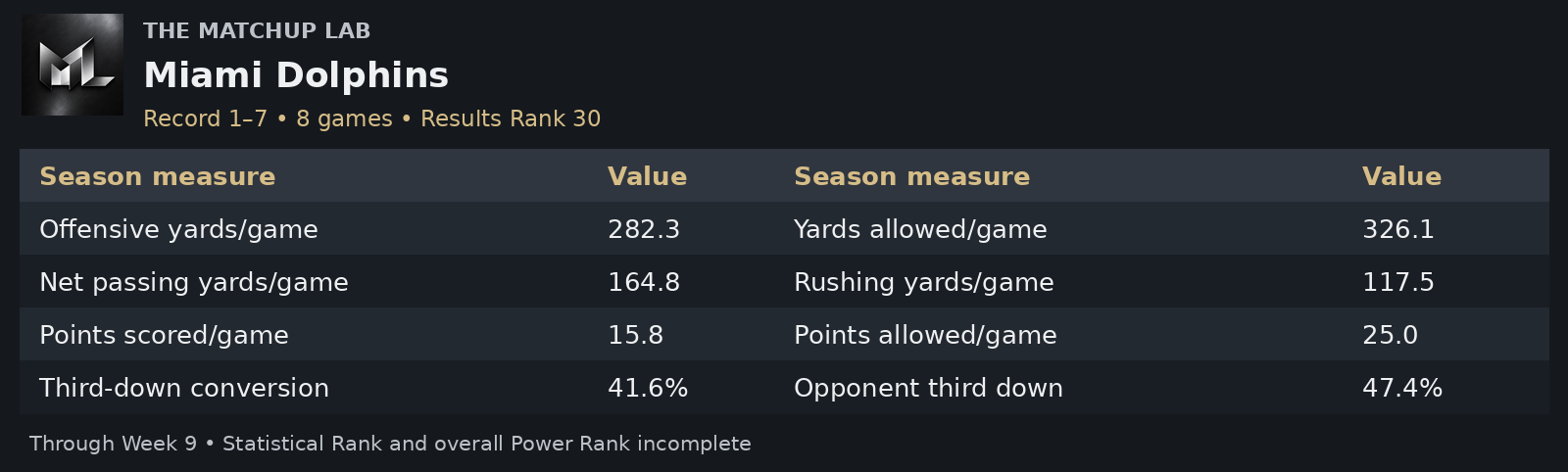
Miami's scoring has fallen from 28 in its win over the Jets to 19 against New England and nine against Detroit. The Dolphins are 1–7, averaging 282.3 yards and 15.8 points per game. Their 41.6 percent third-down conversion rate shows that the offense can extend some possessions, but the overall return remains too small. Passing production of 164.8 yards per game leaves limited support alongside 117.5 rushing yards. The defense allows 25.0 points, making the gap between what Miami needs and what it scores difficult to ignore.
Indianapolis presents another struggling opponent, but its 32.4 percent opponent third-down conversion rate challenges one of Miami's more useful offensive measures. The Dolphins need to generate production without assuming those conversions will remain available. On defense, their own 47.4 percent third-down allowance gives the Colts an obvious area to attack. A better result requires Miami to shorten opposing possessions and earn more from its own, with the recent nine-point total offering little room to debate that priority.
Week 9 loss 23–27 against Dallas Cowboys
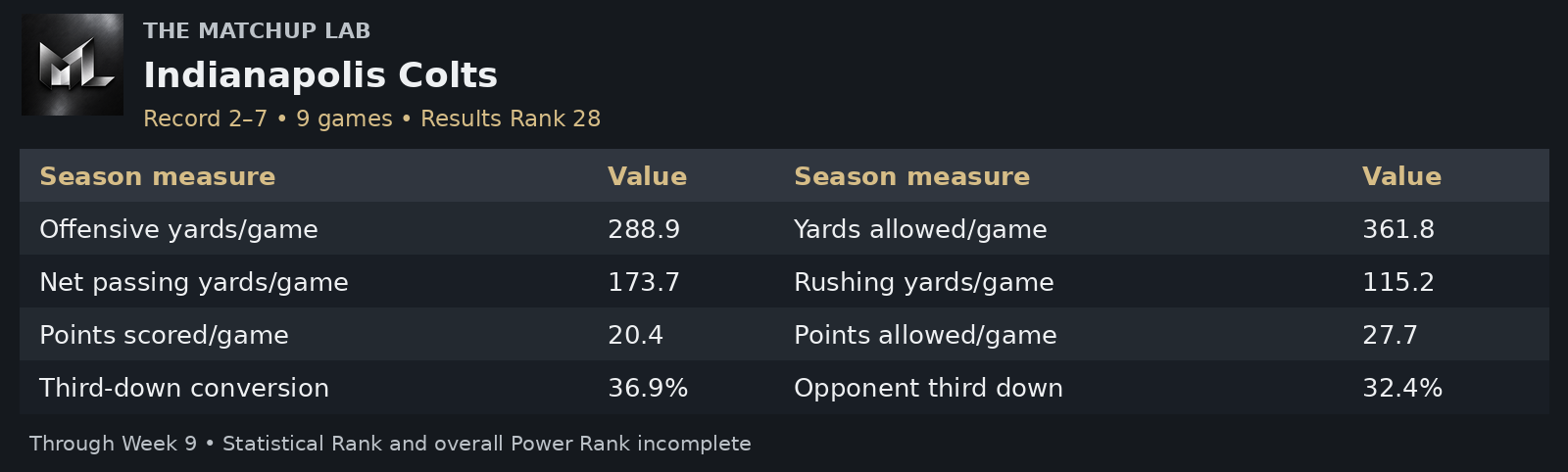
Indianapolis improved its scoring considerably after the 42–7 defeat against Jacksonville, but a 27–23 loss to Dallas still left the Colts 2–7. The season offense averages 288.9 yards and 20.4 points, with 173.7 passing yards limiting the overall reach of the attack. Defensively, Indianapolis allows 361.8 yards and 27.7 points per game despite holding opponents to a 32.4 percent third-down conversion rate. Success in that particular situation has not produced equivalent protection across the full game, and the scoring allowance remains a substantial burden.
Miami is next with an offense averaging 15.8 points per game, giving Indianapolis an opportunity to establish a more controlled defensive result. The Dolphins also allow opponents to convert 47.4 percent of third downs. That offers the Colts a way to improve on their own 36.9 percent conversion rate and extend possessions. The Dallas game showed a better offensive return than the previous week. Indianapolis now needs improvement that changes the result as well as the appearance of the score.