
THE MATCHUP LAB · NFL
Centro del partido
Marcadores, estadísticas y la historia del partido.
Buscando actualizaciones…
Complete NFL Week 10 recap and all 32 team assessments
Houston scored the first 17 points. Cleveland then scored 20 straight without a touchdown pass, with Deshaun Watson and KC Concepcion both running one in. C.J. Stroud reclaimed the lead on an 11-yard touchdown to Dalton Schultz in the fourth. The Browns still had enough offense left to reach the five, where Quinshon Judkins scored with 53 seconds to go. Houston went three for three inside the 20. Cleveland reached that part of the field five times. Efficiency once a team gets close does only half the work.
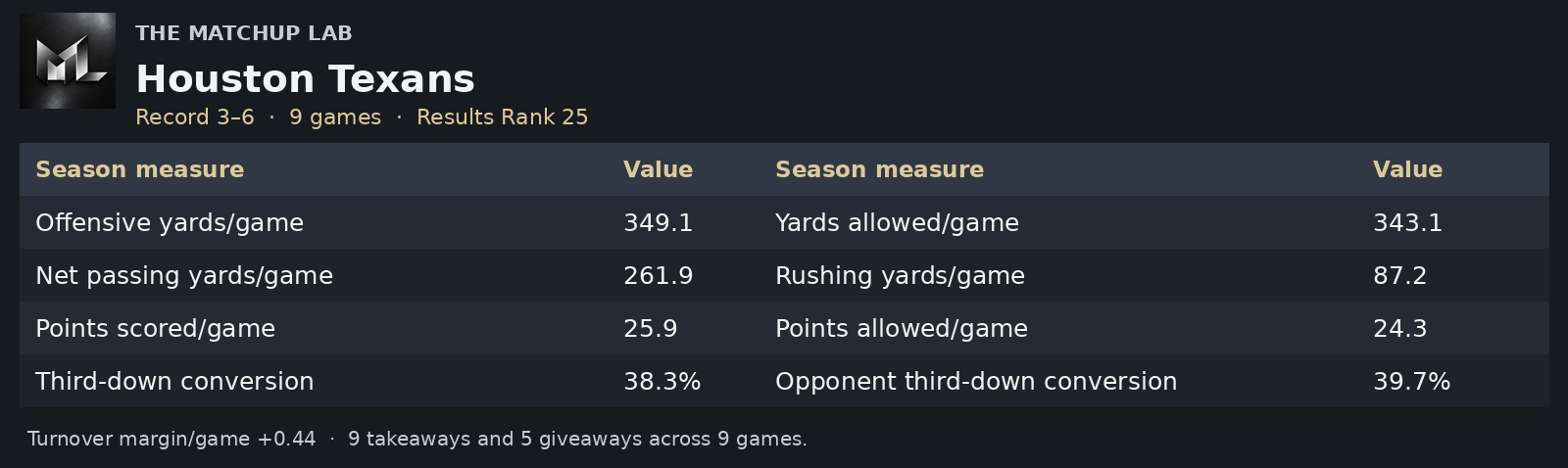
Stroud threw three touchdown passes, all from inside the red zone. Houston averaged 25.9 points through nine games, enough offense to make a 3–6 record sting. The first 17 points in Cleveland illustrated what works. Three conversions in 12 third downs illustrate what happens when the Texans cannot get back into scoring range. Indianapolis is coming off a game it won with a defensive touchdown. Giving the Colts another short path to points would squander Houston’s advantage in the passing game.
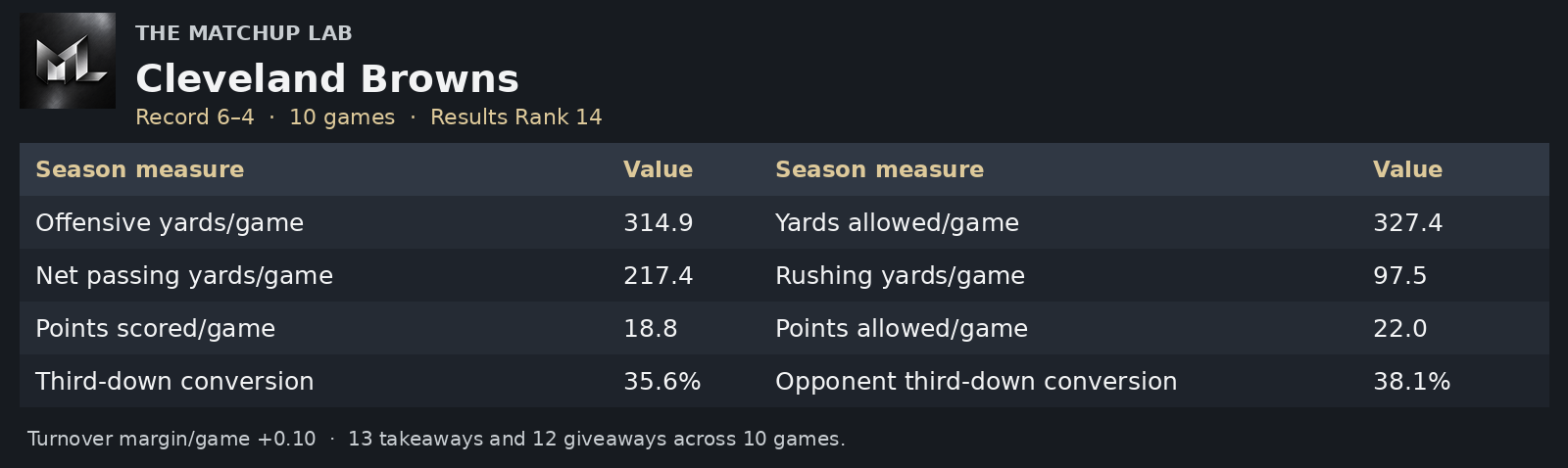
A 6–4 record sits alongside an offense scoring 18.8 points per game and a defense allowing 22.0. The comeback against Houston explains how Cleveland can win a close game without erasing that season-long deficit. Watson ran for one score, and Concepcion and Judkins added two more. Five red-zone trips gave the Browns enough chances to survive settling for kicks. They have a bye to study the possessions that brought them back from 17 down and the ones that dug the hole.
Sun Nov 15 · noon Central | Results Rank 24 and 16
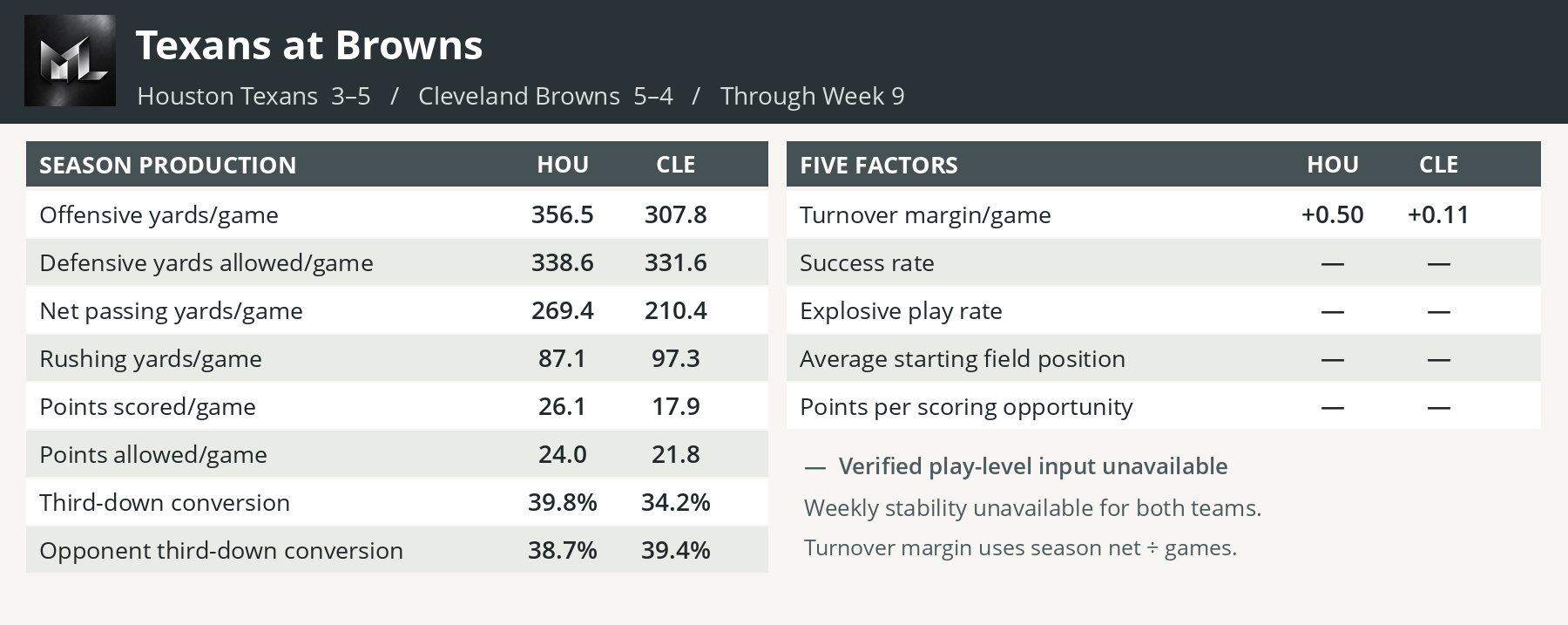
Houston brings a losing record into Cleveland and the higher-scoring offense by more than a touchdown a game. The Texans scored 44 against the Chargers last week, but 26.1 per game is the more useful reference. Cleveland averages 17.9 and just lost 23–22 in overtime to New Orleans. The Browns have the better record and the higher Results Rank because those measures account for what happened across the season. Neither can take a snap when the Texans spread the field.
Houston’s production is concentrated in the air. Its 269.4 net passing yards a game dwarf its 87.1 rushing yards. Cleveland can live with a few unremarkable runs if it can use the other downs to keep completions in front of the defense. It cannot afford to defend the passing total in isolation. If every completion on second and long gains just enough to make the next snap an easy call, a series of short throws can do the damage of a single long one.
Cleveland needs a more sustained answer than it has usually produced. The Browns convert 34.2 percent on third down. Houston allows 38.7 percent, which leaves an opening but hardly promises one. Houston’s eight-game turnover margin is plus four, compared with Cleveland’s plus one in nine. The Browns would benefit from a short field, but they cannot build a whole game plan around getting one. Their most useful series might be the one immediately after a defensive stop. Extending it keeps Houston’s passing game on the sideline and gives Cleveland a chance to spend the fourth quarter within one score.
The early market made Houston a 4.5-point road favorite and put the total at 39.5. Cleveland keeping the scoring low is compatible with that picture. For the Browns to win, their stops must create enough time and field position for one more sustained scoring drive.
Complete NFL Week 9 recap and all 32 team assessments
Week 9 win 44–22 against Los Angeles Chargers
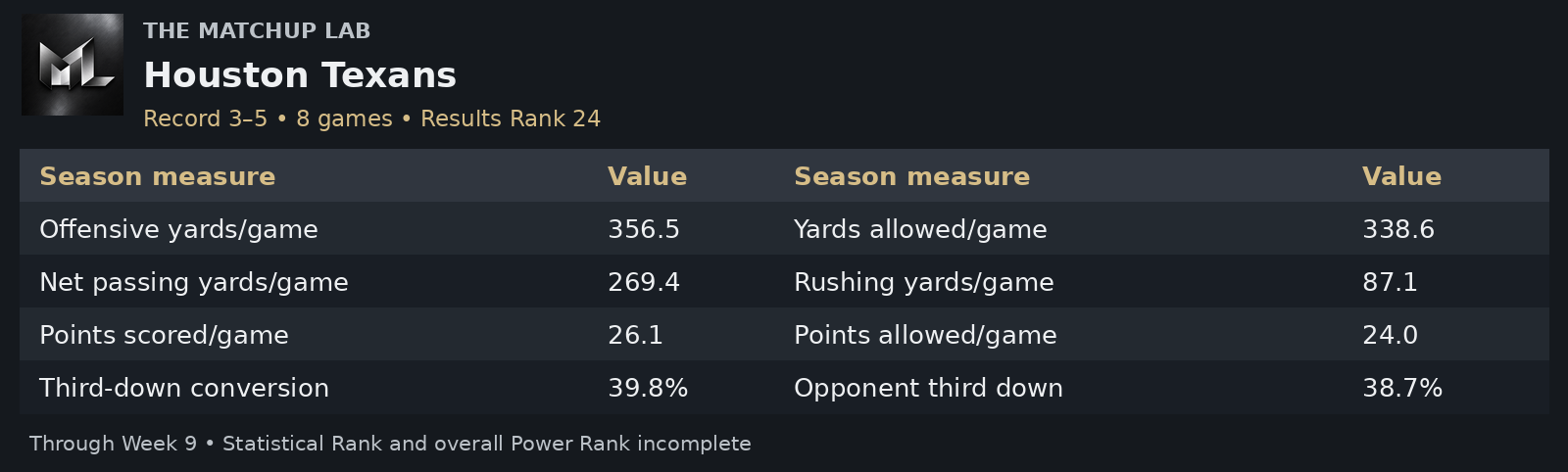
Houston's 44–22 win over the Chargers showed how much scoring the Texans can produce, even though their season record remains 3–5. They average 26.1 points while allowing 24.0, a favorable overall scoring balance that has not translated into more wins than losses. The offense is driven chiefly by 269.4 passing yards per game, alongside 87.1 rushing yards. That combination has produced strong results against Jacksonville and Los Angeles around a 27–21 loss to the Giants, illustrating why one large score cannot describe the whole season.
Cleveland offers a different next assignment. The Browns allow 21.8 points per game and produce only 17.9 themselves, making controlled possessions valuable for Houston on both sides. The Texans convert 39.8 percent of third downs, a rate they can try to improve against a defense allowing 39.4 percent. Sustaining offense without expecting another 44 points would be a useful standard. Houston has demonstrated a scoring ceiling; turning ordinary games into more dependable results is the remaining challenge.
Week 9 loss 22–23 against New Orleans Saints
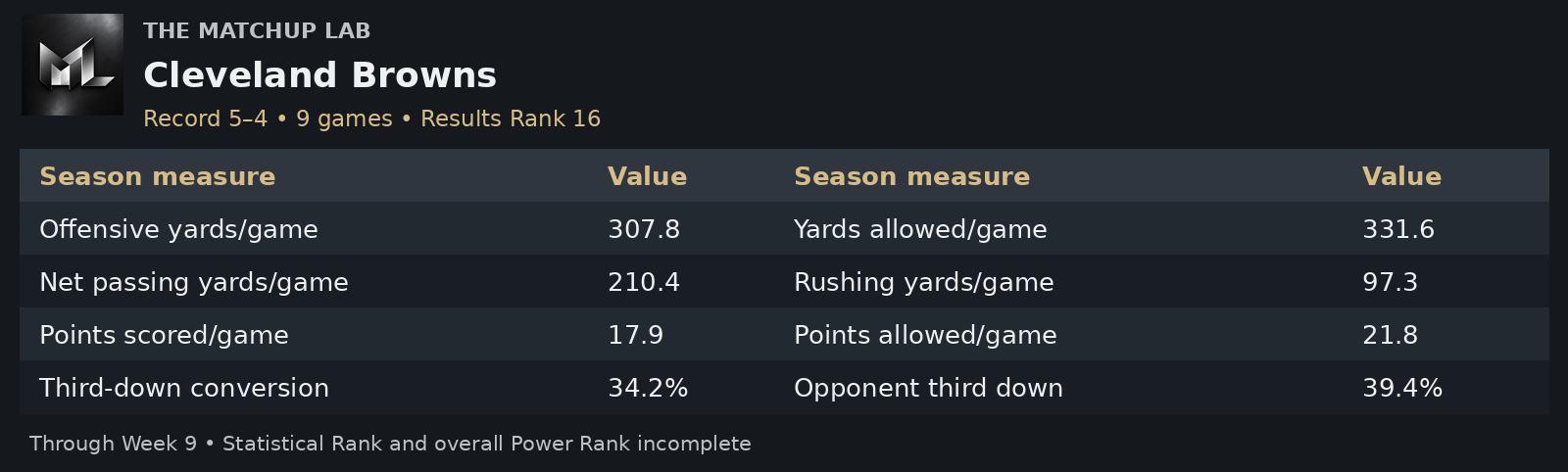
Cleveland remains above .500 at 5–4, although the season's scoring account is much less comfortable. The Browns have scored 161 points and allowed 196. Their 23–22 loss to New Orleans was close, but it followed a 27–6 defeat against Pittsburgh, leaving consecutive losses with very different margins. An offense averaging 307.8 yards and 17.9 points has limited room to waste possessions. Its 34.2 percent third-down conversion rate is an especially clear obstacle to turning occasional productive stretches into enough sustained scoring.
Houston comes next after scoring 44 against the Chargers. The Texans average 269.4 passing yards and 26.1 points per game, so Cleveland cannot plan around another opponent remaining within reach indefinitely. The Browns allow 331.6 yards per game, a defensible total that still needs support from their offense. Improving possession length and scoring returns would ease that burden. The immediate question is whether Cleveland can make its winning record more convincing through the way it plays, rather than relying on the record to explain away the totals.