
THE MATCHUP LAB · NFL
Centro del partido
Marcadores, estadísticas y la historia del partido.
Buscando actualizaciones…
Complete NFL Week 9 recap and all 32 team assessments
Week 9 loss 12–35 against Kansas City Chiefs
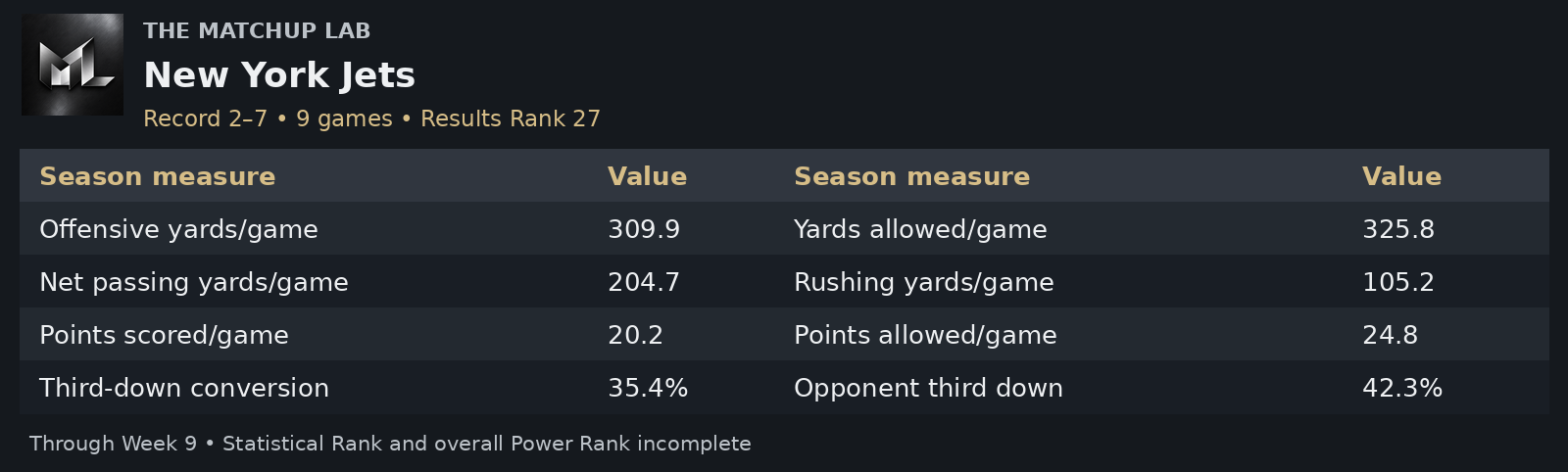
The Jets have lost four straight games. The latest three brought 25 points against Miami, 33 against Las Vegas and a 35–12 defeat against Kansas City. Their 2–7 record reflects problems beyond one bad offensive afternoon. New York averages 309.9 yards and 20.2 points while allowing 24.8 points per game. A 35.4 percent third-down conversion rate limits the offense's ability to keep working, and opponents convert 42.3 percent. That difference repeatedly puts the Jets on the wrong side of the possession exchange.
Buffalo is next at 7–1, averaging 386.4 yards and 32.0 points. The Jets therefore need a response on both sides, rather than counting on a modest improvement from the latest 12-point score to be sufficient. Keeping Buffalo from extending drives would reduce the number of scoring opportunities New York has to answer. The offense also needs its passing and rushing production to lead to more continued possessions. Competing with the Bills begins with those routine demands before any larger upset argument can become credible.
Week 9 win 35–12 against New York Jets
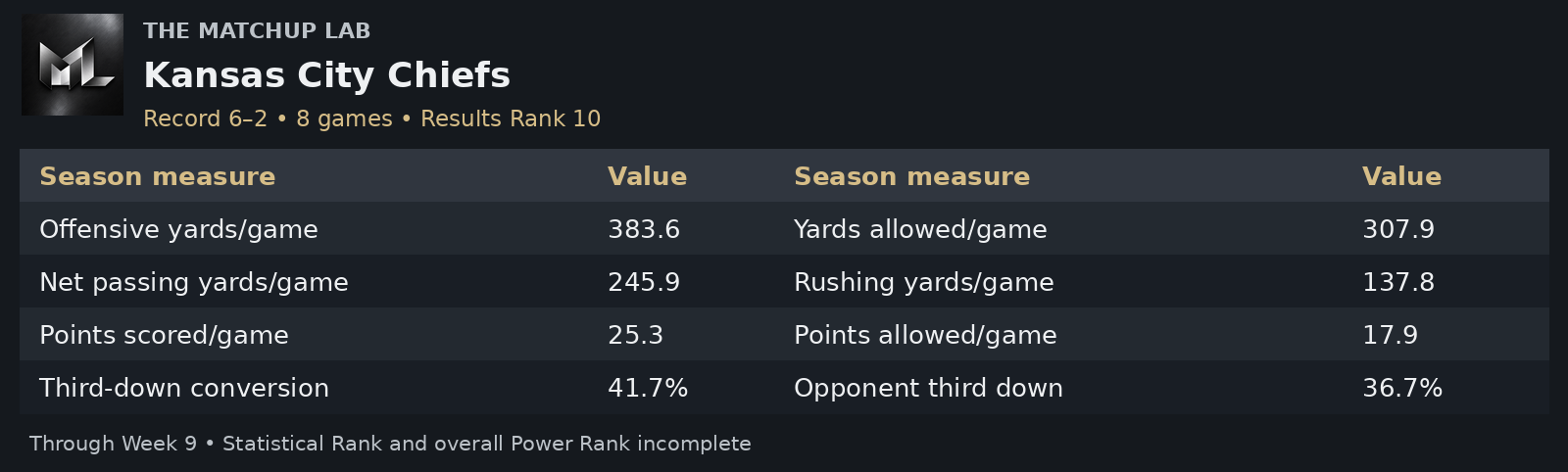
Kansas City needed a stronger response after losses to Seattle and Denver, and the 35–12 win over the Jets supplied one. The Chiefs are 6–2 with a season profile that remains substantial on both sides. Their offense averages 383.6 yards, with 137.8 coming on the ground, while the defense allows 307.9 yards and 17.9 points. The Week 9 result fits that broader defensive record more comfortably than the preceding 28-point allowance against Denver. It also restored scoring after the three-point outing against Seattle two games earlier.
Kansas City brings a larger passing contribution than Atlanta while maintaining a similar rushing output. The Falcons allow a 42.6 percent opponent third-down conversion rate, giving Kansas City an area to test through patient possession as well as bigger gains. Atlanta also ran up 29 points against San Francisco before its recent losses, so dismissing its ceiling would be unwise. The Chiefs should use their range of production to avoid becoming predictable while keeping the defense's improved Week 9 result from becoming a one-game response.
Kansas City reached 6–2 by beating the Jets 35–12, sending New York to 2–7. The Chiefs' season numbers support the breadth of that result. They average 383.6 offensive yards per game against 307.9 allowed, with opponents averaging 17.9 points. Their 35-point output also exceeded their own season scoring average of 25.3. New York averages 20.2 points and converts 35.4% of third downs, leaving limited room for an offensive shortfall. Kansas City has a stronger statistical foundation on both sides, and Week 9 widened the difference in their records.
Complete NFL Week 8 recap and all 32 team assessments
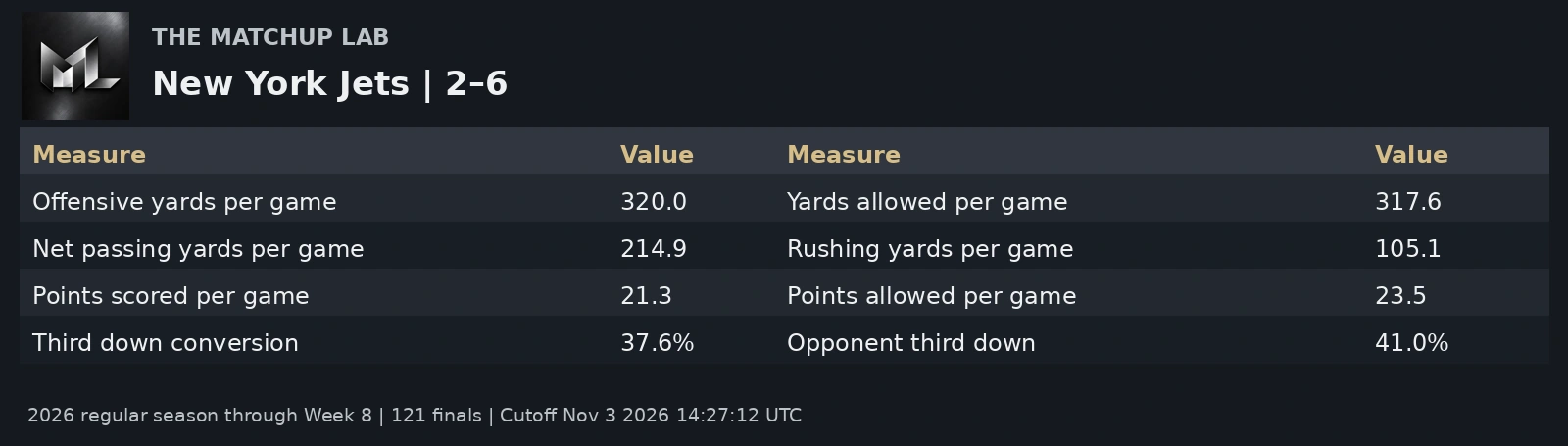
The Jets found 33 points against Las Vegas and still lost, a concise account of why isolated offensive improvement has not rescued a 2–6 season. Their full-season attack averages 320.0 yards and 21.3 points, while opponents score 23.5. The more revealing possession issue is the third-down comparison: New York converts 37.6% and allows 41.0%. The offense needs more repeatable conversions, and the defense needs to end series before another close game becomes a scoring exchange it cannot control.
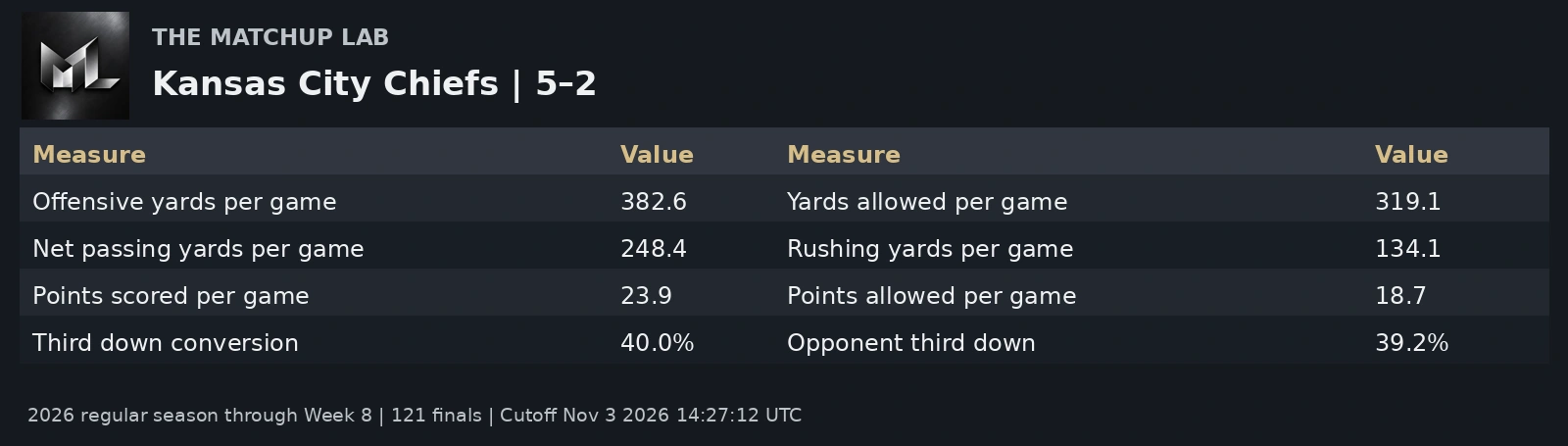
Kansas City lost 28–24 at Denver and sits 5–2, with a season profile that still looks stronger than one result. The Chiefs gain 382.6 yards a game, split between 248.4 net passing and 134.1 rushing, while allowing 319.1. Yet that yardage advantage produces only 23.9 points a game. The defense’s 18.7 points allowed has helped keep the team ahead overall. Kansas City should scrutinize how often its movement becomes scoring rather than assume a productive offense automatically provides enough points.