
THE MATCHUP LAB · NFL
Game Center
Scores, statistics and the story behind the game.
Checking for updates…
Complete NFL Week 9 recap and all 32 team assessments
Week 9 win 27–23 against Indianapolis Colts
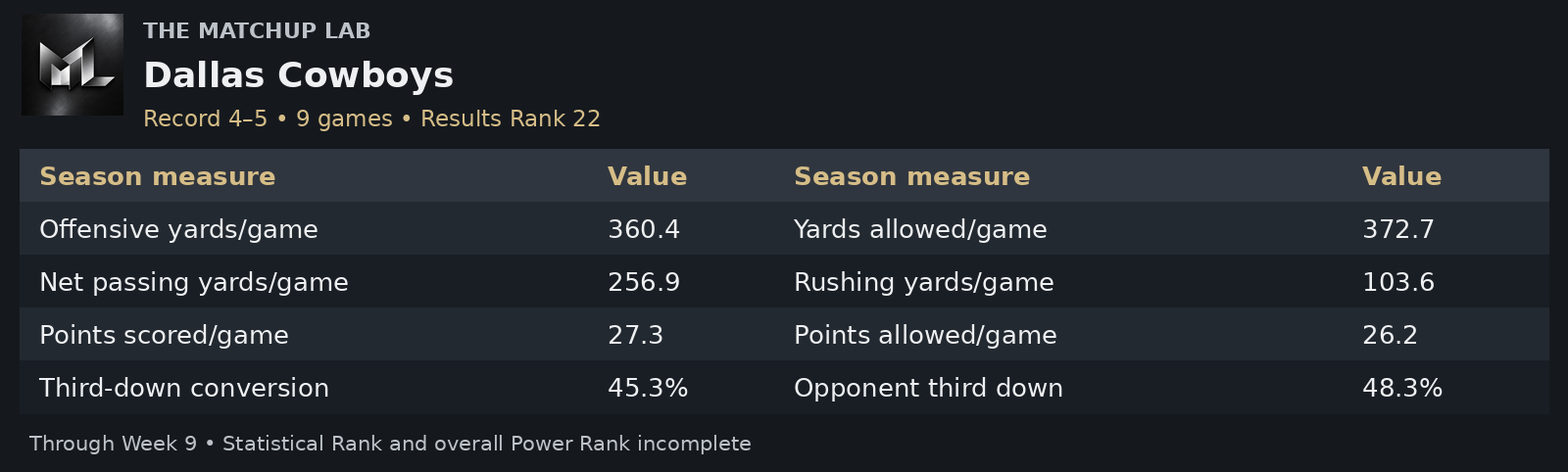
Dallas has enough offense to keep giving itself chances, but a 4–5 record shows how often those chances remain uncomfortable. The Cowboys beat Indianapolis 27–23 after scoring 30 in a loss to Arizona and 38 in a win over Philadelphia. Their season average of 27.3 points is supported by 360.4 yards and a 45.3 percent third-down conversion rate. The defense allows 372.7 yards per game and opponents convert 48.3 percent of third downs. That leaves Dallas asking its offense to answer repeated opportunities rather than enjoy frequent defensive stops.
San Francisco is next with a 51.7 percent third-down conversion rate and 29.4 points per game. That is a direct examination of Dallas's most obvious defensive weakness. The Cowboys should be capable of contributing points themselves, but matching every productive 49ers possession would create another demanding afternoon. Their best route to a more convincing performance is to end drives before the scoreboard requires another response. The Indianapolis win supplied a result; it did not settle that season-long defensive question.
Week 9 loss 23–27 against Dallas Cowboys
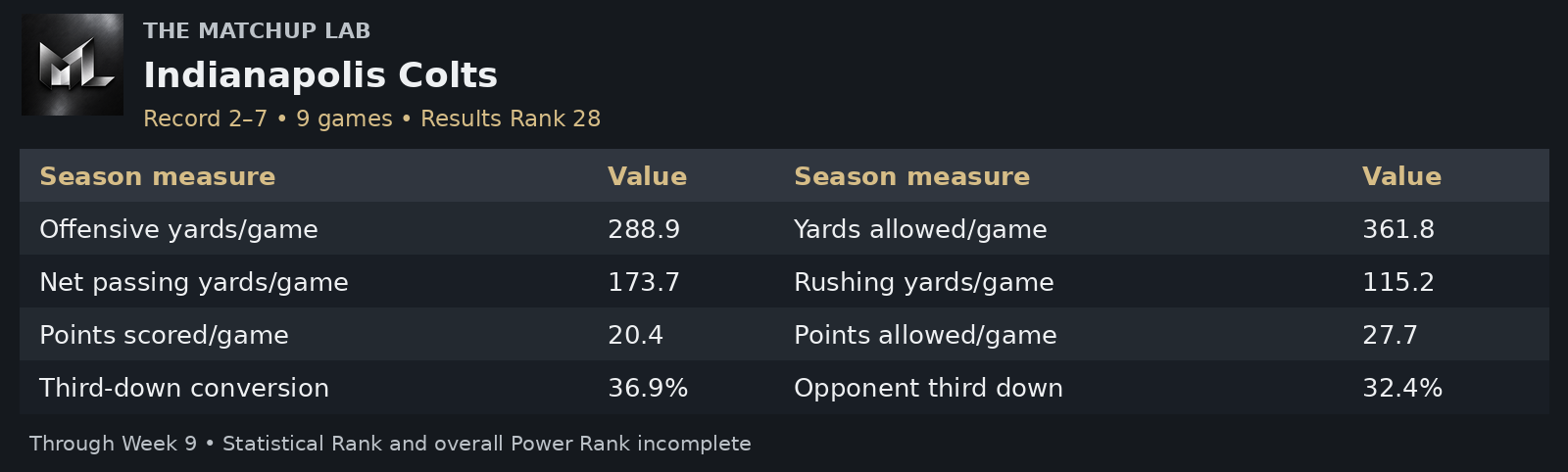
Indianapolis improved its scoring considerably after the 42–7 defeat against Jacksonville, but a 27–23 loss to Dallas still left the Colts 2–7. The season offense averages 288.9 yards and 20.4 points, with 173.7 passing yards limiting the overall reach of the attack. Defensively, Indianapolis allows 361.8 yards and 27.7 points per game despite holding opponents to a 32.4 percent third-down conversion rate. Success in that particular situation has not produced equivalent protection across the full game, and the scoring allowance remains a substantial burden.
Miami is next with an offense averaging 15.8 points per game, giving Indianapolis an opportunity to establish a more controlled defensive result. The Dolphins also allow opponents to convert 47.4 percent of third downs. That offers the Colts a way to improve on their own 36.9 percent conversion rate and extend possessions. The Dallas game showed a better offensive return than the previous week. Indianapolis now needs improvement that changes the result as well as the appearance of the score.
Dallas beat Indianapolis 27–23 to reach 4–5, while the Colts slipped to 2–7. The Cowboys' 27 points were close to their season average of 27.3, but the four-point margin also fits a team allowing 26.2 per game. Dallas converts 45.3% of its third downs while allowing opponents 48.3%, a reminder that its offense carries a heavier burden than the record alone explains. Indianapolis remains vulnerable at 27.7 points allowed per game. This was a useful Dallas win, with its broader defensive questions still unresolved.
Complete NFL Week 8 recap and all 32 team assessments
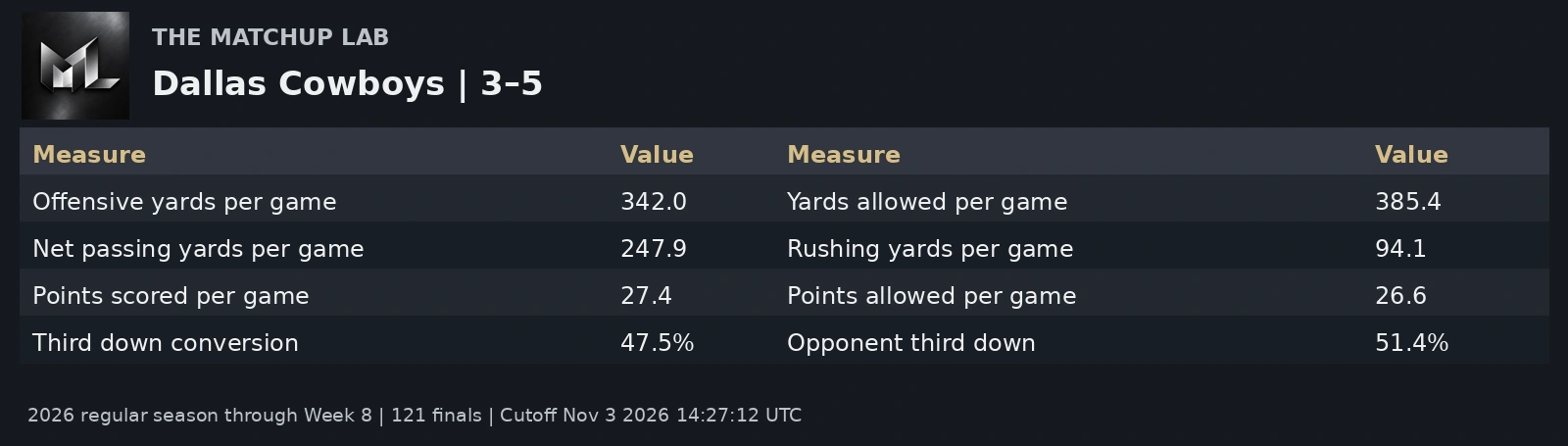
Dallas scored 30 and lost to Arizona in overtime, leaving a 3–5 team with more offensive capability than defensive control. The Cowboys convert 47.5% of third downs and average 27.4 points, but opponents convert 51.4% and gain 385.4 yards a game. Their season scoring edge is only six points despite that offensive production. The practical problem is possession: sustained Dallas series lose much of their value if the defense immediately permits another. The latest loss is evidence that scoring competence alone has not supplied a dependable advantage.
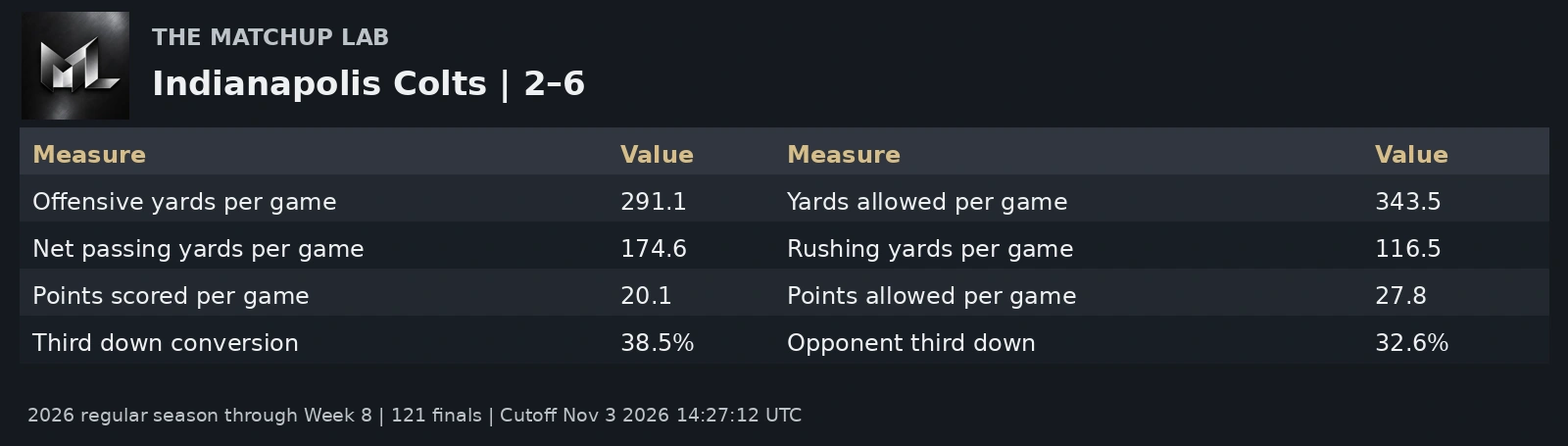
Indianapolis fell 42–7 at Jacksonville, pushing an already unfavorable season scoring balance to 161–222. The Colts average 291.1 yards and 20.1 points, too little production to cover a defense conceding 27.8 points a game. Their opponent third-down rate of 32.6% is relatively encouraging, which makes the broader scoring and yardage concessions worth separating from third-down performance. The evidence does not support a simple claim that one conversion problem explains everything. Both the offense’s output and the defense’s overall containment require improvement.