
THE MATCHUP LAB · NFL
Game Center
Scores, statistics and the story behind the game.
Checking for updates…
Sun Nov 22 · Noon Central | Power 10 / 28 | Statistical 15 / 31
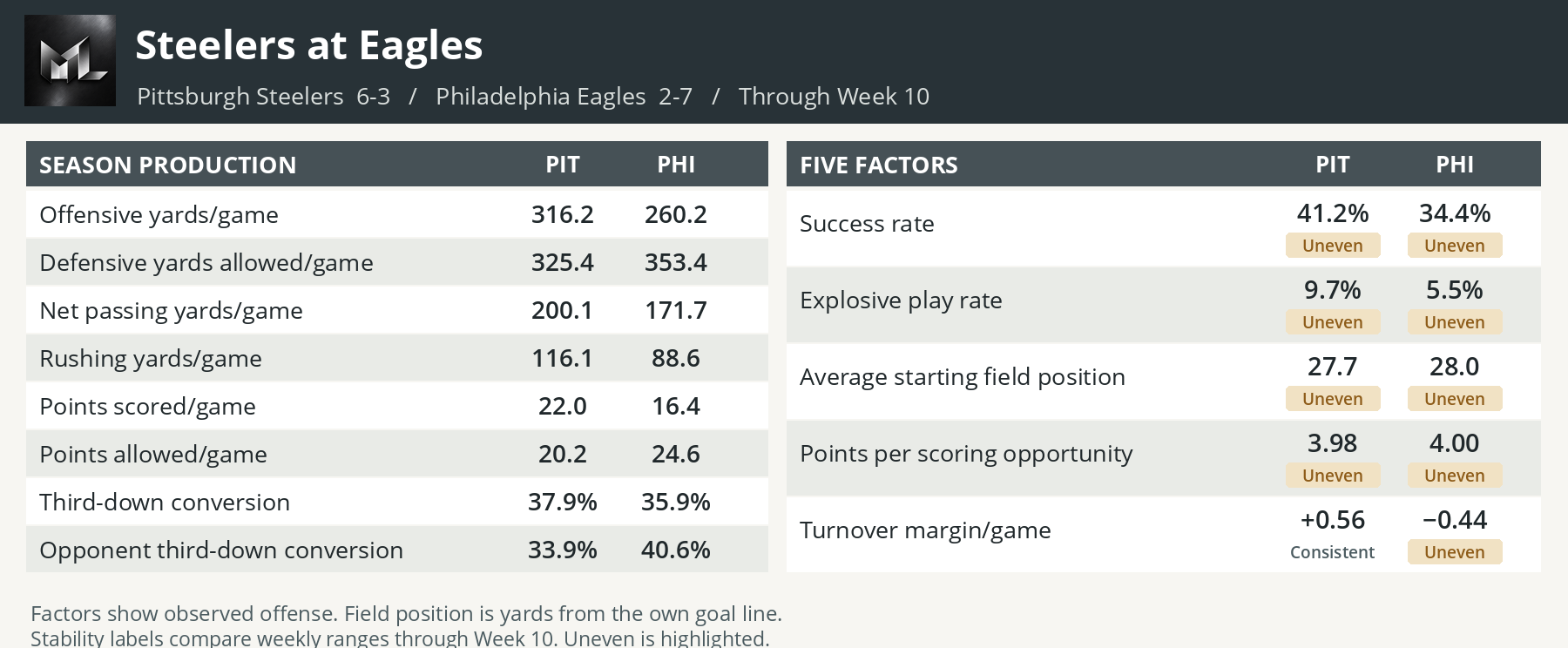
Pittsburgh’s 38–18 loss to Cincinnati was a reminder that a defense can lose control when a strong offense keeps converting. Philadelphia presents a very different test. The Eagles succeed on only 34.4 percent of qualifying plays and generate an explosive gain on 5.5 percent. Pittsburgh has allowed a 43.2 percent success rate, so the opportunity for Philadelphia is to find ordinary gains before asking for something dramatic. Coming off a bye, the Eagles need a sequence of manageable downs more than they need to imitate Cincinnati’s scoring pace.
The Steelers’ defense has kept scoring opportunities relatively contained, allowing 3.43 points per trip into the opponent’s 40. Philadelphia’s offense averages 4.00 on those opportunities, but it gains only 260.2 total yards per game. That is the central tension for the home team. Reaching the useful part of the field has been harder than producing points after arriving there. An early-down success rate of 33.9 percent leaves too many drives dependent on third-down recovery. Pittsburgh’s 33.9 percent third-down defense is well suited to punish that pattern.
On the other side, the Steelers bring a more balanced, moderate offense. They score 22.0 points per game, gain 316.2 yards and produce an explosive play on 9.7 percent of snaps. Philadelphia has conceded an explosive rate of 9.9 percent and 4.27 points per scoring opportunity. Pittsburgh can therefore create enough scoring chances without needing to win a high-volume passing contest. Its plus-five turnover margin supplies another small advantage, although the offense still needs to use any short field well. The Steelers average just under four points per scoring opportunity themselves.
The game moved into the Sunday noon Central window, and the 37.5 total is the lowest on the board. Pittsburgh gives 4.5. That price fits a contest in which a handful of productive drives can decide the result, but it also leaves the favorite vulnerable to a wasted possession near scoring range. Philadelphia’s first objective is to replace long-yardage desperation with repeatable early-down progress. Pittsburgh’s is to take the ordinary openings the defense allows, finish them and avoid letting a close score turn the final few minutes into a single-possession gamble.
Complete NFL Week 10 recap and all 32 team assessments
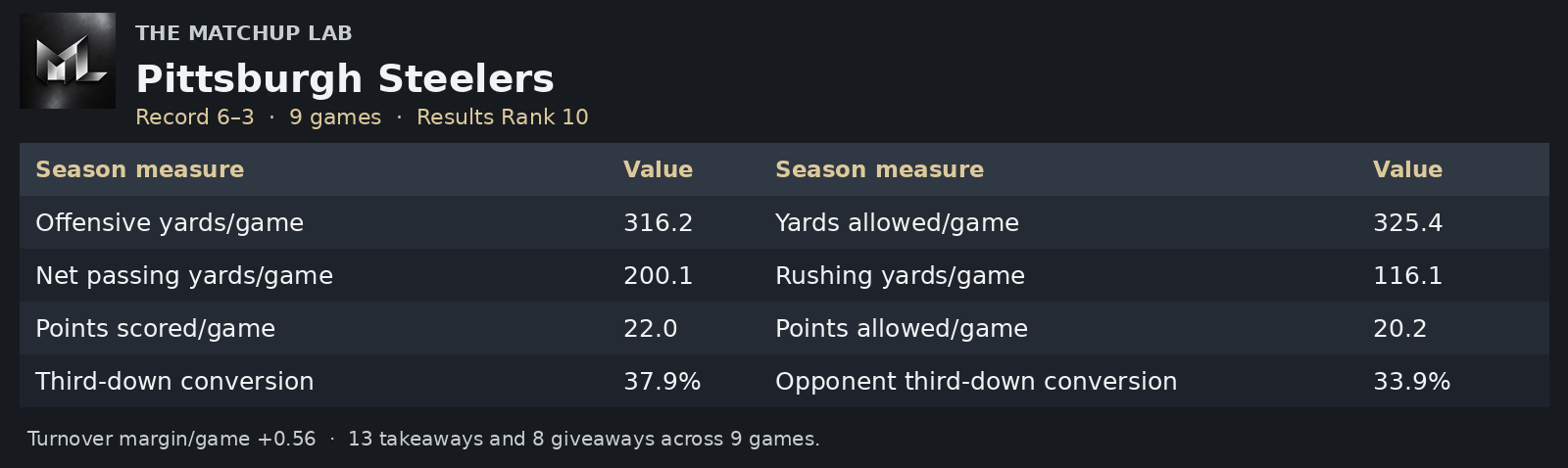
The Steelers left Cincinnati with no giveaways and a 20-point loss. Their defense normally allows opponents to convert 33.9 percent of third downs. Burrow made that strength largely irrelevant by facing only seven. On offense Aaron Rodgers found two fourth-quarter touchdown passes, after Cincinnati already had firm control. Against Philadelphia, a more valuable early throw would be one that keeps a first-half possession alive long enough to give Pittsburgh’s defense a lead to protect.
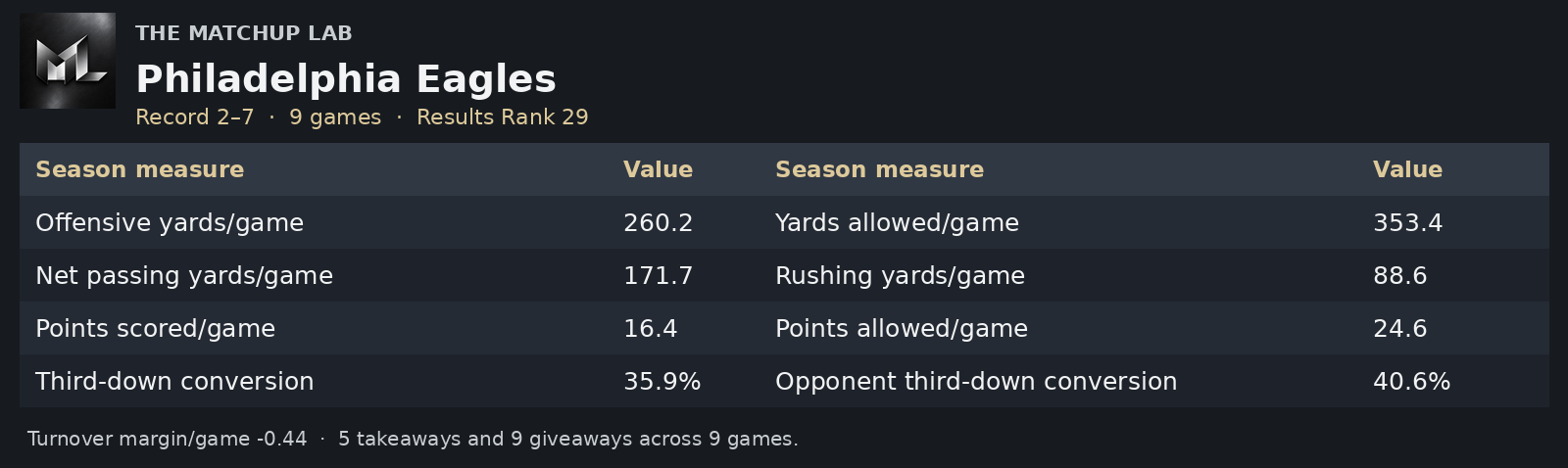
Philadelphia had a bye at 2–7. Over nine games it averaged 260.2 yards and 16.4 points while opponents gained 353.4. Pittsburgh’s loss offers a lesson with a limit. Cincinnati attacked early enough to avoid most third downs, but it did that with one of the league’s most productive passing offenses. For the Eagles, a completion that makes second down manageable is a more plausible starting point than trying to duplicate Burrow’s 409 yards.