
THE MATCHUP LAB · NFL
Centro del partido
Marcadores, estadísticas y la historia del partido.
Buscando actualizaciones…
Sun Nov 22 · 3.05 p.m. Central | Power 29 / 31 | Statistical 22 / 29
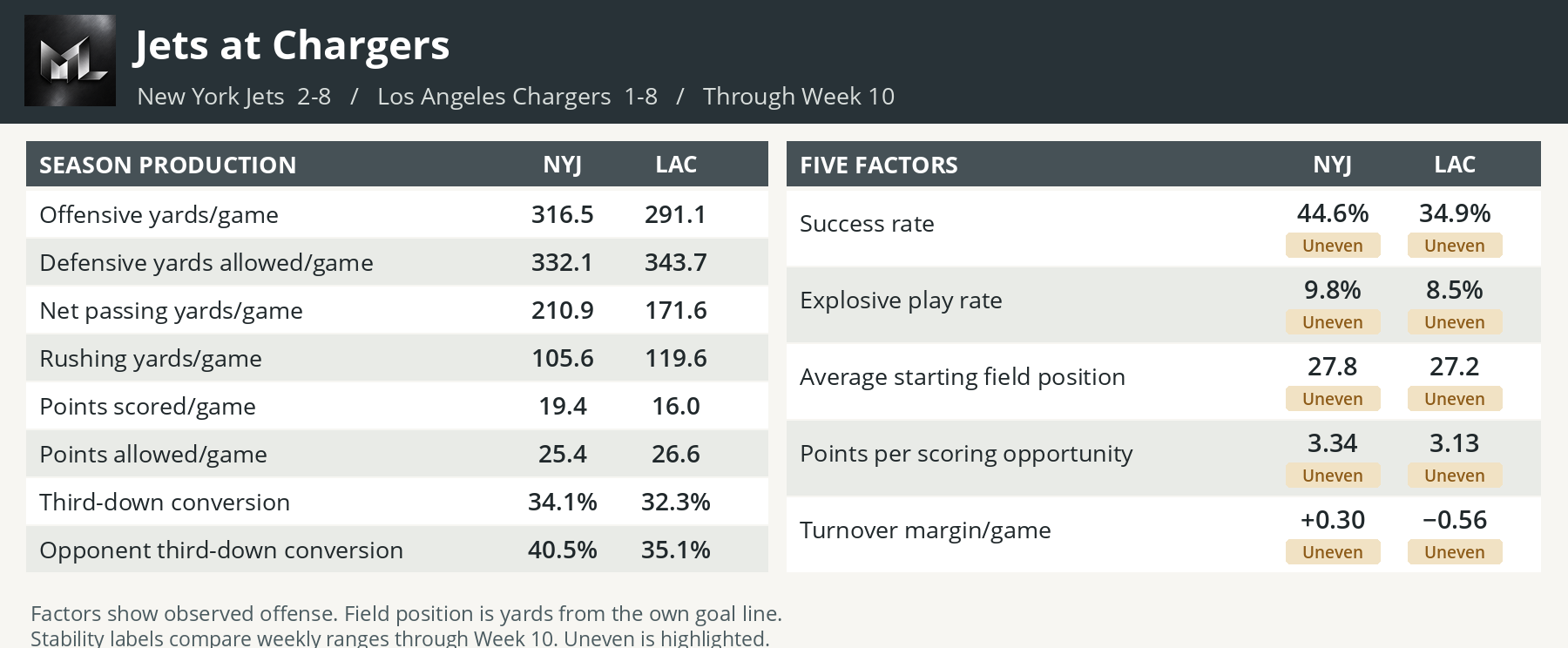
The Chargers finally have a win after beating Baltimore 23–20. The Jets arrive after a 31–12 loss to Buffalo, yet the underlying comparison gives New York a credible route into this game. The Jets succeed on 44.6 percent of offensive snaps and 47.1 percent on early downs. Los Angeles sits at 34.9 and 35.6 percent. The problem for New York is converting that movement into points. Its 3.34 points per scoring opportunity are modest, while its defense has allowed 5.26. The Jets can win ordinary stretches of a drive and still lose badly on the scoreboard.
That finishing problem meets a Chargers offense averaging only 3.13 points per scoring opportunity. Something has to give when Los Angeles reaches the opponent’s 40. The Chargers cannot rely on volume to rescue a poor conversion rate there. They gain 291.1 yards per game and convert only 32.3 percent of third downs. New York’s defense has allowed a 45.6 percent success rate, so there is space for Los Angeles to move more comfortably than its season average suggests. The first requirement is to avoid turning that space into another long third down.
New York has a more favorable turnover record, with 12 takeaways and nine giveaways. Los Angeles has given the ball away 19 times. That comparison could become especially costly for the home team because the Jets already have the stronger early-down offense. A short field would reduce the number of successful plays New York needs before its finishing problem becomes relevant. Conversely, the Chargers can help their defense by making the Jets travel the full field and produce several clean conversions. New York’s 34.1 percent third-down rate offers a place to end those possessions.
Los Angeles gives three points with a total of 41.5. The recent win gives the Chargers something to build on, while the Jets’ statistical profile explains why the spread remains narrow despite their own losing run. This game turns on whether either team can turn useful movement into a complete possession. The Jets need their finishing to catch up with their early-down efficiency. The Chargers need ball security and manageable third downs to let the offense reach scoring territory often enough. A repeat of last week’s close-game execution would be useful, but the season numbers still demand more consistency.
Complete NFL Week 10 recap and all 32 team assessments
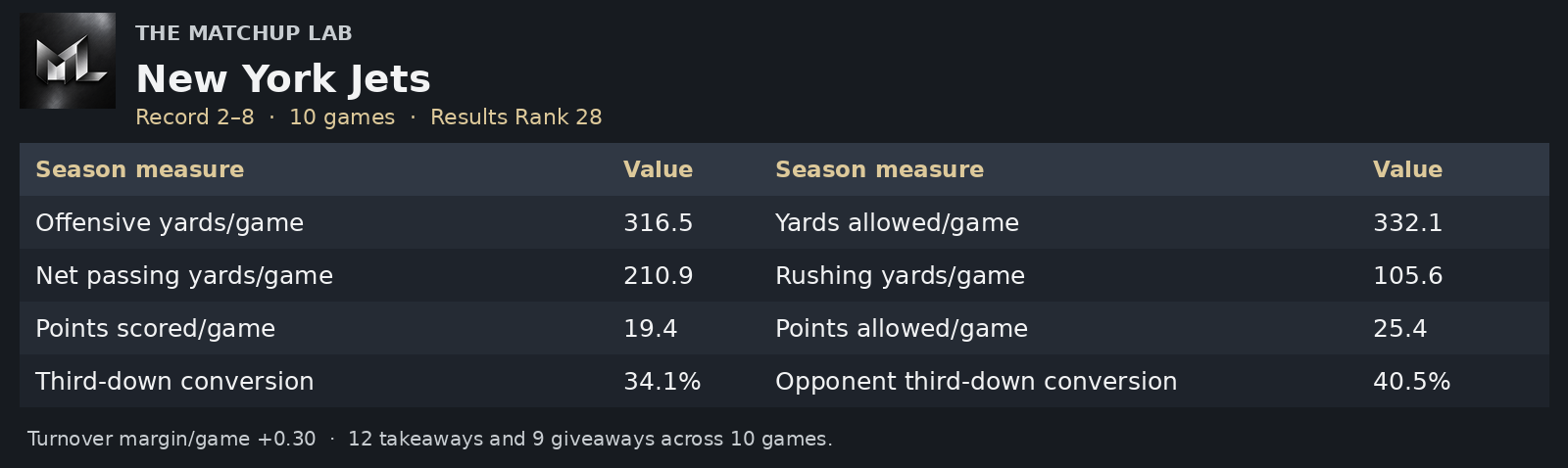
The Jets made 19 first downs and had 376 yards against Buffalo. Their four scoring drives produced 12 points. Garrett Wilson caught seven passes for 106 yards, but New York missed both chances to finish from inside the 20. The Chargers just won with 15 first downs because they protected the ball and ran for two scores. At SoFi the Jets can make a large improvement without gaining a single additional yard if they finish one more of those drives.
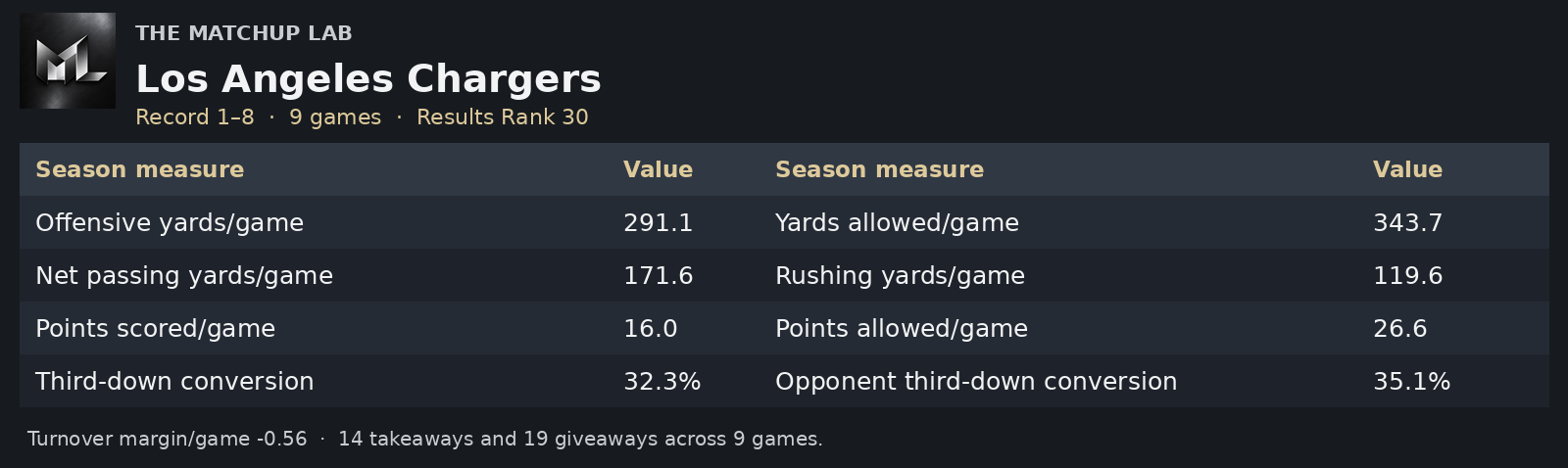
Hampton gained 105 yards on 22 carries and Herbert scored on a 22-yard run. Both helped Los Angeles win for the first time despite going two for 13 on third down. The Chargers average only 16 points per game, so the clean turnover line mattered as much as the rushing total. The Jets can move the ball between the 20s. Giving them a short field would spare them the part of the job they struggled to finish against Buffalo.