
THE MATCHUP LAB · NFL
Game Center
Scores, statistics and the story behind the game.
Checking for updates…
Sun Nov 22 · 3.25 p.m. Central | Power 4 / 11 | Statistical 3 / 19
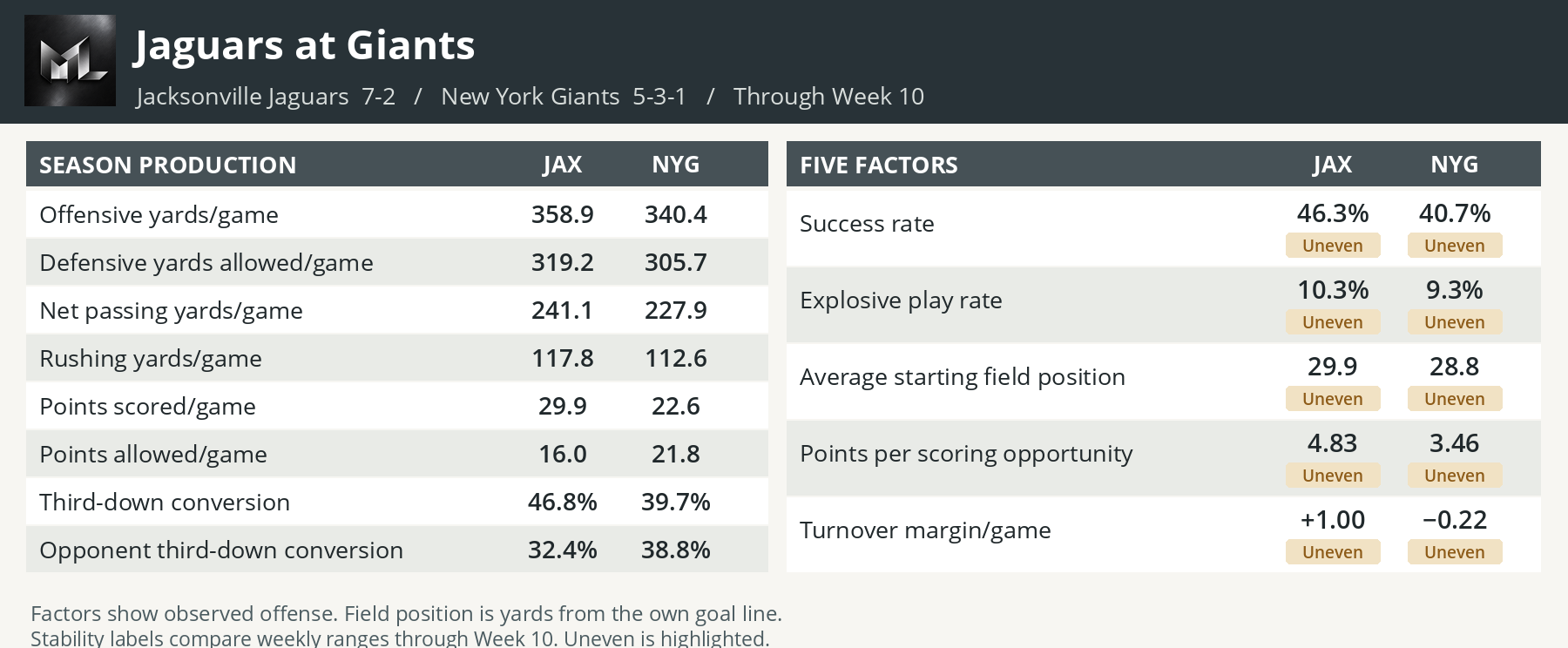
Jacksonville has paired a 7–2 record with the league’s third-best Statistical Rank and a plus-125 scoring margin. The Jaguars’ 40–23 win over Tennessee added to a profile that already works at both ends of the field. They succeed on 46.3 percent of offensive plays and allow 40.3 percent. They also average 4.83 points per scoring opportunity while conceding 3.27. The Giants therefore need more than a respectable yardage afternoon. They need to prevent Jacksonville from converting the possessions that reach the useful part of the field into a steady run of touchdowns.
New York’s defense allows only 305.7 yards per game, which gives it a way to control how often those opportunities appear. The warning is what happens after opponents arrive. The Giants have allowed 4.49 points per scoring opportunity. Jacksonville’s finishing strength can exploit that gap even if its total yardage looks ordinary. The Jaguars also have a plus-nine turnover margin and begin eligible drives at their own 29.9. New York needs clean exchanges and disciplined field position to make Jacksonville earn every scoring chance across a longer field.
The Giants’ offense has a different problem. It gains 340.4 yards per game but averages only 3.46 points per scoring opportunity. Last week’s 24–21 loss to Washington included 399 offensive yards, another example of movement failing to secure the result. New York’s 39.7 percent third-down rate meets a Jacksonville defense allowing 32.4 percent. Useful first- and second-down gains are therefore essential, particularly against a defense that has limited explosive plays to 7.5 percent. Waiting for one long gain to solve a drive is a demanding strategy against this opponent.
The game moved to 3.25 p.m. Central, and Jacksonville is favored by six with a total of 46.5. The Giants’ 5–3–1 record keeps them firmly in a meaningful season, but this matchup tests the weaker parts of their statistical profile. Jacksonville can create separation by repeating the small advantages it has already shown, then finishing the possession. New York’s route is to make the defense’s yardage restraint carry through to the scoreboard and get more than a field goal from its own best drives. A single late possession matters only if those earlier opportunities remain competitive.
Complete NFL Week 10 recap and all 32 team assessments
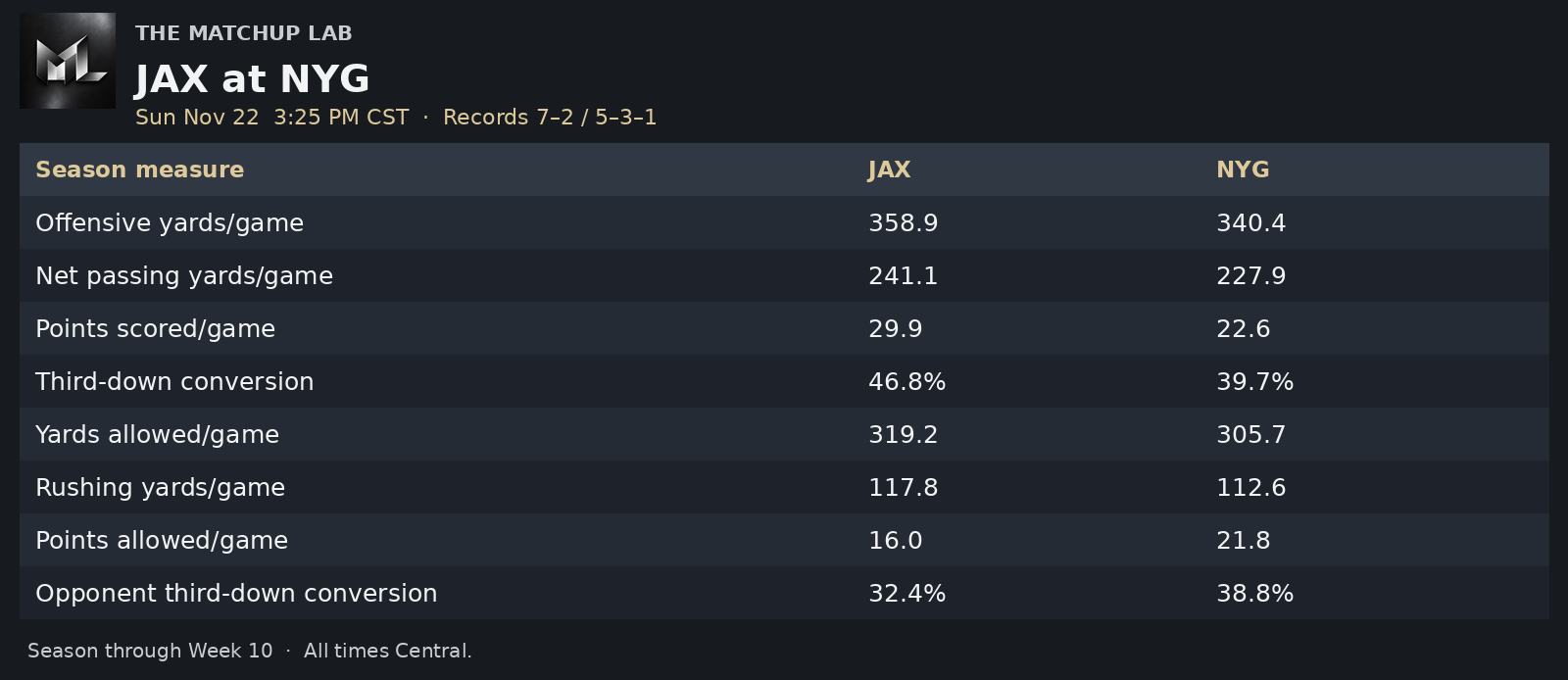
Jacksonville had the ball for more than 38 minutes in Tennessee. The Giants just lost a game in which they outgained Washington by 59 yards. New York has enough offense to threaten a Jacksonville defense allowing 16 points a game, but another two-for-four red-zone day would give Lawrence considerable freedom to alternate throws with Tuten’s runs. Watch whether the Giants can score seven on their first good drive and change the decisions Jacksonville has to make.
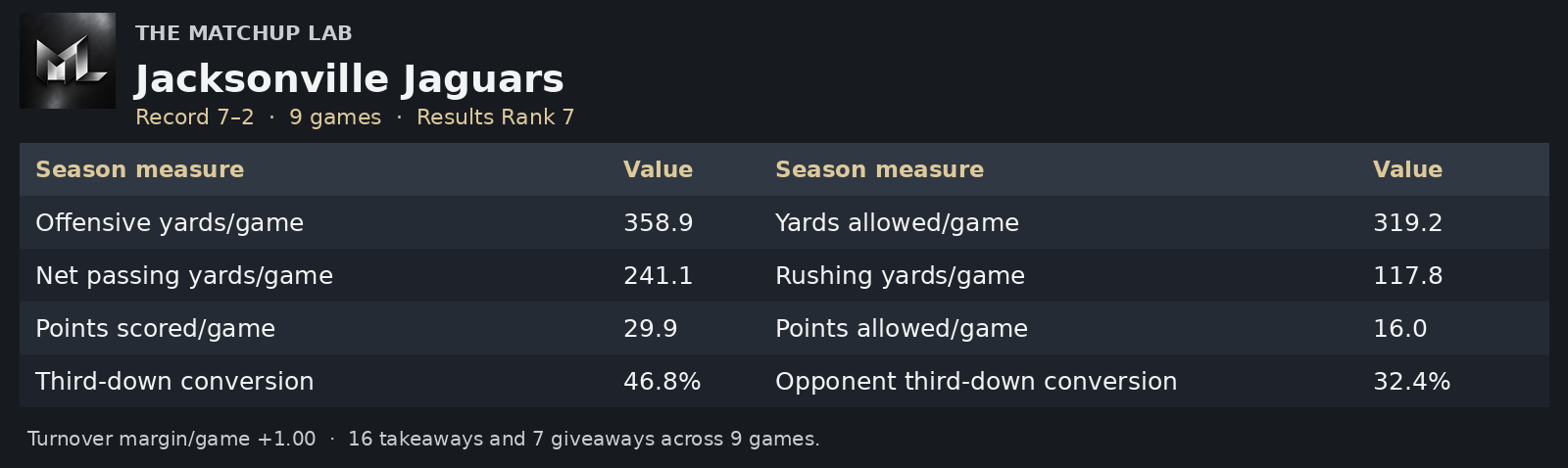
Parker Washington averaged more than 21 yards on each of his seven catches. Jacksonville also got 26 carries from Tuten, keeping the clock moving after the passing game stretched Tennessee’s defense. At 29.9 points scored and 16.0 allowed per game, the Jaguars have room to change speeds. The Giants just surrendered the winning pass with 57 seconds left. Making their secondary defend the full width of the field for four quarters is a better test than hoping to reproduce a single long gain.
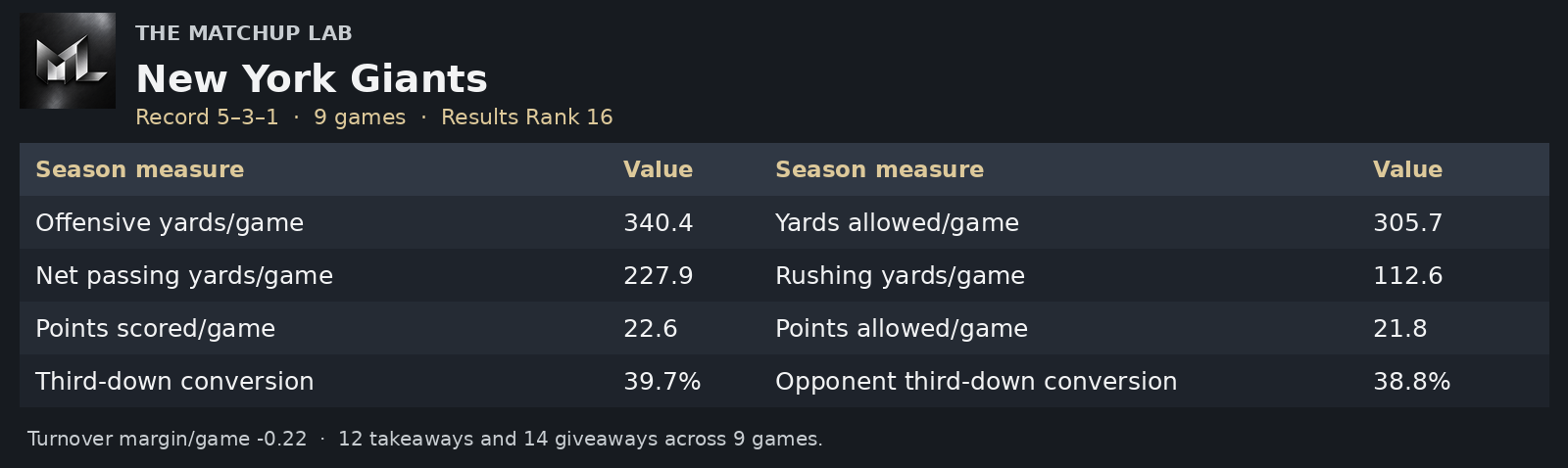
Likely’s nine catches for 127 yards included a 66-yard score that put New York ahead. The Giants did considerably more than hit one pass, finishing with 399 yards. Turning two of four red-zone visits into touchdowns left Washington within a single score. Jacksonville allows 16 points a game. Its defense can live with an occasional completion between the 20s if it forces another field-goal decision near the end of a drive.