
Reporting credits go to NCAA Week 7 coverage, Associated Press reporting on Notre Dame and BYU carried by KPRC, NBC Sports reporting on Tennessee and Alabama, SEC availability reporting and ESPN game summaries. Calculations use the retained SportsDataverse play and team data. The season assessments below are original Matchup Lab analysis.
Wisconsin Badgers 7 at UCLA Bruins 17
Final · 2026-10-17T23:30Z · Rose Bowl
Read the complete Week 7 recap and current performance top 25
Season statistics through October 18 2026 at 5 AM Central.
21 Wisconsin
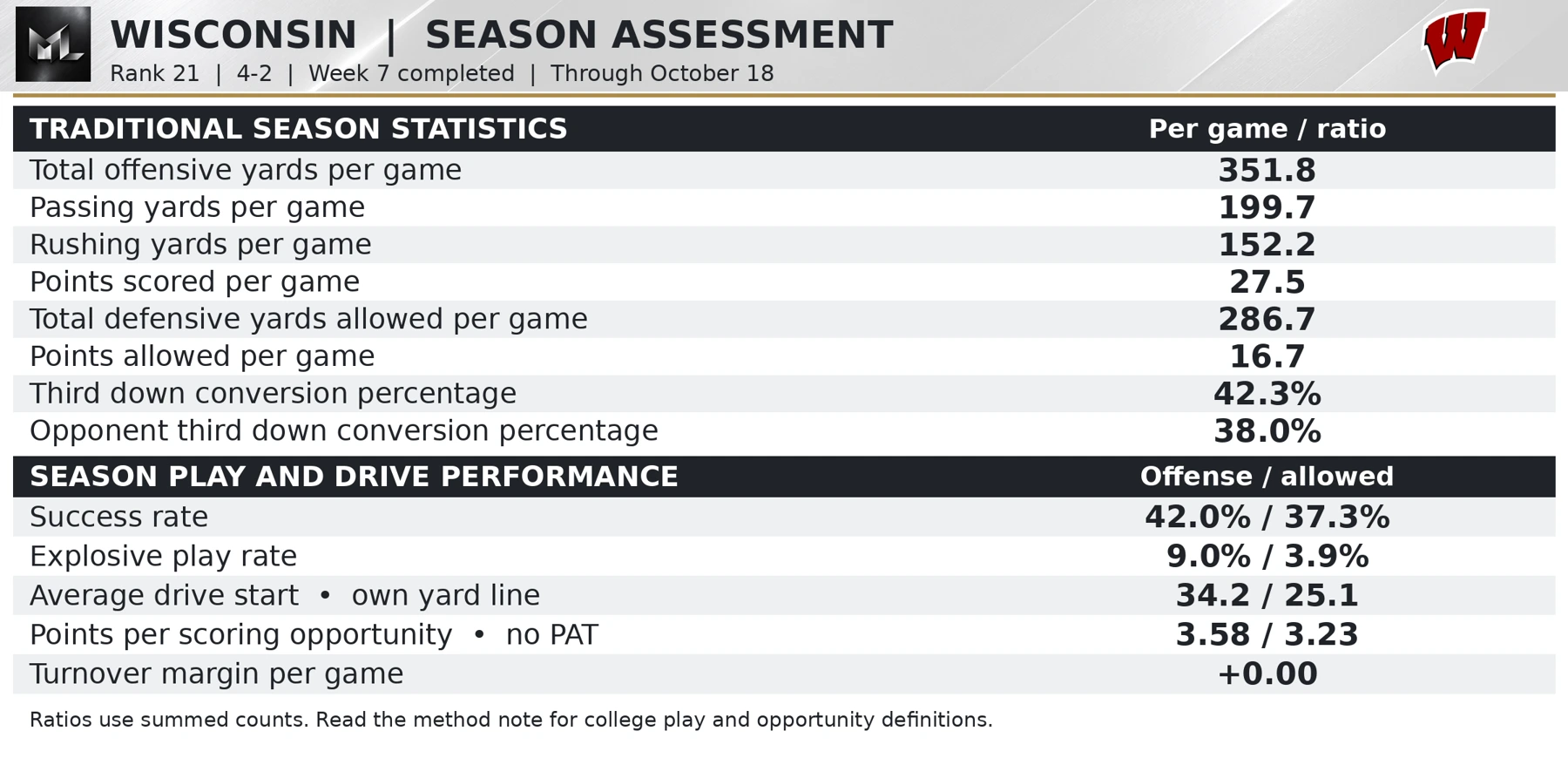
Wisconsin's four-game winning run ended at UCLA, where the Badgers scored seven after their previous four games produced at least twenty-four. The 4–2 season still has a defense allowing 286.7 yards and 16.7 points per game. Saturday's 17–7 defeat shows how little margin that defense receives when the passing game contributes almost nothing.
Wisconsin ran for 148 yards but passed for sixty-six and converted only three of ten third downs. The defense recorded two takeaways while the offense had no giveaway, and the Badgers started farther forward on average. Those advantages made the lack of offensive return more difficult to excuse. UCLA converted thirteen of twenty third downs, keeping Wisconsin's defense occupied even when it avoided a large score.
Preventing major gains remains one of the strongest parts of the season. The defensive explosive rate allowed is only 3.9 percent, well below the Badgers' own rate generated. But a team that cannot extend ordinary offensive possessions may never get enough chances to exploit that advantage. Wisconsin needs a passing contribution that makes the running game less isolated and more efficient use of the fields its defense and special teams help provide. Its rise of two places reflects the entire calculation and opponent evidence, not an endorsement of seven points on an afternoon with extra possessions.
4 UCLA
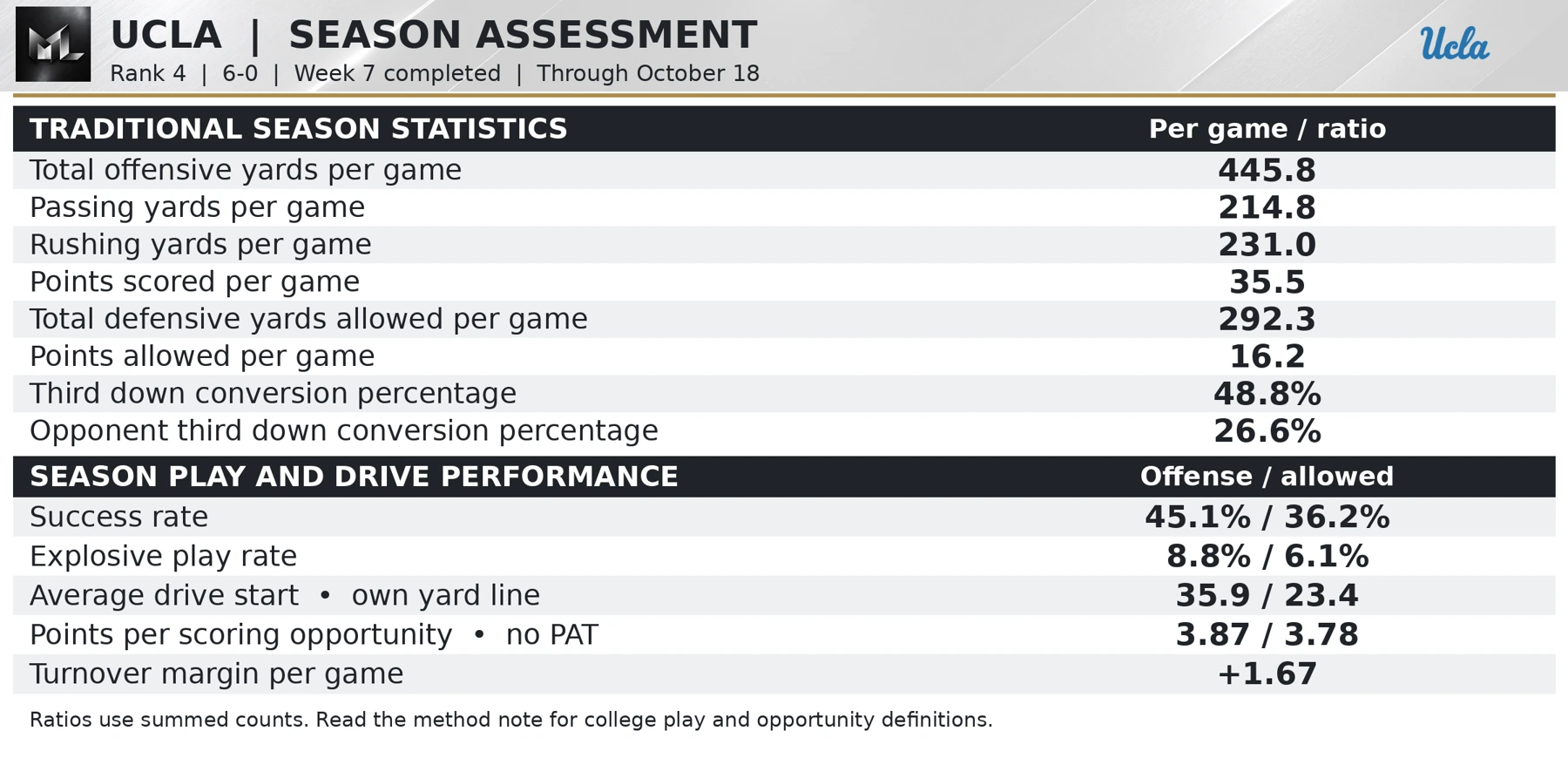
UCLA has followed its fifty-point afternoons with consecutive wins in the teens. The Bruins are 6–0 after beating Wisconsin 17–7, having edged Oregon 17–15 a week earlier. That sequence gives the season a more useful shape than an average of 35.5 points alone. UCLA has shown that its defense can keep a smaller offensive return sufficient.
Wisconsin gained only 214 yards and converted three of ten third downs. UCLA converted thirteen of twenty, a sustained answer that helped compensate for losing the turnover count two to zero. The Bruins also started offensive drives near their own 23, behind Wisconsin's average near the 30. Winning despite those disadvantages is stronger evidence of ordinary execution than winning after receiving repeated short fields.
The season still contains favorable starts and a net takeaway surplus of 1.67 per game. Saturday demonstrates that UCLA is capable of functioning without both gifts, not that it should expect to overcome careless possessions indefinitely. Its scoring-opportunity returns are much closer between offense and defense than the overall scoring margin suggests. More clean finishes would reduce the need for twenty third-down attempts. The Bruins remain fourth in the index. Their practical strength is a defense that repeatedly makes the opponent work, with an offense willing to keep working when the spectacular totals disappear.