
THE MATCHUP LAB · NFL
Game Center
Scores, statistics and the story behind the game.
Checking for updates…
Read the complete NFL Week 6 preview
Sun Oct 18 · Noon Central
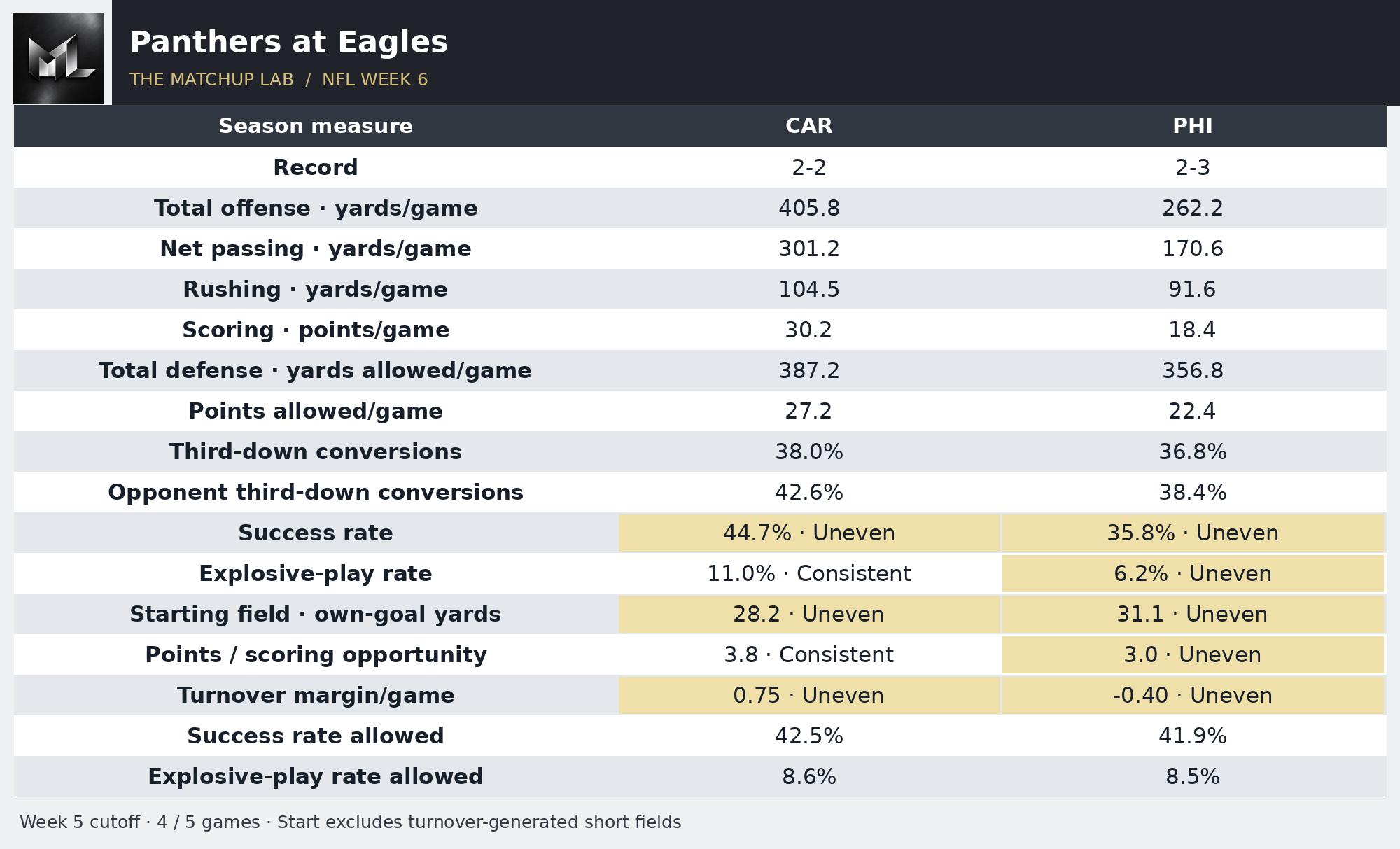
Carolina returns from its Week 5 bye with an offense producing 405.8 yards and 30.2 points per game. Philadelphia averages 262.2 yards and 18.4 points. That difference puts an immediate burden on the Eagles to change the terms of their possessions. They cannot spend the day waiting for a low-scoring game to appear while repeatedly giving Carolina another chance. Philadelphia has succeeded on only 35.8 percent of qualifying offensive snaps, which makes early-down improvement a requirement rather than a cosmetic adjustment.
Carolina's defense does leave an opening. The Panthers allow 387.2 yards and 27.2 points per game. Philadelphia should make that unit defend an entire drive before deciding that the only route back into the game is a difficult long throw. The Eagles have generated explosive gains on 6.2 percent of qualifying plays. Repeatedly seeking a low-frequency solution can turn a manageable possession into another punt before the opponent's defensive limitations have been tested.
Carolina also needs to scrutinize its own success. Its offense succeeds on 44.7 percent of qualifying snaps, a stronger base than Philadelphia's, but its defense allows a 42.5 percent success rate. A productive offense has not made the other side of the ball dependable. The Panthers' plus 0.75 turnover margin per game has been valuable across four games, yet it is not a substitute for a stop when Philadelphia begins with the ball and keeps it. The bye creates a schedule distinction, not proof that every weakness has been repaired.
The decisive contest is Philadelphia's ability to take the ordinary yards Carolina has conceded and keep its next third down manageable. The Eagles need longer, better-finished possessions, while the Panthers need to make their offensive advantage count without allowing a struggling opponent to discover rhythm. If Carolina gives away useful territory through poor defense or careless possession, the contrast in scoring averages will have been an opportunity wasted rather than a result secured.
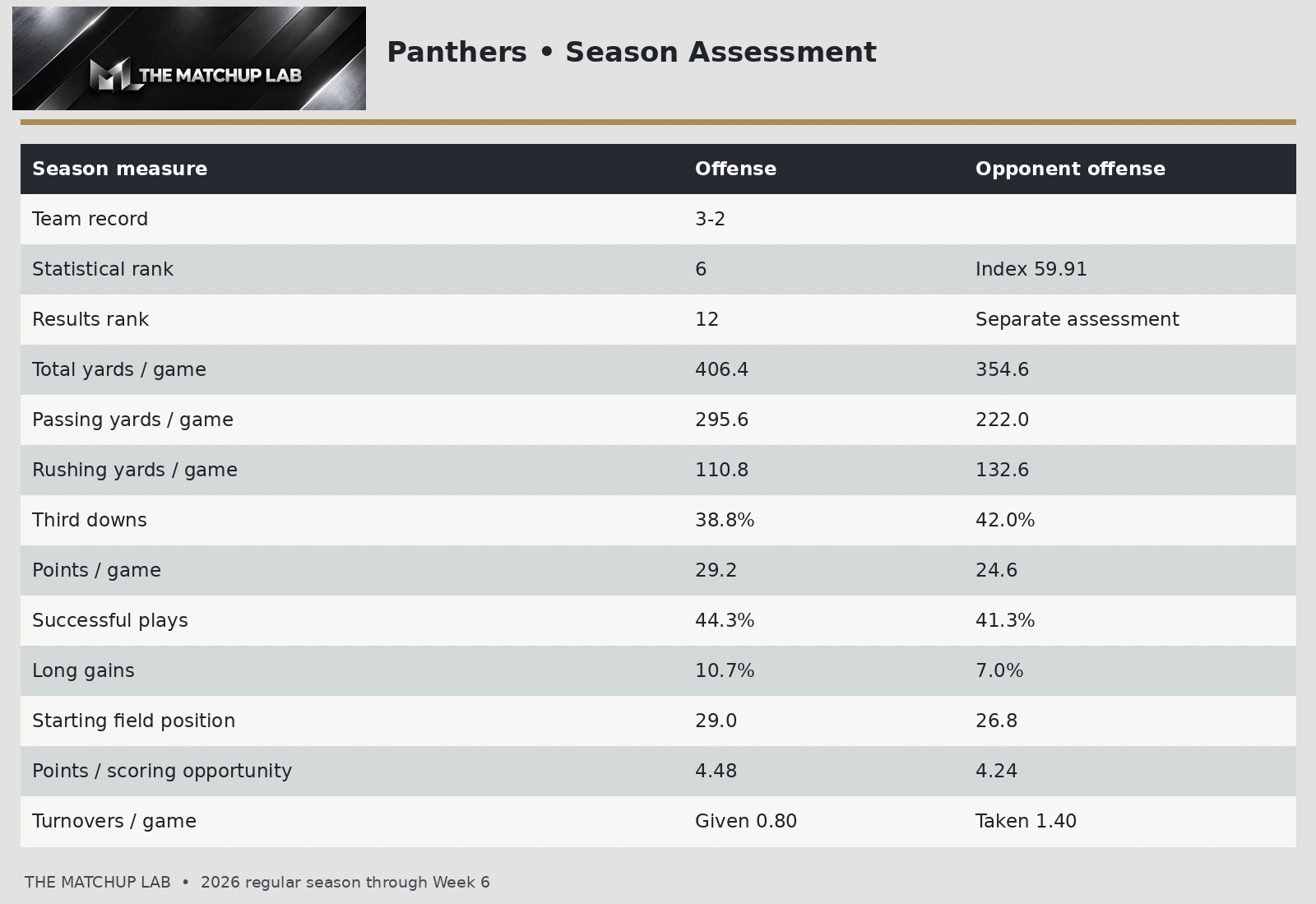
Carolina's 25–14 win at Philadelphia strengthened a season built on controlling the more repeatable portions of a game. The Panthers have created long gains more frequently than they have allowed them, and their ordinary-play comparison is favorable as well. That gives the offense more than one way to reach scoring territory. The record is still only 3–2, so sixth statistically describes the performance evidence rather than a claim that Carolina has already accomplished more than every team below it. The defense's job against Tampa Bay is to keep an opponent with a struggling offense from finding cheap relief. Carolina should insist on another efficient afternoon instead of assuming that the opposing record has already settled the matchup.
Next game is TB at CAR, Sunday, October 25th, 12:00 PM Central.
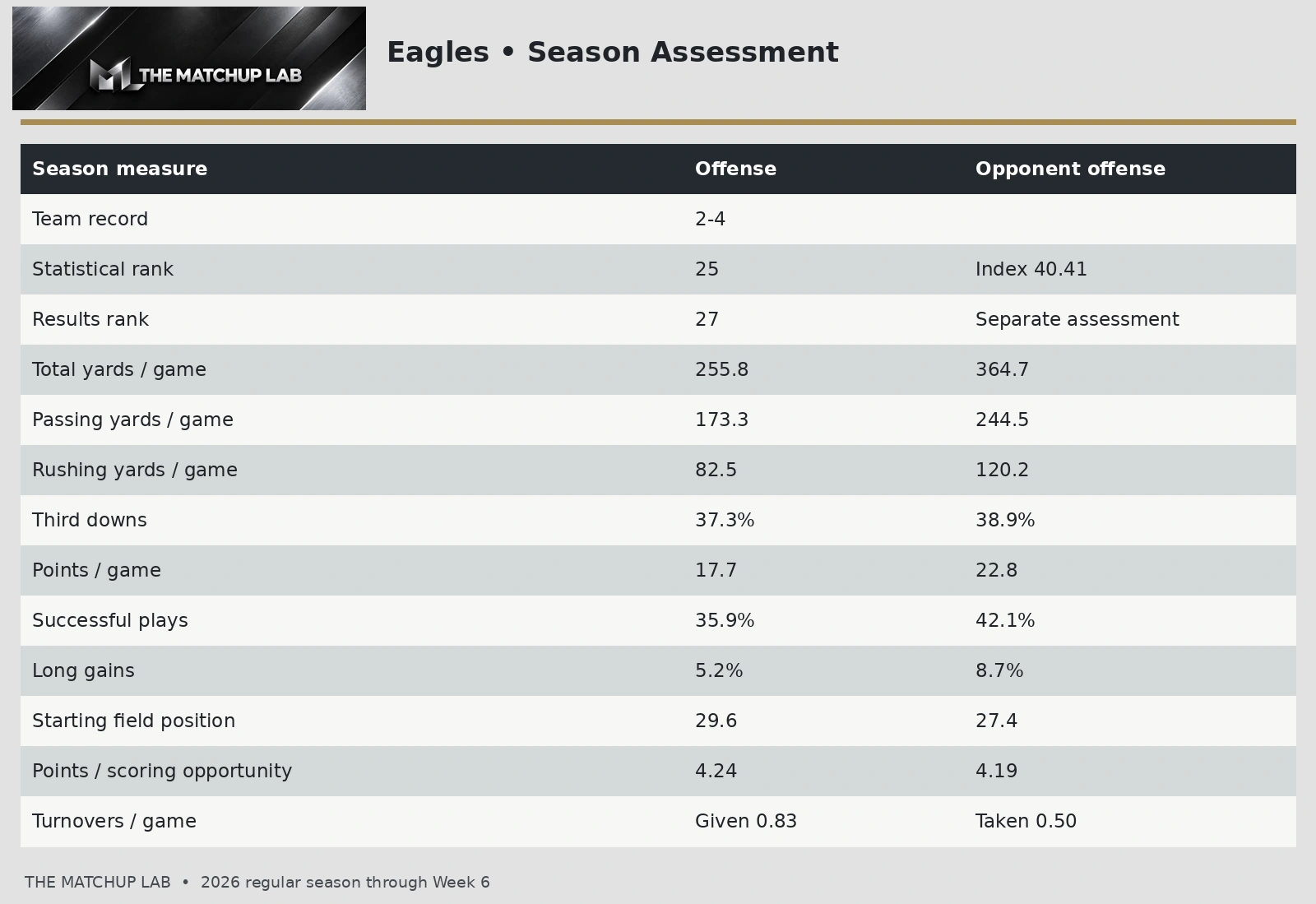
Philadelphia has lost four straight games after the 25–14 home defeat to Carolina. Its offensive scoring rate has fallen below eighteen points per game, while both ordinary progress and long gains have been harder to produce than to allow. Those problems reinforce each other. An offense that neither sustains drives nor escapes stalled possessions with larger plays gives its defense little time or scoreboard assistance. The negative turnover margin adds another avoidable burden. Twenty-fifth statistically and twenty-seventh in results describe the same broad concern. Dallas also arrives with recent offensive difficulty, but that does not solve Philadelphia's problem. The Eagles need to improve the sequence before the scoring attempt, creating manageable downs and fewer immediate returns to defense.
Next game is DAL at PHI, Monday, October 26th, 7:15 PM Central.