
THE MATCHUP LAB · College football · FBS
Game Center
Scores, statistics and the story behind the game.
Checking for updates…
3–31 final | 2026 regular season | Evidence cutoff 2026-11-01T11:35:11Z
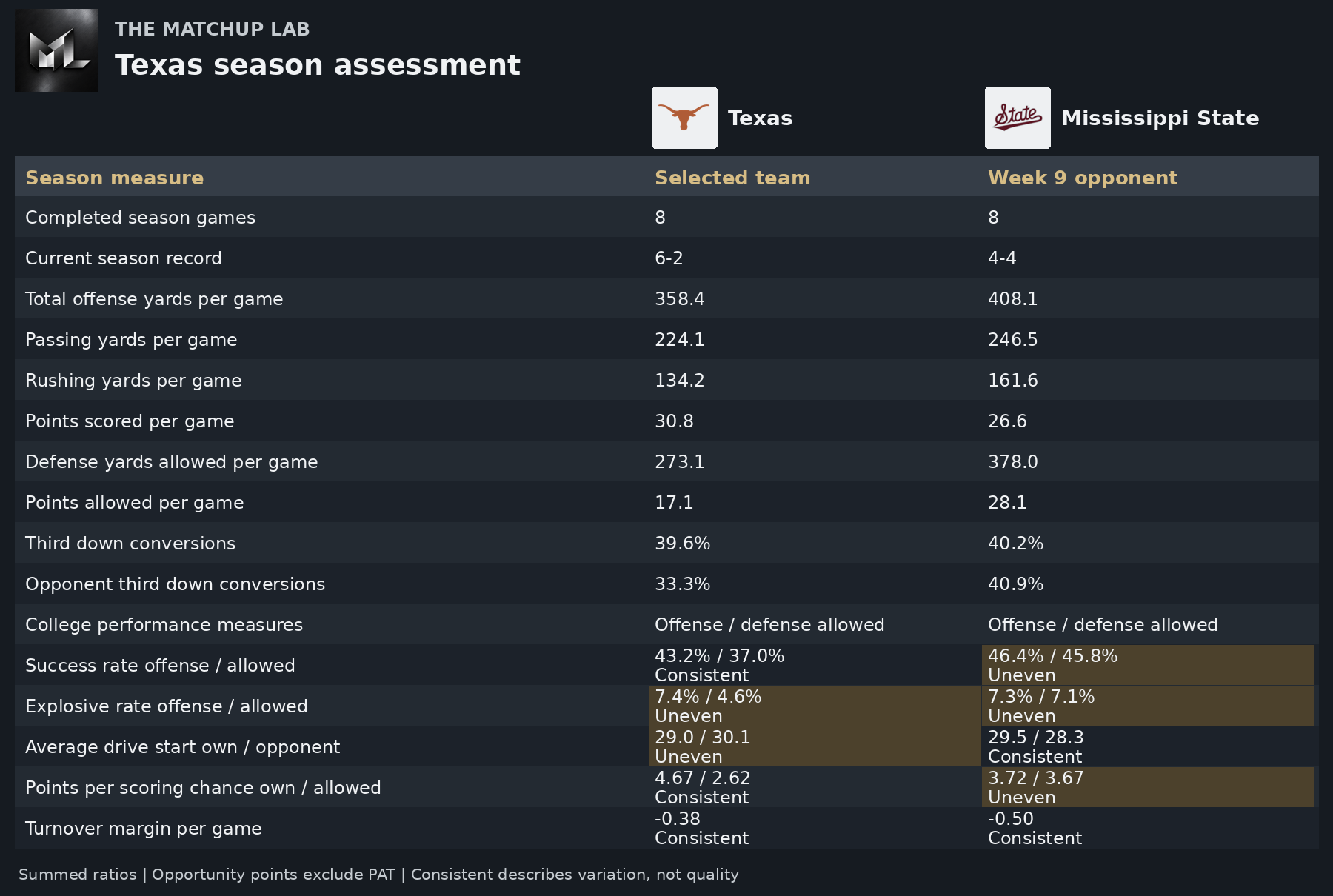
Texas beat Mississippi State 31–3 while gaining only 280 yards. The defense made that offensive total sufficient by allowing 187. The turnover count was level, so the margin cannot simply be explained away as a string of extra possessions. Texas repeatedly restricted what Mississippi State could do with the ball, then received a much larger scoreboard return from their own limited movement.
The season supports a defense-first reading. Texas allow 273.1 yards and 17.1 points per game, with opponents converting one-third of third downs. Their explosive-play allowance is particularly low. Keeping opponents from bypassing several downs at once means the defense has more opportunities to finish a possession before it reaches scoring range.
The offense is less imposing by volume. It averages 358.4 yards, including 134.3 rushing, and converts 39.6 percent of third downs. Against Mississippi State the run supplied only 60 yards. That puts pressure on the offense to turn the chances it does create into points. Its season finishing return is strong, but limited rushing production leaves less margin when the passing game has a difficult stretch.
Missouri are next, bringing a positive turnover margin and a recent four-takeaway game. Texas' own season turnover margin is negative, so possession protection matters even though it was not the deciding difference this week. The Longhorns need to preserve their defensive control while making offensive progress less dependent on squeezing a large return from a small number of useful drives.
2026-10-31T23:30:00.000Z | 2026 regular season | Evidence cutoff 2026-10-30T10:20:00Z
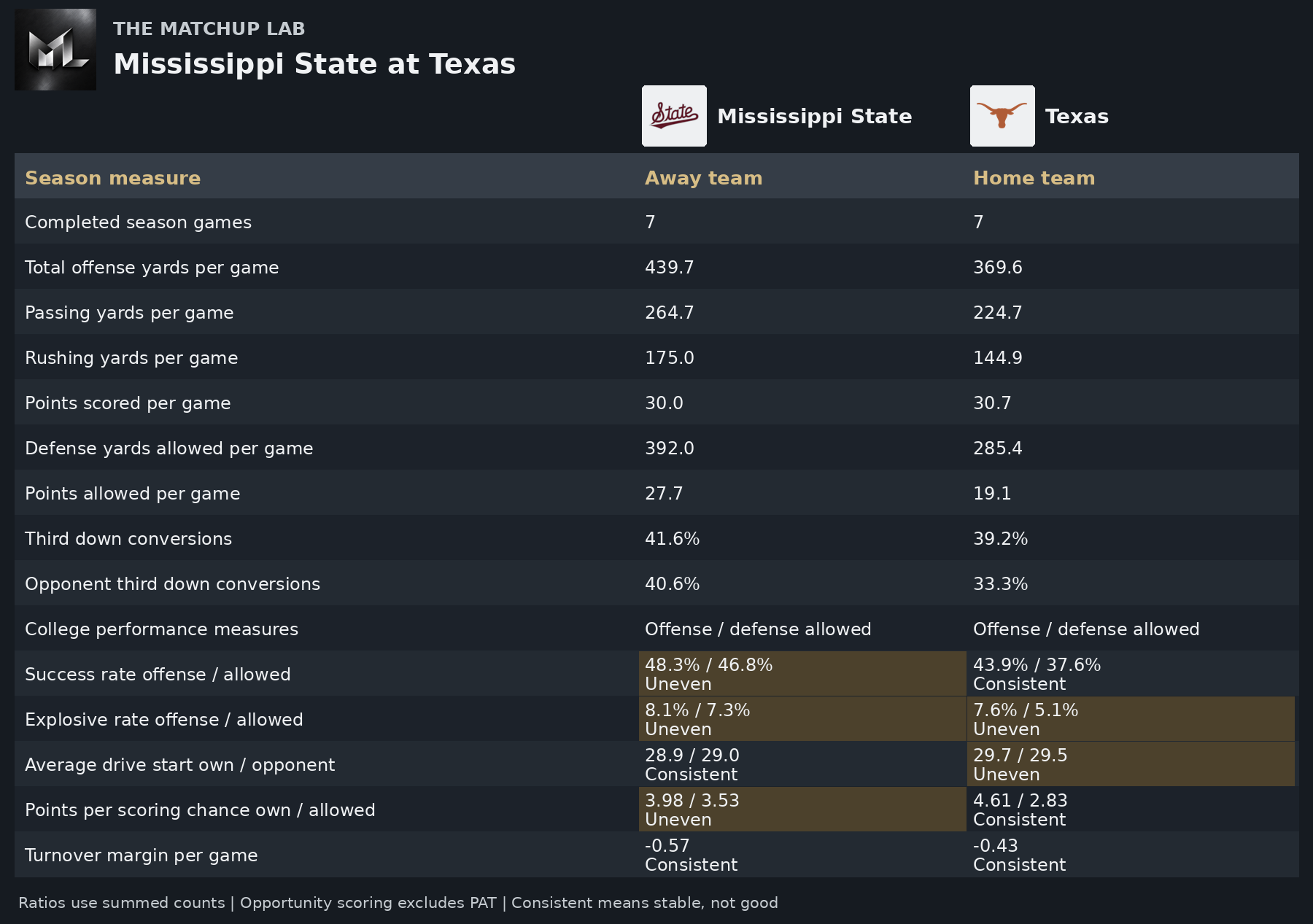
Texas have spent much of the season making defensive resistance carry a modest offensive margin. The Longhorns average fewer than 370 yards but have held opponents below 286, with a strong separation once possessions reach scoring territory. Their latest 34-27 win over Ole Miss added a more useful rushing performance, with 207 yards on the ground. Three giveaways prevented it from becoming a cleaner afternoon, even though three takeaways restored the possession balance. Mississippi State need to make Texas earn its next advantage without receiving that sort of help.
The Bulldogs' recent offense has not resembled its stronger early season. Mississippi State have scored 23, zero and fifteen in the last three games, and their latest defeat to Oklahoma included one successful third down in eleven attempts. Texas should target that inability to sustain the next down. The Bulldogs still average nearly 440 yards across the season, so dismissing their offense as incapable would be careless. The task is to make the current difficulties persist by stopping useful early progress, rather than assuming an earlier low score will repeat itself automatically.
Texas's own offense needs to keep the ground contribution from last week available. A series of productive runs can reduce how often the passing game has to rescue a difficult situation. Mississippi State have allowed ordinary-play success only slightly below their own attacking rate, and opponents have gained 392 yards per game. There is room for sustained offense if Texas preserve the possession. The Longhorns' negative season turnover margin is a reminder that ball security remains part of the evaluation even after a win in which both teams lost the ball three times.
The decisive contest is Texas's ability to use its defensive advantage without making the offense's job harder through another giveaway. Mississippi State need a far better sequence through third down and must keep the Longhorns from turning early runs into comfortable passing choices. Texas need to make a good defensive possession lead to useful offensive work, then finish once inside scoring range. The separate statistical assessment rates their season more strongly than the two losses alone might suggest. The overall order still places them behind every one-loss team in our selected population. Another disciplined result would strengthen both the record and the explanation behind it.