
Formula 1
Qatar Airways Qatar Grand Prix
- season
- 2026
- status state
- scheduled
LAB
REPORTTHE MATCHUP LAB
The whole night.
The story that matters.
The Lab Report brings the games, key moments and context together in one show.
Latest published episode
The Lab Report | October 12, 2026 | Bills–Rams and MLB Postseason
Las Vegas Aftermath as Verstappen Wins and McLaren Close on Red Bull
Reporting credits: Formula 1 official classifications, session results, championship tables and Qatar schedule; FIA race reports and steward decisions. Analysis by The Matchup Lab.
Qatar Airways Qatar Grand Prix
Event window: 2026-11-27T13:30:00.000Z to 2026-11-29T16:00:00.000Z.
Analysis and tables from the November 23, 2026 weekly edition, at its stated reporting cutoff.
The constructor championship
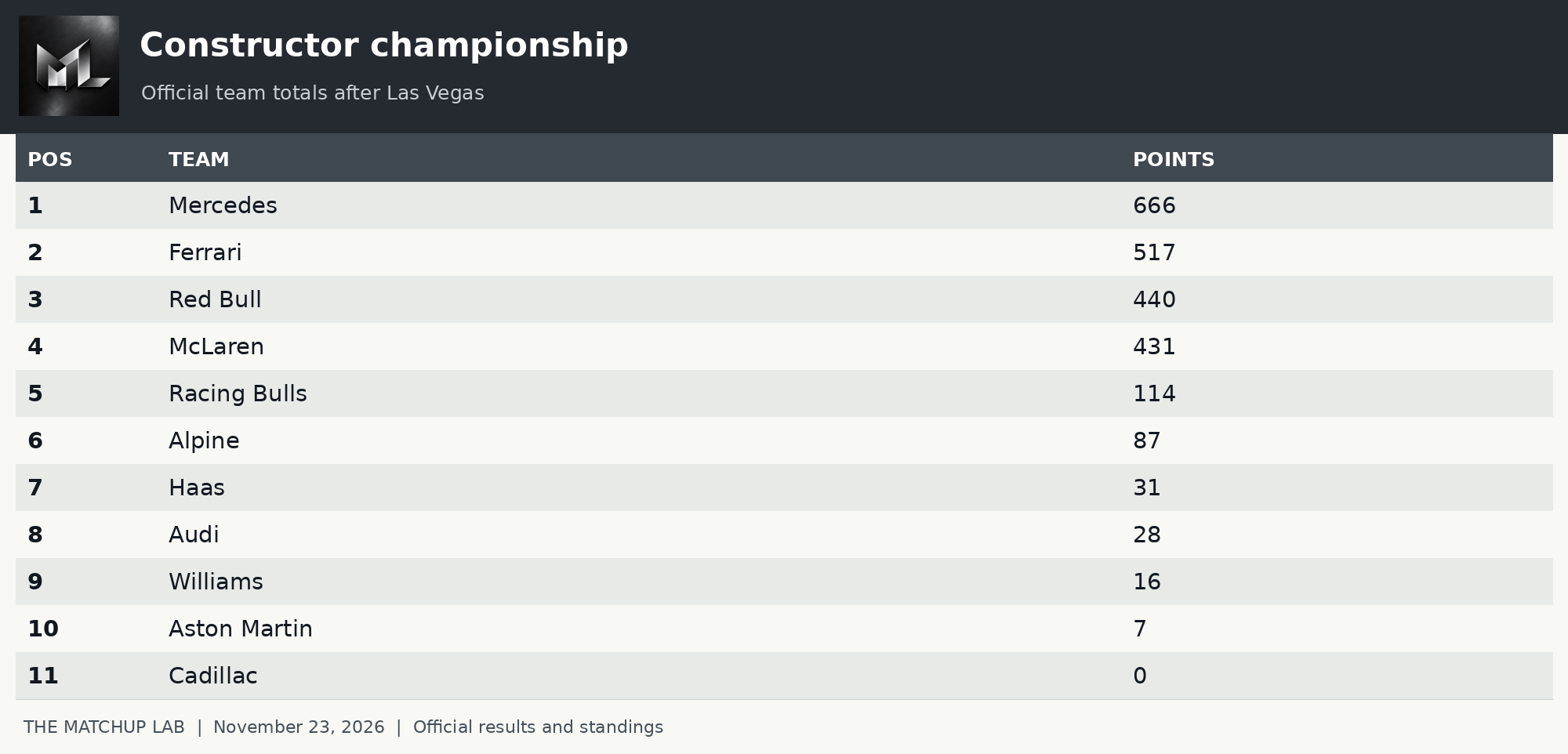
Mercedes have 666 points and Ferrari 517, a 149-point difference. Below them, Red Bull’s 440 and McLaren’s 431 create the nearest contest among the leading four. Racing Bulls are fifth on 114, with Alpine’s Las Vegas return taking them to 87. Haas have 31 and Audi 28.
The official constructor totals are used directly. Adding drivers’ points under their current team labels would not reliably reconstruct the season totals because those labels do not establish where every point was earned. The table therefore preserves the governing competition record rather than forcing an incorrect reconciliation.
Where one result can change the order
Audi need a net gain of four points to move ahead of Haas, while Alpine need a much larger swing against Racing Bulls. Red Bull and McLaren are close enough that the contribution of the second car is central. Las Vegas made that visible: the winner’s 25 points could not match the 33 available from second and third.
Three contests to follow at Lusail
Red Bull versus McLaren: the value of the second car
The nine-point gap is small enough for the second car to determine the next step. Las Vegas is the immediate example: Verstappen won and earned 25 points, while Norris and Piastri combined for 33 in second and third. Red Bull therefore lost eight points of advantage despite taking the most visible result. That is a simple calculation with a useful strategic implication. Protecting third place in the constructor standings requires looking beyond whether Verstappen can win again.
The qualifying picture gives the comparison depth. Red Bull placed Verstappen second and Hadjar fifth, against Norris fourth and Piastri seventh. Penalties then changed the issued grid, particularly for Piastri, who was listed seventeenth. McLaren’s eventual result was not the straightforward conversion of two front-row starts. Red Bull, meanwhile, had two cars in a strong initial position but finished with only one scoring. The difference between those paths matters more than using the podium alone as an account of the weekend.
At Lusail, the circuit’s medium- and high-speed corners make sustained balance an important question. Friday’s running can help distinguish a car that produces one sharp lap from one that remains manageable across repeated corners and a longer stint. The Las Vegas fastest-lap list cannot answer that question in advance: Hadjar was second on that list, ahead of both McLarens, while Verstappen was ninth. Fuel, tyres, traffic and lap timing separate that observation from a general ordering of competitive pace.
Watch whether both teams put both drivers into Q3, then whether their race plans preserve useful track position for the second car. An extra pit visit, a penalty or damage can change the combined result without changing which leading driver appears fastest. McLaren do not need to win the next race to take ground again; Red Bull do not need two podiums merely to improve on the Las Vegas total. The most informative comparison is the sum of the opportunities each team keeps alive through the final stint.
Alpine and Racing Bulls: different routes to the same question
Racing Bulls lead Alpine by 27 points, 114 to 87. Alpine’s eighteen-point Las Vegas result reduced that margin because Racing Bulls scored nothing. A single weekend does not establish that the same swing will repeat, but it gives the next comparison a concrete scale: fifth and sixth together made more difference than one isolated midfield points finish would have done.
Both teams had two cars in Q3. Lindblad and Lawson qualified sixth and eighth, ahead of Gasly and Colapinto in ninth and tenth. The race reversed the value of that starting promise. Lawson began from the pit lane and finished fourteenth; Lindblad retired. Gasly and Colapinto finished fifth and sixth. The result therefore invites an execution question before an assertion about a general performance hierarchy. How much of each team’s qualifying opportunity remains available after the opening phase and the first pit visit?
The single-lap timing reinforces the need for care. Lawson set the race’s fastest lap, while Gasly was third and Colapinto fifth. Their laps were produced at different moments, and Lindblad’s retirement removed the chance to record a late best effort. The list shows that useful speed appeared in both teams. It cannot establish how long that speed was available, nor can it erase the points consequences of a start change or retirement.
Qatar offers three practice sessions before qualifying. For Alpine, the benchmark is repeating the breadth of the Las Vegas weekend: both drivers in the final qualifying phase and both contributing to the race total. Racing Bulls have already demonstrated that qualifying can put both cars ahead of Alpine, so their test is to retain that opportunity through a complete race. The championship gap is still meaningful. An eighteen-point swing would leave Racing Bulls ahead, while another scoreless Alpine weekend would make the recent gain harder to extend. The immediate evidence to watch is two-car continuity from Saturday’s classification into Sunday’s running order.
Haas and Audi: small points, large positional consequences
Haas have 31 points and Audi 28. At this part of the table, a result that looks modest beside a podium can decide the constructor order. A net gain of four points would move Audi ahead. Two points could narrow the margin without reversing it. The exact arithmetic makes it useful to assess both cars’ access to the final scoring places rather than focus only on the best finish.
Las Vegas left Audi eleventh and twelfth, with Haas thirteenth and sixteenth. Audi were closer to the points, but none of those four positions earned any. Hulkenberg and Bortoleto also started from a stronger issued-grid position, twelfth and thirteenth, while Camara was fifteenth and Bearman twenty-second. That pattern gives Audi a concrete qualifying benchmark to preserve and Haas a clear source of recovery work to reduce.
The race timings add texture without resolving the next event. Hulkenberg and Bortoleto’s best laps were separated by 0.049 seconds; their single recorded visits differed by 0.113. Bearman’s best lap was 0.274 slower than Hulkenberg’s, while Camara had two visits and an interrupted race after contact with Perez. These are separate observations from different laps and circumstances. They support a careful account of the weekend, not a prediction that the same ordering will survive at Lusail.
The Qatar circuit shifts the question toward the car’s balance through sustained medium- and high-speed corners. In practice, the useful comparison will be how consistently each driver can complete a sequence of representative laps, followed by whether that work produces a less compromised qualifying position. On Sunday, being close enough to tenth when strategies and retirements alter the order is essential. Audi’s paired proximity in Las Vegas is encouraging evidence, but still produced zero points. Haas’s three-point cushion is real, but small enough that another weekend spent recovering from the rear could leave the team dependent on what Audi fail to convert.
Qatar: circuit and schedule
Lusail is 5.419 kilometres long, with a Grand Prix scheduled for 57 laps and 308.611 kilometres. Medium- and high-speed corners dominate the lap, while the main straight runs for more than a kilometre before Turn 1. That combination asks for sustained cornering balance as well as a useful approach to the principal braking opportunity.
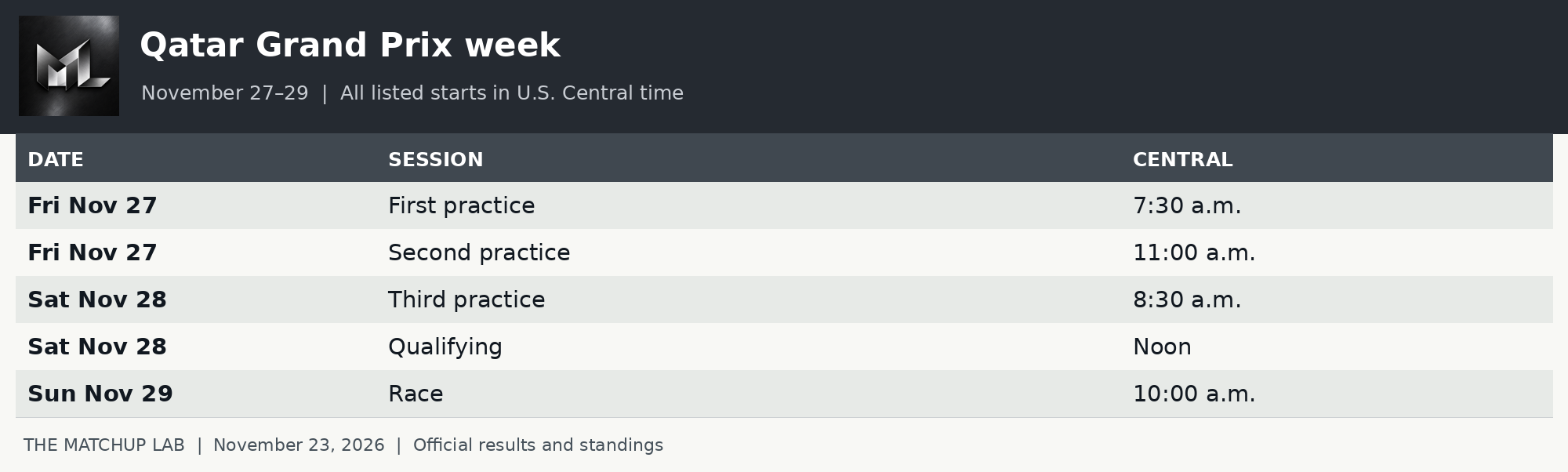
The weekend has three practice sessions, qualifying and the Grand Prix. The Formula 2 sprint appearing elsewhere in the event timetable is not an F1 sprint. Qatar is on UTC plus three; U.S. Central is on UTC minus six for these dates, a nine-hour difference. All listed starts use Central Standard Time.
The race begins Sunday November 29 at 10:00 a.m. Central. Abu Dhabi follows the next week. The immediate focus remains Qatar: Red Bull and McLaren are nine points apart, Racing Bulls and Alpine 27 apart, and Haas and Audi three apart. The titles are decided, but those positions still give both cars at several teams a measurable role in the final rounds.