Premier League Weekly: Arsenal’s edge, Brighton’s challenge
November 2 2026 • 2026/27 regular season • All 20 clubs
The leader wins narrowly, Brighton win the statement game, and the next round tests both scoring and resilience.
Arsenal's 1–0 win at Liverpool and Brighton's 1–0 victory at Manchester City give the round a clear centre of gravity. Arsenal retain the strongest points return; Brighton combine the table's largest scoring total with its best goal difference. Chelsea's clean win over Manchester United and Brentford's 2–0 result against Forest add different arguments about the value of turning scoring balance into full points. This edition reviews every club and the complete current round, then looks ahead to the next seven days. Everton completed the round with a 1–0 win at Newcastle, moving above the twelve point group and giving the final table a different shape from Monday's earlier snapshot.
The complete table, with the correct labels
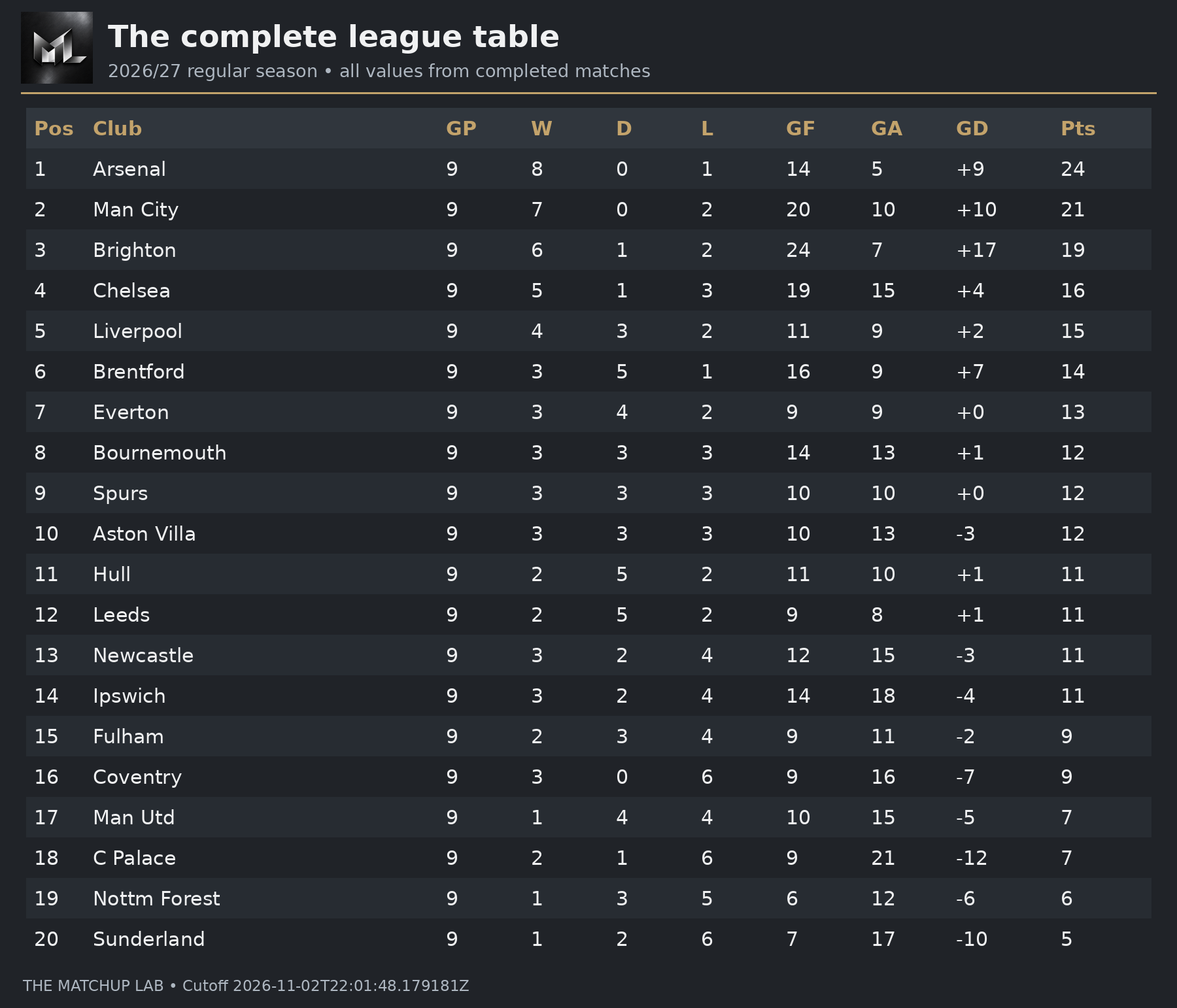
Table position is kept separate from Statistical Rank, overall numerical Power Rank and separately validated Results Rank. Current updates to those three models remain incomplete: a saved appropriate EPL model and certified full raw denominators were not recovered for this snapshot. The standings, points arithmetic, goals per completed game and verified match results below are descriptive measures, not substitutes for those ranks. No unavailable shot, possession, injury, market or chance quality input is invented.
The scoring balance
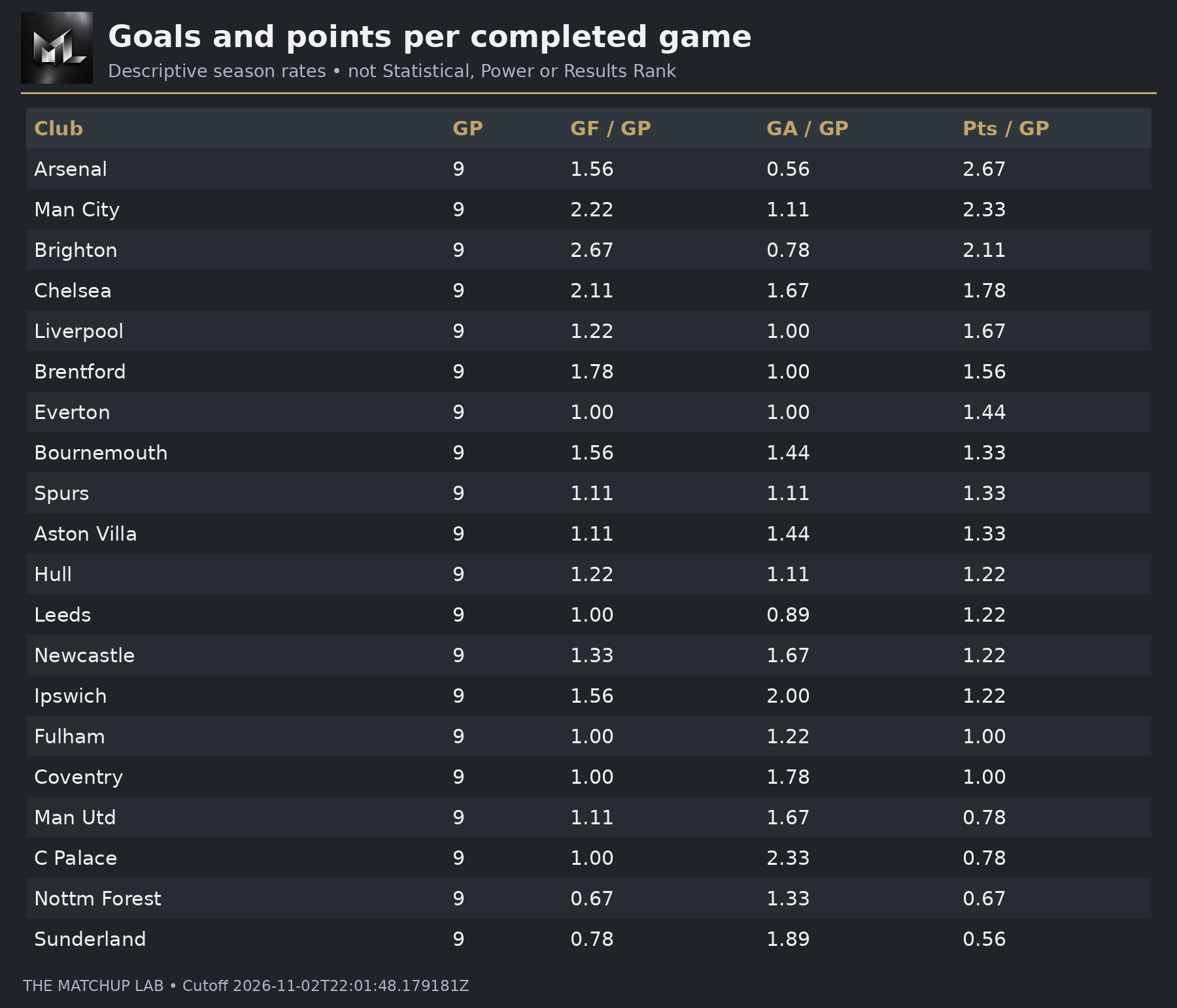
Every rate is the displayed season count divided by that club’s completed league matches, rounded to two decimals. League position uses points, goal difference and goals scored. This ordering is the standings, not any of the three incomplete model ranks.
Every completed result in the review window
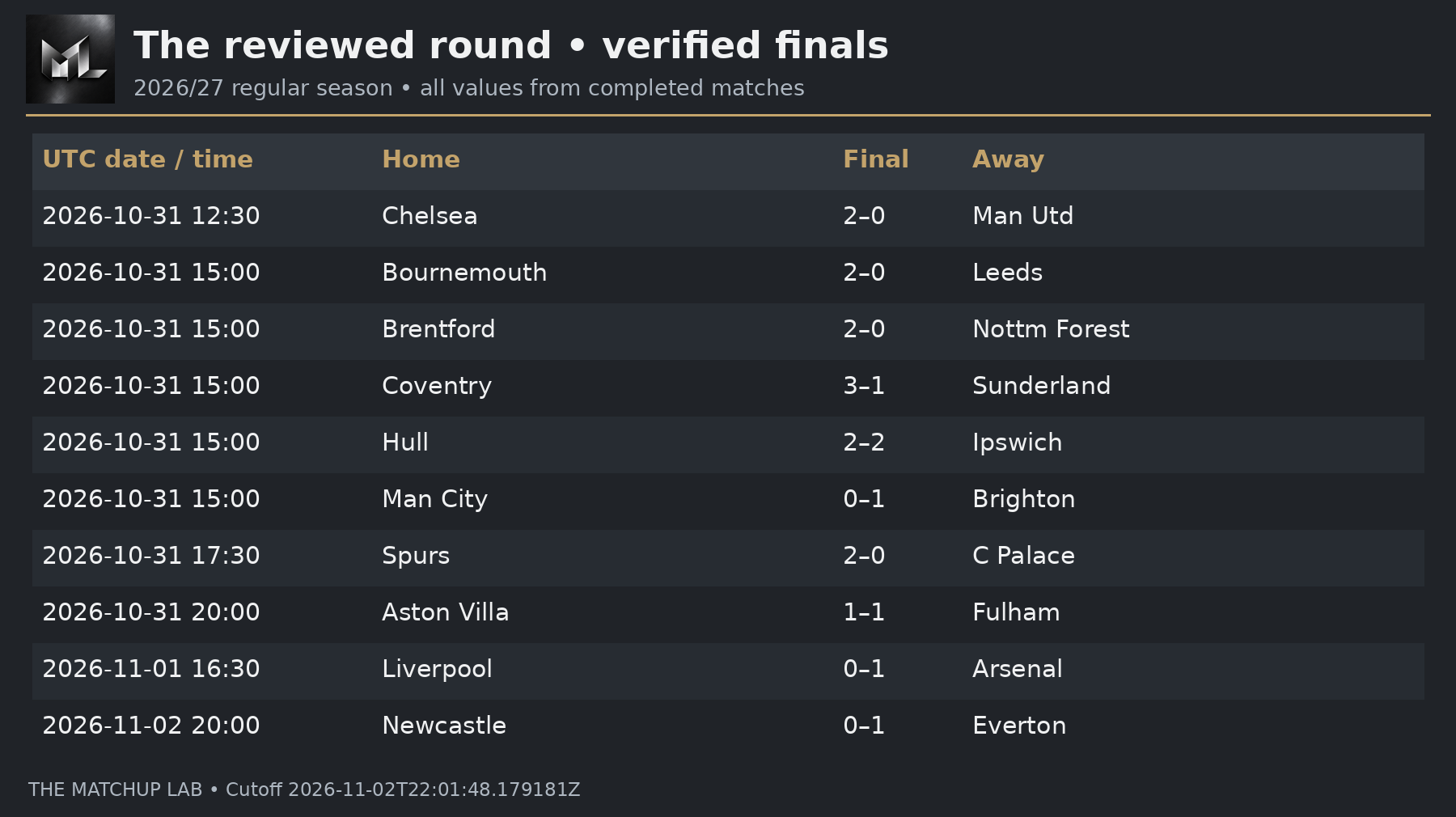
The ten completed Round 9 fixtures produced 21 goals, 2 draws and 3 away wins. Everton completed the round with a verified 1–0 win at Newcastle on Monday. That final lifts Everton to thirteen points and seventh place, while Newcastle remain on eleven. All twenty clubs now have nine completed league games; the season record denominator is ninety fixtures. The table and every displayed rate incorporate this actual final, not the earlier live score.
Only verified final states enter the completed match population. The full reviewed round has twenty distinct club appearances and ten original fixture IDs; no scheduled zero score or elapsed kickoff is treated as a result.
The full next-seven-day fixture list
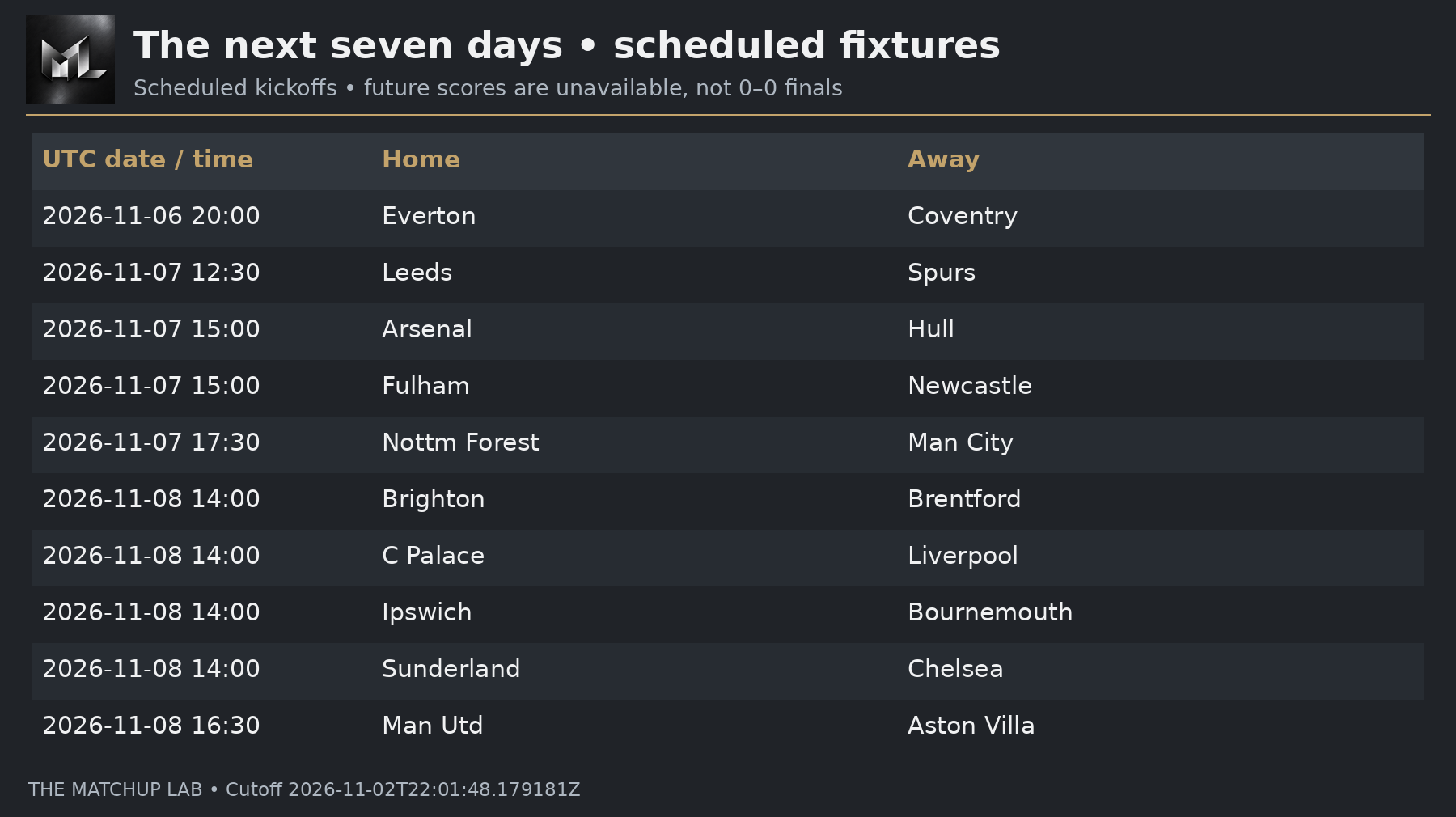
All twenty clubs appear once in the ten retained Round 10 fixtures. The approved shared date range explicitly includes November 9; no additional fixture is present for that date. Kickoffs are UTC and remain subject to source updates. The four featured previews below are selections from this complete list, not the whole schedule.
Arsenal
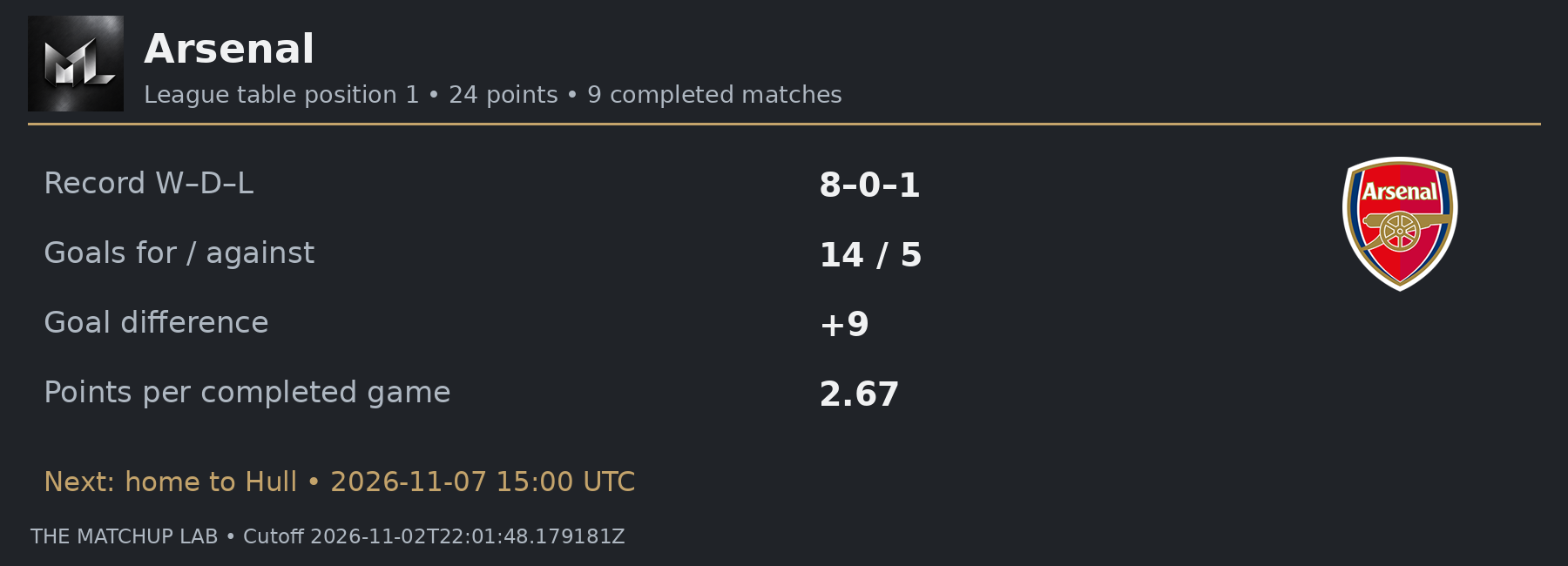
Arsenal are first in the current league table with 24 points from 9 completed matches: 8 wins, 0 draws and 1 defeat. The scoring ledger is 14 for and 5 against, a goal difference of +9.
Arsenal made the most economical statement of the round: a 1–0 win at Liverpool, while Manchester City lost at home. The five goals conceded across nine league games are the foundation of the lead. Fourteen scored is a smaller attacking total than City's twenty or Brighton's twenty four, yet eight wins have turned that relatively modest output into the strongest points return. That distinction matters. Arsenal lead the competition's table; the available evidence does not establish that they lead a separate statistical model.
Hull are the next examination at the Emirates. Five draws in nine games make the visitors an awkward opponent for a side whose season has contained no league draws. The practical question is whether Arsenal can create enough separation to keep a single equaliser from changing the return. Protecting the narrow advantage worked at Anfield, but that result is evidence of one completed match, not a guarantee that every low scoring game will resolve the same way. The three point cushion over City is useful room, and the next task is to preserve it without requiring another one goal margin.
Manchester City
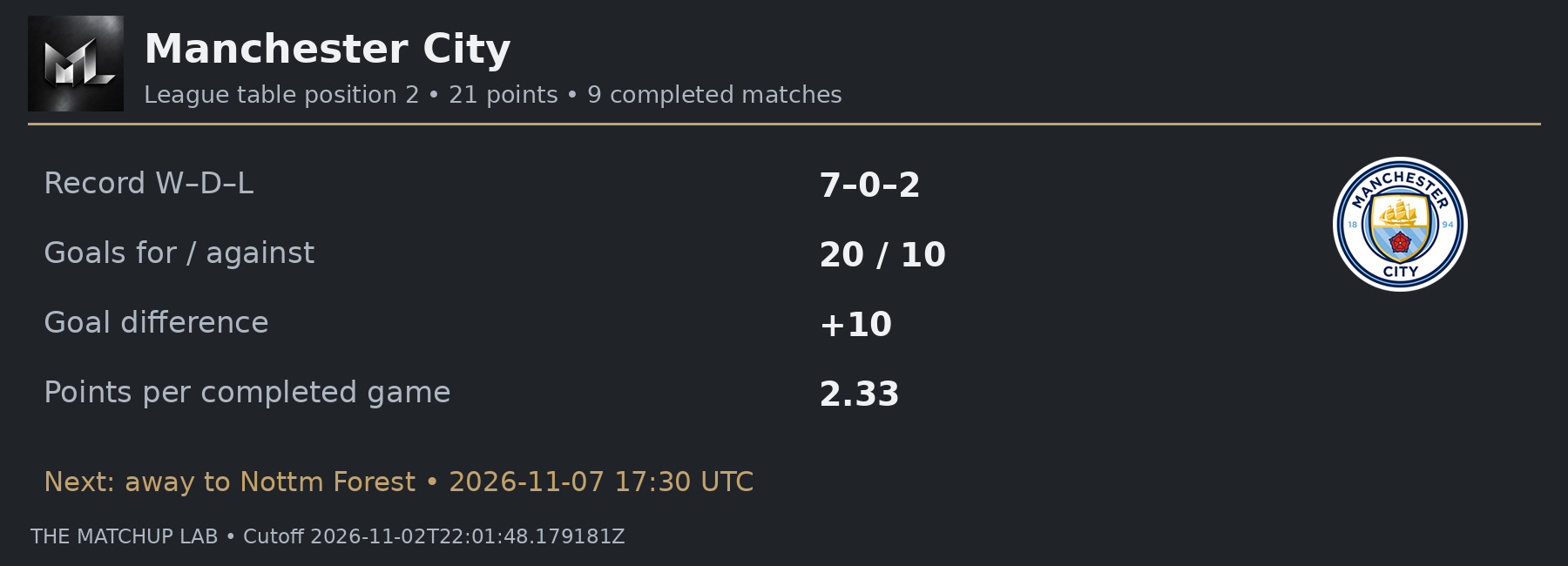
Manchester City are second in the current league table with 21 points from 9 completed matches: 7 wins, 0 draws and 2 defeats. The scoring ledger is 20 for and 10 against, a goal difference of +10.
A 1–0 home defeat to Brighton interrupts an otherwise decisive results pattern. City have seven wins and two losses, with no draws: the season's points have arrived in full three point increments. Twenty goals scored remain a substantial attacking return, but the latest blank demonstrates why a season average cannot be treated as a promise for the next ninety minutes. Brighton's win also leaves Arsenal three points clear rather than allowing City to take advantage of a demanding fixture for the leaders.
The trip to Nottingham Forest brings a different table position but a similar warning about expectations. Forest have scored only six league goals; City have scored more than three times that number. Those totals justify attention to City's attacking ceiling, not an invented win probability. Conceding ten in nine also leaves room for improvement at the other end. A controlled response would combine renewed scoring with a result that does not depend on simply outscoring every defensive mistake. One loss should not erase seven wins, just as those seven wins should not erase the evidence of the Brighton match.
Brighton & Hove Albion
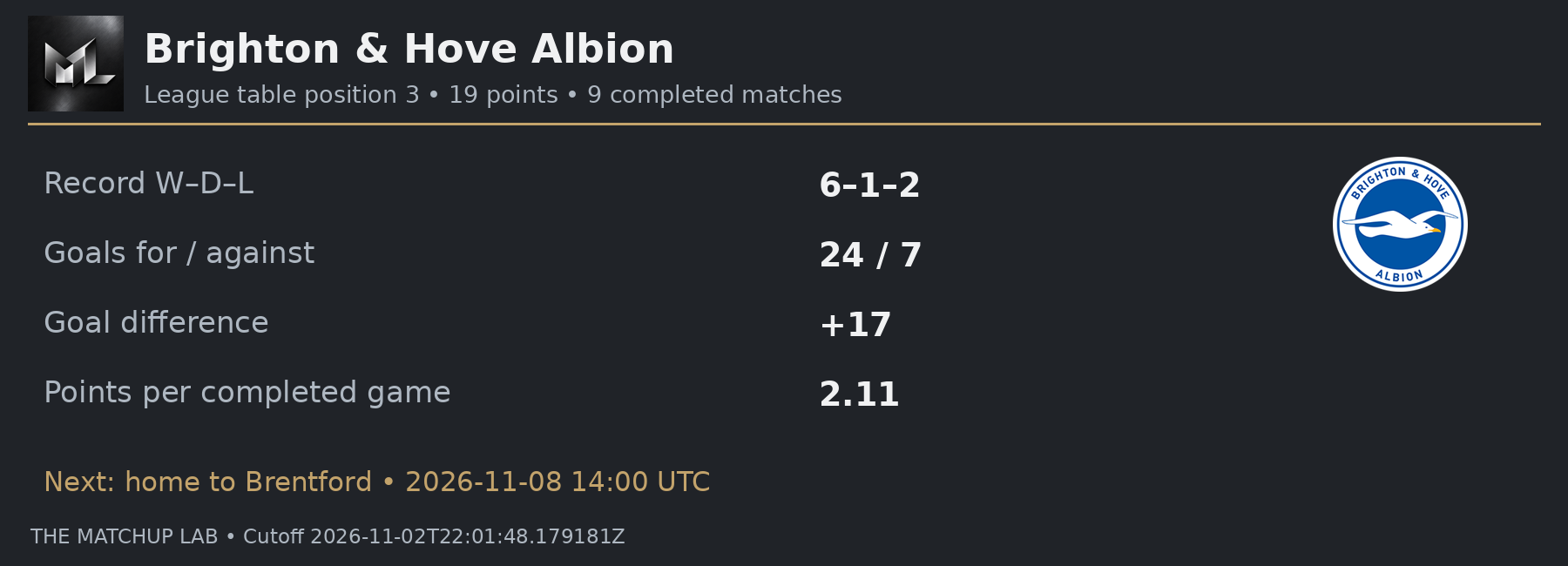
Brighton & Hove Albion are third in the current league table with 19 points from 9 completed matches: 6 wins, 1 draw and 2 defeats. The scoring ledger is 24 for and 7 against, a goal difference of +17.
Brighton's 1–0 win at Manchester City gives the round's most persuasive result to a club already carrying an exceptional goal balance. Twenty four scored and seven conceded produce a plus seventeen differential. Both sides of that ledger matter: the season's largest scoring total in this table is accompanied by fewer concessions than every club except Arsenal. The result at City is consistent with that strong balance, although nine fixtures remain too small a population to turn a descriptive lead into a complete forecasting method.
Brentford visit next with just one league defeat and five draws. That makes this more than an opportunity to celebrate the City result. Brighton face a team that has repeatedly kept the outcome open and has conceded nine times across nine matches. The useful test is whether Brighton can turn their scoring advantage into another win against an opponent whose strongest results trait is avoiding losses. They sit two points behind City and five behind Arsenal. Continuing the pressure requires another complete result; no extra table points are awarded for having the best goal difference among the leading three.
Chelsea
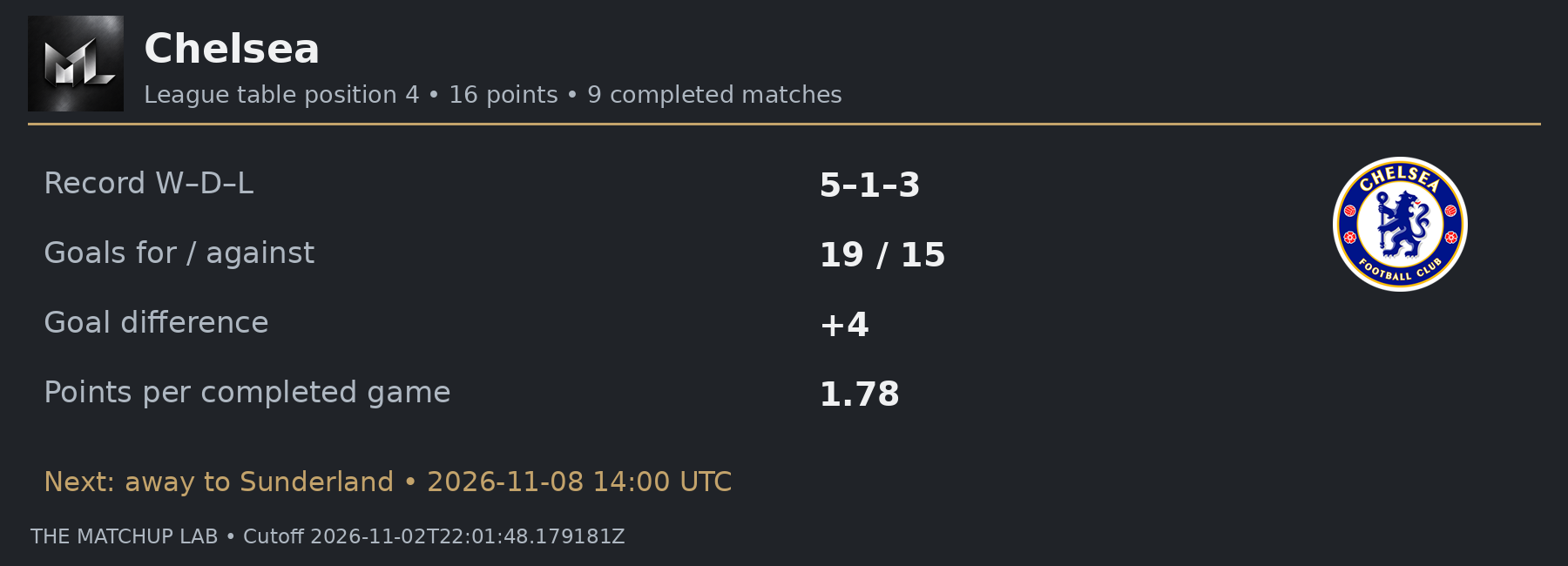
Chelsea are fourth in the current league table with 16 points from 9 completed matches: 5 wins, 1 draw and 3 defeats. The scoring ledger is 19 for and 15 against, a goal difference of +4.
Chelsea's 2–0 win over Manchester United supplies the clean result their season balance needed. Nineteen goals scored show genuine output in the completed league record, but fifteen conceded have kept the differential to plus four. The latest two goal margin therefore improves both sides of the argument: Chelsea added enough attack to win and did not need to compensate for a concession. It is one clean sheet in the reviewed round, rather than evidence that the earlier defensive cost has disappeared.
The next match is away to Sunderland, whose seven goals scored and seventeen allowed leave them bottom of the current table. Chelsea's stronger points and scoring totals create a clear results based contrast. They do not remove the need to control the game. A side that has already lost three league matches cannot treat an opponent's low position as points already banked. Fourth place is supported by five wins, and the immediate opportunity is to build on the United result while bringing the concession rate down. The next assessment should ask whether the improved balance repeats, not merely whether Chelsea can produce another attractive attacking total.
Liverpool
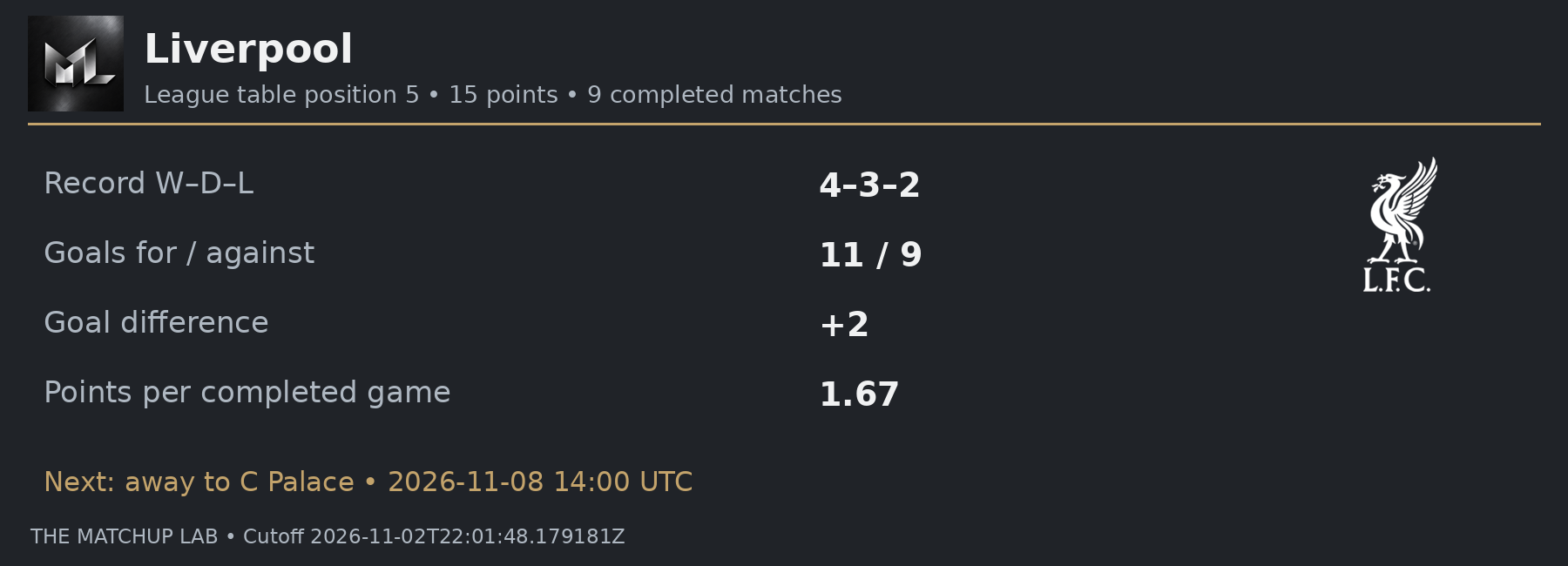
Liverpool are fifth in the current league table with 15 points from 9 completed matches: 4 wins, 3 draws and 2 defeats. The scoring ledger is 11 for and 9 against, a goal difference of +2.
Liverpool's 1–0 defeat to Arsenal leaves a narrow positive goal balance and a nine point gap to the leaders. Eleven goals scored across nine games is the main constraint visible in the aggregate record. Nine conceded is comparatively contained, but modest scoring leaves little room when the opponent finds the only goal. The Arsenal match is the clearest recent example of that arithmetic. It does not establish the quality or number of chances Liverpool created, because a verified chance denominator is not part of this edition's evidence.
Crystal Palace are next, away from home. Palace have allowed twenty one goals, the largest concession total in this table, while Liverpool have scored only eleven. That opposition of records makes attacking conversion the central editorial question without requiring a claim about individual finishing form. Four wins and three draws have kept Liverpool fifth, but draws have returned only one point each and the latest defeat returned none. A stronger scoring response would help turn their comparatively restrained concession record into more wins. Until it happens, the table should retain both facts: Liverpool remain in the upper group, and their current attacking output trails the clubs above them.
Brentford
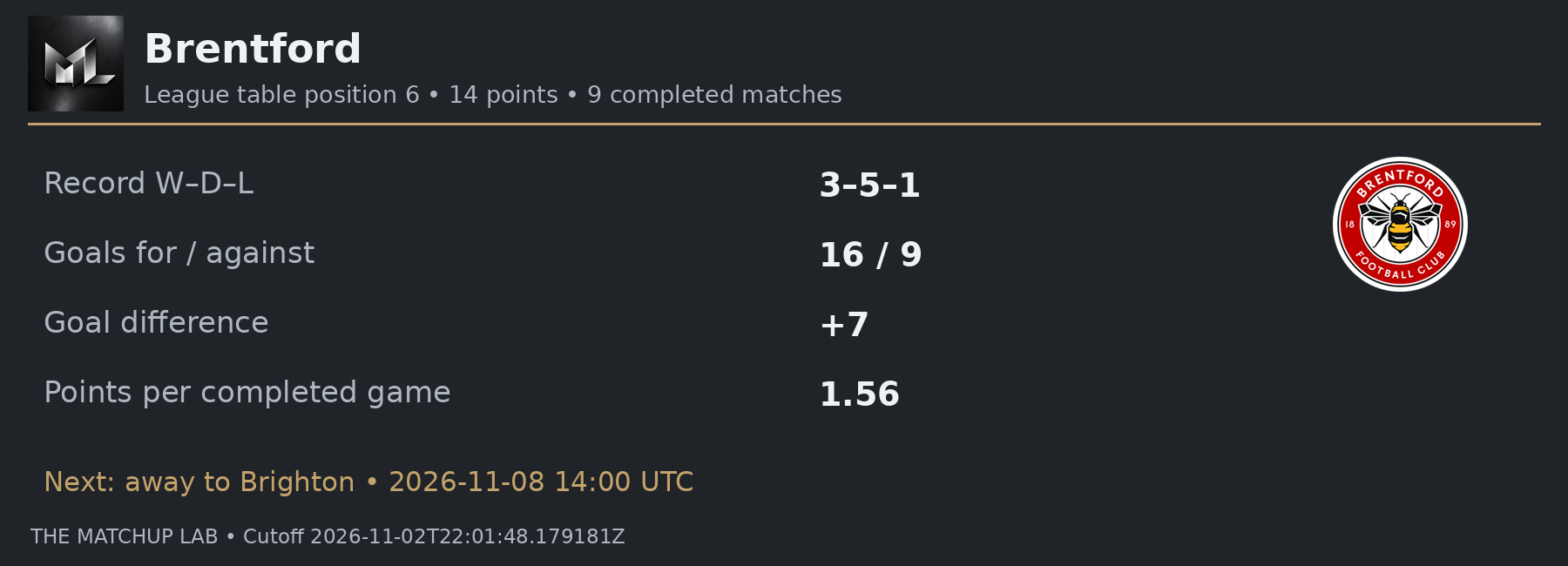
Brentford are sixth in the current league table with 14 points from 9 completed matches: 3 wins, 5 draws and 1 defeat. The scoring ledger is 16 for and 9 against, a goal difference of +7.
Brentford's 2–0 win over Nottingham Forest addresses the conspicuous limitation in an otherwise resilient record: too many draws. Only one defeat in nine is the fewest in this table alongside Arsenal, but five draws have limited Brentford to fourteen points. The clean win adds three points rather than one and protects a season goal balance of sixteen scored against nine conceded. Their record is therefore strong at avoiding defeat and less successful at extracting the maximum return from every competitive match.
The next trip, to Brighton, is a demanding measure of that balance. Brighton have scored twenty four and conceded seven; the reviewed round included their away win over Manchester City. Brentford's own nine concessions provide a more encouraging basis for the matchup than a simple comparison of table positions would suggest. Still, avoiding defeat and winning are separate achievements. A draw would extend the low loss count while leaving the points gap largely intact; a win would materially change the relationship between the clubs. The useful development to watch is whether Brentford can carry the decisiveness of the Forest result into a meeting with one of the league's strongest current scoring records.
Everton
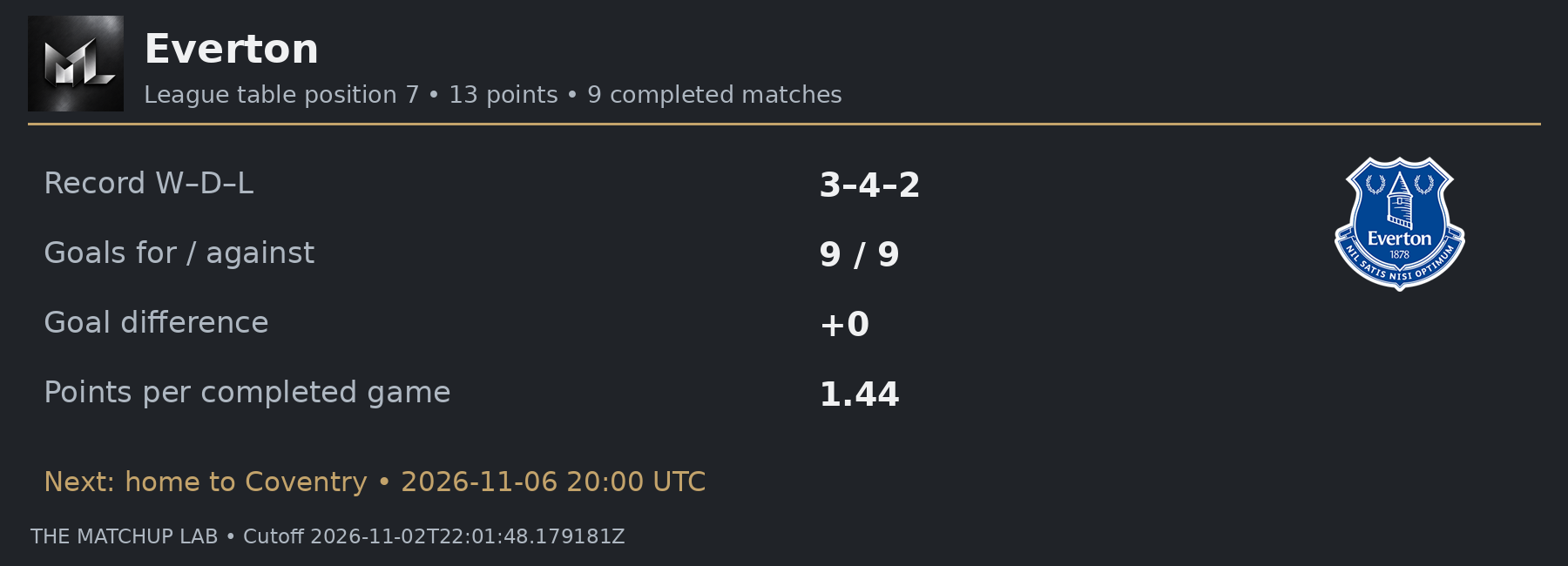
Everton are seventh in the current league table with 13 points from 9 completed matches: 3 wins, 4 draws and 2 defeats. The scoring ledger is 9 for and 9 against, a goal difference of +0.
Everton's 1–0 win at Newcastle turns a narrow season balance into thirteen points and seventh place. Nine goals scored and nine conceded are now level across nine completed league games. The result is especially useful in a record that still contains four draws: this time Everton obtained three points from a low scoring contest rather than sharing the return. Three wins, four draws and two defeats place them ahead of the twelve point group containing Bournemouth, Tottenham and Villa.
Coventry visit on Friday with a contrasting distribution of three wins, six losses and no draws. Both clubs have scored nine league goals, but Coventry have conceded sixteen compared with Everton's nine. That makes defensive cost a particularly clear difference before the next game. Coventry's latest 3–1 win over Sunderland is also a reason to assess the current opponent rather than simply extending Monday's clean result into a forecast. Everton's opportunity is to convert another competitive fixture into a win while protecting the concession record that has made thirteen points possible from modest scoring output. The Newcastle result improves the position; repeating its balance would give the improvement more substance than a single successful night.
AFC Bournemouth
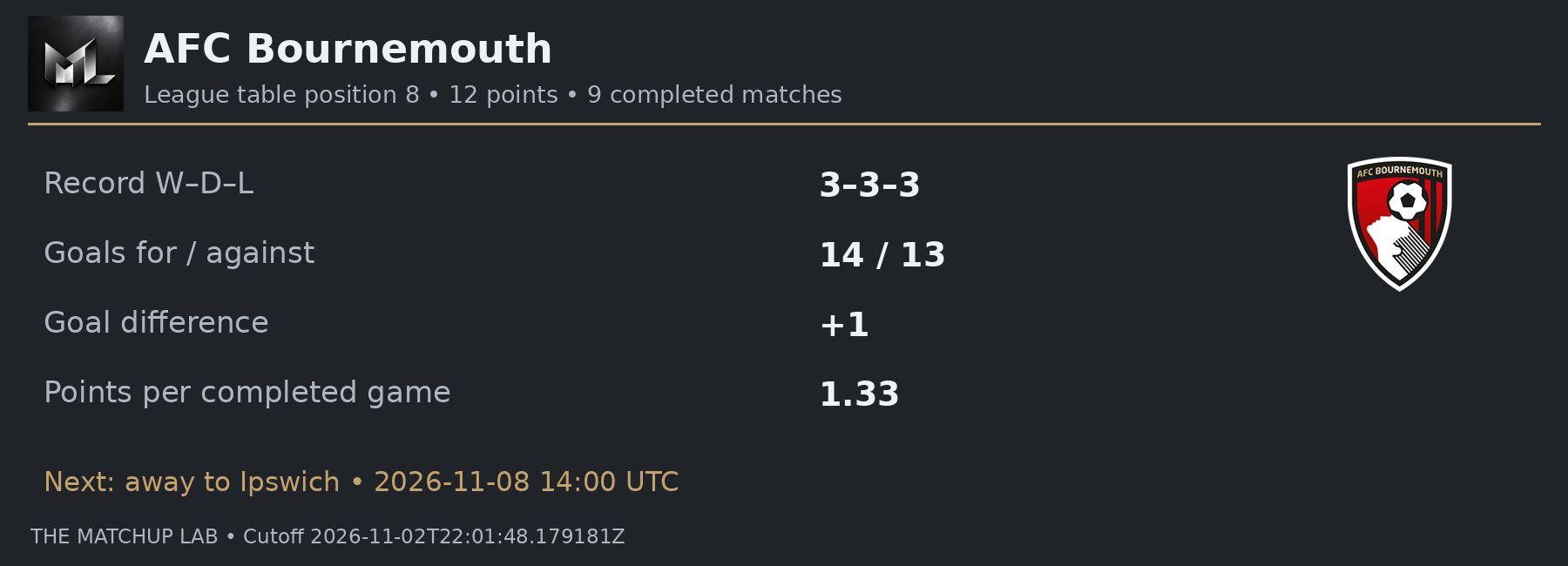
AFC Bournemouth are eighth in the current league table with 12 points from 9 completed matches: 3 wins, 3 draws and 3 defeats. The scoring ledger is 14 for and 13 against, a goal difference of +1.
Bournemouth's 2–0 victory over Leeds restores a positive goal balance and gives a balanced season record a timely push. Three wins, three draws and three losses describe a side with twelve points but little separation between its attacking and defensive totals. Fourteen scored against thirteen conceded is a plus one margin. The reviewed result is consequently valuable beyond the three points: two goals were added without another concession, rather than the season ledger improving through attack alone.
Ipswich are next at Portman Road. Both clubs have scored fourteen league goals, but Ipswich have conceded eighteen compared with Bournemouth's thirteen. The most useful contrast is therefore defensive cost, not a claim that one attack has already proved superior. Bournemouth can test whether the cleaner Leeds result is repeatable against another side capable of scoring but vulnerable at the other end. Their place in the middle remains tightly contested: several clubs sit within a single result. A second win would create more substance than the current narrow goal difference, while another draw would leave Bournemouth close to the crowded middle. Their next step is to turn an encouraging clean result into a wider margin of safety in the table.
Tottenham Hotspur
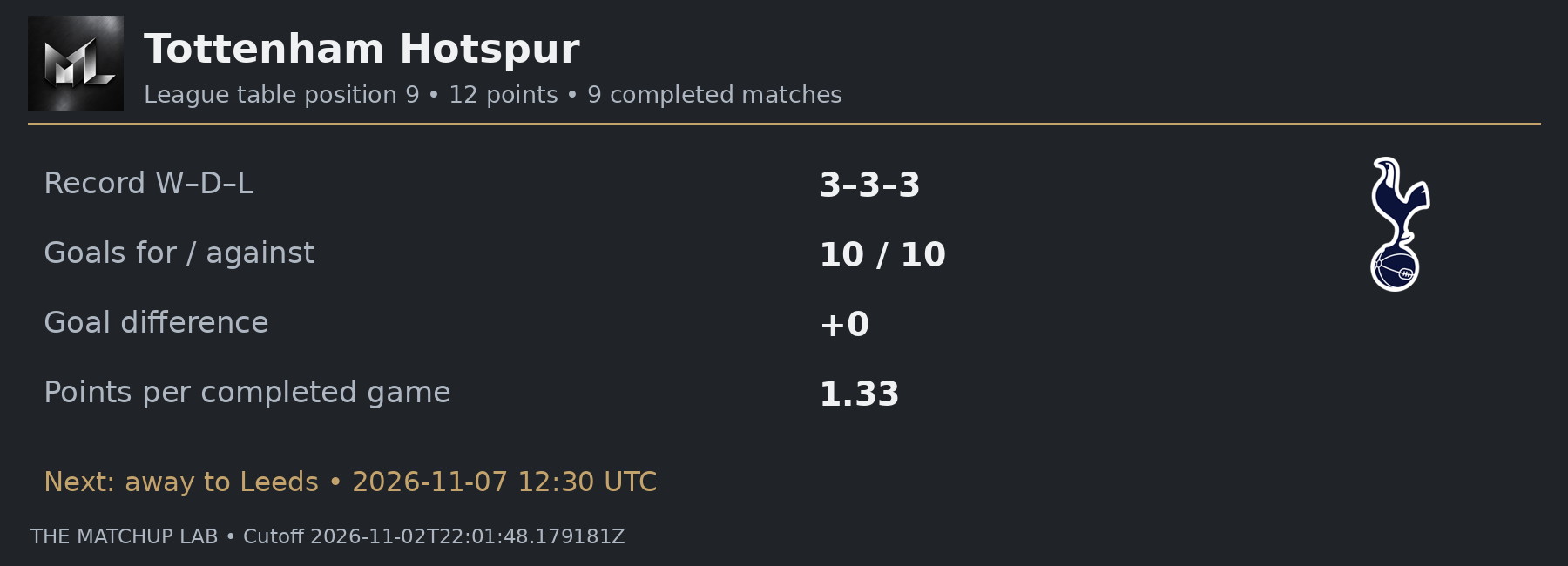
Tottenham Hotspur are ninth in the current league table with 12 points from 9 completed matches: 3 wins, 3 draws and 3 defeats. The scoring ledger is 10 for and 10 against, a goal difference of +0.
Tottenham's 2–0 win over Crystal Palace brings the season's goals for and against level at ten each. The immediate result was decisive; the wider record remains evenly distributed across three wins, three draws and three losses. That combination explains why twelve points place Spurs in the crowded middle rather than among the leaders. Scoring twice without conceding is an improvement in the reviewed match, but it should not be expanded into an unsupported claim about a lasting tactical transformation.
Leeds host Tottenham next. Leeds have conceded only eight league goals, fewer than Spurs, despite sitting below them in the table. Their five draws and nine goals scored describe a different route to a similar points total. The meeting will test whether Tottenham can build on the Palace score against an opponent with a more restrictive season concession record. A single successful round can move a club sharply within this part of the standings, where Bournemouth, Spurs and Villa all have twelve points. The useful target is to build a positive goal balance and another win together. Repeating the latest scoreline is an aspiration, not a forecast implied by the season average.
Aston Villa
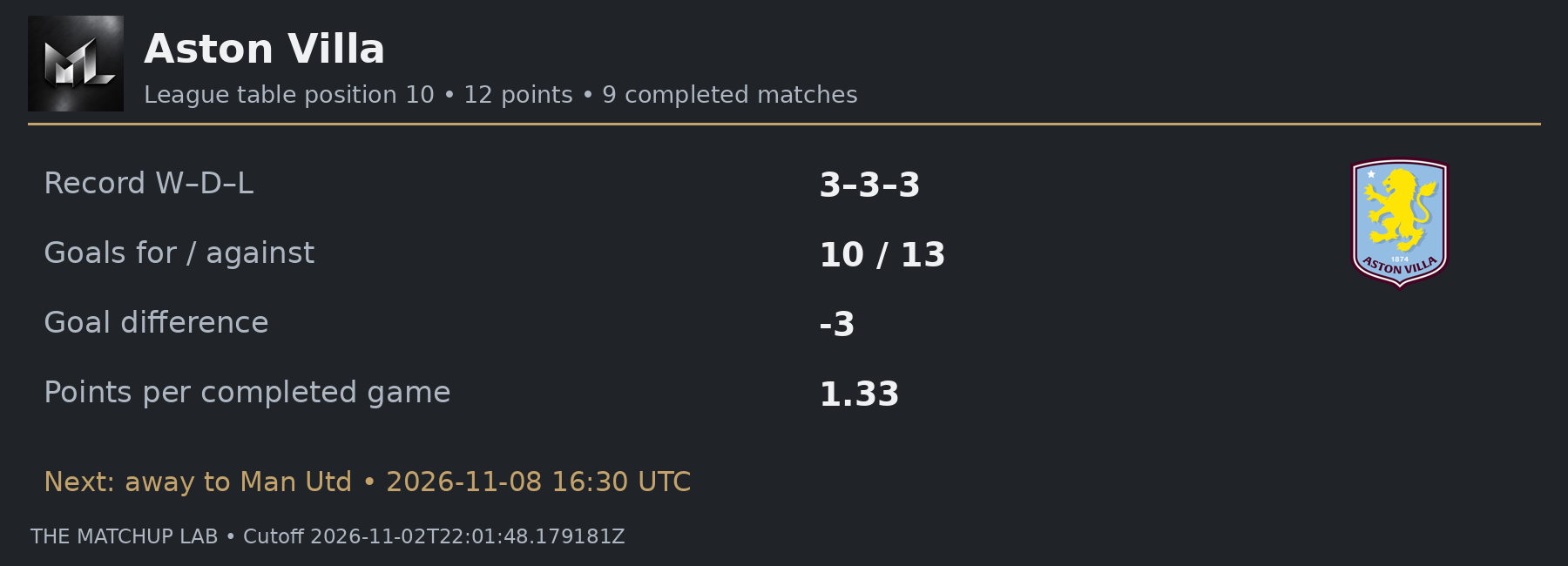
Aston Villa are tenth in the current league table with 12 points from 9 completed matches: 3 wins, 3 draws and 3 defeats. The scoring ledger is 10 for and 13 against, a goal difference of -3.
Villa's 1–1 draw with Fulham leaves them in the group of clubs with twelve points from nine games. The distribution is symmetrical at three wins, three draws and three defeats, but the goal balance is not: ten scored and thirteen conceded. That negative three differential is a reason to read the table position with care. Villa are level on points with Bournemouth and Tottenham, yet behind both on the ordering criteria applied to the current records.
Manchester United away is the next fixture. United have conceded fifteen and have only one win, so there is a clear opportunity to improve a scoring rate only a little above one per game. Villa also need to keep their own concessions from making the contest more open than necessary. The Fulham draw showed a completed one goal return on each side; it did not supply a possession or chance quality explanation. What can be measured is the cost of another shared result. A win would move Villa beyond the twelve point cluster, whereas a draw would leave the same question about turning balanced matches into three points. Better separation between goals scored and allowed would make the table position more convincing.
Hull City
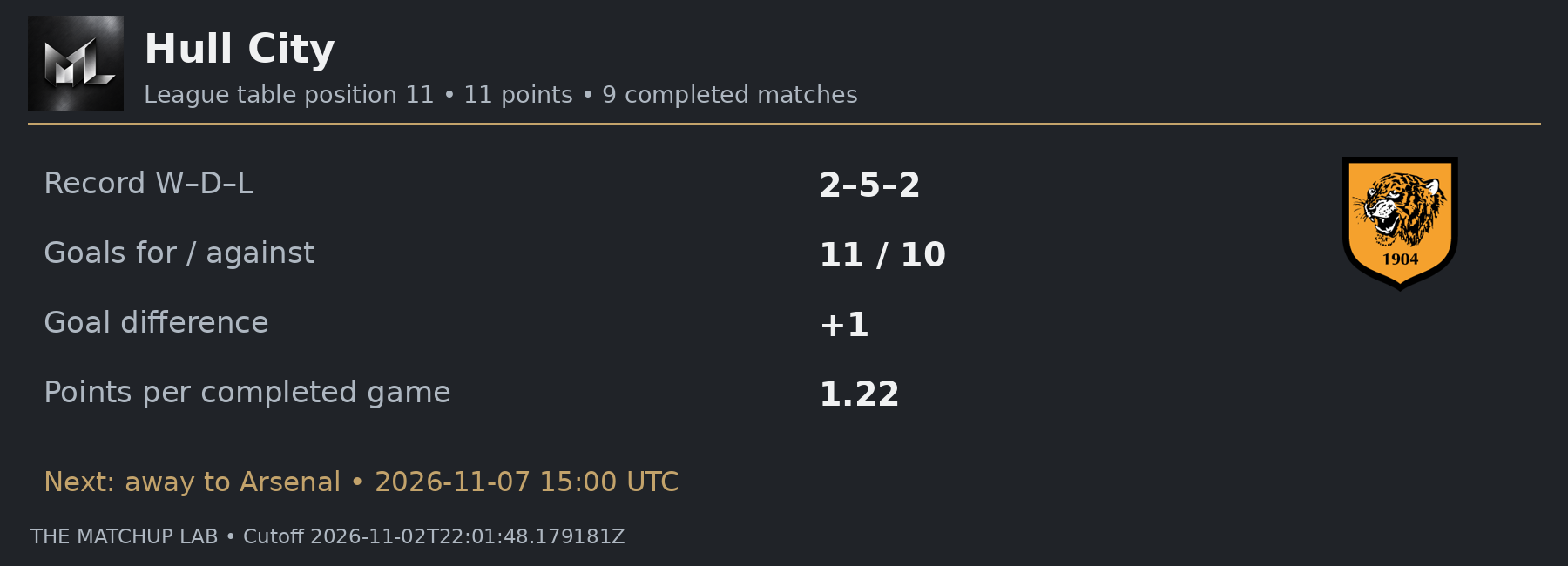
Hull City are eleventh in the current league table with 11 points from 9 completed matches: 2 wins, 5 draws and 2 defeats. The scoring ledger is 11 for and 10 against, a goal difference of +1.
Hull's 2–2 draw with Ipswich adds another shared result to a season already defined by them. Five draws in nine games sit alongside two wins and two defeats. Eleven points and a plus one goal difference keep Hull competitive in the middle, but the latest two concessions also show why a modest positive balance can be fragile. Their eleven goals scored exceed Leeds' nine on the same points total, while their ten conceded exceed Leeds' eight.
Arsenal away is a severe next test. The leaders have conceded five times in nine matches and have won eight, including the latest 1–0 victory at Liverpool. Hull's ability to avoid defeat in seven of nine is relevant evidence, yet Arsenal's no draw record presents a different results pattern. The practical challenge is to keep the contest within reach without allowing the defensive cost of the Ipswich draw to repeat. A draw at the Emirates would be a meaningful result even though Hull need more wins over the broader season. That distinction is important: judging one demanding fixture and judging the accumulated points return are related tasks, but they are not identical.
Leeds United
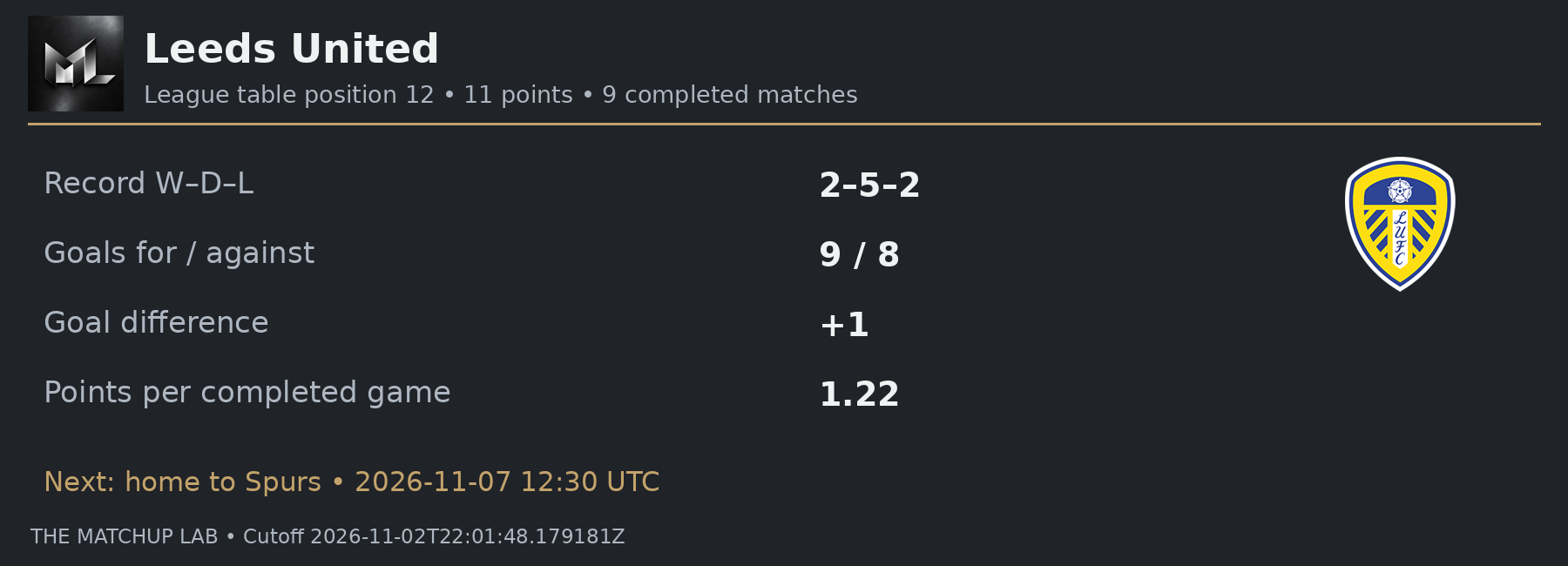
Leeds United are twelfth in the current league table with 11 points from 9 completed matches: 2 wins, 5 draws and 2 defeats. The scoring ledger is 9 for and 8 against, a goal difference of +1.
Leeds lost 2–0 at Bournemouth, a result that pushes against the strongest part of their season record. Eight goals conceded across nine games remains a low total, but two arrived in the reviewed defeat while Leeds added none. Nine goals scored means the attack has averaged exactly one per league game. That leaves the club reliant on keeping concessions limited if draws are to become wins. Five shared results, two victories and two losses explain the eleven point return.
Tottenham visit next after beating Palace 2–0. Spurs have ten scored and ten conceded, so the current aggregate evidence does not suggest an overwhelming difference in attacking output. It instead frames a contest between two clubs whose points totals have been constrained by three point returns arriving too infrequently. Leeds' better concession count is a useful foundation, provided the latest Bournemouth score does not become a repeated pattern. The next assessment should focus on whether Leeds can add enough attack while preserving that foundation. A single clean attacking response would matter more than a superficial comparison of table positions, especially with only one point separating the teams before the next round.
Newcastle United
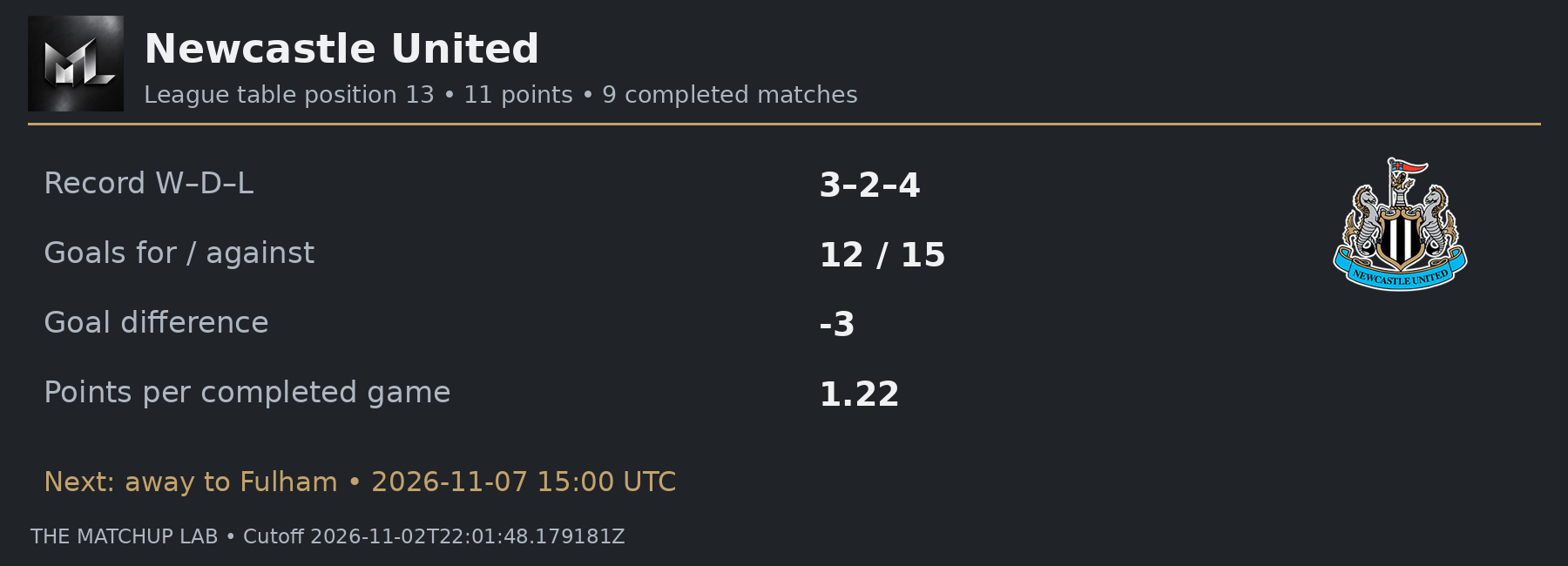
Newcastle United are thirteenth in the current league table with 11 points from 9 completed matches: 3 wins, 2 draws and 4 defeats. The scoring ledger is 12 for and 15 against, a goal difference of -3.
Monday's 0–1 home defeat to Everton leaves Newcastle with a second constraint alongside the defensive cost: the latest match supplied no goal of their own. Twelve scored and fifteen conceded across nine league games produce a negative three balance. Three wins and two draws have earned eleven points, while the fourth defeat leaves Newcastle below several clubs on the same points total. A single goal against was enough to decide this match, so the result cannot be repaired in the analysis by pointing only to a season scoring average.
Fulham away is next. Their nine goals scored and eleven conceded offer a useful comparison: Newcastle have produced more attack, but Fulham have paid a smaller defensive cost. Both sides need more wins, and a narrow table gap makes the next completed result consequential. Newcastle's task is to combine an attacking response with enough restraint to keep another small margin from deciding the outcome against them. The Everton defeat is now part of the actual season ledger rather than an in progress score. What follows must be judged on another complete match, with the same distinction between goals created in the record and points actually obtained.
Ipswich Town
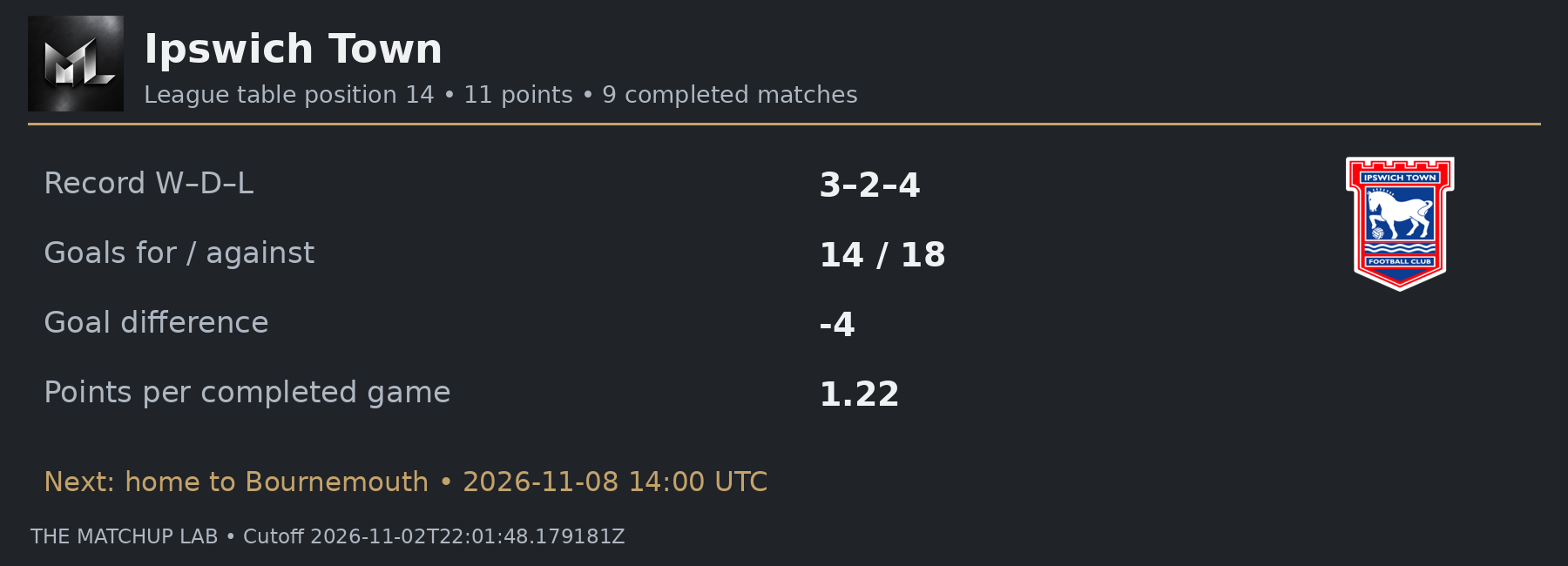
Ipswich Town are fourteenth in the current league table with 11 points from 9 completed matches: 3 wins, 2 draws and 4 defeats. The scoring ledger is 14 for and 18 against, a goal difference of -4.
Ipswich's 2–2 draw at Hull preserves an attacking contribution that is competitive with several clubs higher in the table. Fourteen league goals is the same total as Arsenal and Bournemouth. Eighteen conceded is the reason those goals have produced only eleven points rather than a leading position. The recent draw fits that wider imbalance: scoring twice was sufficient to stay in the result but not sufficient to win it. No extra explanation about chance quality or defensive errors is needed to identify the arithmetic problem.
Bournemouth visit next with the same fourteen goals scored and five fewer allowed. That makes the coming game an unusually direct comparison of two equal attacking totals with different defensive costs. Ipswich do not need a more flattering label for their current standing; they need a better relationship between goals gained and conceded. Three wins show that full points have been available, while four defeats have repeatedly interrupted progress. Keeping the next opponent below their own scoring return would do more than simply adding another high scoring draw. The Hull result is a useful point on the road, but the season's negative four goal balance remains the central constraint.
Fulham
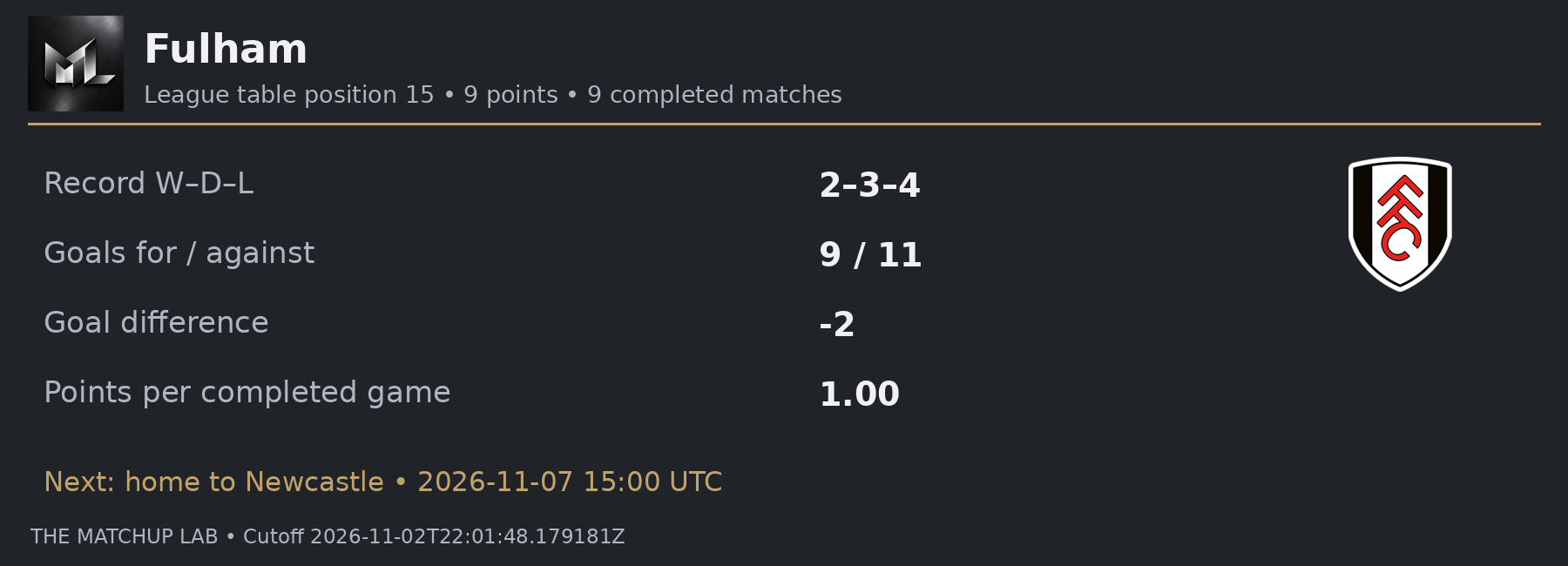
Fulham are fifteenth in the current league table with 9 points from 9 completed matches: 2 wins, 3 draws and 4 defeats. The scoring ledger is 9 for and 11 against, a goal difference of -2.
Fulham's 1–1 draw at Aston Villa adds a point without changing the season's broader scoring limitation. Nine goals in nine games is a rate of one per match, while eleven conceded leaves the goal difference at minus two. Two wins, three draws and four defeats produce nine points. The draw is a completed result worth retaining, but it does not by itself move Fulham clear of the clubs clustered near the lower part of the table.
Newcastle visit next. Fulham's main task is to turn their own modest scoring output into a more decisive result while limiting the opponent's opportunities to answer. Their nine points are level with Coventry, with goal difference currently providing separation. That is a thin margin when a single result can move several clubs. The recent Villa game offers a useful starting standard: Fulham scored and did not lose, but another one point return would leave the win count low. This edition does not have verified injury or lineup evidence to explain how the next improvement must be achieved. The supported conclusion is narrower and still important: more goals or fewer concessions must create more wins if Fulham are to establish room above the bottom group.
Coventry City
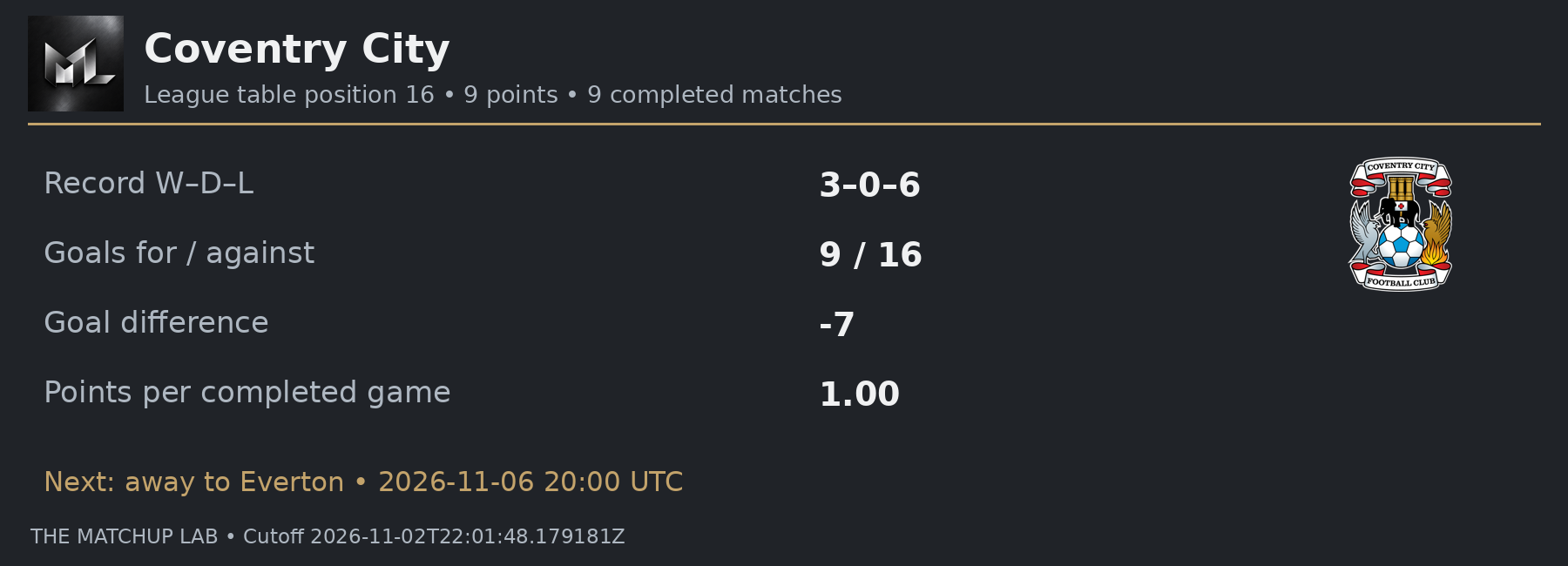
Coventry City are sixteenth in the current league table with 9 points from 9 completed matches: 3 wins, 0 draws and 6 defeats. The scoring ledger is 9 for and 16 against, a goal difference of -7.
Coventry's 3–1 win over Sunderland is a substantial result within a season that has contained no draws. Three wins and six losses mean every completed league match has returned either three points or none. The latest victory supplies both a needed points gain and one third of Coventry's nine season goals. It improves the goal difference to minus seven, although sixteen conceded remains a large defensive cost over nine fixtures.
Everton away is next on Friday. Coventry's immediate opportunity is to make the Sunderland result the beginning of a sequence rather than another isolated three point return. Their current nine points match Fulham, but the inferior goal balance leaves Coventry behind. A more stable defensive return would reduce the burden on an attack averaging one goal per game. Scoring three in the latest match is encouraging evidence of what occurred, not grounds to project three in the next. The all or nothing record also makes a draw potentially useful in a difficult fixture even as more wins are required over time. The next test is whether Coventry can combine enough attack to compete with fewer of the concessions that have made six league defeats costly.
Manchester United
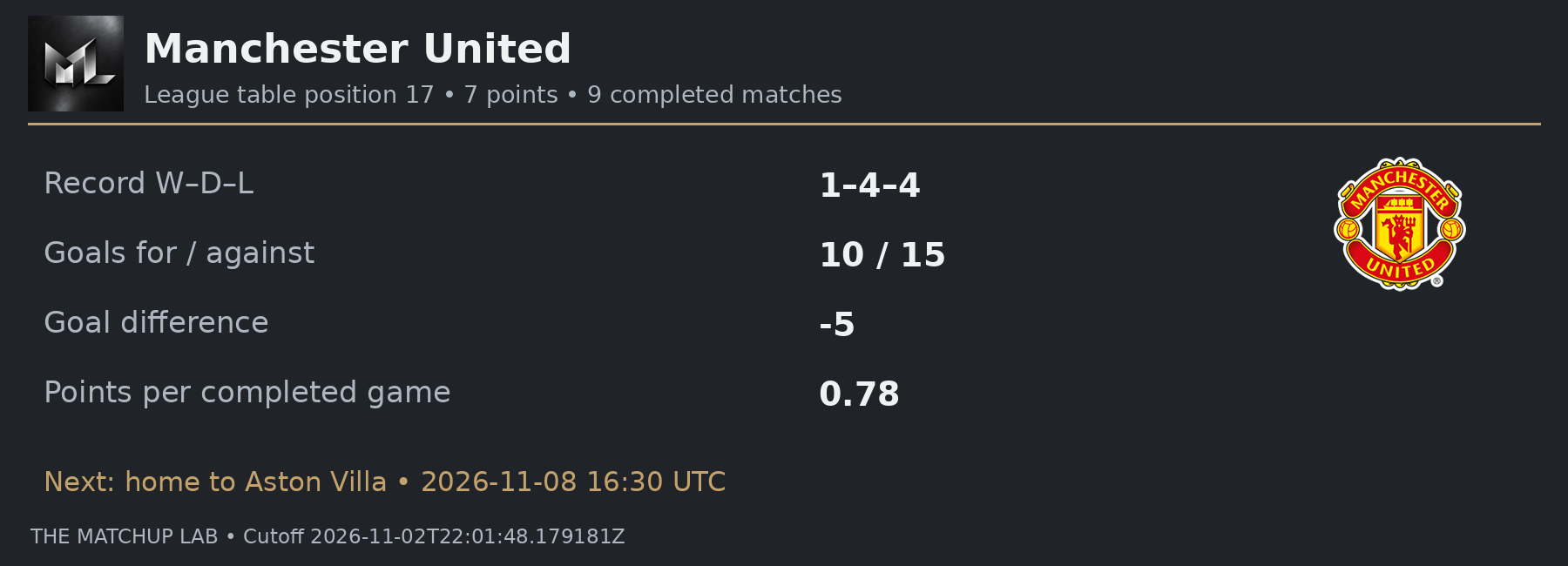
Manchester United are seventeenth in the current league table with 7 points from 9 completed matches: 1 win, 4 draws and 4 defeats. The scoring ledger is 10 for and 15 against, a goal difference of -5.
Manchester United's 2–0 defeat at Chelsea leaves a difficult combination: one win in nine league games and a negative five goal difference. Four draws have prevented the loss total from being worse, but they have not supplied enough points to move United away from the bottom group. Ten goals scored against fifteen conceded describes a side whose attack has not compensated for its defensive cost. The latest blank is therefore particularly damaging in a record already short of victories.
Aston Villa visit next with twelve points but a negative three goal balance of their own. That creates a relevant opportunity rather than an automatic recovery. Villa have scored the same ten league goals as United and conceded two fewer. The comparison suggests the margin may depend as much on reducing concessions as on expecting a large attacking jump. United's current table position is seventeenth, level on points with Palace but ahead on goal difference. Protecting that narrow ordering is not a sufficient season objective. The meaningful change would be another win supported by a better balance of goals. Reputation and club size do not alter the evidence in these nine completed matches.
Crystal Palace
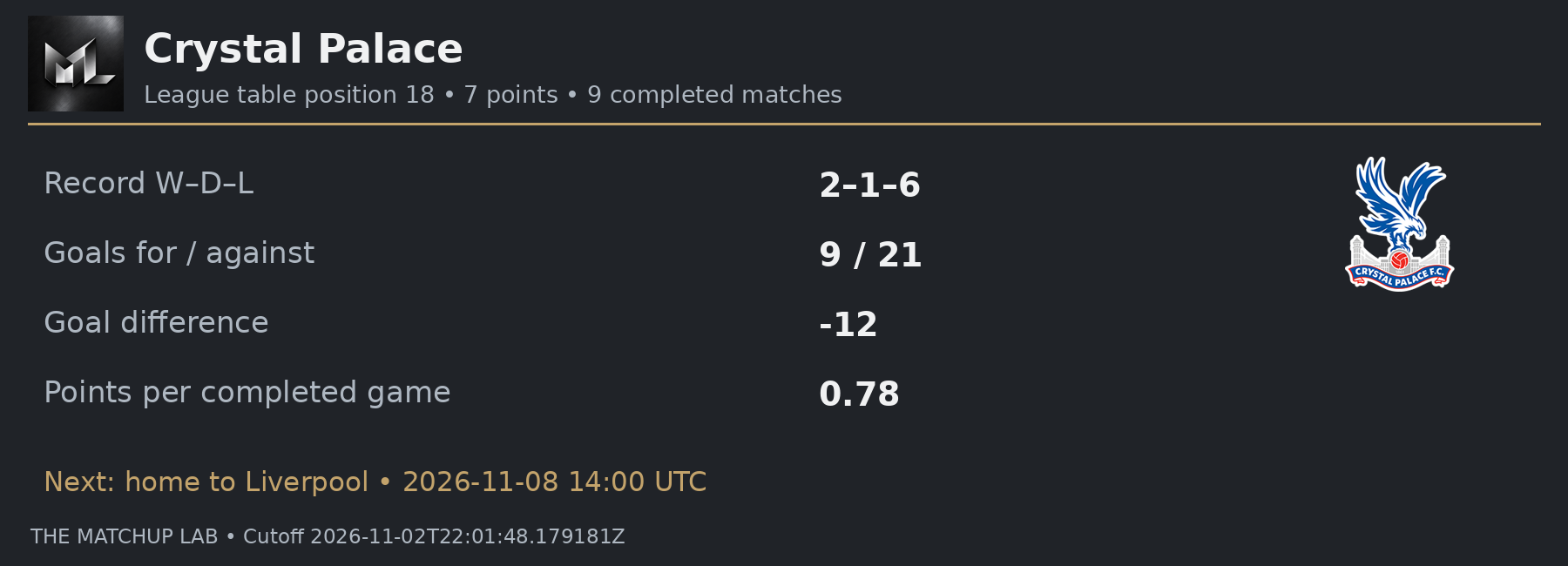
Crystal Palace are eighteenth in the current league table with 7 points from 9 completed matches: 2 wins, 1 draw and 6 defeats. The scoring ledger is 9 for and 21 against, a goal difference of -12.
Palace's 2–0 defeat at Tottenham adds to the most expensive concession record in the table. Twenty one goals allowed across nine league games is more than two per match, while nine scored has not kept pace. Two wins and one draw have produced seven points; six losses leave Palace in the bottom three of the current standings. The latest score is a continuation of that negative goal balance, without proving which specific tactical or personnel change would repair it.
Liverpool visit next after losing 1–0 to Arsenal. Their eleven goals scored is a more modest total than several other top half clubs, but Palace cannot take that as evidence that conceding will be harmless. Liverpool have also allowed only nine, so Palace face a dual task: reduce the defensive cost and produce enough of their own attack against a comparatively restrained concession record. Level points with Manchester United are not the whole story because Palace's minus twelve goal difference is substantially worse. A cleaner result would help both the points total and the tie breaking position. Until that improvement is recorded, the table's lower placing is supported by the complete season arithmetic.
Nottingham Forest

Nottingham Forest are nineteenth in the current league table with 6 points from 9 completed matches: 1 win, 3 draws and 5 defeats. The scoring ledger is 6 for and 12 against, a goal difference of -6.
Forest's 2–0 defeat at Brentford leaves the league's smallest scoring total in this snapshot. Six goals from nine games is below one per match. Twelve conceded is less severe than several other lower table records, but limited attack has turned that defensive return into only six points. One win, three draws and five losses show the practical effect. The recent blank reinforces the constraint without offering a verified explanation about shot selection, finishing or chance creation.
Manchester City visit next after losing 1–0 to Brighton. City's twenty goals scored contrast sharply with Forest's six, even though the latest round left both clubs without a goal. Forest cannot assume the visitor's blank will repeat, and City cannot treat the table gap as a result already obtained. For the home side, keeping the contest close is useful only if enough attack follows to obtain a return. A draw would add a point, but a longer improvement requires more than one win in every nine games. The next match is therefore a difficult immediate test of both survival in the contest and the ability to convert that survival into points.
Sunderland
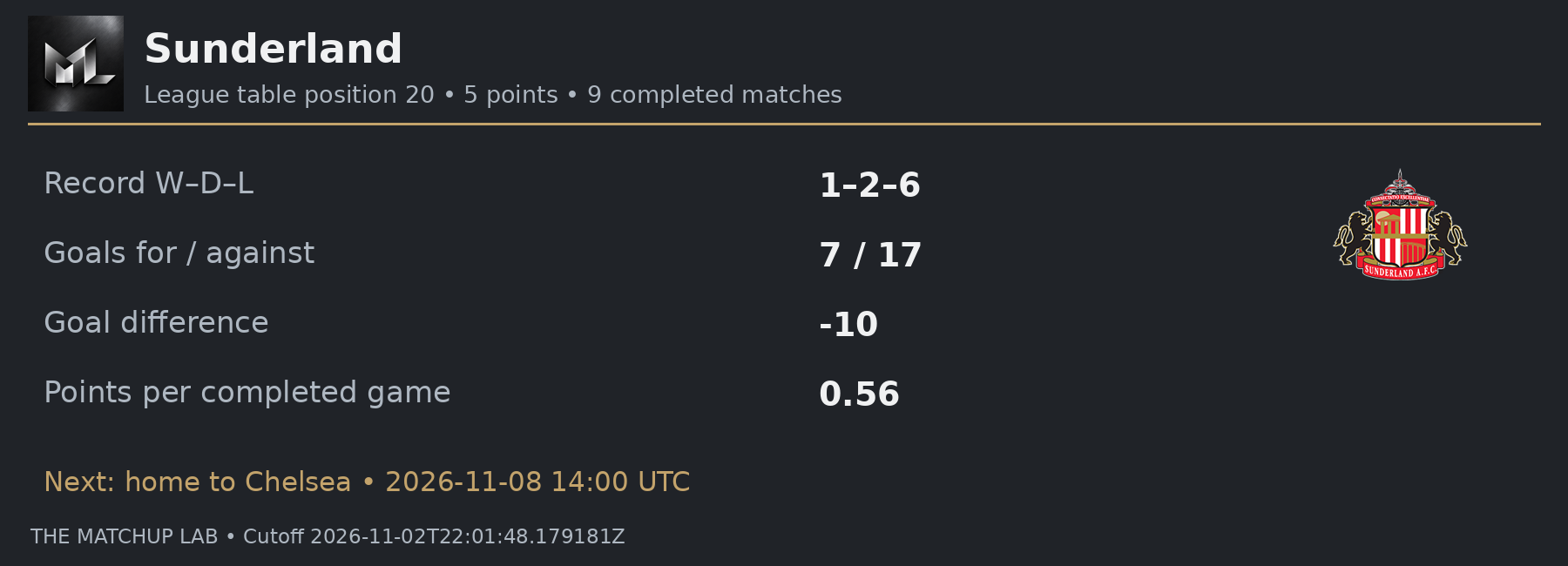
Sunderland are twentieth in the current league table with 5 points from 9 completed matches: 1 win, 2 draws and 6 defeats. The scoring ledger is 7 for and 17 against, a goal difference of -10.
Sunderland's 3–1 defeat at Coventry leaves them bottom with five points. Seven goals scored and seventeen conceded produce a negative ten balance after nine league games. One win and two draws have supplied the entire return, while six losses have repeatedly removed opportunities to close the gap. Scoring once at Coventry prevented a blank but did not make the result close enough in points terms. The defensive total is a central problem alongside the low attacking output.
Chelsea visit next with nineteen goals scored and sixteen points. The visitors' fifteen concessions show that their record is not without weakness, but Sunderland need to exploit an opportunity while also reducing their own cost at the other end. The latest Chelsea result, a 2–0 win over Manchester United, supplies no reason to assume that task will be easy. Forest are only one point ahead and Palace two, so the table still offers reachable targets. Reaching them requires actual results, not a softer description of the current numbers. An improved concession count in the next match would be valuable, and a scoring contribution must then turn that improvement into a draw or win.
Arsenal–Hull: the leader meets a draw specialist
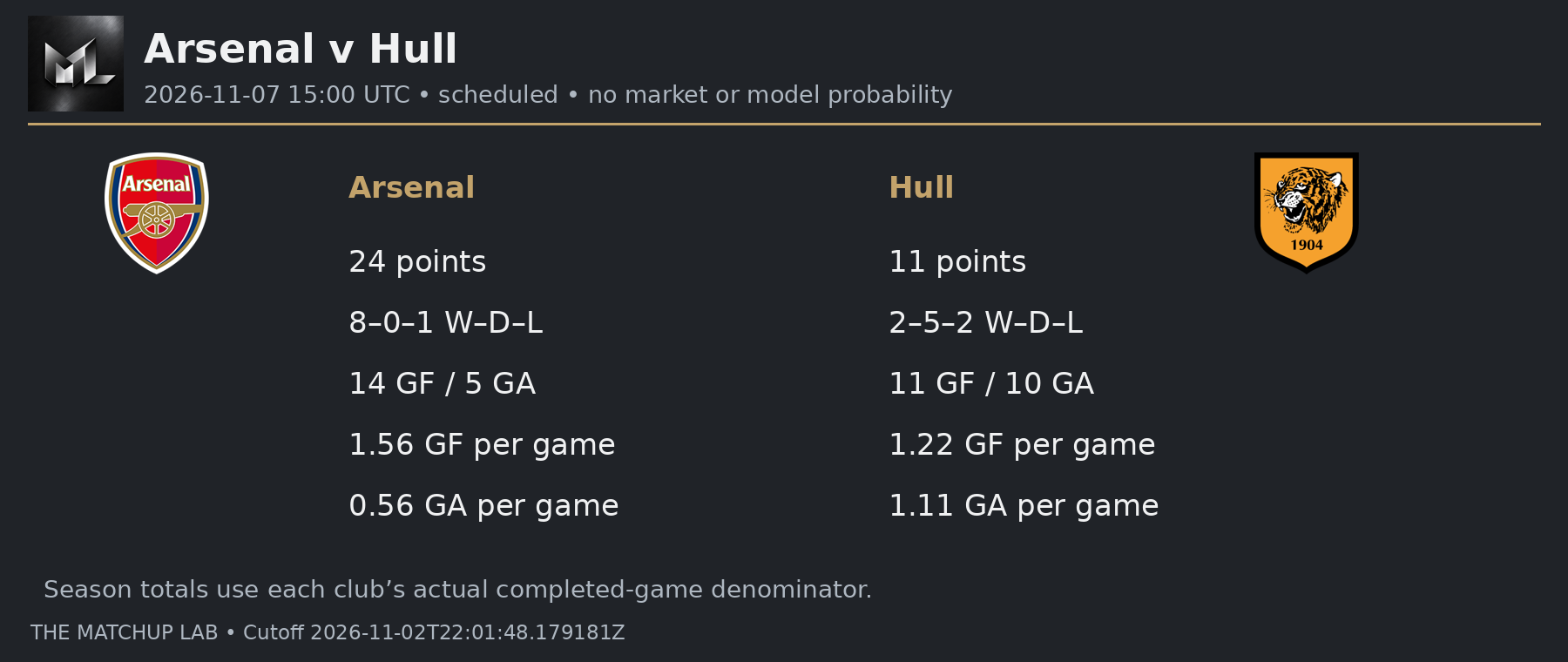
Arsenal host Hull on November 7 at 15:00 UTC with a clear contrast in results patterns. The leaders have eight wins and one defeat, no draws, and twenty four points. Hull have drawn five of nine, won twice and lost twice. Both have avoided defeat in most of their completed fixtures, but Arsenal's ability to finish matches with three points has created a thirteen point difference. That distinction is the most useful starting point for the game.
The scoring records add a second layer. Arsenal have fourteen goals for and five against; Hull have eleven for and ten against. The home side's concession rate is half Hull's, across the same nine game denominator. Arsenal's latest 1–0 win at Liverpool demonstrates the value of a narrow scoring margin when no goal is allowed. Hull's 2–2 draw with Ipswich shows a different recent balance: enough attack to share the outcome, with two concessions preventing a win. Neither match tells us the underlying chance quality, so the comparison stays with verified scores.
The editorial test is whether Hull can keep the result open long enough for their draw heavy season to remain relevant, and whether Arsenal can create separation without surrendering the defensive foundation of the lead. Those are questions for the game, not claims about an observed tactical plan. The table favours Arsenal's results record, but there is no certified probability or current market in this snapshot. A home win would protect the lead before City's result is known; a Hull return would interrupt the leaders' remarkably decisive start. The canonical game page carries this edition's matchup link, and the listed kickoff remains a scheduled event subject to a later source update. No score is assigned to a fixture that has not begun. Hull’s five draws remain a reason to examine the contest rather than dismiss it.
Brighton–Brentford: scoring force against resistance
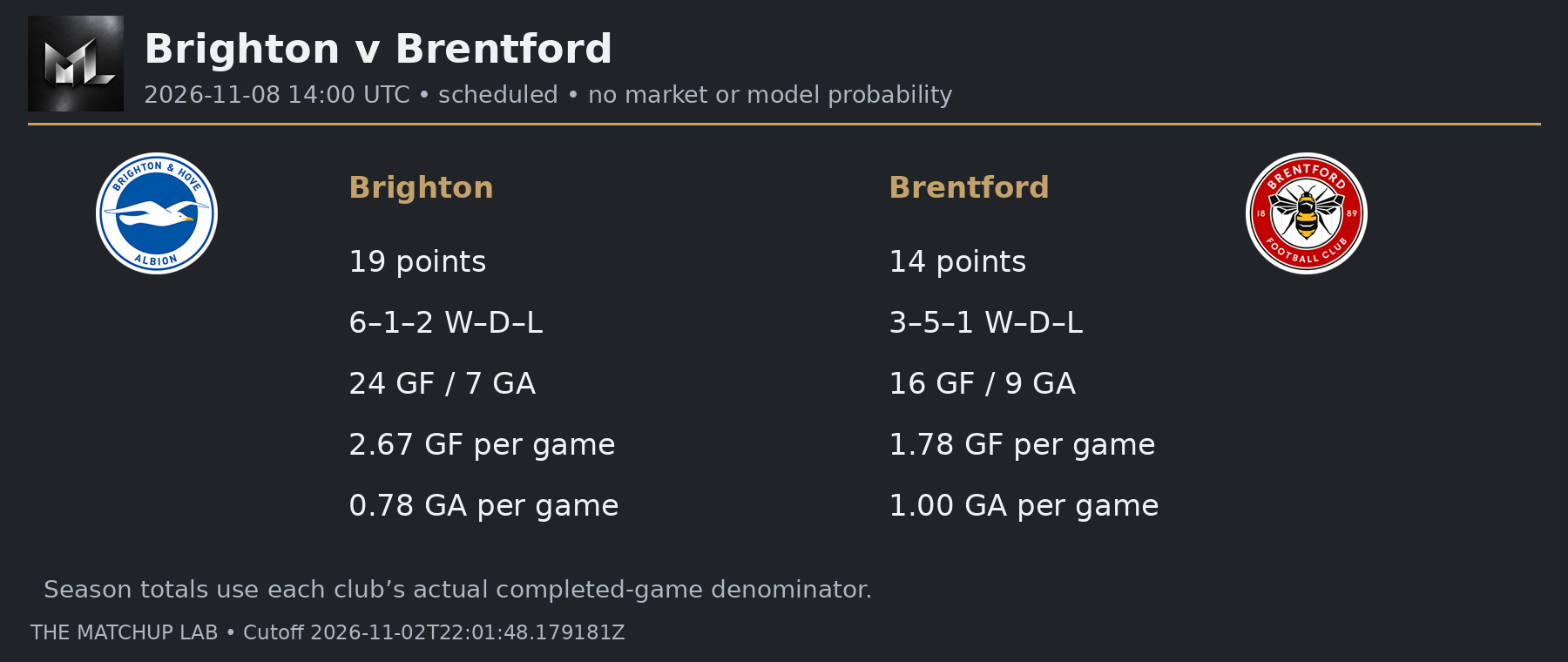
Brighton host Brentford on November 8 at 14:00 UTC in a meeting that tests two strong but different early season records. Brighton have nineteen points, twenty four goals scored and seven conceded. Brentford have fourteen points, sixteen scored and nine conceded. The five point gap is therefore real, but it sits alongside a loss count that favours Brentford: one defeat compared with Brighton's two. The difference is how often each club has turned a competitive result into a victory.
Brighton have won six times and drawn once; Brentford have won three and drawn five. That distinction explains the points more clearly than assigning an unsupported model label to either club. Both enter from clean wins in the reviewed round. Brighton beat Manchester City 1–0 away, while Brentford beat Nottingham Forest 2–0 at home. The scores establish the completed outcomes and add useful context, without proving that the same defensive or attacking performance will recur in this fixture.
Brighton's plus seventeen goal balance is the strongest in the current table, and their attacking total is eight higher than Brentford's. Brentford's nine concessions nevertheless provide a credible aggregate basis for resistance. The central question is whether Brighton can keep turning that larger scoring output into wins against a visitor that has repeatedly avoided defeat. For Brentford, another draw would preserve the low loss count while doing little to close the points gap. A win would change the relationship much more sharply. There is no verified lineup, injury adjustment, shot denominator or live price here to turn those observations into a numerical prediction. The game deserves attention because the records present a concrete tension: one side has been much more productive in attack, the other unusually difficult to beat. The result must resolve it on the field. Both clubs therefore offer more substance than their table positions alone can convey.
Forest–Manchester City: two blanks, unequal foundations
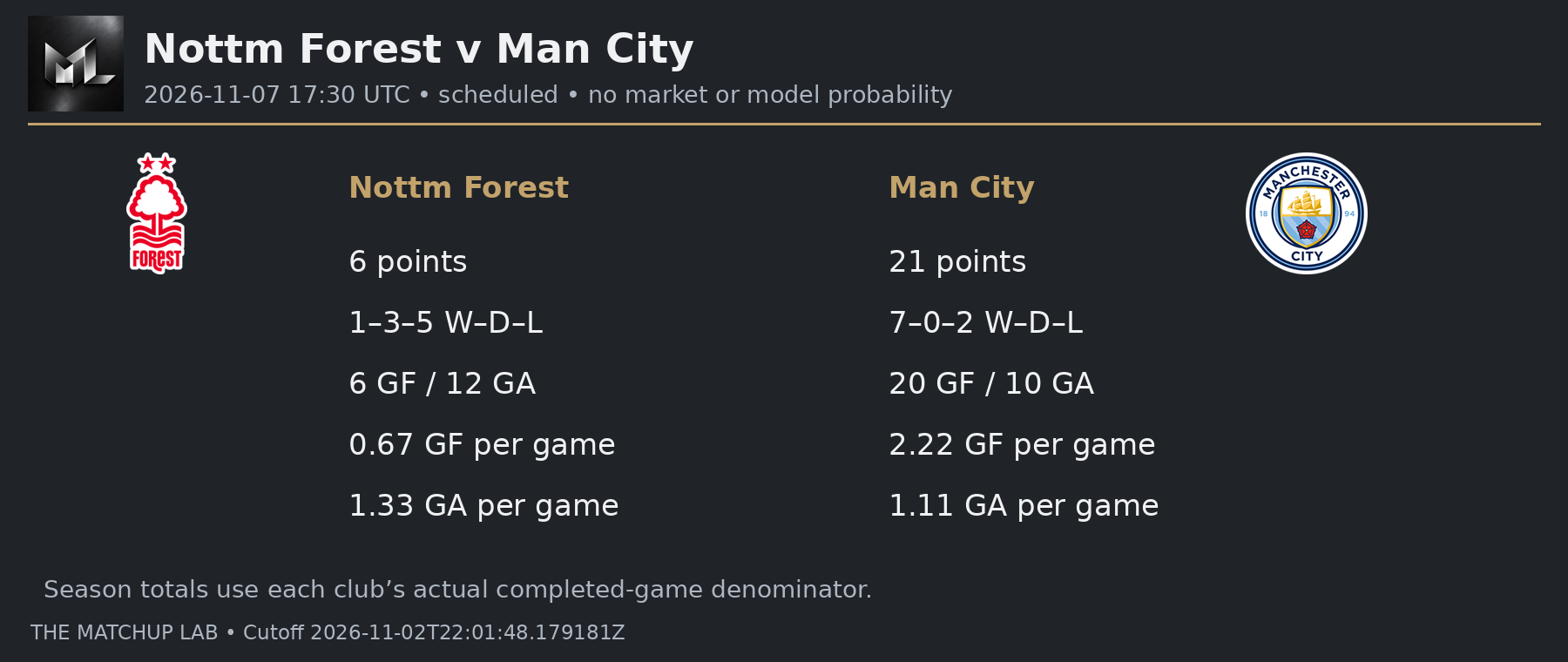
Nottingham Forest host Manchester City on November 7 at 17:30 UTC after both clubs failed to score in the reviewed round. Forest lost 2–0 at Brentford; City lost 1–0 at home to Brighton. Those common blanks should not obscure the season's unequal foundations. City have twenty goals scored, twenty one points and seven wins. Forest have six goals, six points and one win. A single shared outcome type does not make the broader records equivalent.
The concession totals are closer: twelve for Forest, ten for City. That comparison helps identify why Forest's attacking return is so important. Their defence has not conceded as often as several clubs near the bottom, but six goals across nine games has offered limited compensation. City, by contrast, have paired a similar concession count with more than three times the scoring. This is a comparison of actual completed goals, rather than an estimate of chance quality or an opponent adjusted statistical rating.
Forest's immediate task is to make the contest competitive while generating enough attack for that competitiveness to matter in points. City need a scoring response that also prevents a lower placed opponent from turning an isolated opportunity into another damaging result. Both are editorial conditions, not assertions about a confirmed approach. Arsenal's three point lead adds context for City; Forest's position one point above Sunderland supplies a different kind of urgency. No certified win probability, available lineup adjustment or current betting price is attached to the game. The stronger City record is clear without one. The useful next evidence will be whether City convert that advantage into an actual result and whether Forest can exceed the low scoring baseline that has constrained their season. The scheduled kickoff and canonical game link are retained so the matchup can be followed under its original identity.
Manchester United–Villa: equal goals, different returns
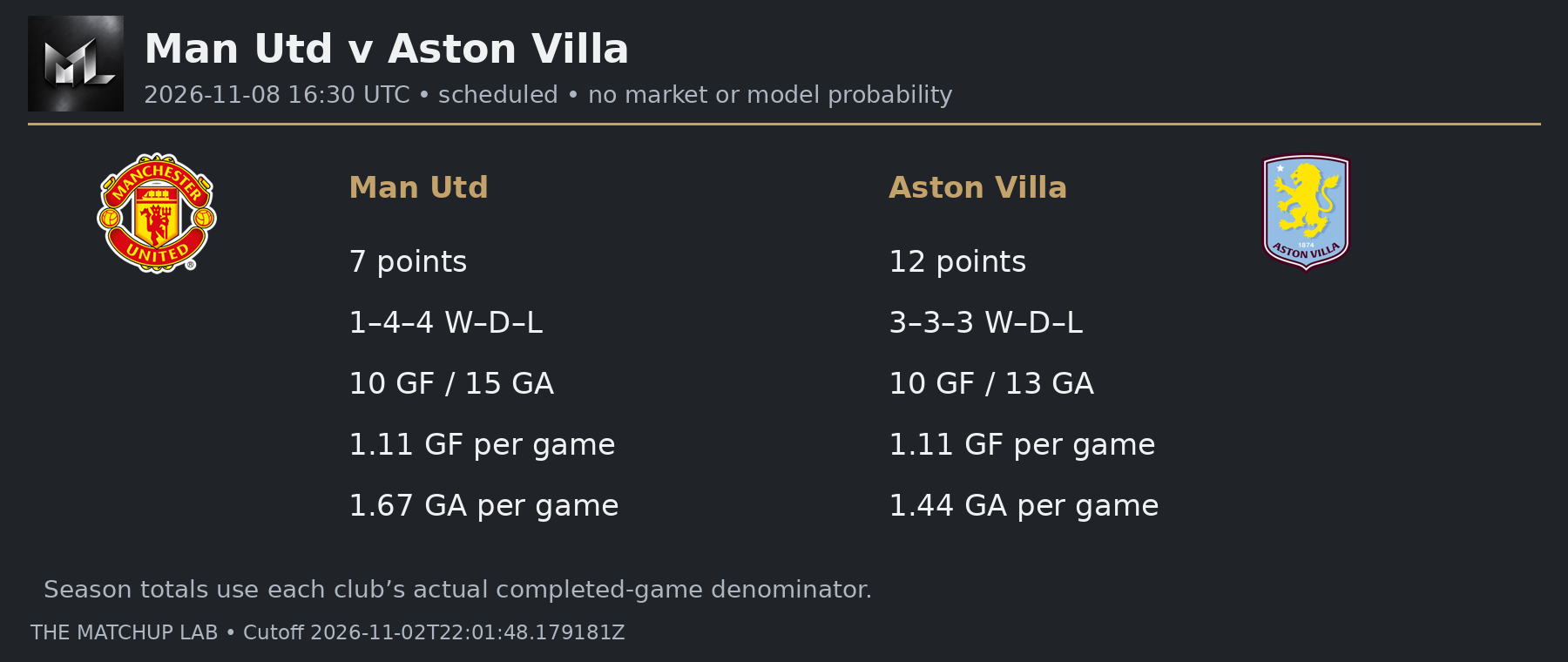
Manchester United host Aston Villa on November 8 at 16:30 UTC with both clubs having scored ten league goals. The equal attacking totals have produced very different returns: Villa have twelve points and three wins, United seven points and one win. Thirteen conceded for Villa against fifteen for United explains part of that separation, while the distribution of draws and victories explains the rest. This is a useful game for examining how modest scoring output becomes points.
United enter after a 2–0 defeat at Chelsea; Villa after a 1–1 draw with Fulham. Villa's shared result preserved a place in the twelve point group but left a negative three goal balance. United's blank left the goal difference at minus five and the win count unchanged. Neither club can use an equal season scoring total as evidence that the attack has done enough. Both are averaging only a little above one goal per league game, which makes the concession side of the ledger consequential.
The practical question is which team can create enough separation to obtain three points without increasing its own defensive cost. United need a result that changes the one win record; Villa need to move beyond another draw if they are to separate from the crowded middle. A Villa win would widen the existing points gap, while a United victory would reduce it sharply. Those consequences follow from the table arithmetic and do not require an invented model or a reputation based exception. There are no verified current injuries, lineups, possession denominators or markets in this evidence set, so none are used to assign a forecast. The fixture's appeal is more concrete: two equal scoring totals, two negative goal balances and a significant difference in points already earned. The next completed ninety minutes will show whether that difference widens or begins to close.
Evidence cutoff and reporting scope
Common evidence cutoff: 2026-11-02T22:01:48.179181+00:00. The current Newcastle–Everton final was observed in the existing approved source at 2026-11-02T22:00:58.234766+00:00. The retained standings baseline was observed at 2026-11-02T17:33:26.536000+00:00; its 89 completed fixtures were advanced by that one verified final to ninety. All twenty current club records and goal/point rates were recalculated together. The ten reviewed result IDs and ten scheduled next-round IDs reconcile across retained native and shared coverage. Complete historical raw-statistic ID and denominator coverage remains uncertified, so Statistical Rank, overall numerical Power Rank and separate Results Rank updates remain incomplete.
League identity and 2026/27 regular-season stage, current club records and fixture identities come from the existing approved shared EPL source and retained native source payloads. The primary Premier League table request at 10:16 UTC returned Access Denied; its exact response is retained privately. No alternate primary route or browser bypass was used. Goals per game and points per game use each club’s actual completed-match denominator. No unavailable shot, possession, injury, chance-quality or market input is substituted.
Canonical game pages
- Chelsea v Manchester United — final
- AFC Bournemouth v Leeds United — final
- Brentford v Nottingham Forest — final
- Coventry City v Sunderland — final
- Hull City v Ipswich Town — final
- Manchester City v Brighton & Hove Albion — final
- Tottenham Hotspur v Crystal Palace — final
- Aston Villa v Fulham — final
- Liverpool v Arsenal — final
- Newcastle United v Everton — final
- Everton v Coventry City — scheduled
- Leeds United v Tottenham Hotspur — scheduled
- Arsenal v Hull City — scheduled
- Fulham v Newcastle United — scheduled
- Nottingham Forest v Manchester City — scheduled
- Brighton & Hove Albion v Brentford — scheduled
- Crystal Palace v Liverpool — scheduled
- Ipswich Town v AFC Bournemouth — scheduled
- Sunderland v Chelsea — scheduled
- Manchester United v Aston Villa — scheduled
Reporting sources and scope
League identity and 2026/27 regular-season stage, current club records and fixture identities come from the existing approved shared EPL source and retained native source payloads. The primary Premier League table request at 10:16 UTC returned Access Denied; its exact response is retained privately. No alternate primary route or browser bypass was used. Goals per game and points per game use each club’s actual completed-match denominator. No unavailable shot, possession, injury, chance-quality or market input is substituted.
Fixture identities, scores and league records: existing approved shared EPL source and retained native query caches. Primary table access restriction retained; no bypass or alternate primary route used. Current model updates remain incomplete.