
Schedule, records and season totals checked against the retained shared sports feed and current NFL league and club statistics. All matchup assessments and Results Rank calculations are original work by The Matchup Lab.

NFL Week 8 Preview
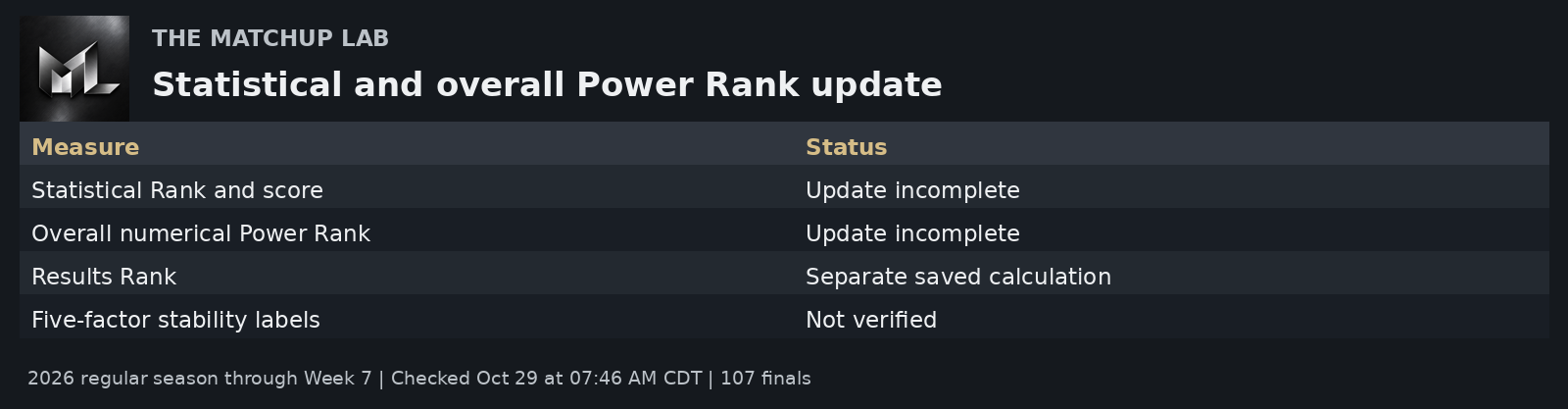
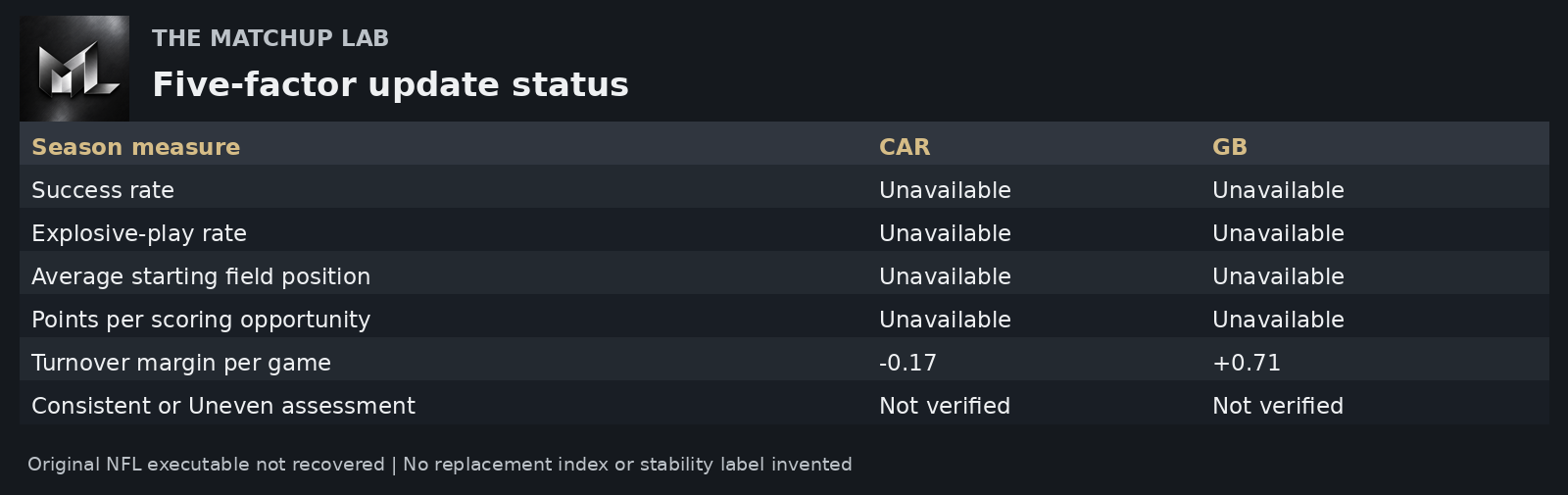
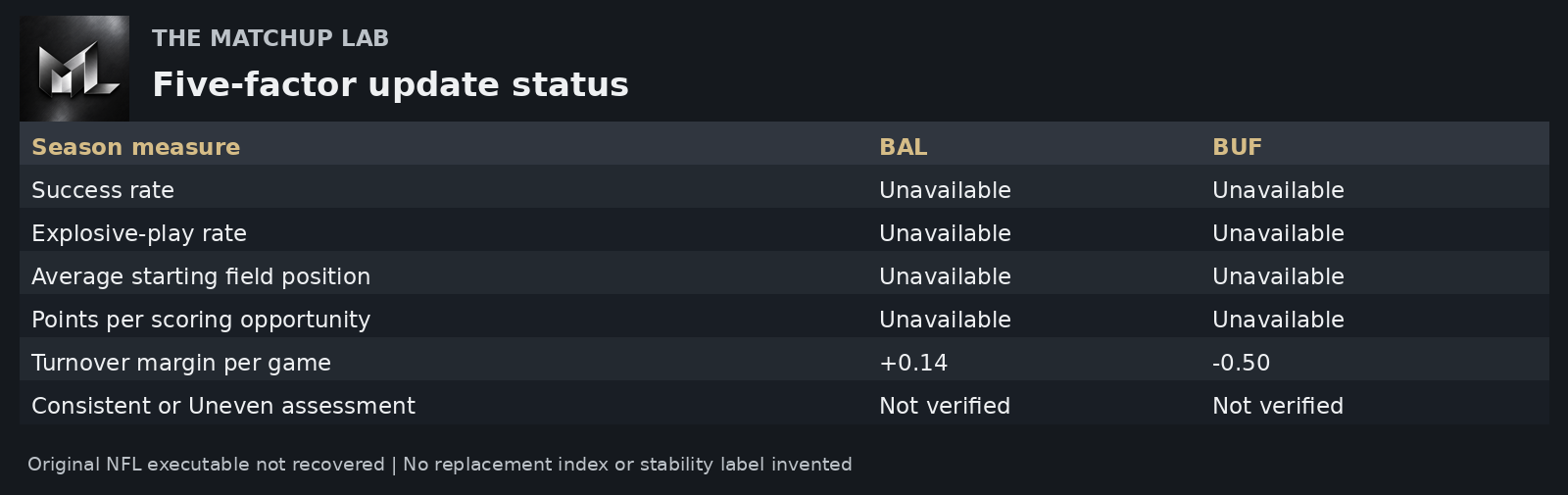
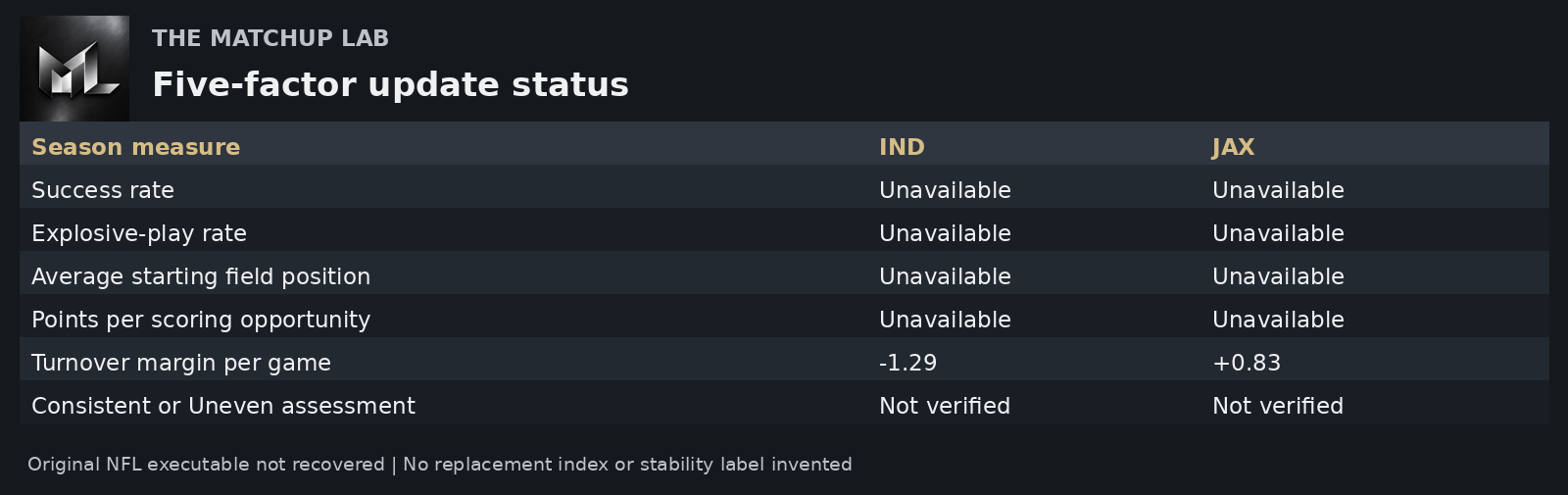
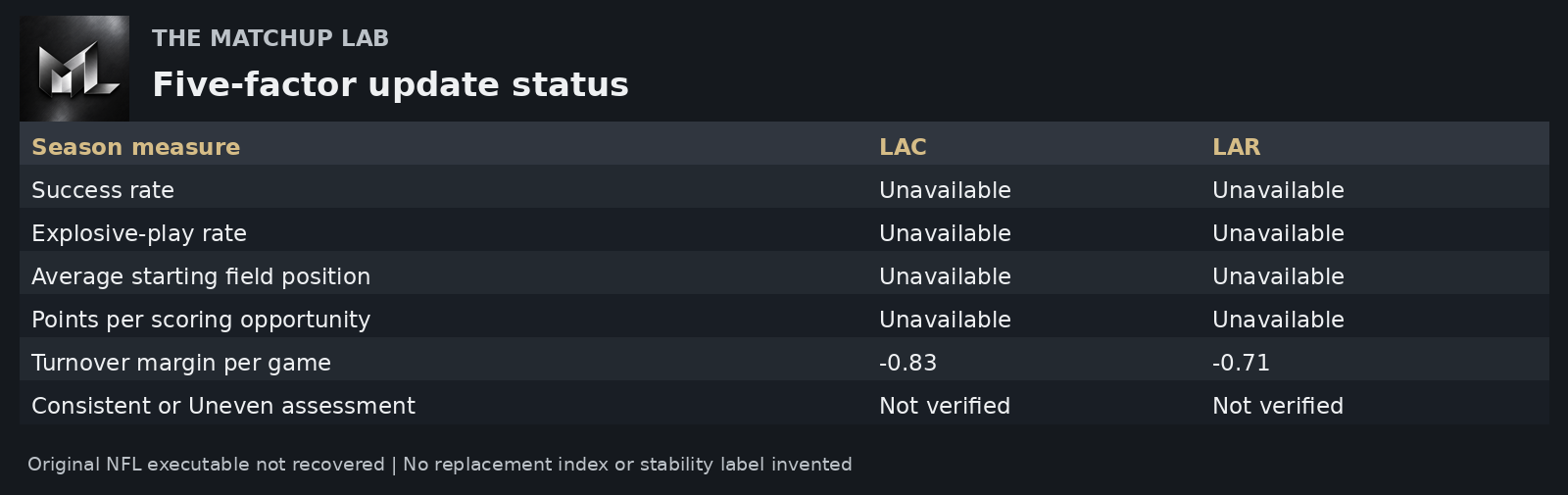
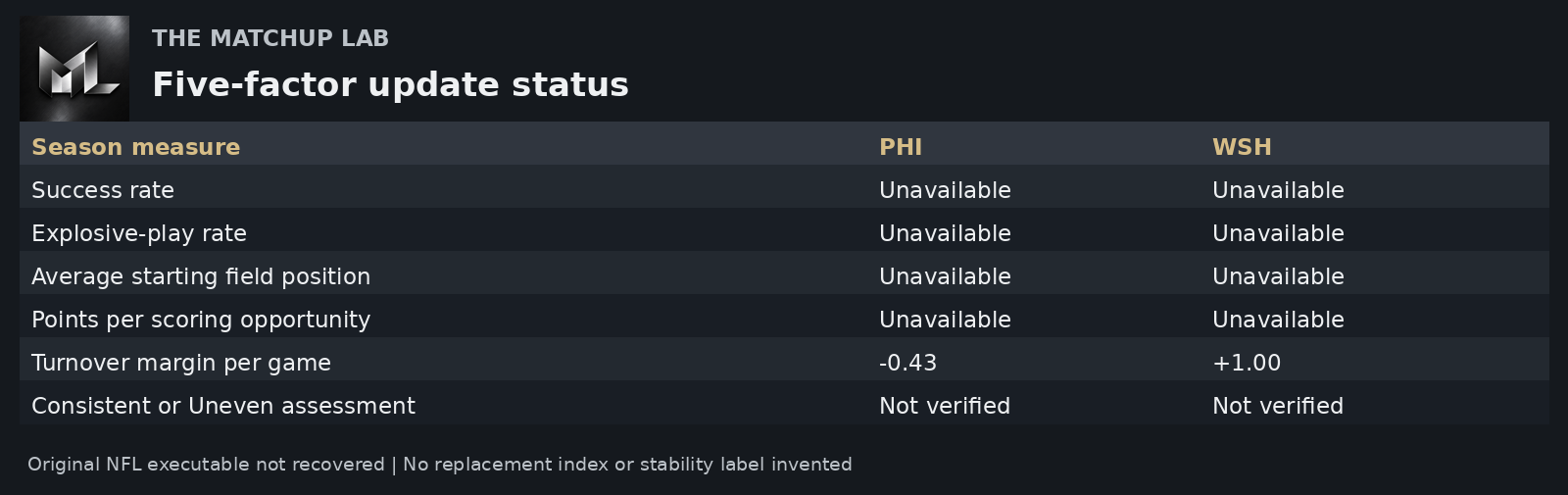
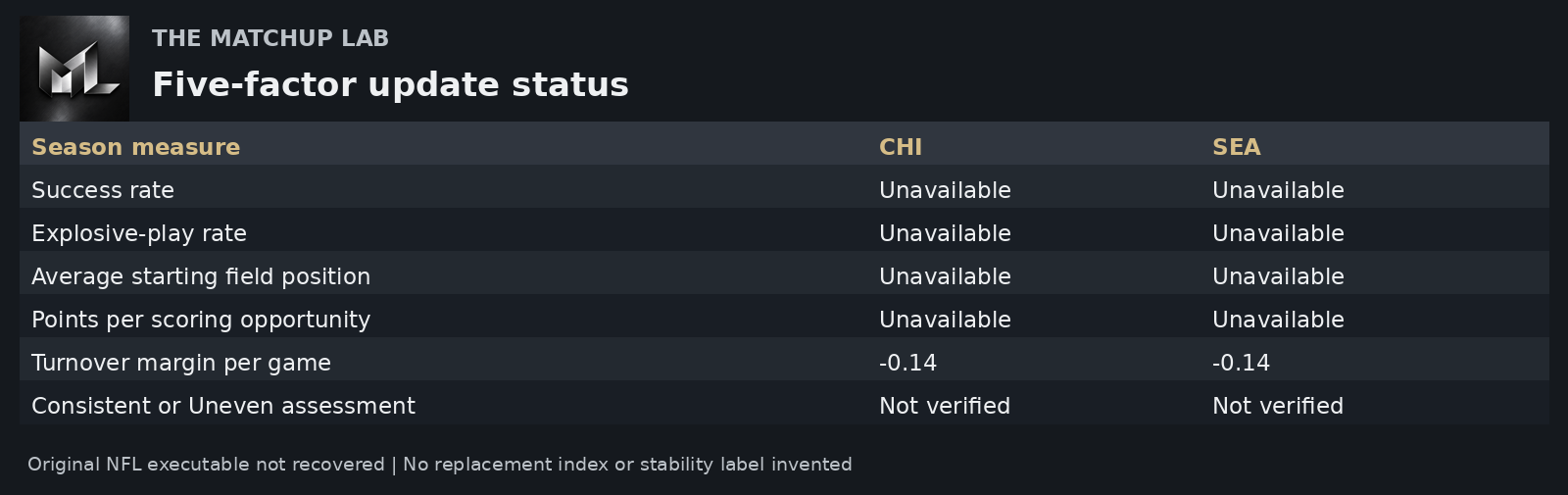
The Statistical Rank update remains incomplete because the saved original NFL executable has not been recovered with its required version binding. Its established weights remain efficiency 40 percent, explosive plays 25 percent, finishing drives 15 percent, field position 10 percent and turnovers 10 percent, with offense and defense, small-sample priors and category caps. No replacement scores or unverified movement are issued. Overall Power Rank requires fewer losses first and the unchanged Statistical Rank within each loss group, so an unsupported numerical overall order is not shown.
Results Rank
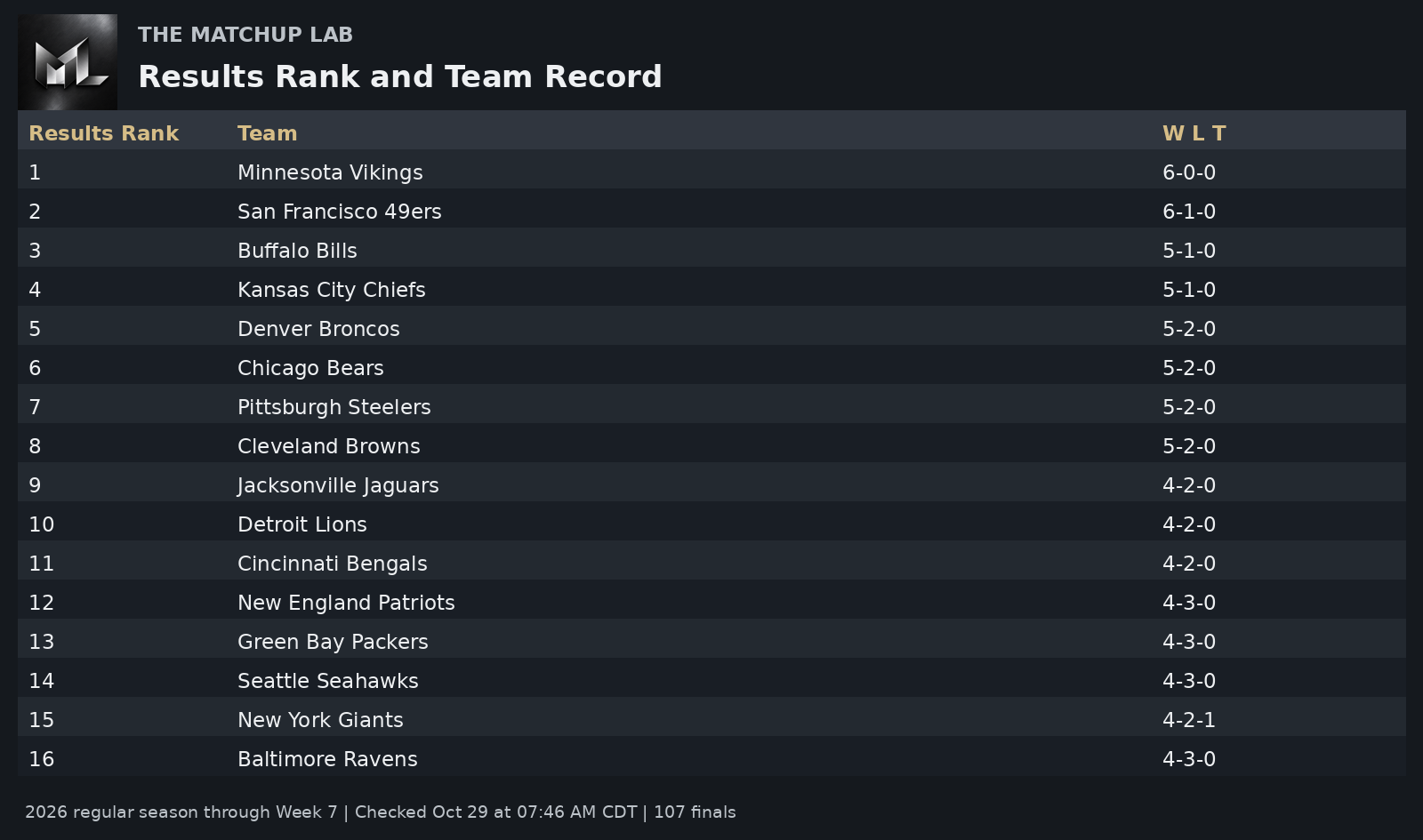
Results Rank is a separate calculation of observed results. The saved matchup-lab-results-v1.0 method weights smoothed record 60 percent, schedule 15 percent, strength of victory 15 percent and loss quality 10 percent. It removes every head-to-head meeting from each opponent evaluation and keeps ties at one-half. Repeated opponents count once per meeting. This is an editorial results measure, not a betting probability or the Statistical Rank. Opponent records and calculation components remain private.
Results Rank continued
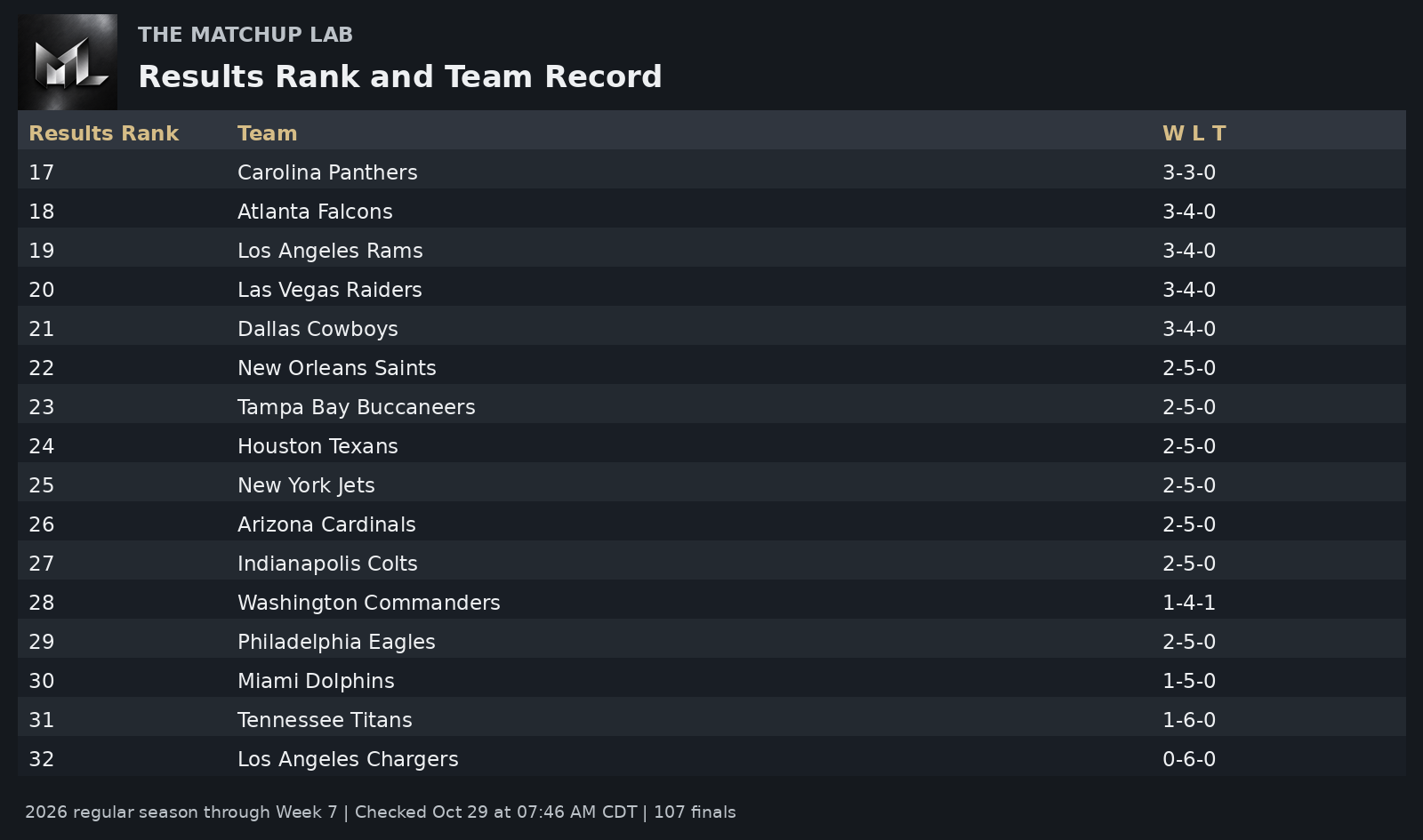
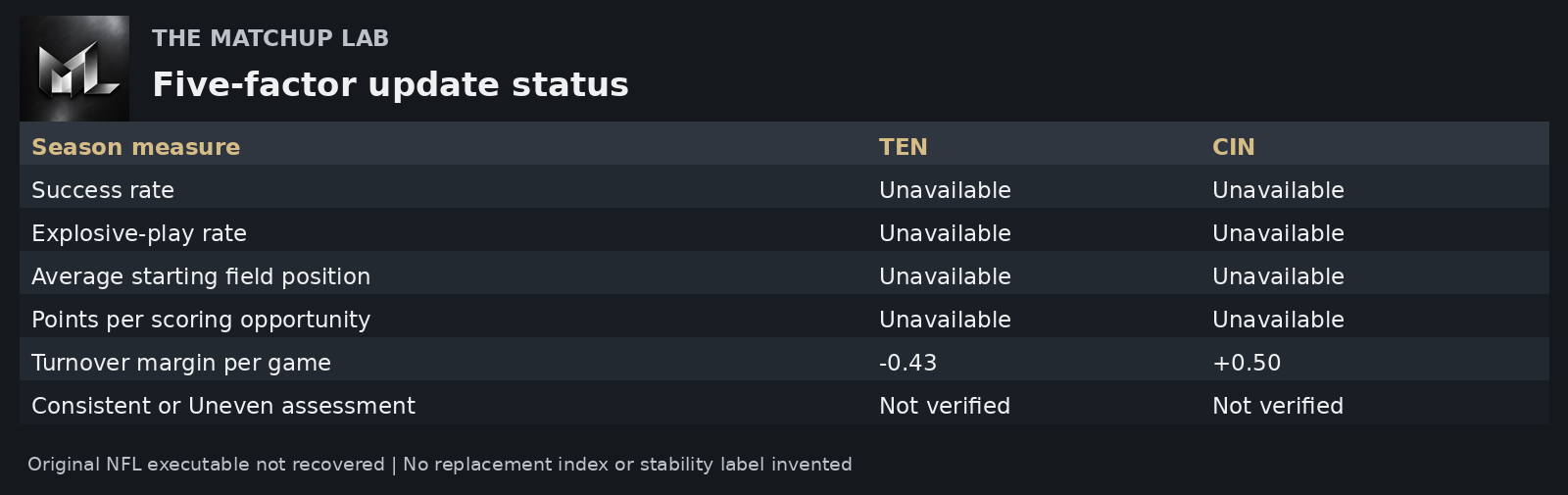
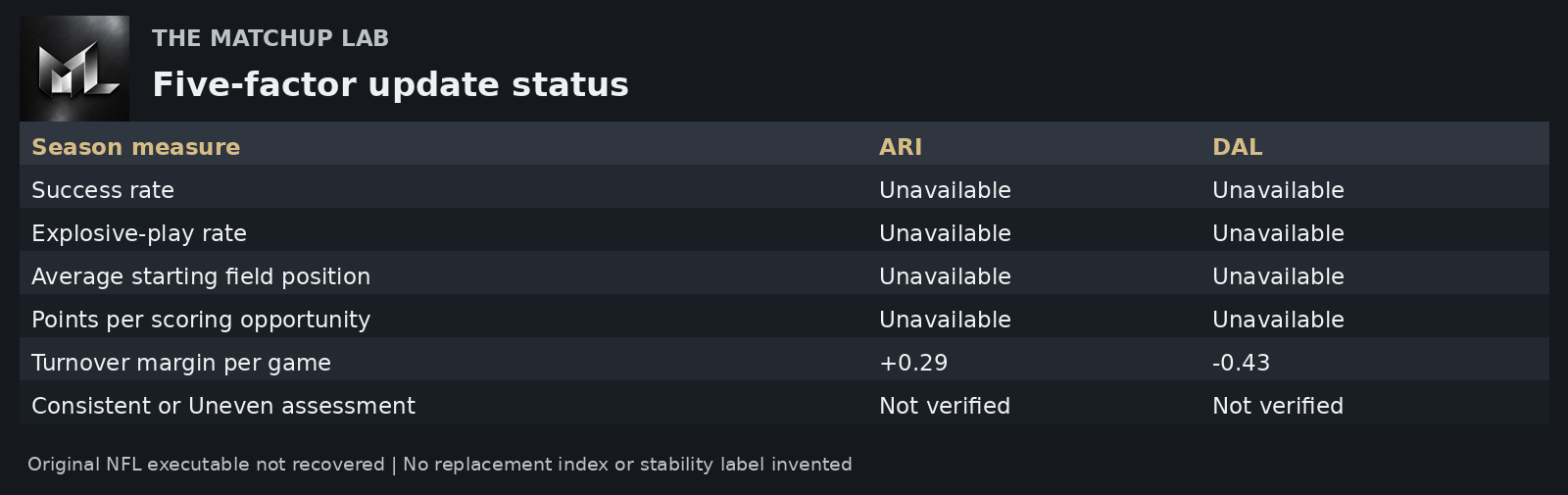
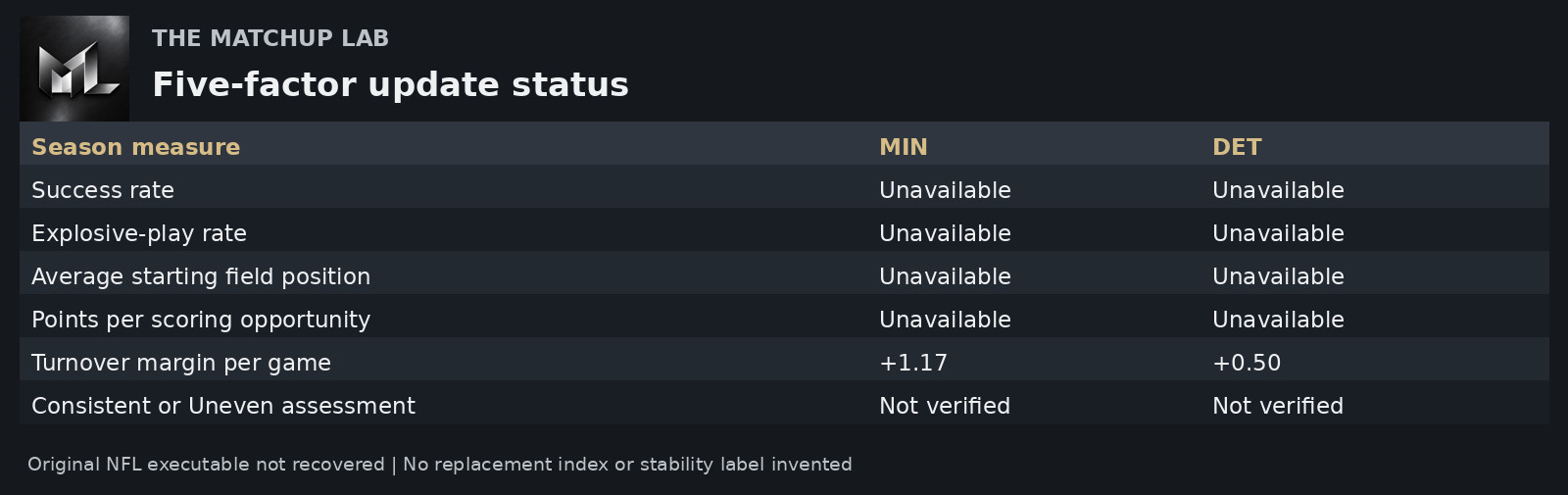
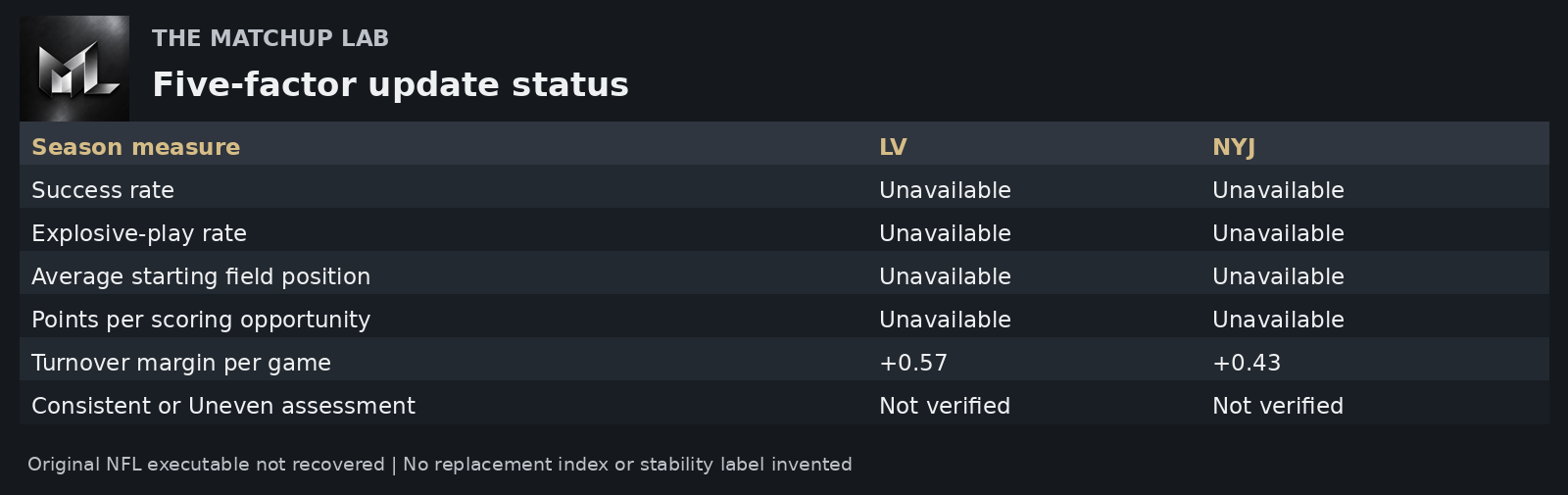
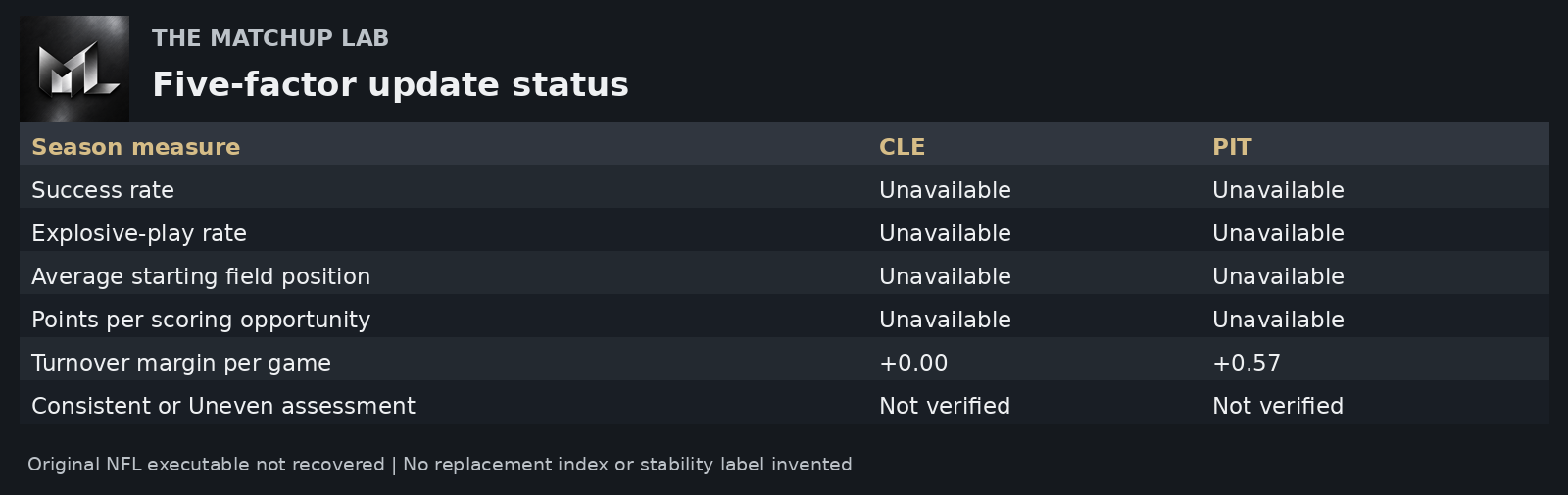
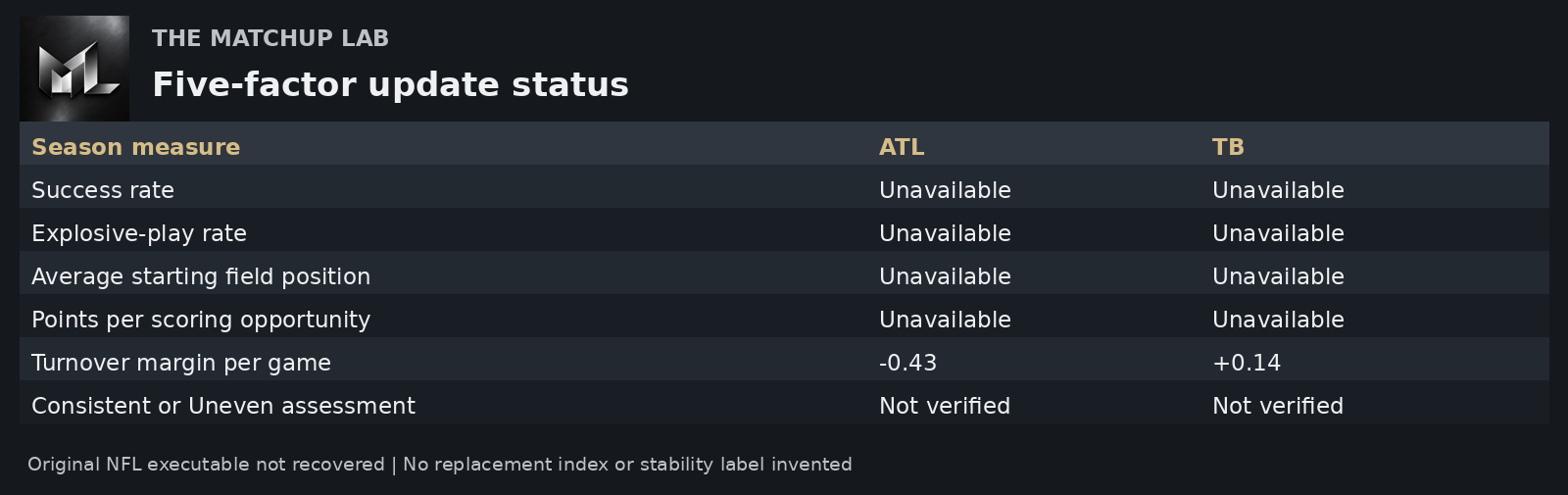
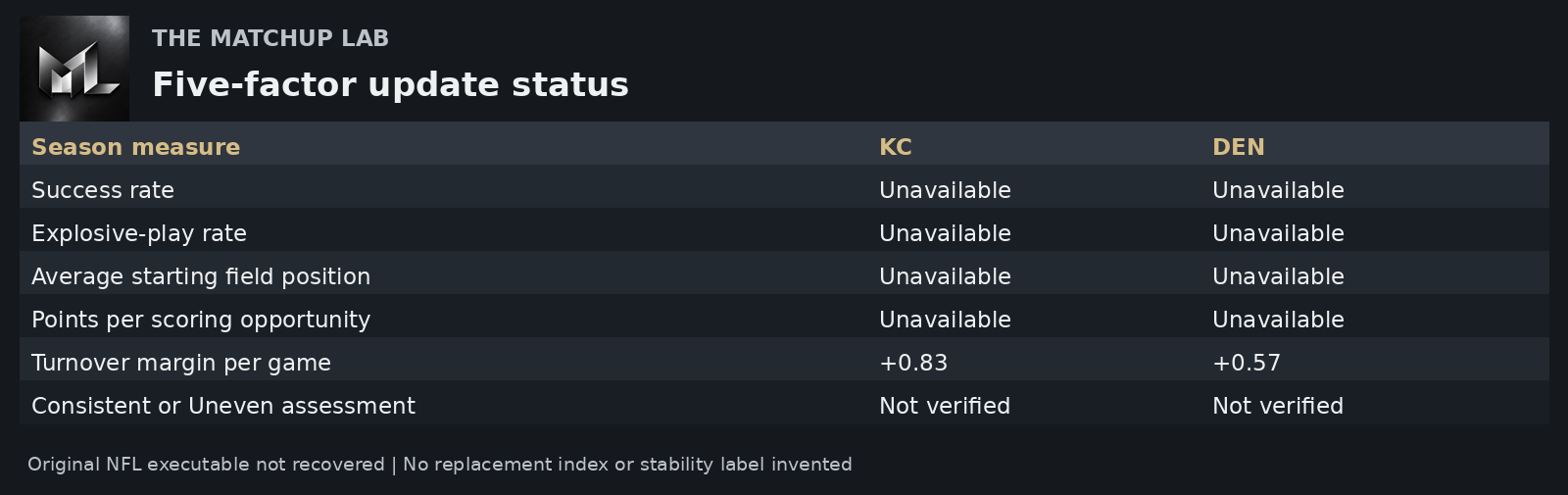
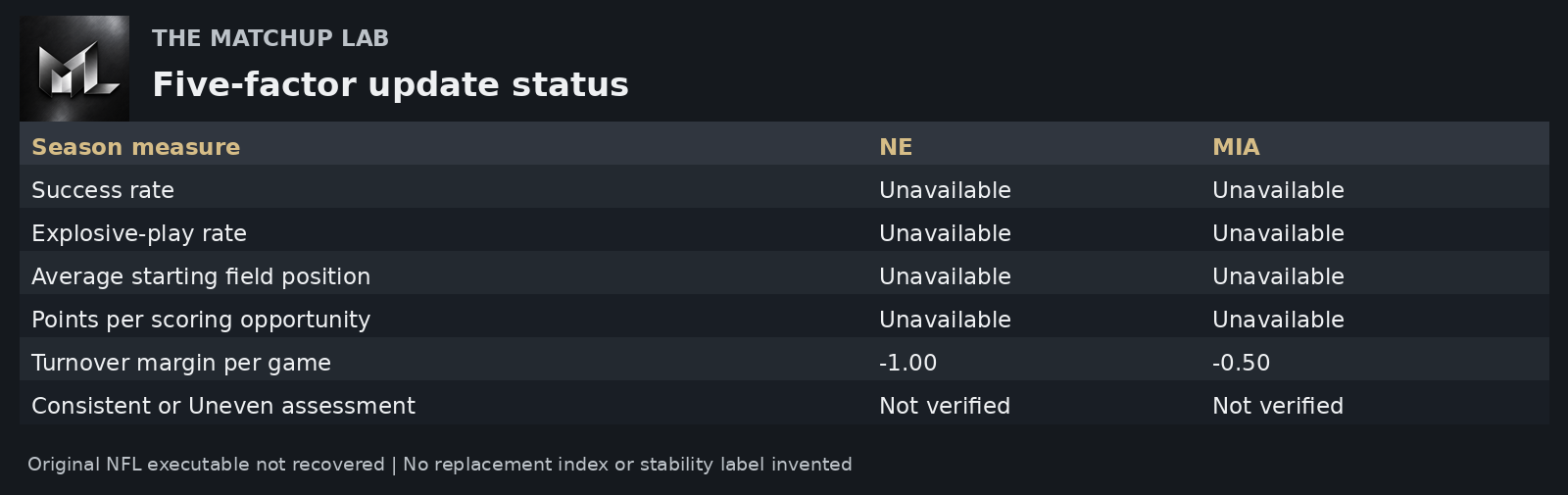
Records show outcomes, while the season statistics help explain how those outcomes were reached. A team can win one game comfortably and lose the next without either result making the underlying measurements meaningless. The team and matchup tables use summed season counts. Conversion percentages divide total conversions by total attempts rather than averaging individual game percentages. Unverified factor values and stability labels remain unavailable.
Introduction to Week 8
Minnesota takes its unbeaten record to Detroit for the sharpest test of this week's contrast between scoring production and prevention. Chicago brings a productive rushing attack to Seattle. Buffalo and Baltimore offer a different examination of whether a strong offense can keep covering a defense that allows opponents to move the ball. Fourteen games run from Thursday October 29 through Monday November 2. Houston, New Orleans, the New York Giants and San Francisco are on bye.
The evidence cutoff is 2026-10-29T12:46:14Z. Season statistics cover all 107 completed regular-season games through Week 7. Current season totals and records were checked on October 29. The usual feed refresh was unavailable, and the latest published totals do not disclose a precise upstream update time. They include all 32 teams and exclude preseason and unfinished games. A tie remains a tie. Scoring totals include every point on the scoreboard, not only offensive points. The schedule is shown in Central time, including the change from daylight to standard time on November 1.
The complete Week 8 schedule
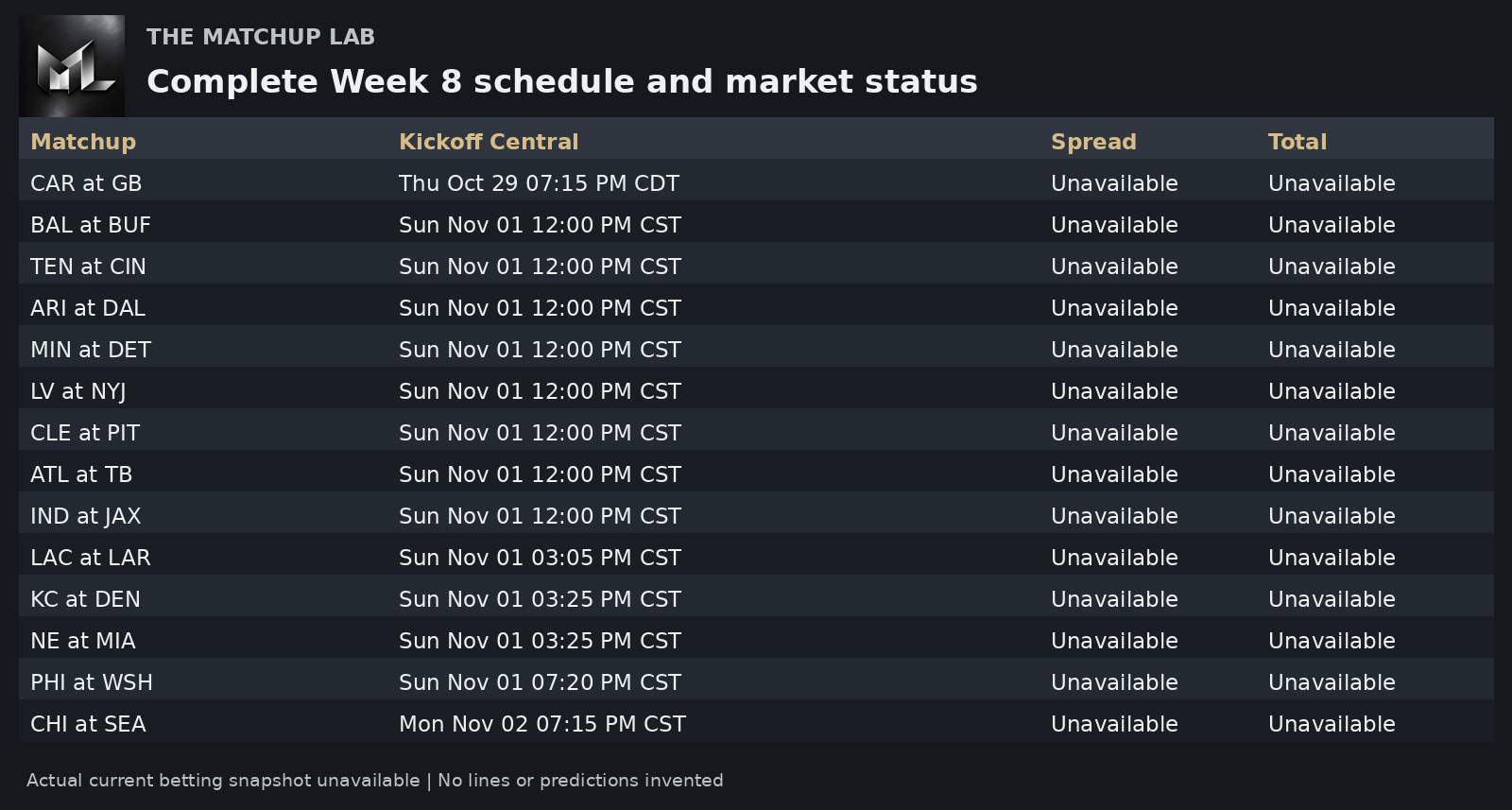
No verified current spread or total snapshot is available for this edition. No favorite, closing line, betting grade or probability is asserted. Spreads and totals reflect their stated observation date and time, can change before kickoff and are informational rather than a guarantee of results. No price is presented without a verified snapshot. Availability claims require their own current verification; no projected starter is described as confirmed here.
Carolina Panthers at Green Bay Packers
Thursday October 29 at 07:15 PM CDT
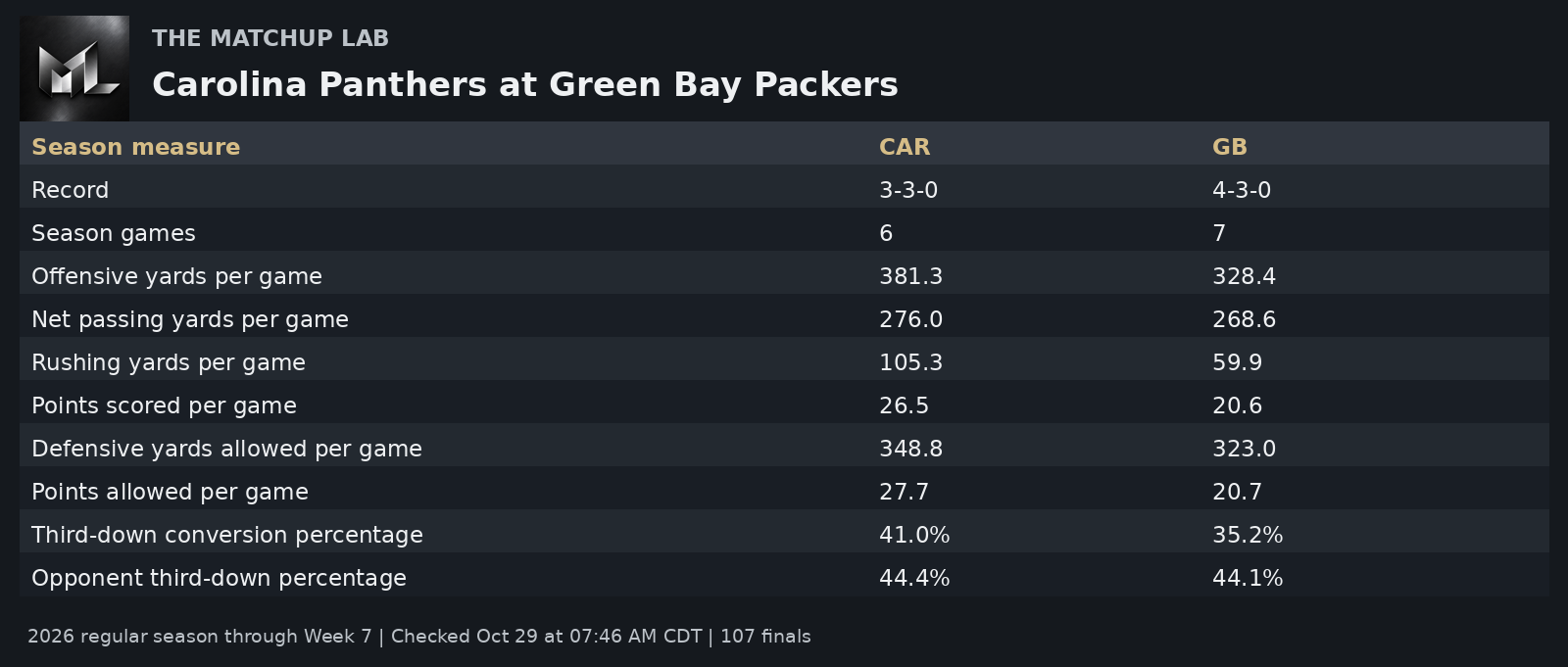
Carolina has the more productive offense in this Thursday matchup, but Green Bay has allowed fewer points and fewer yards. That makes the first few possessions more revealing than the records alone. The Panthers need to make their passing production travel into scoring range without repeatedly leaving the defense a short field. Their season scoring average is strong enough to threaten Green Bay, yet their points allowed leave little room for empty trips.
The Packers have a particularly thin rushing baseline. An offense averaging fewer than sixty rushing yards per game cannot assume that a lead will automatically become a comfortable fourth quarter. Carolina can make that weakness matter by forcing Green Bay to finish long drives rather than handing over possession near midfield. Green Bay's own third-down defense has allowed a substantial share of conversions, so the Panthers have a route to controlling the number of possessions even without a dominant rushing total.
For Green Bay, the useful defensive target is to make Carolina earn repeated conversions without surrendering a quick scoring play. The Packers do not need to match Carolina's yardage if they can restrict the number of touchdowns those yards produce. Carolina, meanwhile, needs its defense to contribute a normal afternoon rather than asking the offense to win a scoring contest by itself. The decisive question is whether Green Bay can get Carolina behind schedule often enough to keep its own limited run production from becoming the game's governing problem.
Carolina Panthers lost 13-43 against Tampa Bay Buccaneers in its latest completed game, in Week 7. Green Bay Packers lost 17-20 against Detroit Lions in its latest completed game, in Week 7. Those results are evidence of where the teams arrive, not a forecast. The season measurements above cover every completed regular-season game through the evidence cutoff; they are not single-game rates.
Baltimore Ravens at Buffalo Bills
Sunday November 01 at 12:00 PM CST
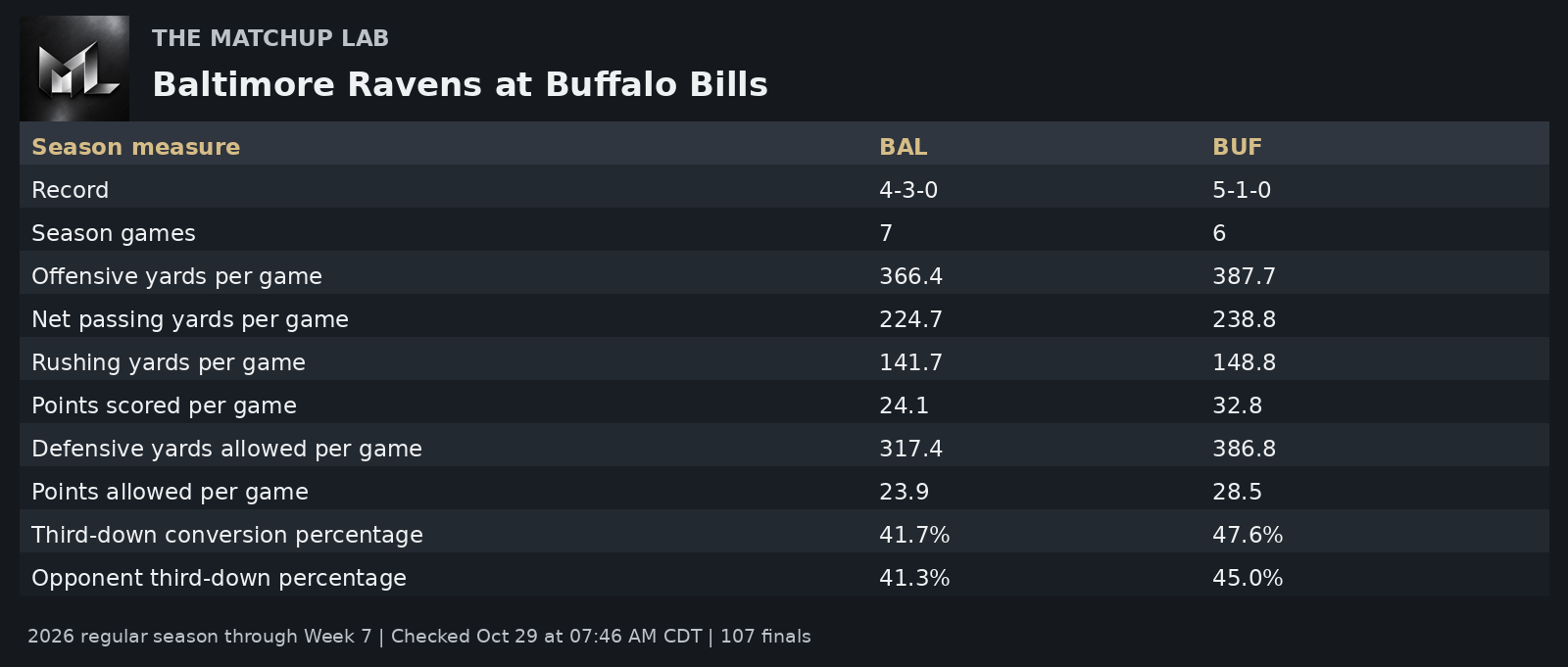
Buffalo's scoring has been more convincing than its prevention. The Bills enter this matchup with a strong record and an offense that has converted nearly half its third downs, but they have also allowed almost as much total yardage as they produce. Baltimore has enough rushing production to examine that weakness without needing every possession to become a passing contest. A successful Baltimore drive can cost Buffalo both points and another chance to use its more explosive scoring baseline.
The Ravens cannot confuse keeping the ball with keeping Buffalo under control. Their own points scored and allowed are close together, which leaves them vulnerable if a promising drive ends without points. Buffalo's larger scoring output creates pressure on an opponent to finish rather than merely reach midfield. Baltimore needs to turn first-down gains into manageable follow-up snaps, then sustain that work when the field compresses. Empty possessions after a long march would suit Buffalo perfectly.
The Bills should be scrutinized even if they get ahead. A defense allowing substantial yardage and a high third-down conversion rate can make an early lead feel safer than it is. Buffalo needs stops that return the ball without an immediate answer from Baltimore. The Ravens need a balanced enough attack that one unsuccessful run does not turn an entire series into a rescue mission. The decisive matchup is Baltimore's ability to sustain productive possessions against a defense whose season results have depended heavily on the offense continuing to score.
Baltimore Ravens lost 13-35 against Cincinnati Bengals in its latest completed game, in Week 7. Buffalo Bills won 33-30 against Las Vegas Raiders in its latest completed game, in Week 6. Those results are evidence of where the teams arrive, not a forecast. The season measurements above cover every completed regular-season game through the evidence cutoff; they are not single-game rates.
Tennessee Titans at Cincinnati Bengals
Sunday November 01 at 12:00 PM CST
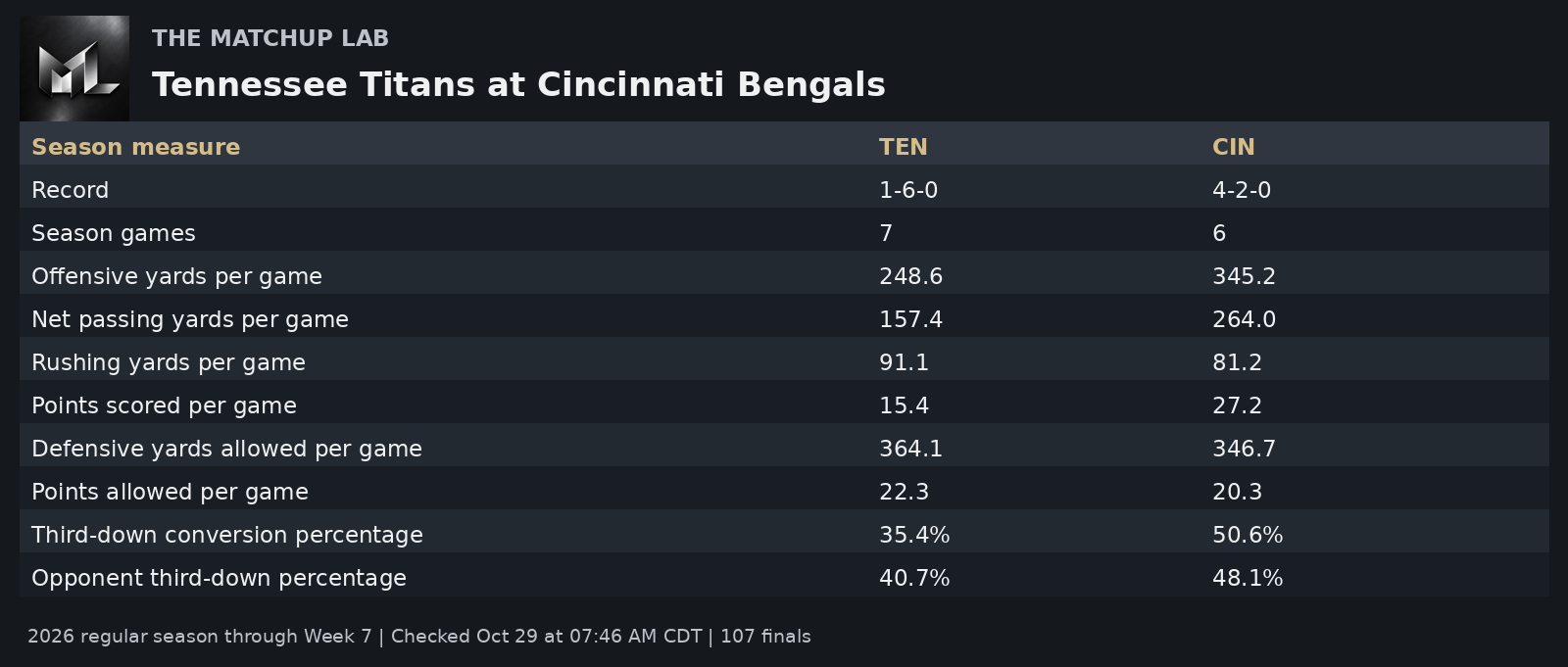
Tennessee's first task is to give its defense a game it can reasonably defend. The Titans have averaged fewer than sixteen points and fewer than 250 yards, so an early deficit is particularly expensive. Cincinnati has scored far more efficiently in the ordinary scoreboard sense, producing a much stronger points average without a dominant rushing total. Tennessee must force the Bengals to work through an entire possession rather than accelerating that difference with a lost ball or a failed short drive.
Cincinnati's third-down offense is the clearest sustained-drive challenge. Converting more than half those opportunities means an opponent cannot assume that winning first and second down has finished the job. The Titans need pressure and coverage to agree on the critical snap, because a conversion can undo several otherwise useful defensive plays. Their offense can help by creating enough first downs to keep that challenge from arriving every few minutes.
There is also a fair criticism of Cincinnati beneath the stronger record. Its defense has allowed opponents to convert a high share of third downs, giving Tennessee a specific opening if the Titans can reach manageable distances. Cincinnati should not need an overwhelming rushing afternoon, but it does need enough usable early-down gains to preserve its passing options. Tennessee's path starts with ball security and ends with turning a few extended possessions into touchdowns. Cincinnati's path is to make the Titans answer its scoring pace without giving away easy continuations.
Tennessee Titans lost 24-27 against Cleveland Browns in its latest completed game, in Week 7. Cincinnati Bengals won 35-13 against Baltimore Ravens in its latest completed game, in Week 7. Those results are evidence of where the teams arrive, not a forecast. The season measurements above cover every completed regular-season game through the evidence cutoff; they are not single-game rates.
Arizona Cardinals at Dallas Cowboys
Sunday November 01 at 12:00 PM CST
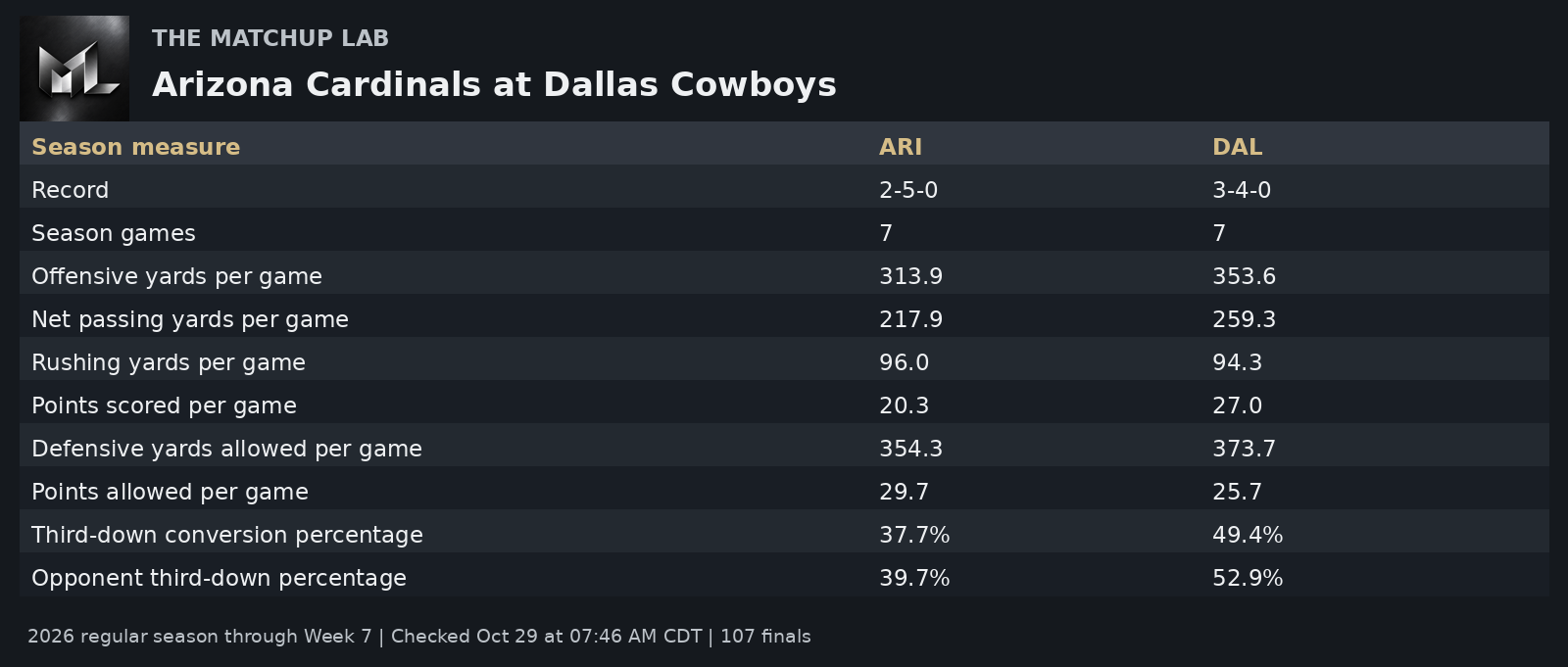
Dallas has a chance to build on its scoring production, but its defense gives Arizona a reason to stay interested. The Cowboys have allowed opponents to convert more than half their third downs. That is a dangerous invitation to a Cardinals offense that needs help sustaining possessions. Dallas can win an exchange of good offensive series and still leave the underlying problem intact if it cannot get off the field when the opportunity arrives.
Arizona's defense has allowed nearly thirty points per game, making every empty offensive possession costly. The Cardinals need to reduce the number of short fields Dallas receives and make the Cowboys finish against a full defense. Their own modest rushing production does not support a plan built solely around shortening the afternoon. They must create useful gains without demanding a difficult passing conversion on every series. A few ordinary first downs would do more for their chances than chasing a spectacular answer to every Dallas score.
Neither team's rushing baseline suggests that a lead is automatically secure. Dallas has produced points without a large rushing average, while Arizona has struggled to prevent points despite a less alarming third-down rate than the Cowboys. Those differences make location and finishing important, but the available totals do not identify which possessions began with favorable field position. The decisive test is whether Dallas can pair its offensive execution with genuine defensive stops. Arizona needs to exploit the continuation opportunities that have been available against Dallas and keep its own defensive possessions from ending in touchdowns.
Arizona Cardinals lost 16-30 against Denver Broncos in its latest completed game, in Week 7. Dallas Cowboys won 38-21 against Philadelphia Eagles in its latest completed game, in Week 7. Those results are evidence of where the teams arrive, not a forecast. The season measurements above cover every completed regular-season game through the evidence cutoff; they are not single-game rates.
Minnesota Vikings at Detroit Lions
Sunday November 01 at 12:00 PM CST
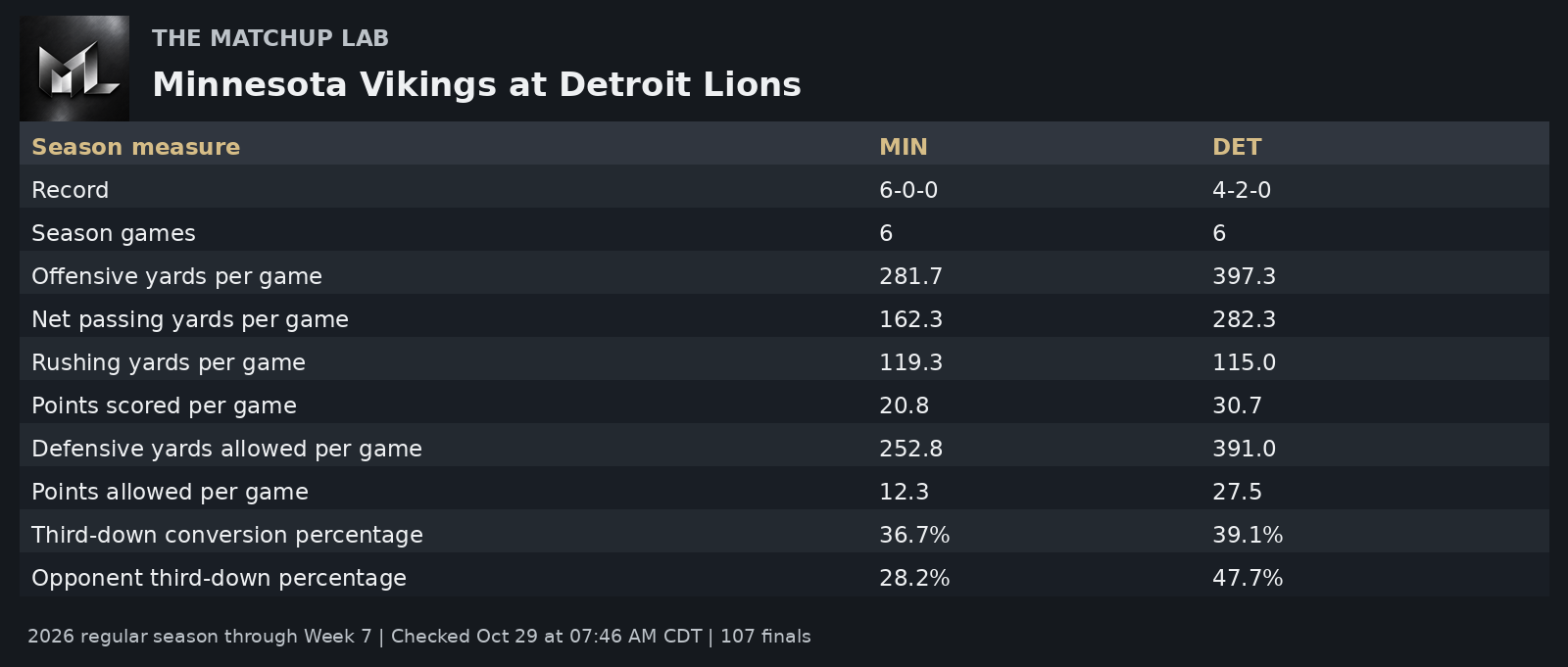
The unbeaten team meets an offense capable of asking a much harder question than the record alone supplies. Minnesota has allowed little yardage, few points and a low third-down conversion rate. Detroit has averaged close to four hundred yards and more than thirty points. The central issue is whether Detroit can preserve that production when routine conversions become scarce. Minnesota does not need to win a yardage race if its defense keeps deciding where possessions end.
The Vikings should also be challenged on their own offensive standard. An undefeated record does not turn modest yardage and a below-forty-percent third-down rate into an automatic advantage. Detroit's defense has allowed enough yardage and conversions to offer Minnesota a more productive afternoon, but the Vikings still have to take it. Settling for a series of short possessions would give Detroit more opportunities to test a defense that has carried a substantial part of Minnesota's season.
Detroit's offensive output is impressive, yet its defensive allowance has been almost as large. That makes this a test of whether the Lions can create separation rather than merely trade successful drives. Minnesota needs to use Detroit's defensive vulnerabilities to finish possessions without abandoning the ball security that keeps its defense out of immediate trouble. Detroit needs to make the Vikings defend sustained offense, not survive on a single long gain. The decisive matchup is Detroit's ability to turn its yardage production into repeated scoring opportunities against Minnesota's unusually restrictive season defense.
Minnesota Vikings won 16-10 against Indianapolis Colts in its latest completed game, in Week 7. Detroit Lions won 20-17 against Green Bay Packers in its latest completed game, in Week 7. Those results are evidence of where the teams arrive, not a forecast. The season measurements above cover every completed regular-season game through the evidence cutoff; they are not single-game rates.
Las Vegas Raiders at New York Jets
Sunday November 01 at 12:00 PM CST
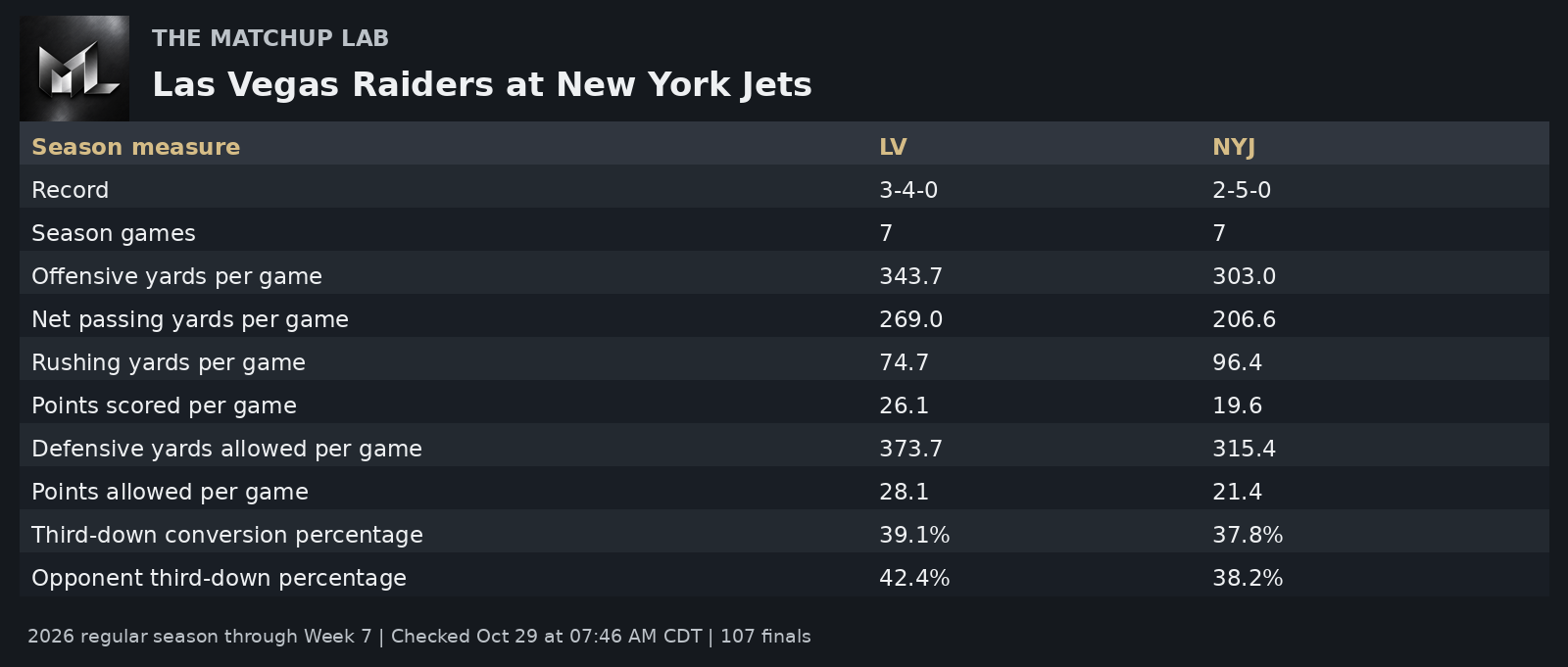
Las Vegas has produced enough points to challenge the Jets, but the Raiders' defense has made those points work unusually hard. New York presents a different balance, with less offensive production and a more restrained defensive allowance. The Jets do not need to imitate Las Vegas's scoring pace. They need to keep the Raiders from turning the game into a succession of possessions in which their own offense must answer immediately.
The Raiders' rushing average is small enough that New York can make an early-down stop carry into the rest of the series. Las Vegas needs its passing game to generate useful progress before the situation becomes predictable. The Jets' defensive third-down rate offers evidence that they can finish some of those series, but a season percentage does not guarantee that a particular long-yardage snap will be handled properly. Las Vegas must make New York defend the whole field without allowing one failed play to end the possession.
New York's offense has its own work to do. Facing a defense that has allowed substantial yards and points is an opportunity, not proof of an automatic breakthrough. The Jets need to finish the possessions that their defense creates and avoid wasting a favorable game situation with repeated punts. Las Vegas needs enough defensive improvement that a useful offensive afternoon is not immediately consumed by the next answer. The decisive question is whether the Jets can turn their more credible prevention into scoring support, or whether the Raiders can make the offensive difference large enough to overcome their defensive allowance.
Las Vegas Raiders lost 21-35 against Los Angeles Rams in its latest completed game, in Week 7. New York Jets lost 25-28 against Miami Dolphins in its latest completed game, in Week 7. Those results are evidence of where the teams arrive, not a forecast. The season measurements above cover every completed regular-season game through the evidence cutoff; they are not single-game rates.
Cleveland Browns at Pittsburgh Steelers
Sunday November 01 at 12:00 PM CST
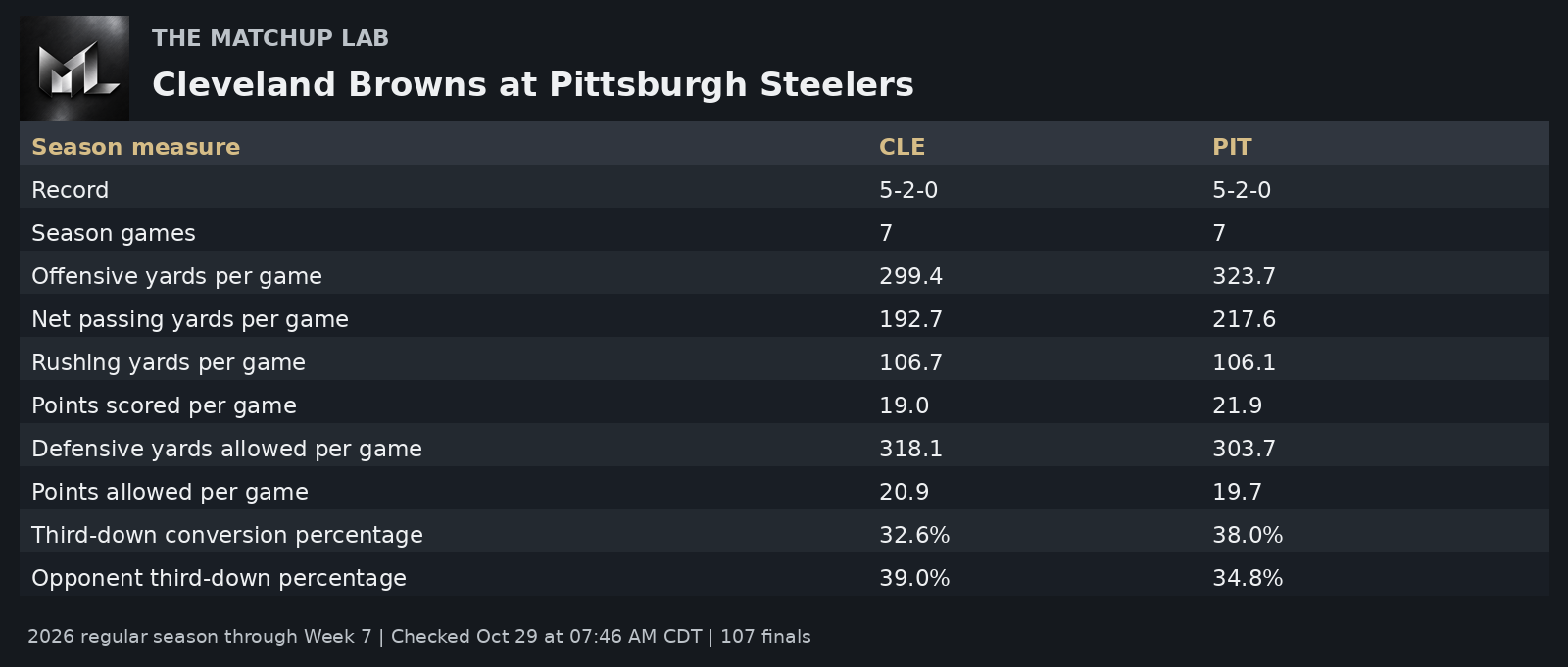
Two five-win teams arrive with very little room to treat a possession casually. Cleveland has scored fewer than twenty points per game, while Pittsburgh has kept opponents below that mark. The Steelers also have the stronger defensive third-down rate. Cleveland therefore needs to find progress before its drives become a repeated examination of the least productive part of its offense. Asking for another difficult conversion after two unhelpful snaps would favor Pittsburgh's season pattern.
The Browns' defense gives them a legitimate way to keep the game close without pretending the offense has been dominant. They have held yardage allowed near Pittsburgh's own offensive output. That creates a manageable defensive assignment if Cleveland avoids gifting the Steelers a shorter field. The available season totals do not prove a special field-position advantage for either team, so the analysis should not assign one. Each side must make the other travel and then finish the defensive possession.
Pittsburgh should not mistake its record for an excuse to accept empty drives. The Steelers' offense has been useful rather than overwhelming, and Cleveland's defense can make a modest scoring target feel demanding. Both teams have enough rushing production to keep a balanced plan available, but neither has a baseline that justifies expecting to run through every difficult situation. The decisive matchup is Cleveland's ability to escape its third-down weakness against a defense that has consistently limited conversions. Pittsburgh needs to turn its defensive work into enough ordinary scoring possessions to avoid leaving the outcome to one late mistake.
Cleveland Browns won 27-24 against Tennessee Titans in its latest completed game, in Week 7. Pittsburgh Steelers won 16-10 against New Orleans Saints in its latest completed game, in Week 7. Those results are evidence of where the teams arrive, not a forecast. The season measurements above cover every completed regular-season game through the evidence cutoff; they are not single-game rates.
Atlanta Falcons at Tampa Bay Buccaneers
Sunday November 01 at 12:00 PM CST
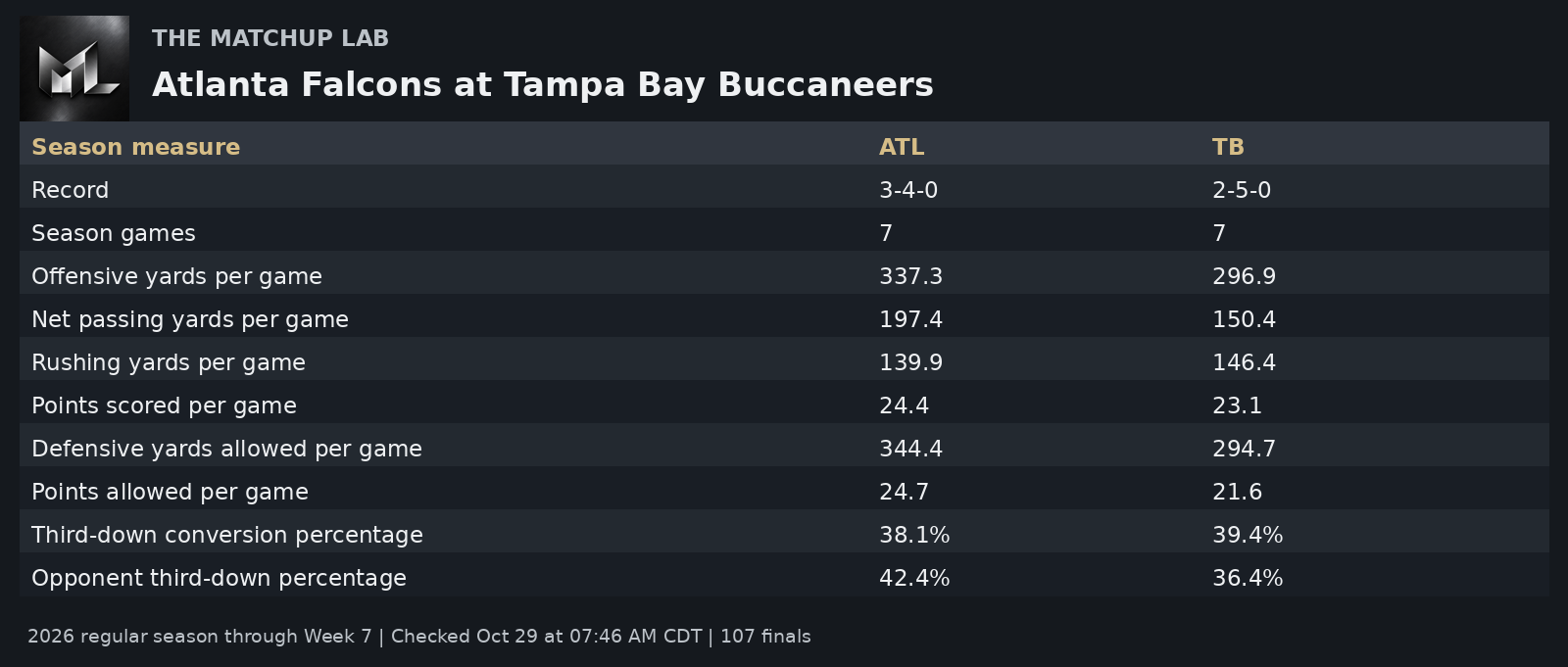
Atlanta faces a defense with a better prevention baseline than its own record might suggest. Tampa Bay has allowed fewer than three hundred yards per game and has restricted third-down conversions more effectively than the Falcons. Atlanta's rushing production gives it a sensible way to begin the challenge, but the Falcons still need to finish drives. Moving the ball for a while without points would let Tampa Bay play the lower-possession game its defense can support.
Tampa Bay's offense has been more productive on the ground than through its overall yardage total. That creates a practical test for Atlanta. The Falcons need to keep early runs from supplying a succession of manageable second and third downs, because their defense has allowed opponents a substantial share of conversions. Tampa Bay does not need to win a passing-yardage contest to make that advantage matter. It needs possession quality that produces points without offering Atlanta extra chances through mistakes.
Atlanta's points scored and allowed are close together, leaving little evidence of a large season cushion. Tampa Bay has a somewhat better scoring balance but should still be judged on whether its offense can capitalize on its defensive stops. Neither side can treat rushing volume as a complete explanation of success. The outcome will depend on what those runs make possible on the following snaps and how often the possession reaches a useful finish. The decisive matchup is Atlanta's ability to sustain scoring drives against Tampa Bay's prevention while keeping the Buccaneers from controlling the afternoon with manageable situations.
Atlanta Falcons won 29-20 against San Francisco 49ers in its latest completed game, in Week 7. Tampa Bay Buccaneers won 43-13 against Carolina Panthers in its latest completed game, in Week 7. Those results are evidence of where the teams arrive, not a forecast. The season measurements above cover every completed regular-season game through the evidence cutoff; they are not single-game rates.
Indianapolis Colts at Jacksonville Jaguars
Sunday November 01 at 12:00 PM CST
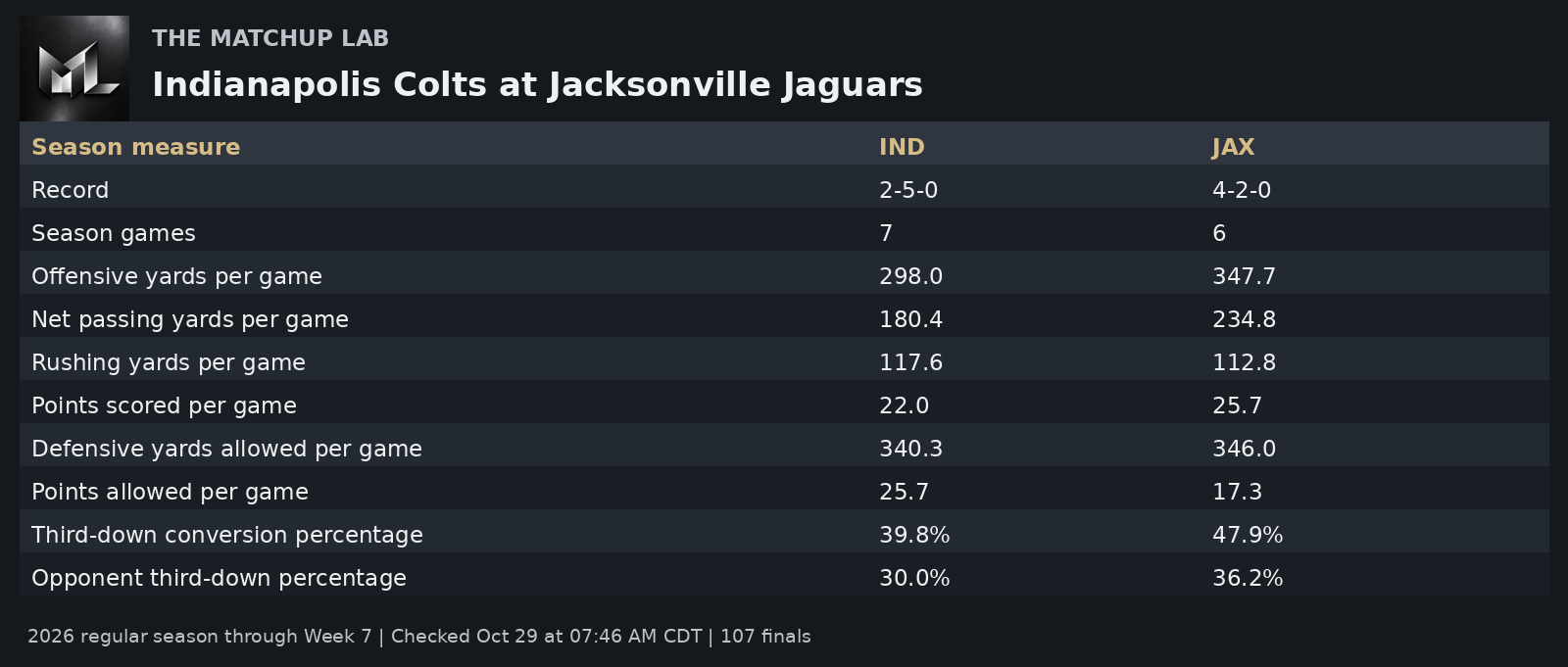
Jacksonville has prevented points more successfully than its yardage allowance alone would suggest. Indianapolis has done almost the reverse of what it needs, allowing more points than it scores despite a strong defensive third-down rate. That makes this a useful test of the difference between winning selected situations and defending an entire game. The Colts cannot assume that getting a stop on third down repairs damage that occurred earlier in the possession.
The Jaguars have converted nearly half their offensive third downs, so Indianapolis's stronger situational defense will be asked to prove itself directly. Jacksonville needs useful early-down progress that gives it options when the conversion snap arrives. Indianapolis needs to make those situations demanding enough that its third-down performance remains relevant. A successful Jaguars drive that does not need many third downs would bypass one of the Colts' more encouraging season measurements.
Indianapolis must also produce more on offense than its season yardage average has usually supplied. Jacksonville has allowed enough ground to make that possible, but it has held down points. The Colts need to turn good field position or an extended series into a meaningful finish without assuming those advantages will recur. Jacksonville's own task is to avoid making its defensive scoring resilience do all the work. The decisive matchup is the Jaguars' ability to extend possessions against Indianapolis's third-down defense, paired with the Colts' ability to convert their limited offensive chances into points rather than another promising but empty drive.
Indianapolis Colts lost 10-16 against Minnesota Vikings in its latest completed game, in Week 7. Jacksonville Jaguars lost 31-34 against Houston Texans in its latest completed game, in Week 6. Those results are evidence of where the teams arrive, not a forecast. The season measurements above cover every completed regular-season game through the evidence cutoff; they are not single-game rates.
Los Angeles Chargers at Los Angeles Rams
Sunday November 01 at 03:05 PM CST
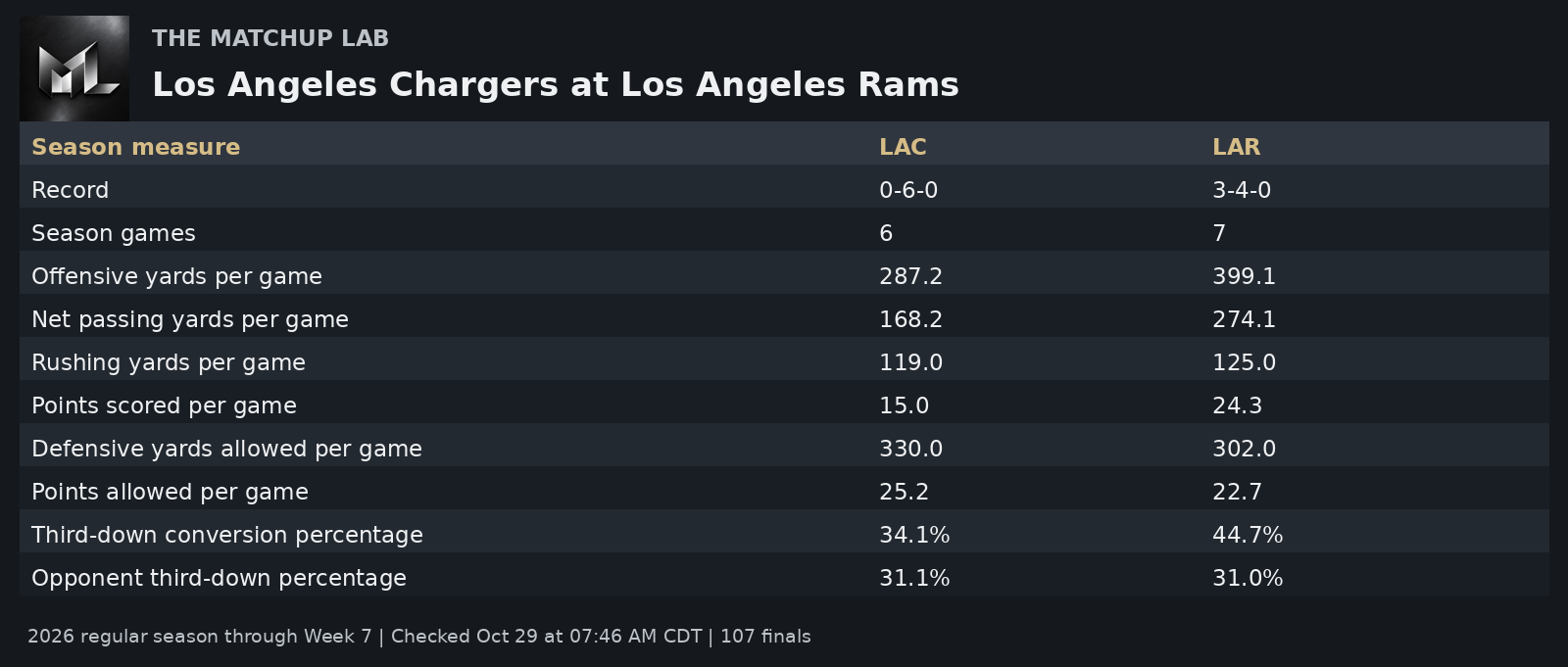
The Rams' yardage production gives them a clear opening, but the difference between their yards and points deserves scrutiny. They have averaged almost four hundred yards while scoring a more modest total. The Chargers have struggled to score at all, yet their defensive third-down rate offers a real obstacle. The Rams need to finish the opportunities they create rather than treating a long drive as an accomplishment by itself.
For the Chargers, staying competitive begins with an offense that has averaged fifteen points. Their rushing output is not negligible, but the overall attack has not regularly supplied enough scoring support. Against a Rams defense that has limited both total yardage and third-down conversions, the Chargers need useful progress on early downs. A plan that repeatedly asks them to rescue a series with a long passing conversion would magnify the part of the matchup that already looks difficult.
The Rams should demand more than simply avoiding an upset. A favorable offensive assignment is an opportunity to turn sustained movement into touchdowns and give their defense some room to work. The Chargers, meanwhile, need to make every Rams possession earn its finish and keep the game within reach of a few productive offensive series. Their defensive conversion rate is a reason to examine the matchup carefully, not a guarantee that the Rams will be stopped. The decisive question is whether the Chargers can supply enough offense to make their useful defensive stretches matter, or whether the Rams can translate their much larger yardage baseline into an equally clear scoring advantage.
Los Angeles Chargers lost 6-22 against Kansas City Chiefs in its latest completed game, in Week 6. Los Angeles Rams won 35-21 against Las Vegas Raiders in its latest completed game, in Week 7. Those results are evidence of where the teams arrive, not a forecast. The season measurements above cover every completed regular-season game through the evidence cutoff; they are not single-game rates.
Kansas City Chiefs at Denver Broncos
Sunday November 01 at 03:25 PM CST
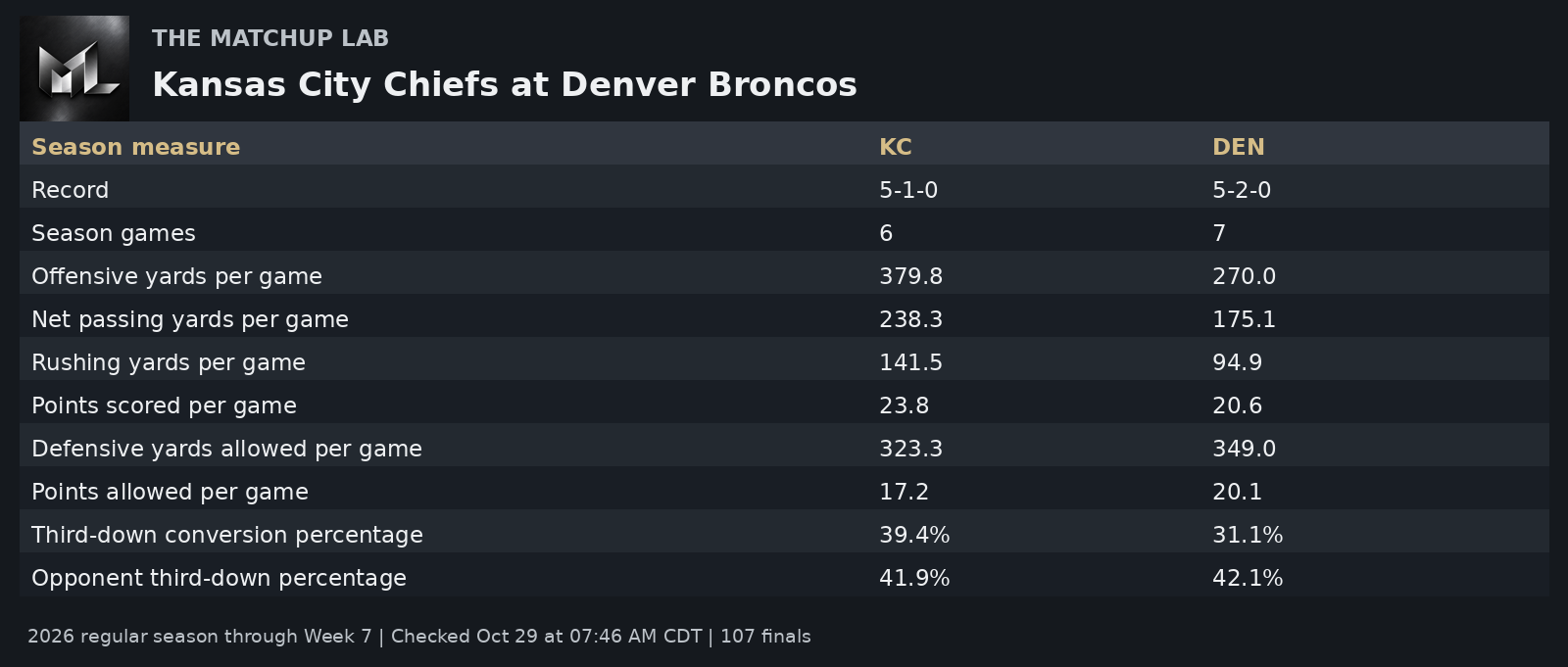
Kansas City's first defeat should prompt an examination of its offense without erasing the work that came before it. Denver's defense has kept the scoring allowance manageable, but its own offense has produced comparatively little yardage and has struggled on third down. The Broncos need to make Kansas City defend real possessions rather than relying on their defense to manufacture a low scoring target every week.
The Chiefs have the larger offensive baseline and enough rushing production to keep multiple approaches available. Denver's defensive third-down allowance gives Kansas City a particular route to extending drives. The Chiefs still have to make their early gains useful. Reaching third down with no credible alternative to a difficult throw would turn a promising matchup into a series of narrow escapes. Denver can help itself by forcing Kansas City to finish from a long field and avoiding the mistakes that make a limited offensive day impossible to survive.
Denver's record is stronger than its offensive yardage would lead a casual reader to expect. That is a reason to examine its margins carefully, not dismiss the wins. The Broncos need another way to sustain their season if the defense cannot keep every opponent near twenty points. Kansas City needs a controlled response that produces points without assuming its earlier success makes each possession safe. The decisive matchup is Denver's offense against the Chiefs' scoring prevention. If the Broncos cannot extend drives, their defense may face too many opportunities for Kansas City's larger offensive capacity to become decisive.
Kansas City Chiefs lost 3-20 against Seattle Seahawks in its latest completed game, in Week 7. Denver Broncos won 30-16 against Arizona Cardinals in its latest completed game, in Week 7. Those results are evidence of where the teams arrive, not a forecast. The season measurements above cover every completed regular-season game through the evidence cutoff; they are not single-game rates.
New England Patriots at Miami Dolphins
Sunday November 01 at 03:25 PM CST
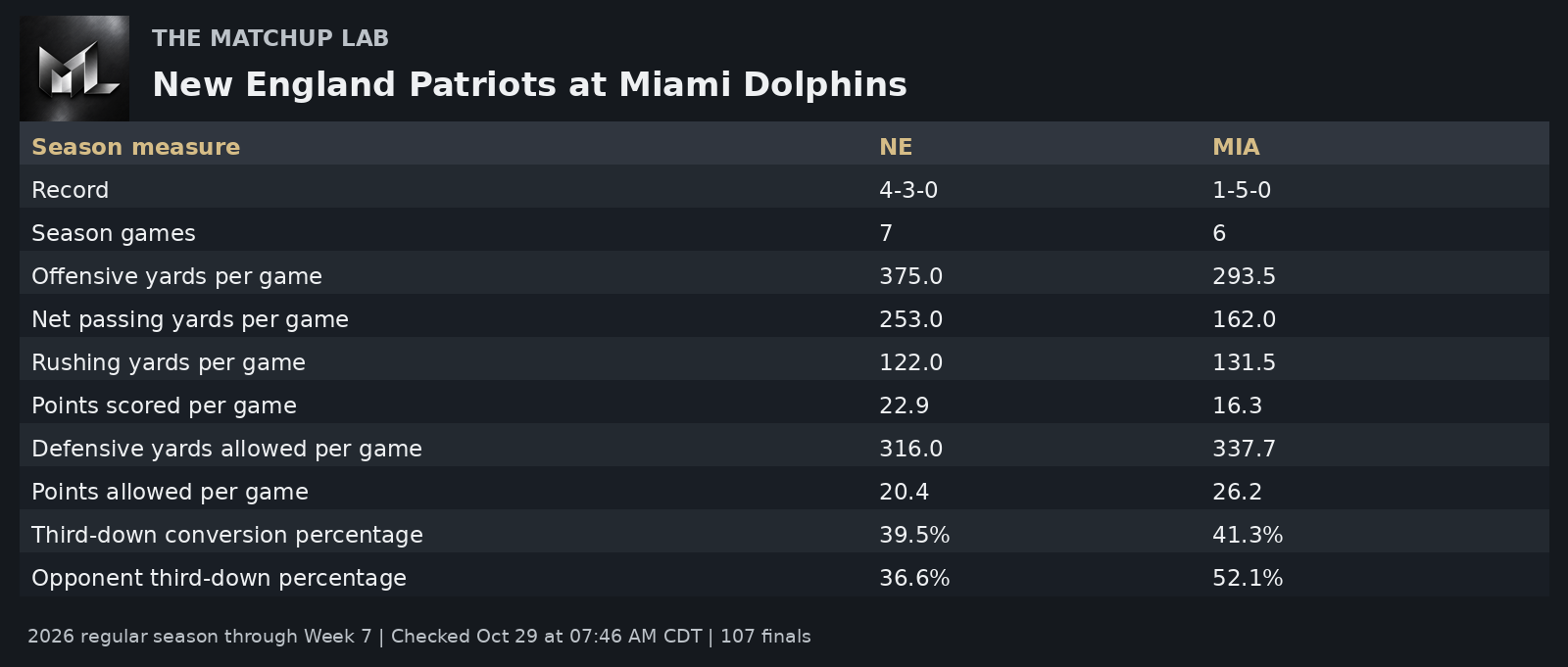
New England has the more complete season balance, while Miami has a specific defensive problem that could make that difference grow. The Dolphins have allowed opponents to convert more than half their third downs. New England has produced substantial yardage without converting it into an equally large scoring average, so this is an opportunity to improve the finish of its possessions rather than merely add another large yardage total.
Miami needs its rushing production to serve a larger offensive purpose. The Dolphins have averaged useful ground yardage but still have one of the lower scoring averages in this week's field. Running the ball is helpful when it creates manageable follow-up snaps and eventually points. It becomes less useful as an explanation if the drive still ends before a scoring opportunity. New England's defensive third-down rate makes that distinction particularly relevant.
The Patriots also have a responsibility to keep Miami from finding easier possessions through mistakes. Their defensive yardage and scoring baselines are stronger, but those measurements do not guarantee that a short field can be defended repeatedly. Miami needs to turn its useful offensive series into touchdowns and make New England prove it can do the same. The decisive question is whether New England can exploit the extra continuations Miami has allowed and turn its yardage advantage into clear scoreboard separation. For Miami, progress requires both a better defensive finish on third down and an offense that makes the rushing work count.
New England Patriots lost 24-30 against Chicago Bears in its latest completed game, in Week 7. Miami Dolphins won 28-25 against New York Jets in its latest completed game, in Week 7. Those results are evidence of where the teams arrive, not a forecast. The season measurements above cover every completed regular-season game through the evidence cutoff; they are not single-game rates.
Philadelphia Eagles at Washington Commanders
Sunday November 01 at 07:20 PM CST
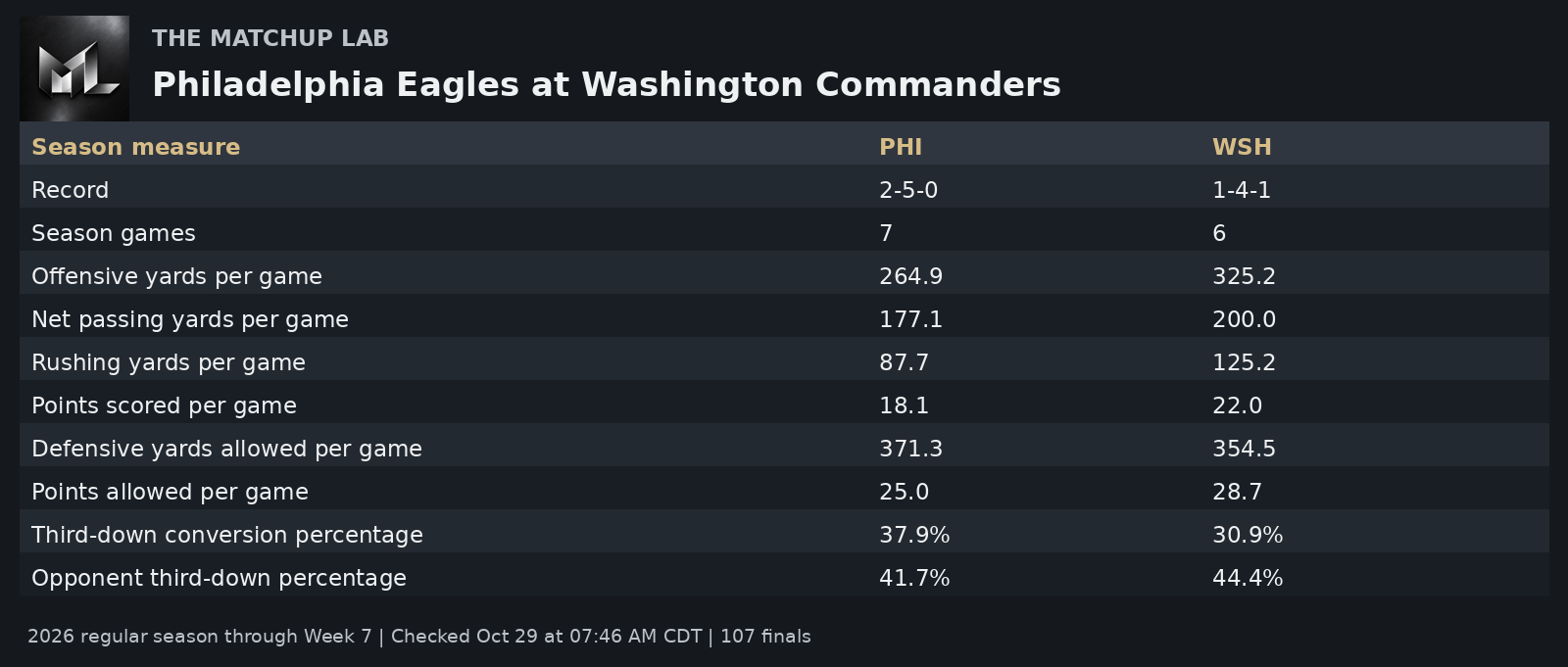
Philadelphia and Washington both need more than a favorable opponent to repair their seasons. The Eagles have struggled to produce yards and points, while Washington has allowed a high scoring average and has not converted third downs reliably on offense. Each team therefore has an opening that is easy to describe and harder to use. Philadelphia needs to turn Washington's defensive allowance into sustained scoring possessions, and Washington needs to make the Eagles defend more than a few successful plays.
The Commanders' rushing production is the more credible starting point, but their low third-down rate makes an unsuccessful early sequence expensive. Philadelphia can make that weakness matter by preventing the first useful gain rather than waiting for a later conversion attempt to rescue the possession. The Eagles have allowed substantial yardage themselves, so they cannot assume that Washington's offensive difficulties will continue without disciplined defensive work.
Philadelphia's own rushing baseline leaves little reason to expect that an early lead will automatically protect itself. The Eagles need a balanced enough attack to keep possessions alive without placing every important snap on one difficult throw. Washington needs its defense to force a genuine punt rather than allowing another continuation against an offense that has not generally moved the ball well. The decisive matchup is the ability of either side to turn the other's season weaknesses into repeatable progress. A few encouraging drives will not be enough if the next possession immediately restores the same defensive and finishing problems.
Philadelphia Eagles lost 21-38 against Dallas Cowboys in its latest completed game, in Week 7. Washington Commanders lost 17-23 against San Francisco 49ers in its latest completed game, in Week 6. Those results are evidence of where the teams arrive, not a forecast. The season measurements above cover every completed regular-season game through the evidence cutoff; they are not single-game rates.
Chicago Bears at Seattle Seahawks
Monday November 02 at 07:15 PM CST
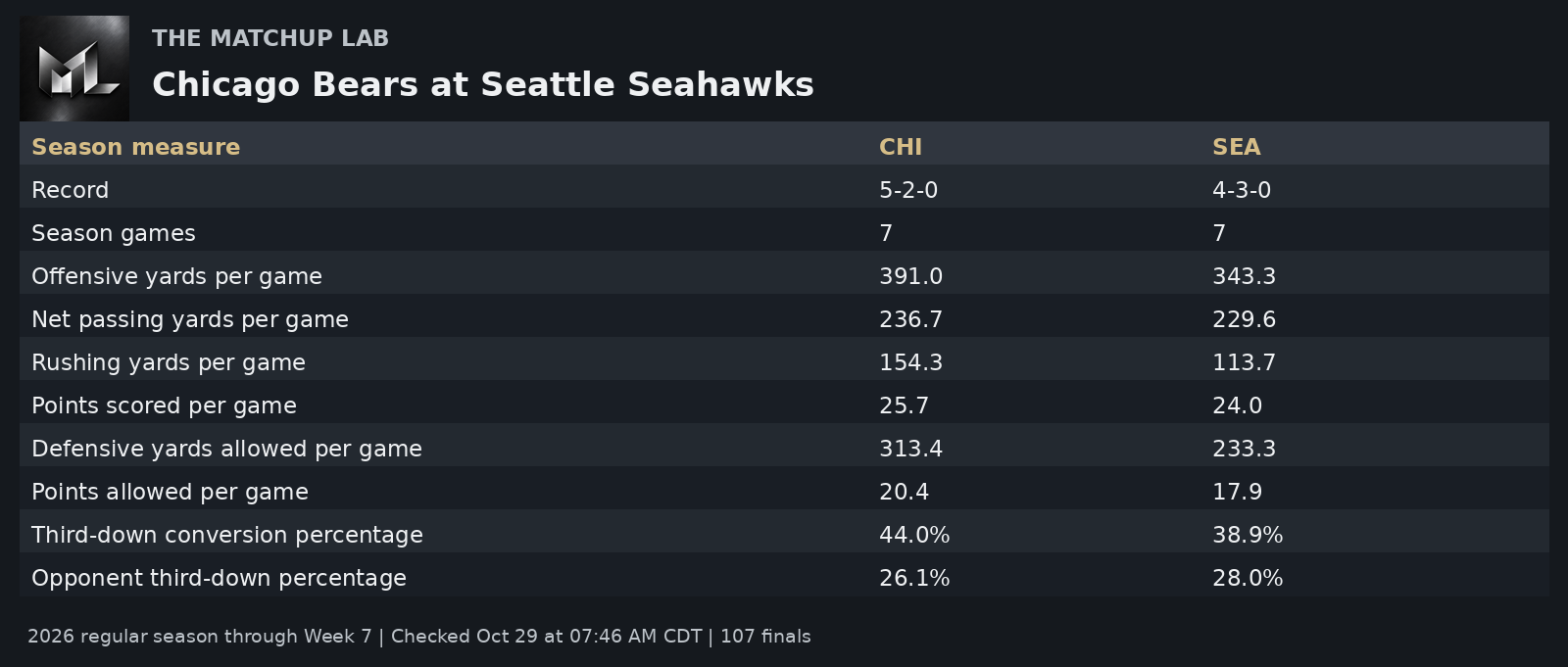
Chicago brings a productive offense to a defense that has allowed very little ground. Seattle's yardage allowance is the strongest in this matchup, while the Bears' rushing output and third-down offense give them several ways to test it. This is not simply a comparison of records. Chicago needs to show that its sustained-drive production survives when the first useful gain is harder to find and the next conversion is less comfortable.
The Bears' defense supplies its own demanding assignment. Opponents have converted a low share of third downs against Chicago, which puts pressure on Seattle to make its early snaps productive. The Seahawks cannot assume that one strong defensive series will be followed by an easy offensive answer. They need to turn their own yardage into points often enough that the defense is not required to repeat its best work indefinitely.
Seattle's recent defensive success is valuable evidence, but it should not become a promise that every opponent will be handled in the same way. Chicago has produced more rushing yardage and more total offense across the season than Seattle's latest opponent managed in that particular game. The Bears must make that production travel without exposing the defense through careless possessions. Seattle needs to interrupt Chicago's early-down rhythm and then capitalize on the possessions those stops create. The decisive question is whether Chicago can sustain its offensive standard against Seattle's prevention, while the Seahawks solve a Bears defense that has been particularly effective at ending drives on third down.
Chicago Bears won 30-24 against New England Patriots in its latest completed game, in Week 7. Seattle Seahawks won 20-3 against Kansas City Chiefs in its latest completed game, in Week 7. Those results are evidence of where the teams arrive, not a forecast. The season measurements above cover every completed regular-season game through the evidence cutoff; they are not single-game rates.