
Data coverage and limitations
Research and schedule verification: retained shared sports service; NBA Communications official season calendar. Complete source bindings and arithmetic are retained privately.
NBA Weekly Review and Outlook
Early records face real tests

Memphis is the NBA's only unbeaten team, but the most useful early comparison is between what teams have won and how much scoring control they have established. Minnesota owns the largest current average margin at 14.8 points, yet has two losses. Philadelphia and Detroit have each reached five wins while scoring fewer than 110 per game. Those are different routes through a short opening sample.
This edition assesses all 30 clubs using 81 completed regular-season games through October 30. The review window contains 53 finals from October 24–30; the outlook lists all 51 currently verified fixtures from October 31 through November 6. Season figures and the seven-day sample are kept separate. Raw points per game describe scoring volume, not possession-adjusted efficiency.
Data coverage and limitations
The common evidence cutoff is 2026-10-31T11:20:31.077Z. The newest shared-service schedule and all 30 standings records were observed on October 31 around 11:05 UTC. They confirm the latest 25 finals, the complete current records and all 51 outlook fixtures without a score or schedule change. Earlier season finals retain their verified game identities. Actual period evidence now covers all 81 completed games, including four overtime games. Availability and betting markets are not asserted where no current verified observation is available.
Completed results
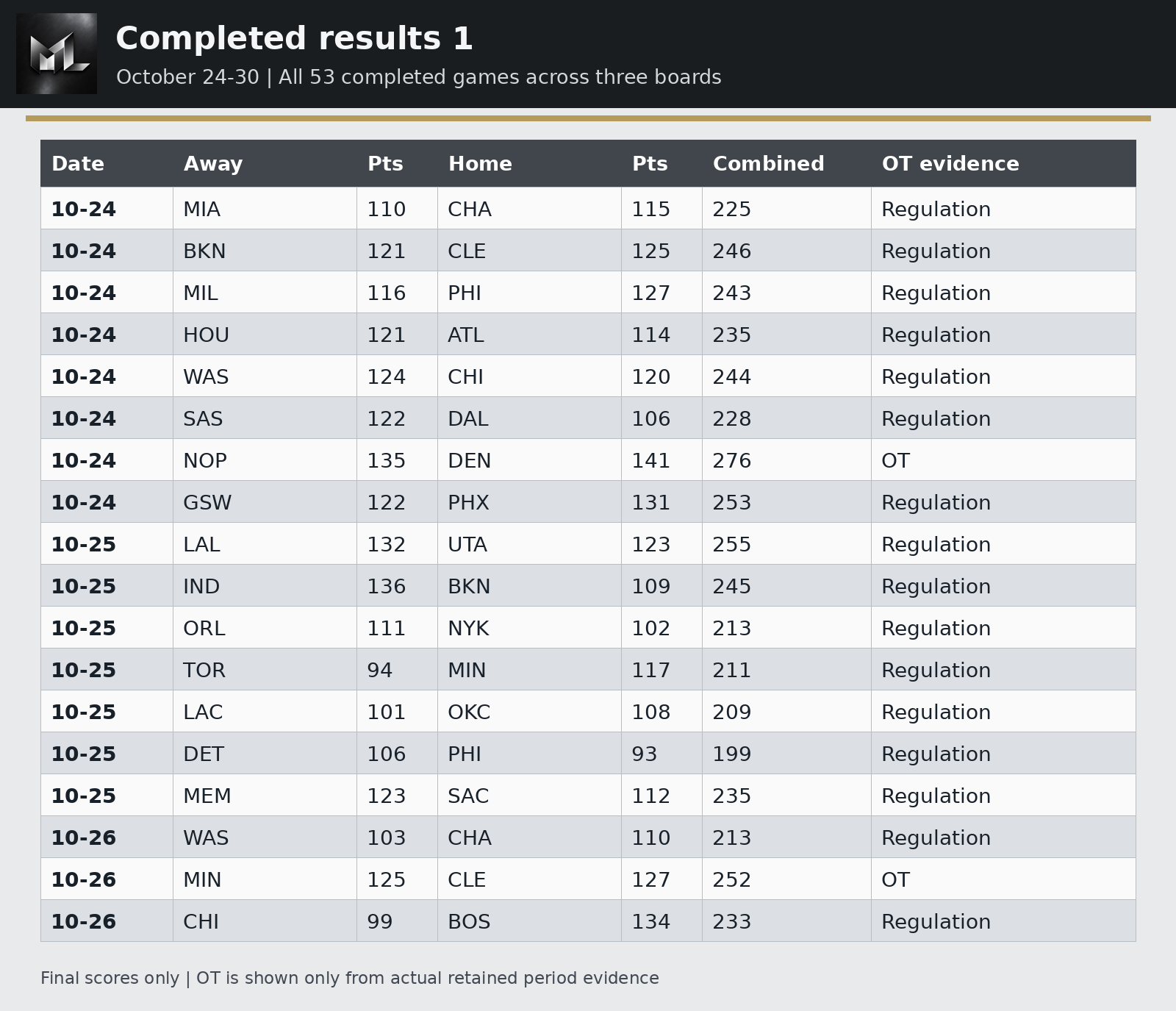
Completed results continued
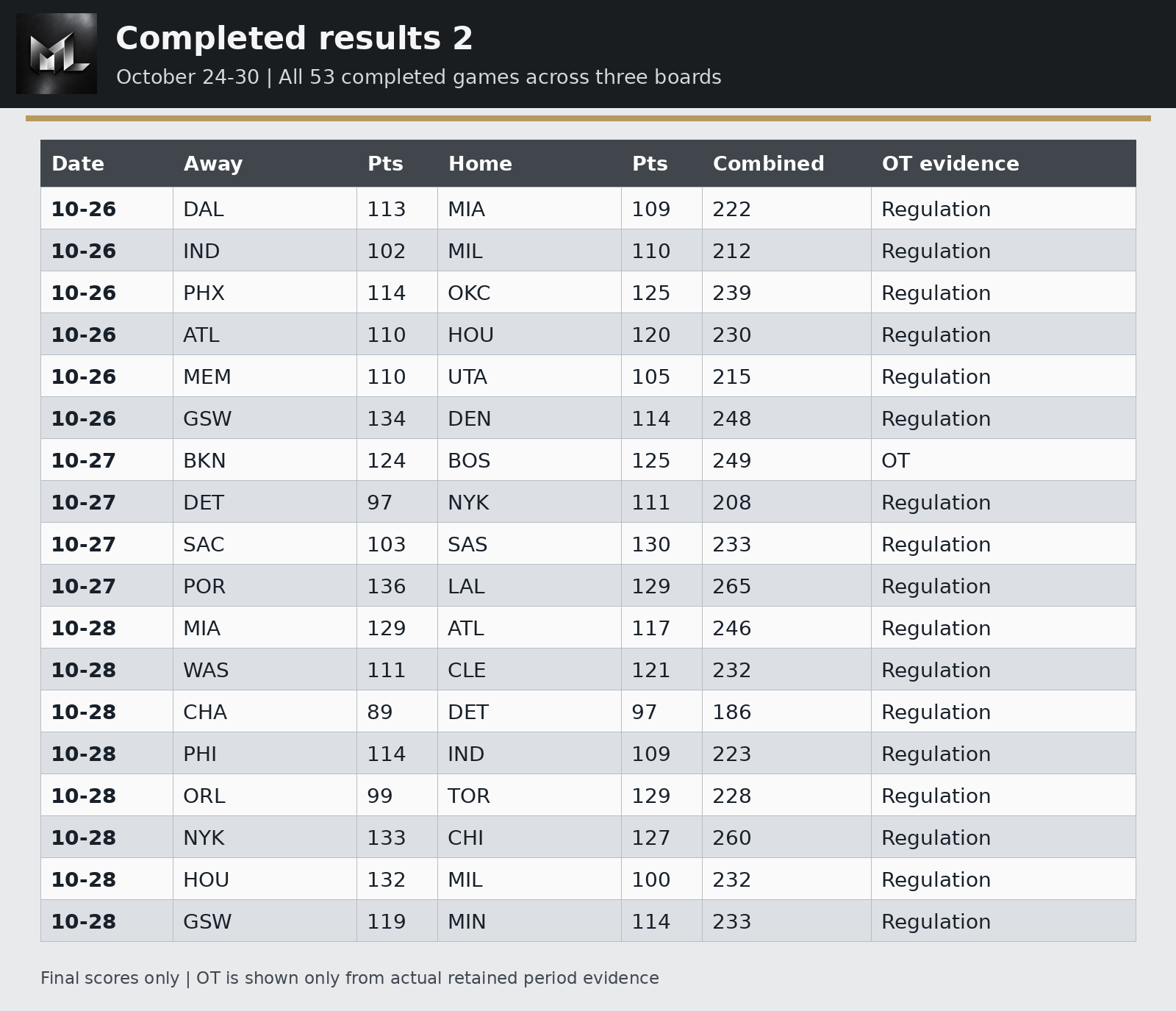
Completed results continued
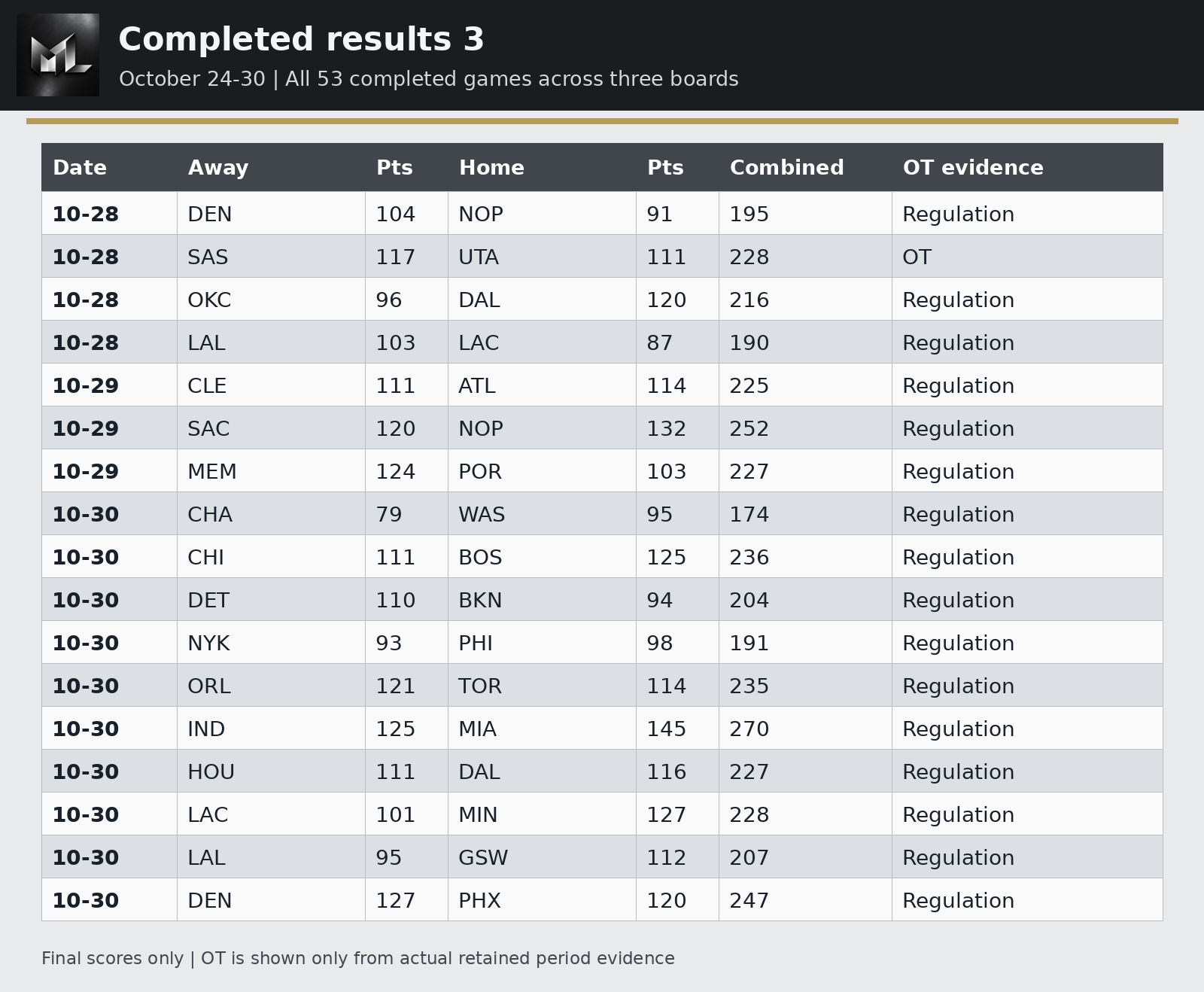
East records and scoring
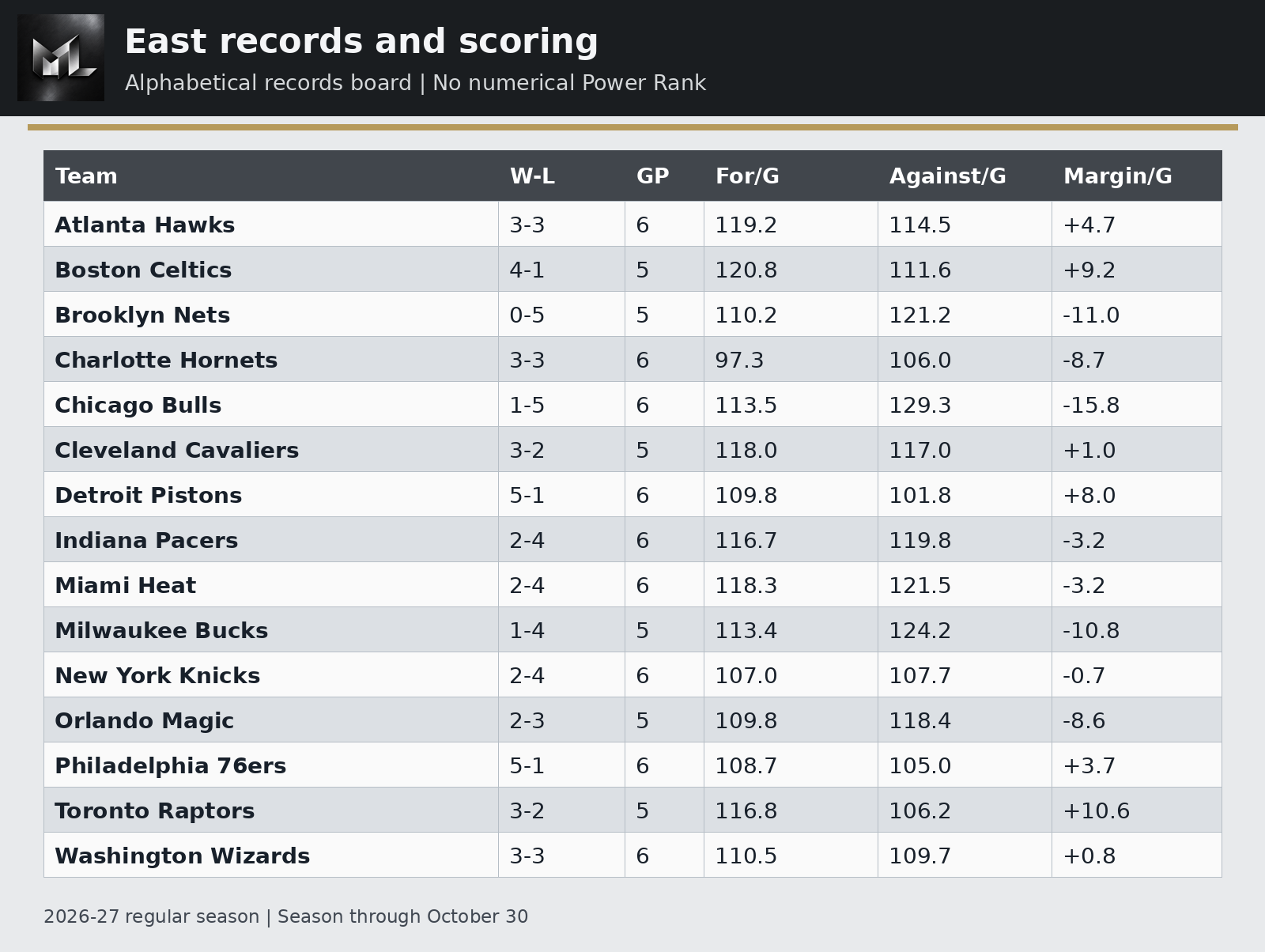
West records and scoring
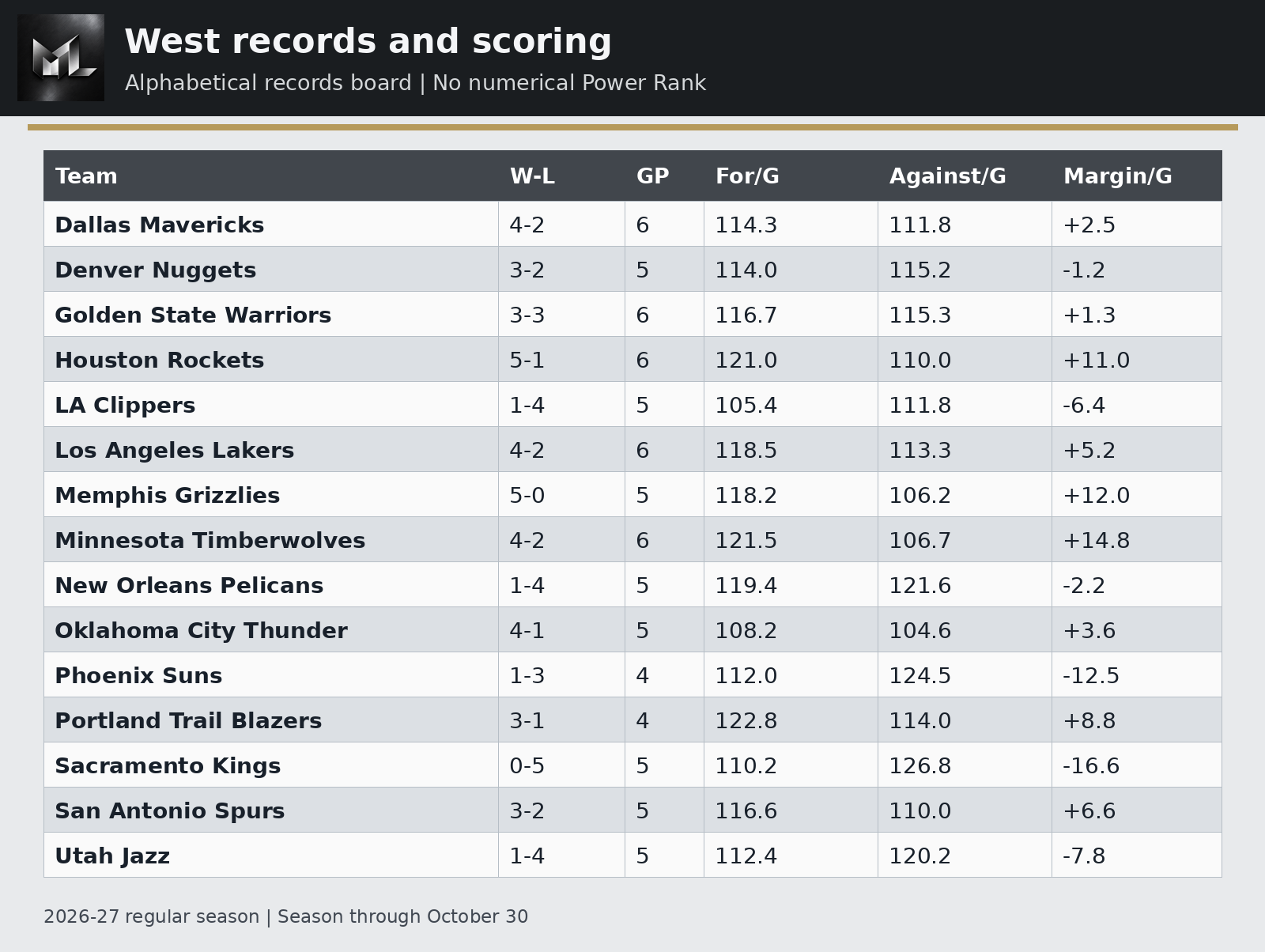
Every club assessed
Atlanta Hawks
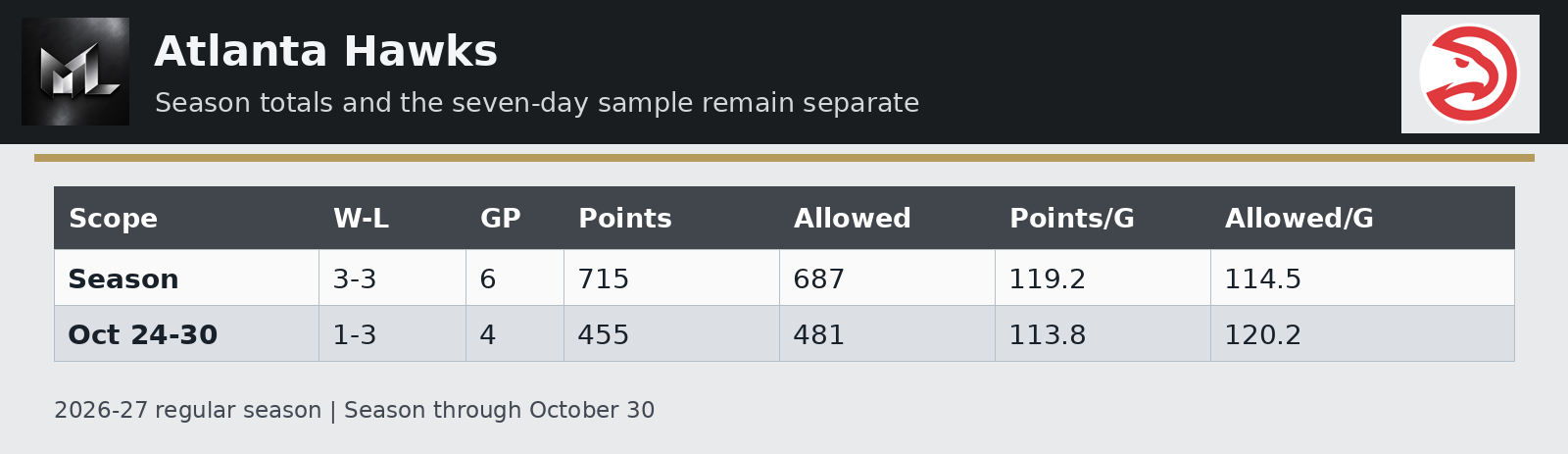
Atlanta's positive scoring margin has not produced a winning record. The Hawks lost twice to Houston and then allowed Miami 129 before edging Cleveland 114–111. That sequence matters more than treating 119.2 points per game as proof that the offense has solved everything. Atlanta has shown enough scoring to stay competitive, but three defeats in four review-window games leave the season at 3–3.
The next four games offer a chance to establish consistency against New Orleans, Indiana and Washington twice. Those opponents have combined modest records, but Atlanta has already demonstrated that a favorable scoring average does not finish a close game. The immediate test is to carry the control from the Cleveland win into consecutive road dates.
Boston Celtics
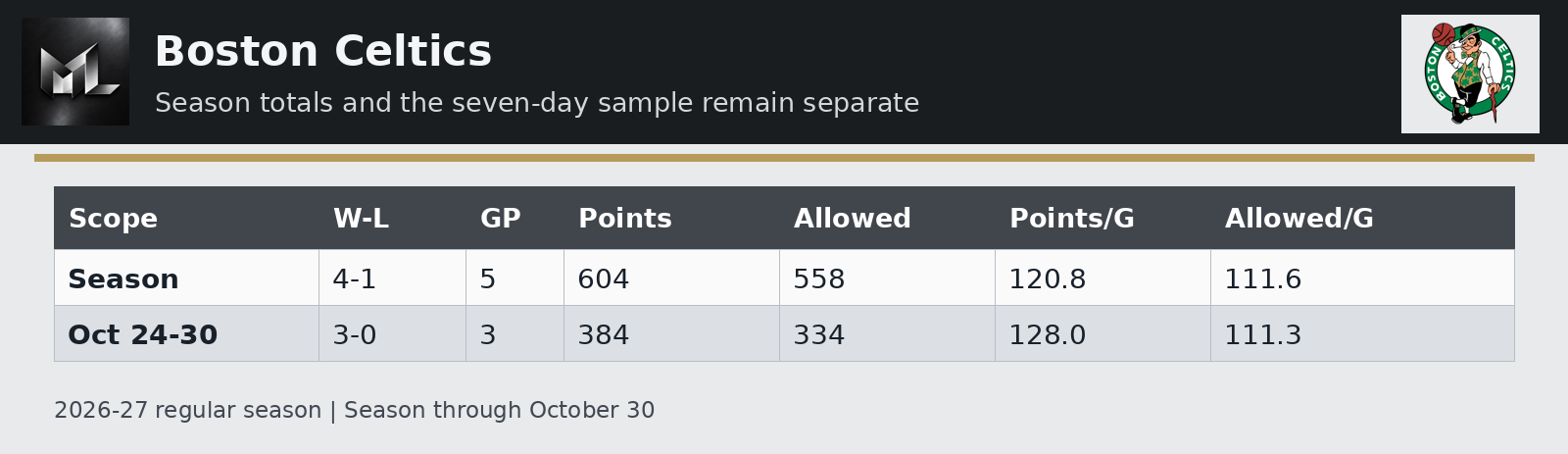
Boston won all three games in the review window, but the manner of the wins deserves scrutiny. The Celtics beat Chicago by 35 and 14 while escaping Brooklyn by one. A 4–1 record and 120.8 points per game establish a strong opening; the 125–124 Brooklyn result also shows how little protection a large offensive total provides when the opponent keeps scoring.
The Orlando–Houston road back-to-back on November 1–2 is the most useful next examination. Houston brings a 5–1 record and 121.0 scoring average. Boston then hosts Milwaukee before visiting Charlotte. Maintaining the scoring output against Houston would be more persuasive than another comfortable result against an opponent struggling to stop anybody.
Brooklyn Nets
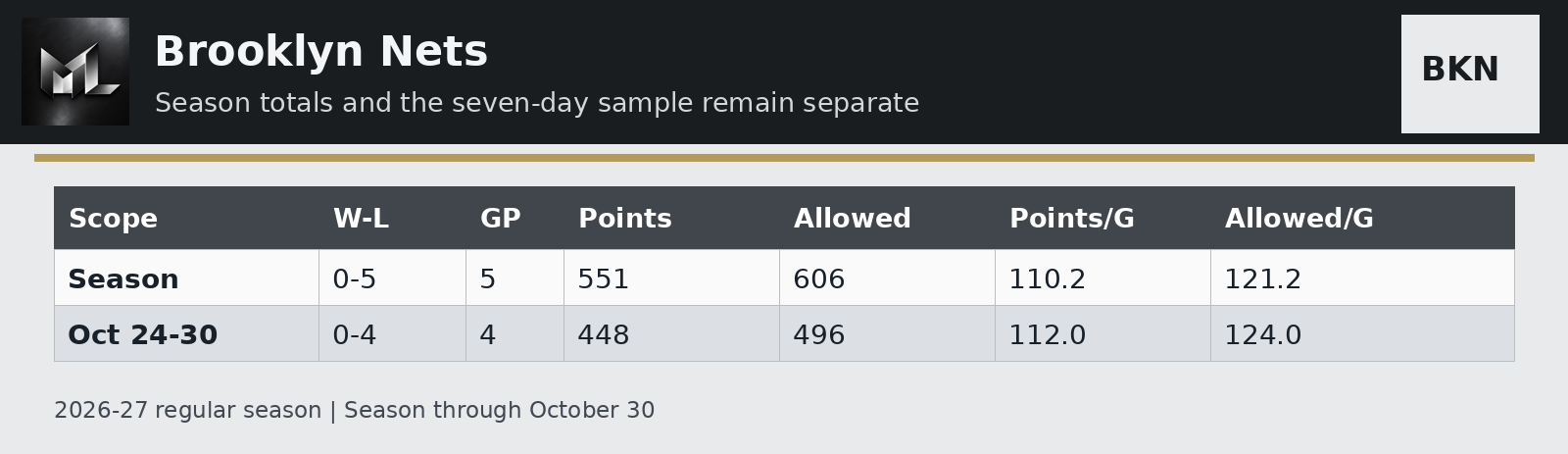
Brooklyn is 0–5 despite two competitive losses in the review window. The Nets fell 125–121 to Cleveland and 125–124 to Boston, but also lost by 27 to Indiana and 16 to Detroit. The narrow defeats show that the record does not describe every performance equally. They do not erase a season in which Brooklyn has allowed 121.2 points per game.
A return meeting at Indiana on November 1 gives Brooklyn a direct comparison with the 136–109 defeat. The following night brings a road game against the Knicks, then Charlotte visits. The priority is to keep the game within reach for longer; repeatedly needing exceptional scoring to compensate for concessions is a difficult way to end a losing streak.
Charlotte Hornets
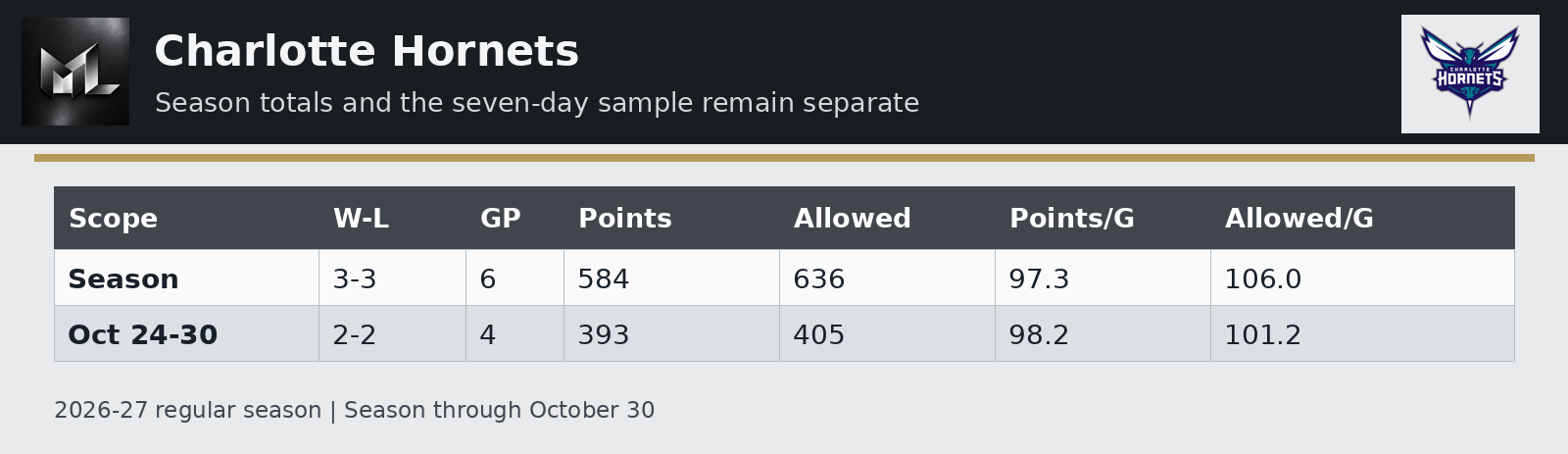
Charlotte split four games in the review window and stands 3–3, yet its scoring profile is much less comfortable than the record. The Hornets averaged 97.3 points over the season and finished the week with 89 against Detroit and 79 at Washington. Holding opponents to 106.0 per game has preserved a path to wins, but the offense has left very little room for ordinary defensive slippage.
Philadelphia, Detroit and Boston appear among the next four opponents, with Brooklyn the only road date. Charlotte cannot assume that keeping these games in the low hundreds will be enough. The immediate question is whether the attack can recover from consecutive sub-90 totals without requiring the defense to produce another unusually restrictive result.
Chicago Bulls
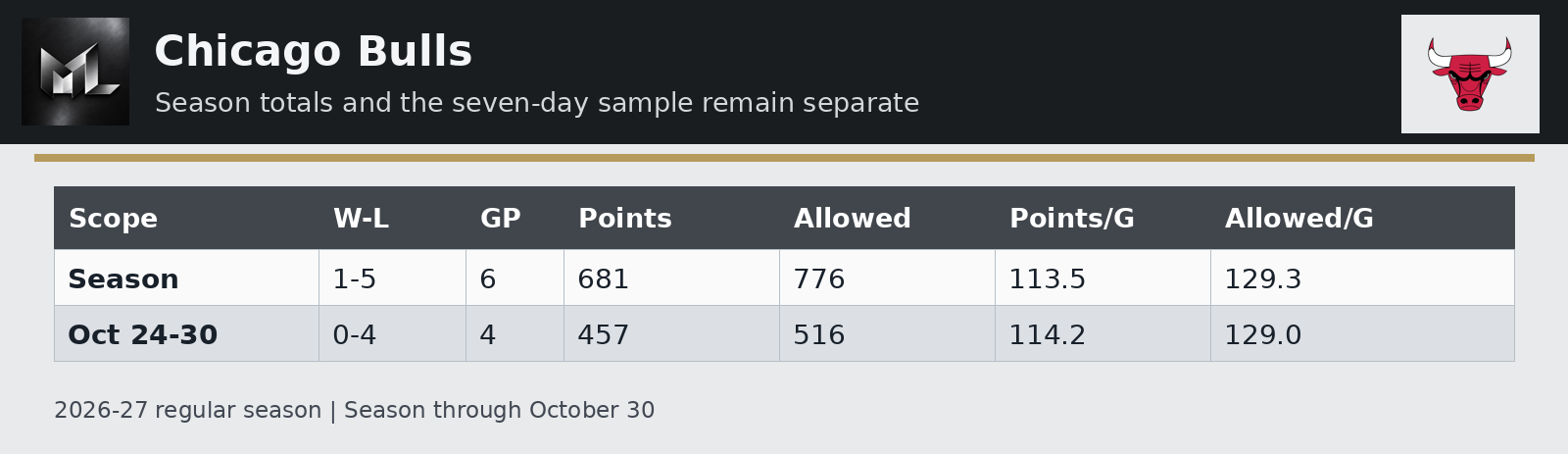
Chicago's 1–5 start is supported by a clear and damaging number: 129.3 points allowed per game. The Bulls lost all four review-window games, including two meetings with Boston. Even 120 against Washington and 127 against New York failed to produce a win. The available scoring record establishes the scale of the problem, although it does not identify whether shooting, turnovers or rebounding is the main possession-level cause.
Only Philadelphia and New York are on Chicago's next-seven-day schedule. Fewer games provide no automatic relief when both opponents have already demonstrated they can finish against the Bulls. Another high-scoring loss would leave the central question unanswered: can Chicago reduce what an opponent needs to do to win, rather than asking its own attack to chase 130?
Cleveland Cavaliers
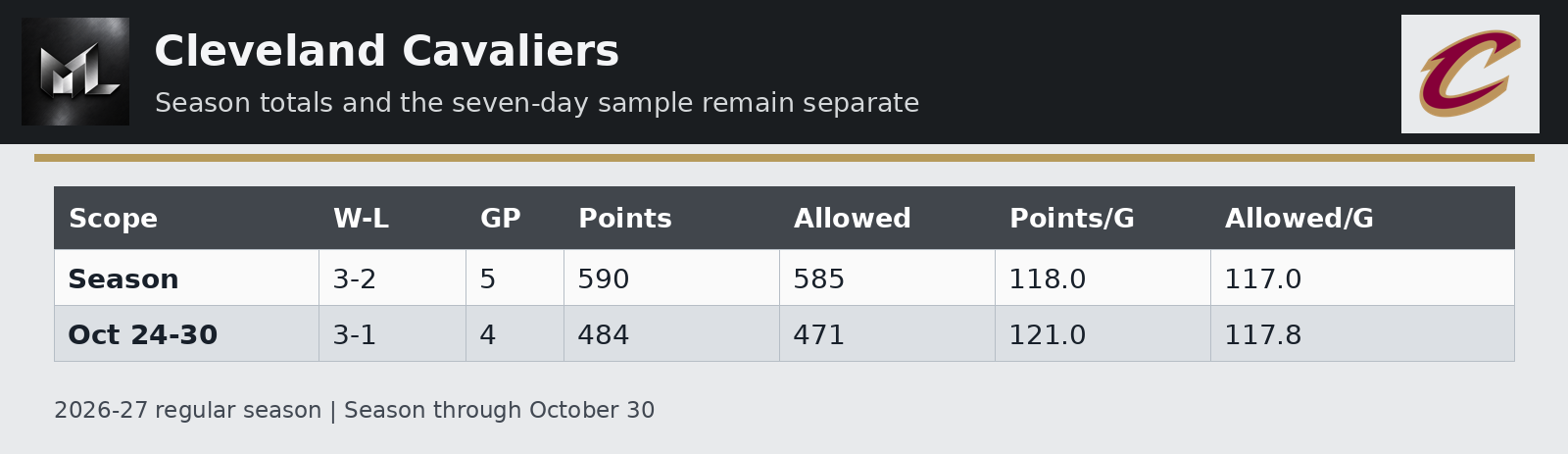
Cleveland won three of four review-window games but has only a one-point season scoring margin per game. The Cavaliers beat Brooklyn 125–121 and Minnesota 127–125, then defeated Washington before losing 114–111 at Atlanta. Those results show an ability to win close contests. They also show why a 3–2 record should not be mistaken for comfortable control over the opposition.
The next four games are Milwaukee, Oklahoma City twice and Philadelphia. The consecutive Thunder meetings create a useful test of adaptation: the same opponent returns on the opposite floor within two days. Cleveland's larger scoring totals will need to translate into a clearer margin against a Thunder team allowing 104.6 points per game.
Detroit Pistons
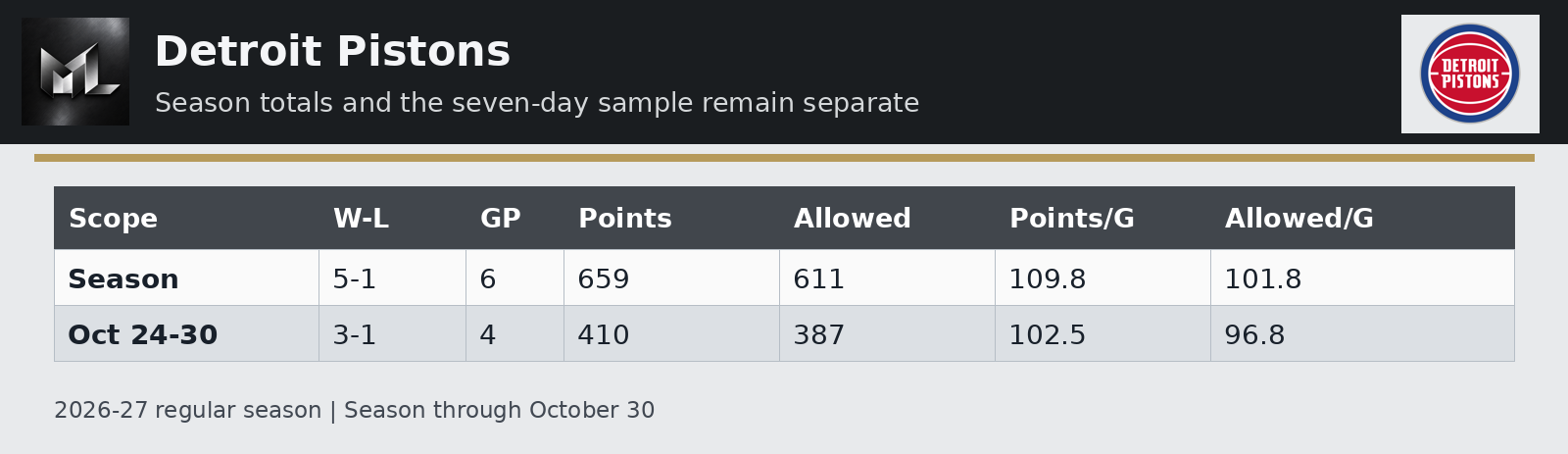
Detroit's 5–1 start rests on allowing 101.8 points per game, not on overwhelming scoring volume. The Pistons held Philadelphia to 93, Charlotte to 89 and Brooklyn to 94 in their three review-window wins. New York supplied the interruption, beating Detroit 111–97. That defeat is a reminder that the current formula still needs enough scoring to survive a less restrictive defensive night.
Detroit visits Charlotte on November 2 before hosting Philadelphia two days later. Both are return matchups from the review window. The Philadelphia game is particularly useful because the 76ers also have five wins and have just won a low-scoring contest against New York. Detroit's existing 13-point win is evidence, not a guarantee of the rematch.
Indiana Pacers
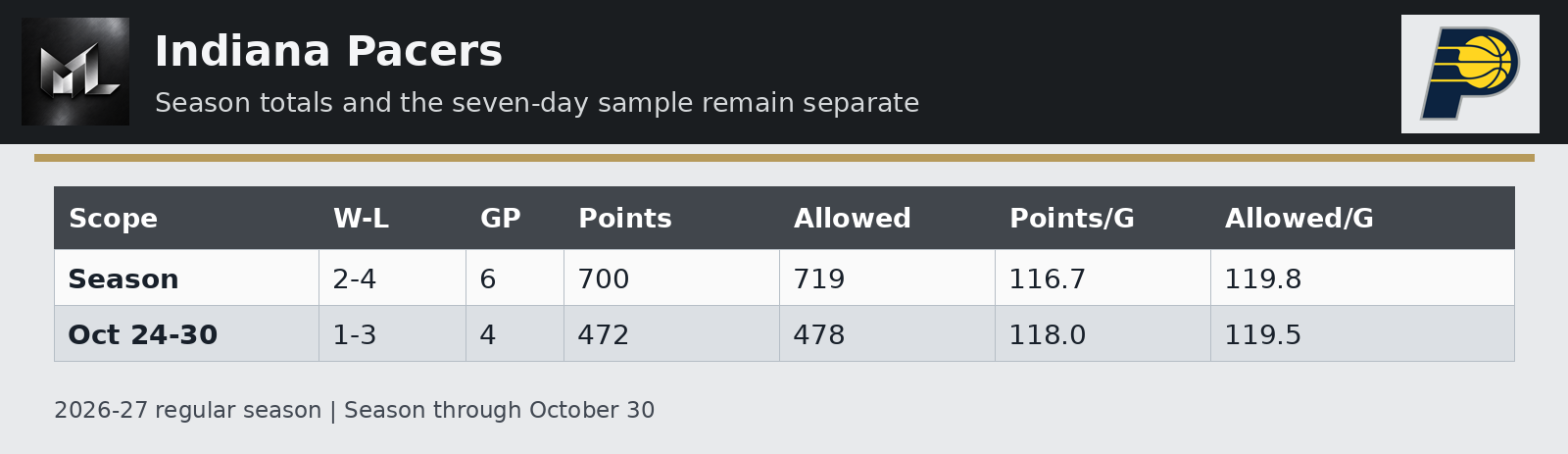
Indiana's 136–109 win over Brooklyn was followed by three defeats, ending with 145 conceded at Miami. The Pacers are scoring 116.7 per game, but the season's 119.8 allowed makes that production insufficient. The Miami loss should receive particular scrutiny because 125 points scored still left Indiana 20 short. A strong attacking total cannot be used to soften that result.
Brooklyn and Atlanta visit before Indiana travels to unbeaten Memphis. The opening two games offer a chance to stabilize results, while Memphis provides the stronger test of whether the concessions are actually coming down. A repeat of the Brooklyn victory would help the record; competing more securely across all three games would say more about the season's direction.
Miami Heat
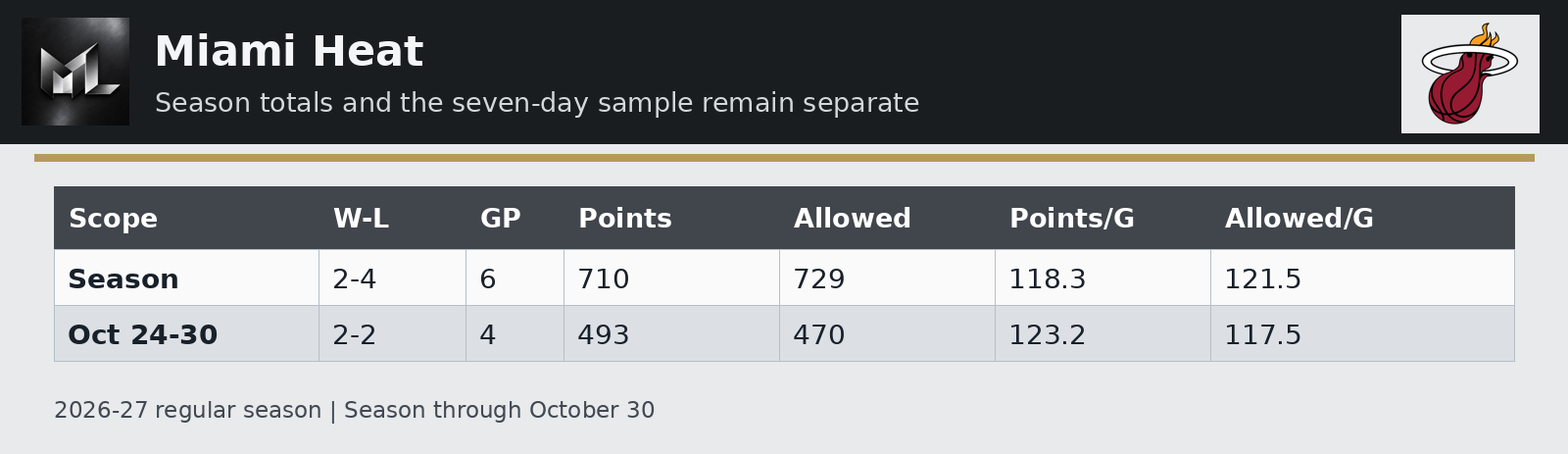
Miami's first two wins came in the review window, 129–117 over Atlanta and 145–125 over Indiana. They changed the immediate mood of a 2–4 start, but the Heat still allow 121.5 points per game. The latest result proves that Miami can produce an enormous scoring night. It does not prove that conceding 125 is a sustainable platform for the next opponent.
The next three games are all in California: the Lakers, Clippers and Warriors, with the final two on consecutive nights. That stretch will test whether the recent scoring burst travels. The Warriors have won three straight, so Miami will need to assess the quality of its possessions without assuming another 140-point performance is available.
Milwaukee Bucks
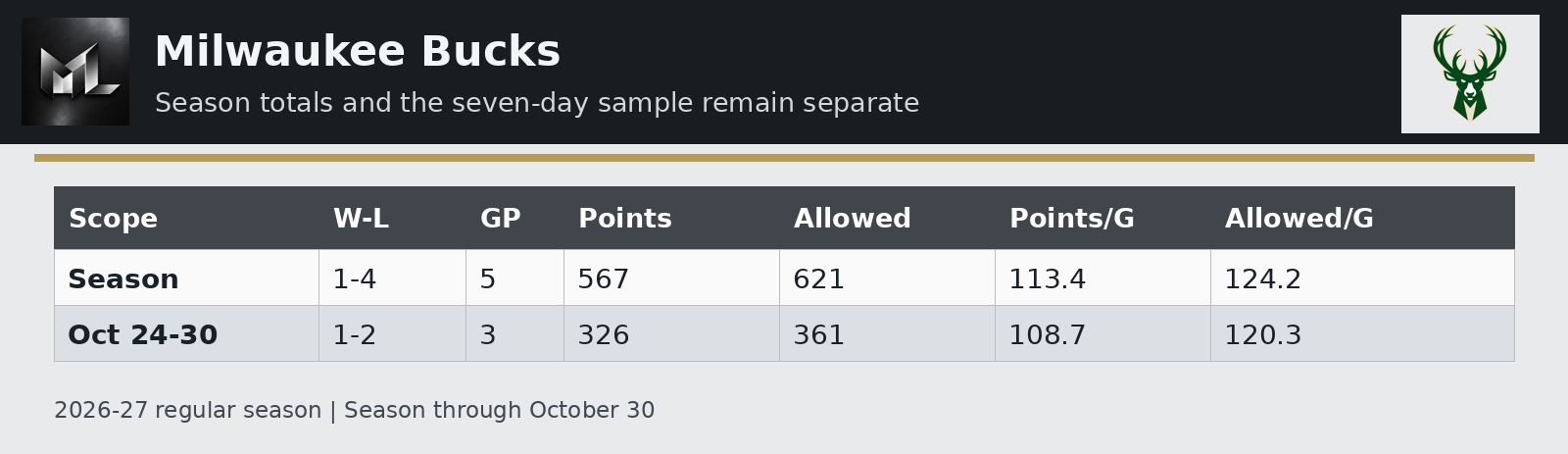
Milwaukee's 110–102 win over Indiana is its only victory in a 1–4 start. The Bucks then lost 132–100 to Houston, a 32-point margin that demands more attention than the win immediately before it. A season average of 124.2 points allowed leaves Milwaukee chasing games even when its own scoring reaches a respectable level.
Cleveland, Minnesota, Boston and Toronto fill the next seven days. That is a demanding sequence for a team whose concessions remain high. Milwaukee needs a reduction that lasts across different opponents. Keeping one game manageable and then returning to another heavy defeat would leave the same structural concern visible in the results, whatever the attacking total.
New York Knicks
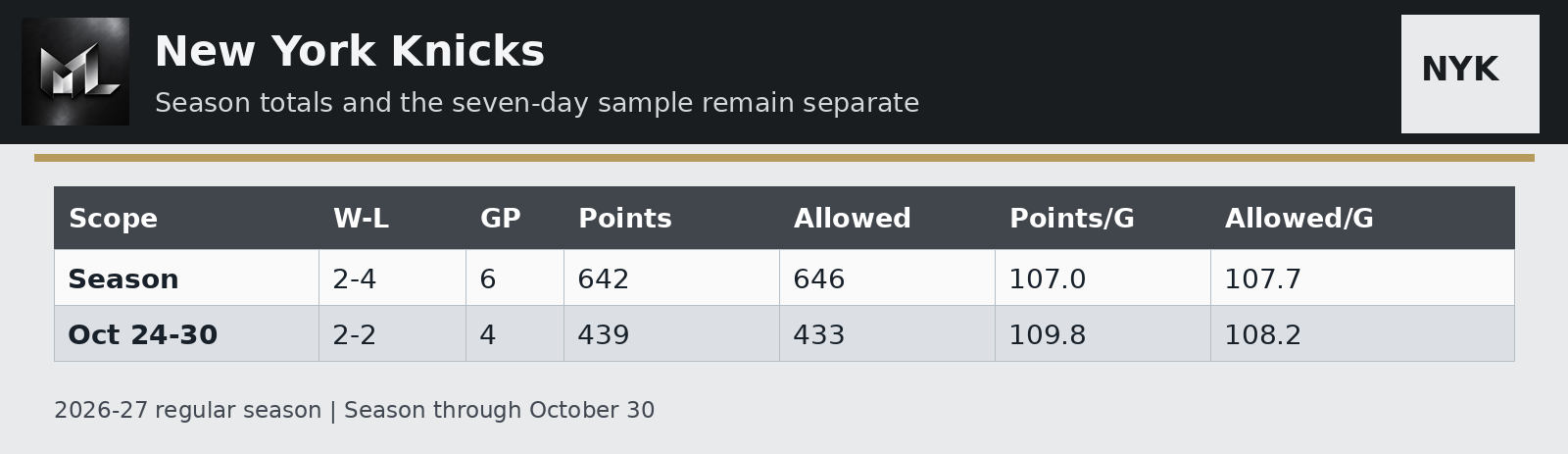
New York is 2–4 with a scoring margin close to even. The Knicks beat Detroit 111–97 and Chicago 133–127, but lost 98–93 to Philadelphia to close the review window. The record and margin describe different parts of the start: New York has remained competitive in aggregate, yet has not converted enough of those games into wins. Its 107.0 scoring average leaves limited insurance when a finish becomes tight.
Brooklyn and Chicago are the only opponents in the next seven days. Both have struggled to limit scoring, making this an opportunity for New York to improve its record without abandoning defensive standards. The useful measure is whether the Knicks can build repeatable separation, rather than relying on one more difficult final possession.
Orlando Magic
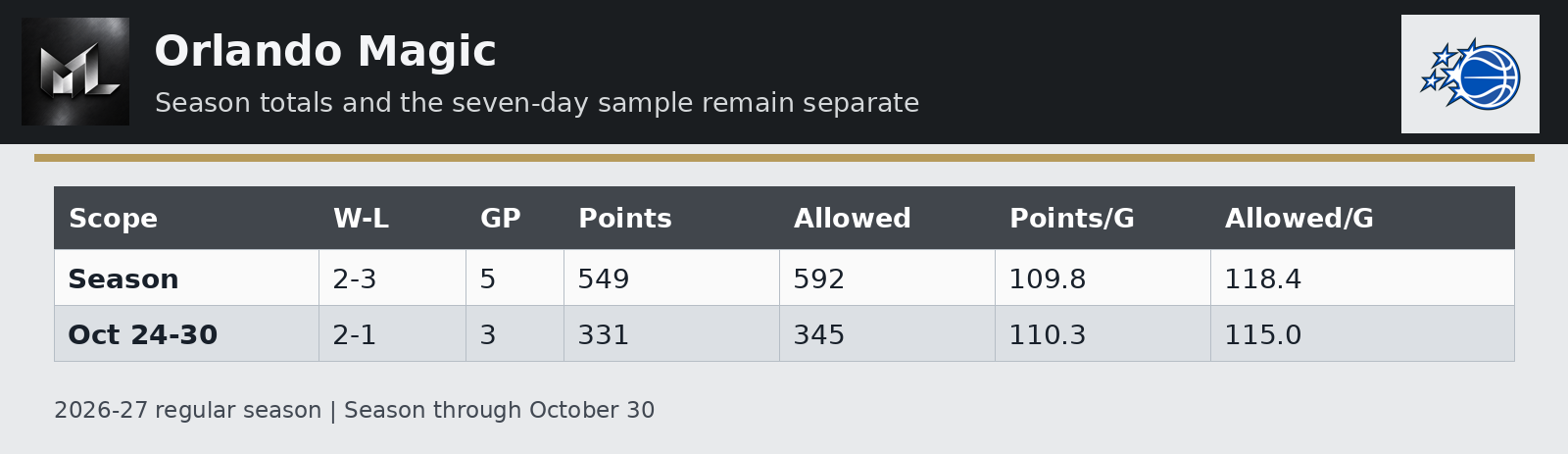
Orlando's two Toronto games produced a revealing reversal. A 129–99 loss was followed by a 121–114 win, giving the Magic two victories in three review-window games and a 2–3 season record. The response deserves credit. The earlier 30-point defeat still weighs heavily in a season scoring profile of 109.8 for and 118.4 against.
Boston visits on November 1, Washington follows the next day, and Orlando then travels to Phoenix. Boston's 120.8 scoring average makes the opener a direct test of whether Orlando can prevent another large concession. The Toronto rematch showed a better result was possible; the next task is to carry that improvement into a different matchup.
Philadelphia 76ers
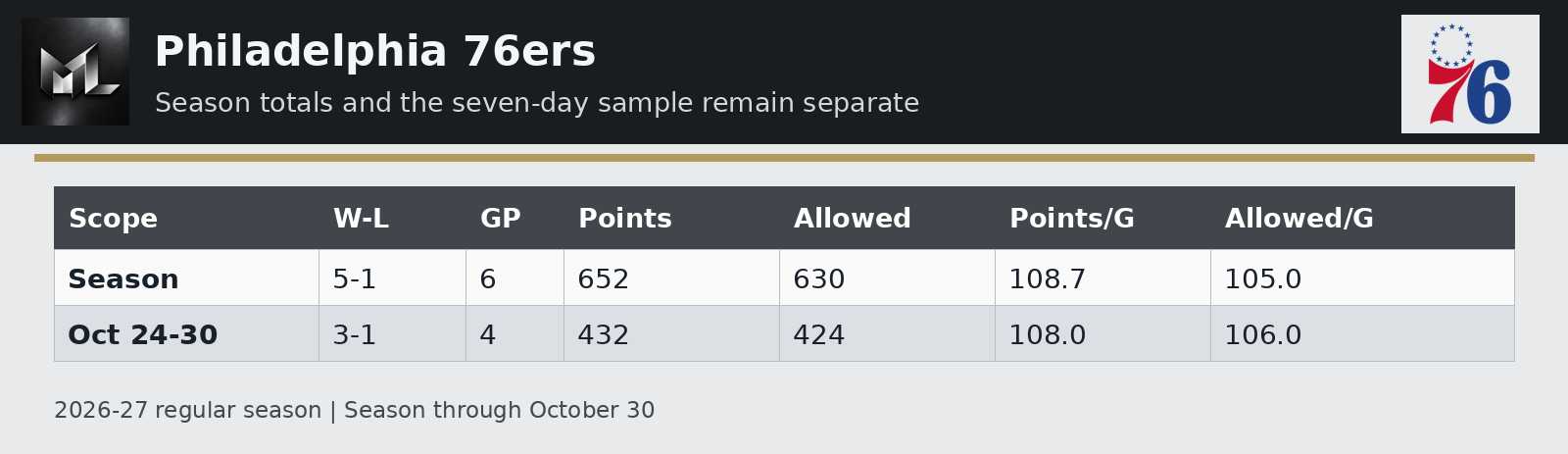
Philadelphia has reached 5–1 while averaging 108.7 points scored and 105.0 allowed. The 98–93 win over New York is a useful reminder that the 76ers do not need every game to become a scoring race. Their one review-window defeat, 106–93 to Detroit, also identifies a level of resistance against which the offense has not yet prevailed.
Charlotte and Chicago come first, followed by road games against Detroit and Cleveland. The Detroit return on November 4 is the strongest immediate check on Philadelphia's start. Winning frequently is already established; finding more scoring against the opponent responsible for its only loss would add a different and more convincing piece of evidence.
Toronto Raptors
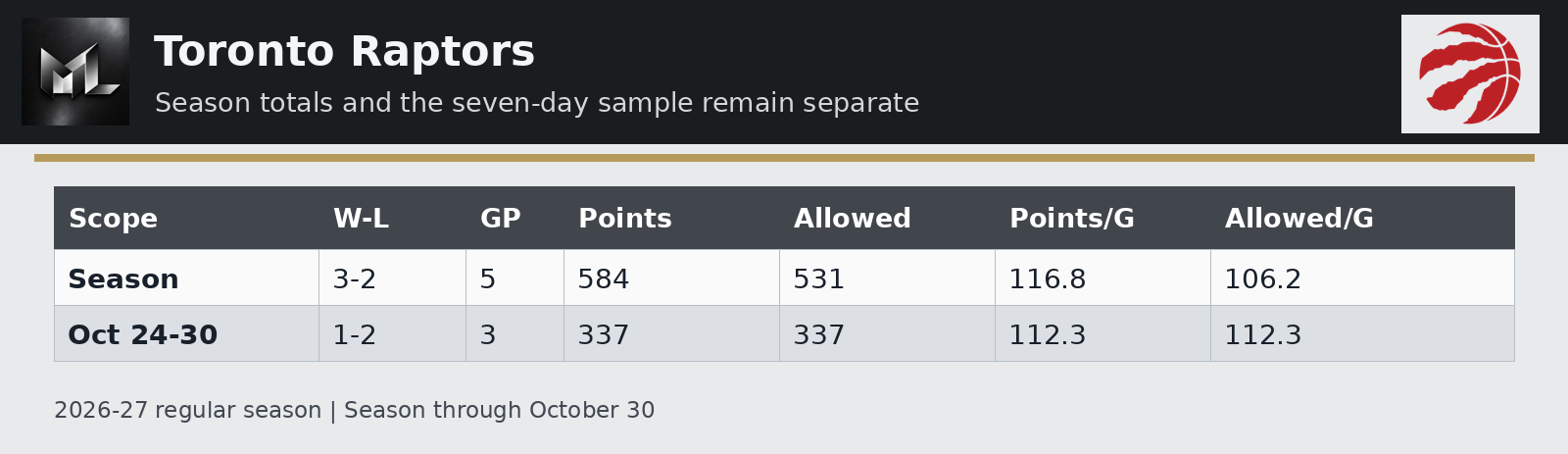
Toronto's 3–2 record comes with a large positive season scoring margin, but the review window was uneven. The Raptors lost 117–94 at Minnesota, beat Orlando 129–99, then lost the rematch 121–114. A 116.8 scoring average and 106.2 allowed remain encouraging season evidence. Those numbers should not conceal the fact that Toronto lost two of its latest three games.
Four straight road games follow: the Lakers, Clippers, Denver and Milwaukee. The first two are on consecutive nights. Toronto will need to reproduce the control of its large Orlando win across a broader range of matchups. The schedule offers no immediate home reset, making consistency more useful than another isolated dominant performance.
Washington Wizards
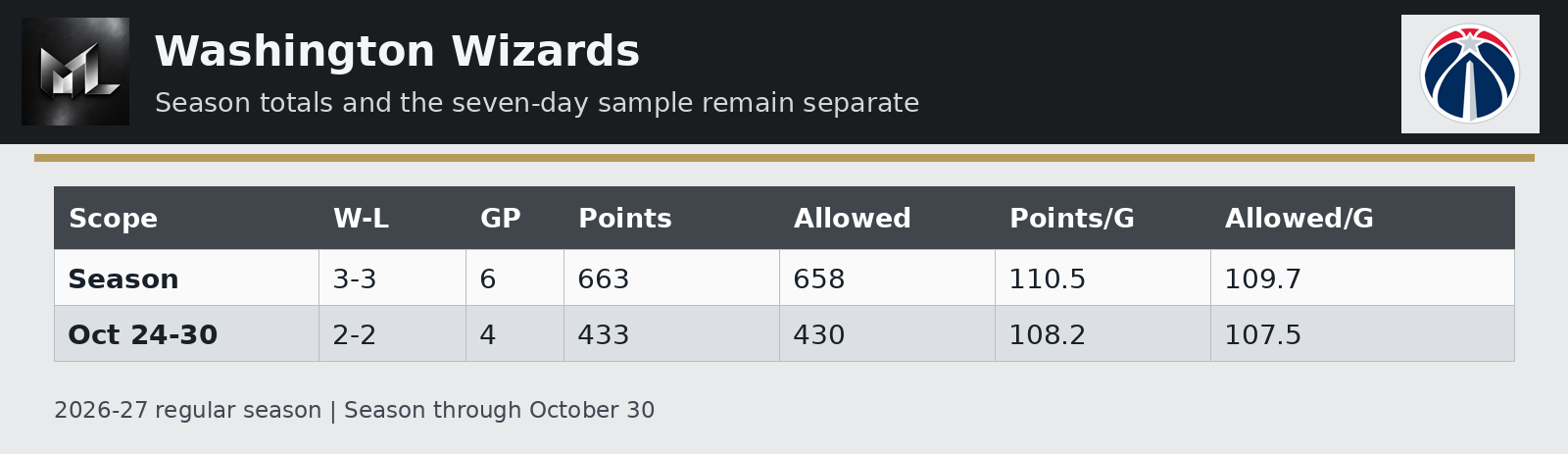
Washington split four review-window games and stands 3–3 with season scoring and concessions nearly level. The Wizards beat Chicago 124–120, lost at Charlotte and Cleveland, then held Charlotte to 79 in a 95–79 win. The final result is encouraging because it did not require a huge attacking total. It also arrived against the league's lowest current scoring average.
Washington visits Orlando before facing Atlanta twice, once on each floor. Those paired Atlanta games should help distinguish a repeatable improvement from one favorable matchup. Atlanta is scoring 119.2 per game, a different challenge from Charlotte. The Wizards need to preserve control without assuming the next opponent will also finish below 80.
Dallas Mavericks
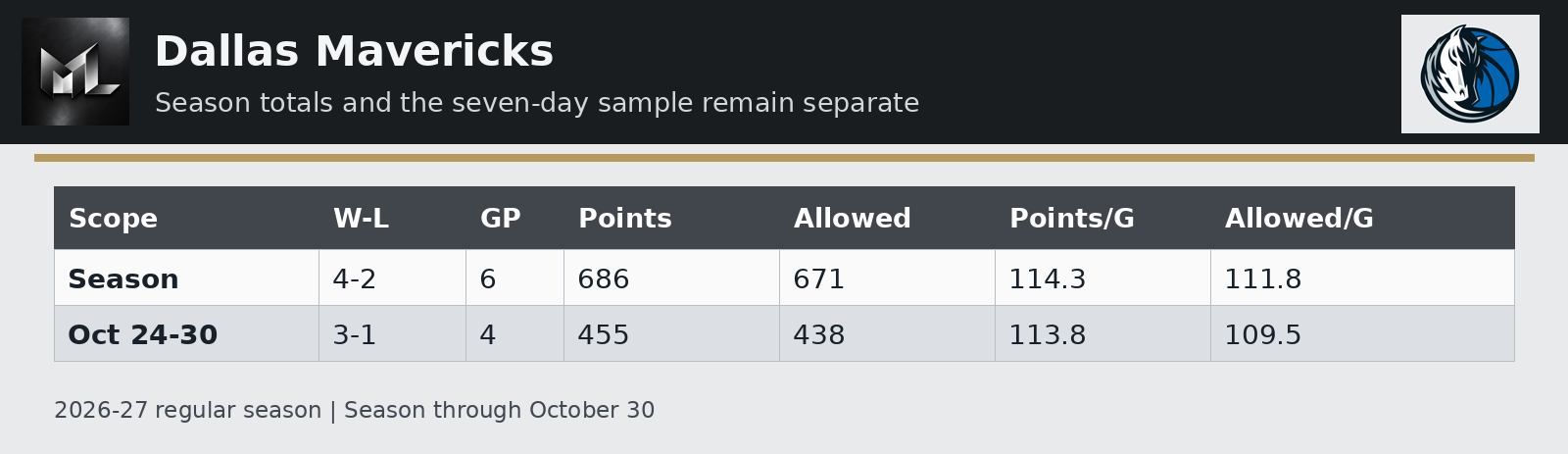
Dallas responded to a 122–106 loss to San Antonio with wins over Miami, Oklahoma City and Houston. Beating the Thunder by 24 and ending Houston's unbeaten start are significant results within a 4–2 season. The Mavericks' overall scoring margin remains a modest 2.5 points per game, so the recent run has improved a start that was less secure than the latest headlines alone suggest.
Sacramento visits before Dallas returns to San Antonio and then hosts Utah. The Spurs rematch on November 4 offers the clearest comparison with the review window's one defeat. Dallas has already shown it can beat teams with strong records; repeating that level while correcting the San Antonio matchup would make the recent improvement more convincing.
Denver Nuggets
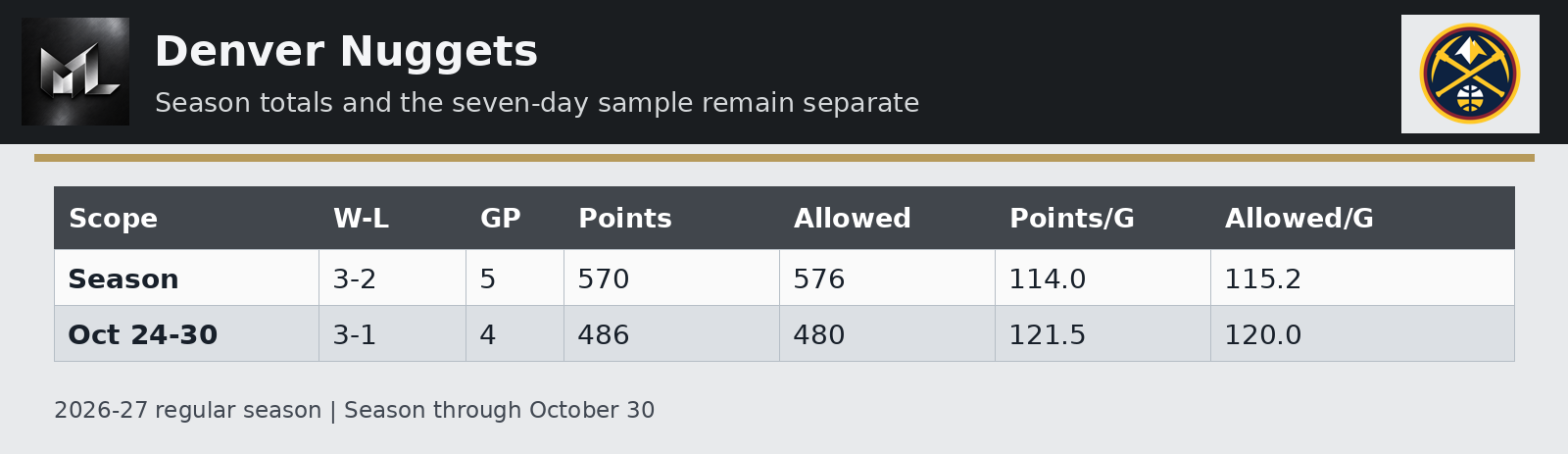
Denver won three of four review-window games, but its season scoring margin is still negative. The Nuggets beat New Orleans twice, lost 134–114 to Golden State, and then won 127–120 at Phoenix. The 3–2 record is positive; allowing 115.2 while scoring 114.0 shows that the distribution of margins has been less favorable. Winning close or high-scoring games should not make the heavy Warriors defeat disappear.
Portland and Toronto visit in the next seven days. Both enter with positive scoring margins, giving Denver a useful pair of tests without another immediate trip. The aim is to turn the recent wins into more consistent separation, especially when an opponent can score quickly enough to punish another loose defensive result.
Golden State Warriors
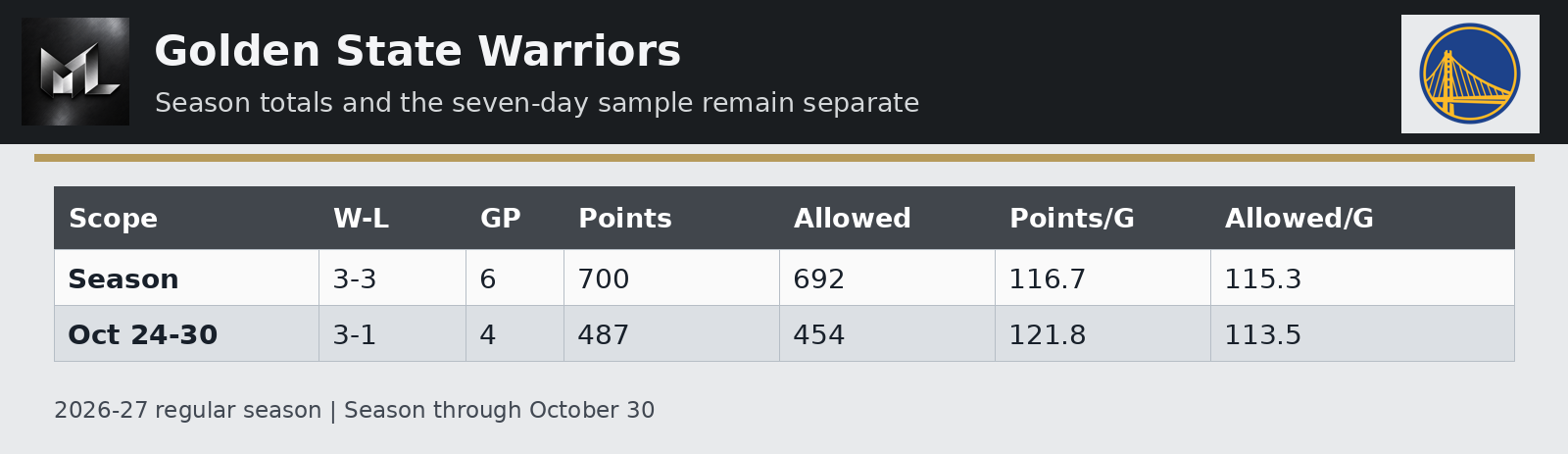
Golden State has recovered to 3–3 with consecutive wins over Denver, Minnesota and the Lakers. Those victories came by 20, five and 17, following a 131–122 loss to Phoenix. The recent improvement is clear in the results. The season scoring margin of 1.3 points per game is more restrained, reflecting the damage from the earlier part of the start.
The Warriors stay home for the Clippers, Phoenix and Miami. Phoenix provides a direct rematch of the last defeat, while Miami arrives after scoring 145 against Indiana. Golden State does not need to win a second scoring contest in the same way. Limiting what those attacks produce would make the winning streak's defensive progress more credible.
Houston Rockets
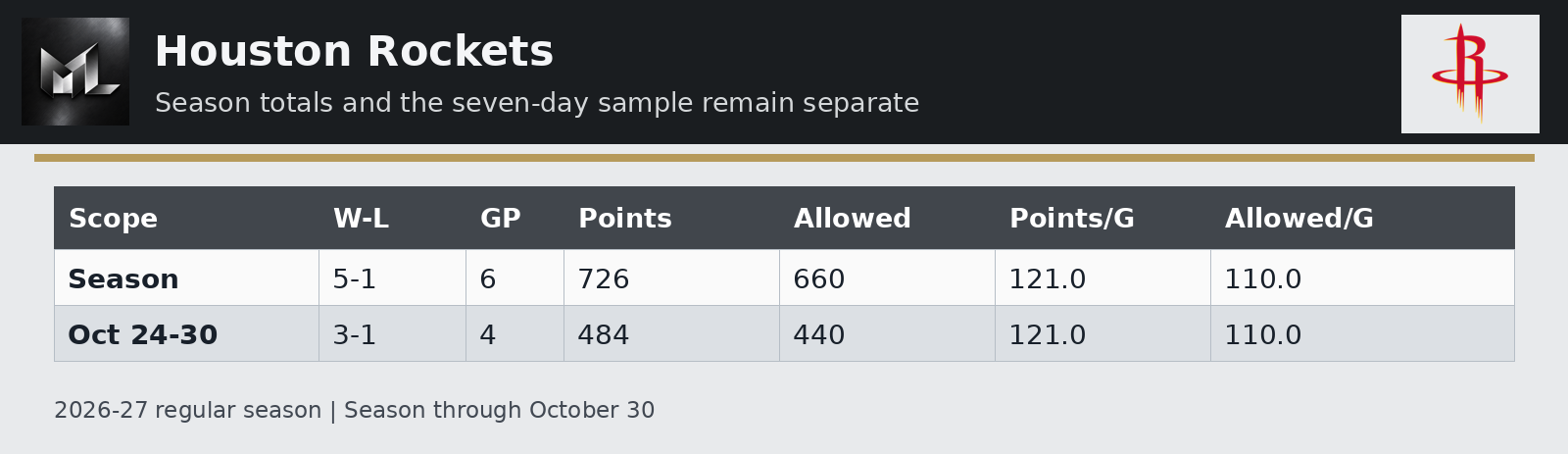
Houston's first defeat came at Dallas, 116–111, after wins over Atlanta twice and Milwaukee. The Rockets are 5–1 with 121.0 points scored and 110.0 allowed per game. That is strong evidence on both sides of the score. The Dallas loss still matters: it shows that Houston's usual scoring volume can be reduced enough for a competitive opponent to finish the job.
Oklahoma City, Boston and Minnesota visit consecutively. All three have winning records, and two average more than 120 points. This is a more demanding sequence than treating the loss as a brief interruption would suggest. Houston's next assessment should depend on how it handles those different scoring profiles, not on preserving an attractive early average.
LA Clippers
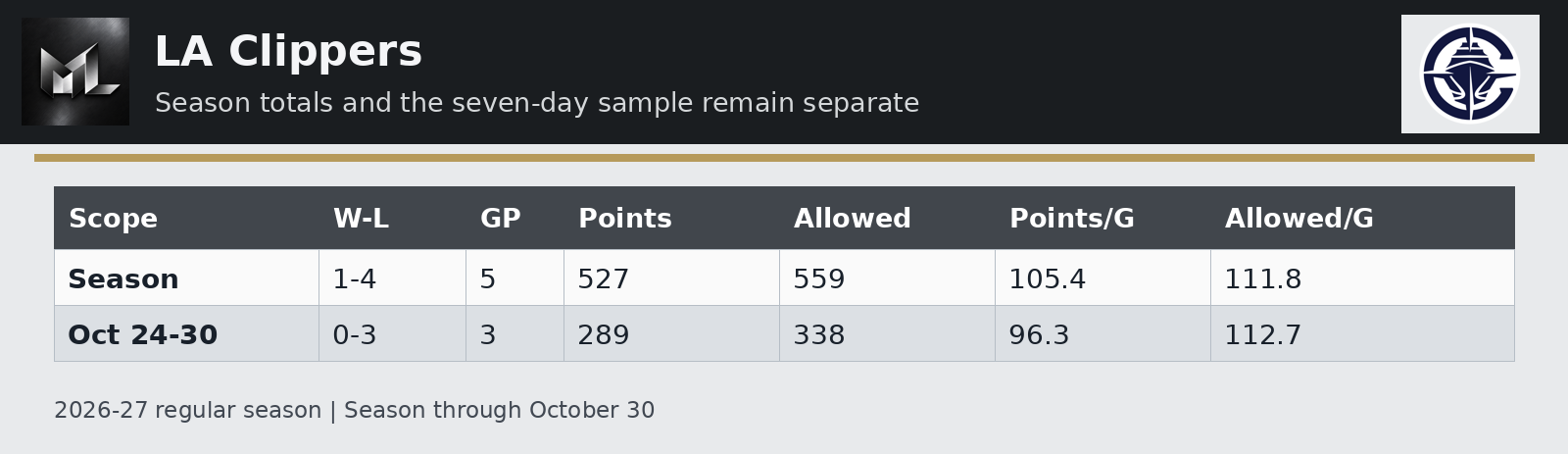
The Clippers lost all three review-window games and are 1–4. They scored 101 against Oklahoma City, 87 against the Lakers and 101 at Minnesota. A season average of 105.4 points gives them little room to absorb mistakes, and the 127–101 Minnesota defeat shows how quickly the deficit can expand when the opponent also has a productive night.
Golden State is next, followed by home games against Toronto and Miami. The first opponent has won three straight; the last has just scored 145. The Clippers need a more reliable attacking floor while keeping the concessions under control. Improving only one side may still leave them chasing a larger total than they can currently reach.
Los Angeles Lakers
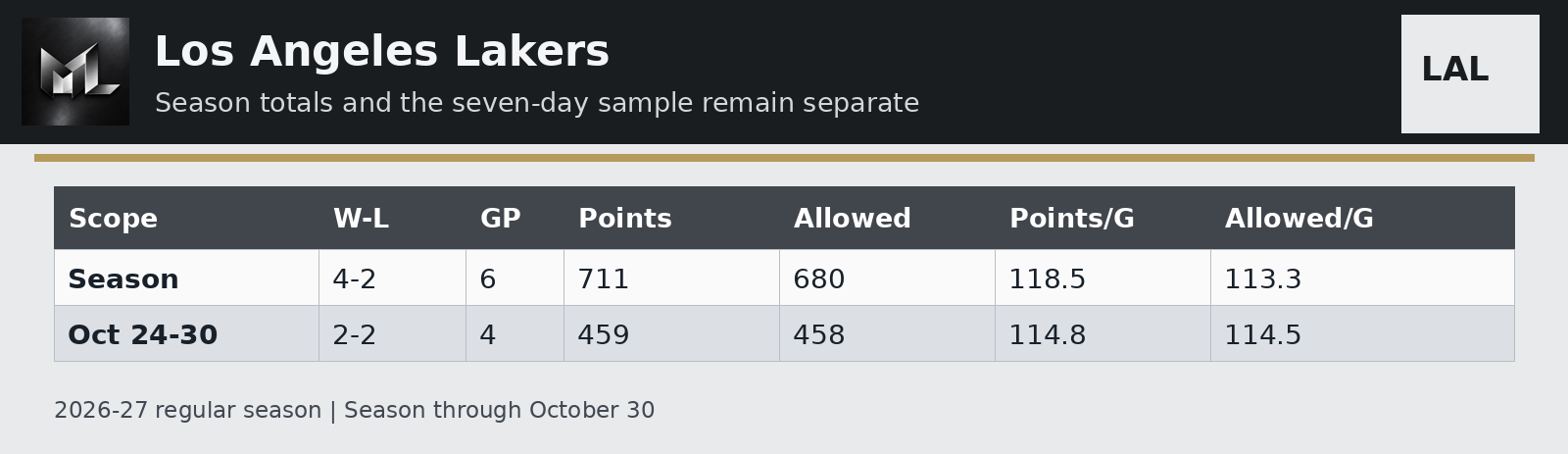
The Lakers split four review-window games, beating Utah and the Clippers while losing to Portland and Golden State. Their 4–2 record and 118.5 scoring average are solid, but the contrast between the 103–87 Clippers win and the 112–95 Warriors loss is instructive. The attack has not supplied the same protection in every matchup.
Toronto and Miami visit on consecutive nights before a trip to Sacramento and a home rematch with Portland. The Portland game closes a useful comparison with the 136–129 defeat. Los Angeles has already demonstrated it can win at a lower total; carrying that control into a matchup that previously became a scoring race would be a meaningful step.
Memphis Grizzlies
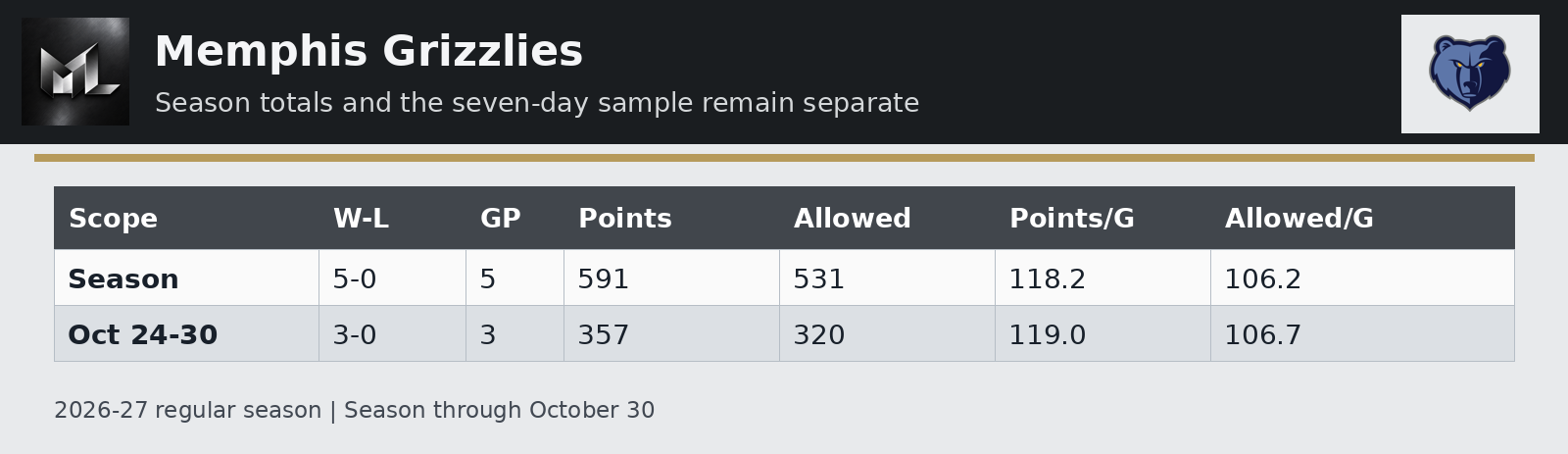
Memphis is the only unbeaten team at 5–0. Its three review-window wins came against Sacramento, Utah and Portland, and the latest was the clearest: 124–103 over a Trail Blazers team that entered unbeaten. The Grizzlies score 118.2 and allow 106.2 per game. The five-point Utah win also supplies a useful caution against describing every result as comfortable.
Sacramento, New Orleans, Indiana and Oklahoma City all visit over the next seven days. The first three offer chances to extend the start, but the Thunder provide the stronger final examination. Memphis has earned the attention attached to a perfect record. Maintaining control through that entire sequence would give the record a broader base.
Minnesota Timberwolves
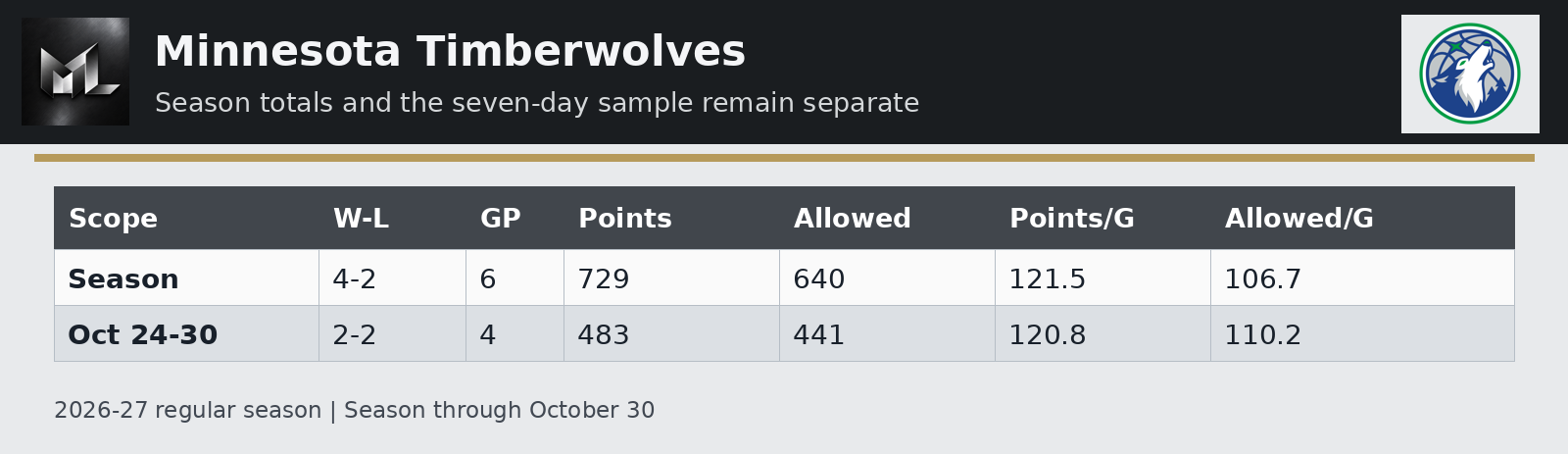
Minnesota is 4–2 with the league's largest current average scoring margin, 14.8 points per game. The Timberwolves beat Toronto by 23 and the Clippers by 26 in the review window, but lost close games to Cleveland and Golden State between those wins. The arithmetic explains how a dominant aggregate profile and two defeats can coexist. It does not turn either loss into a win.
San Antonio, Milwaukee, Houston and New Orleans are next, with three games on the road. Houston is the strongest upcoming scoring comparison, while San Antonio enters on a three-game winning run. Minnesota now needs its ability to create large margins to translate into more reliable results when the game stays close.
New Orleans Pelicans
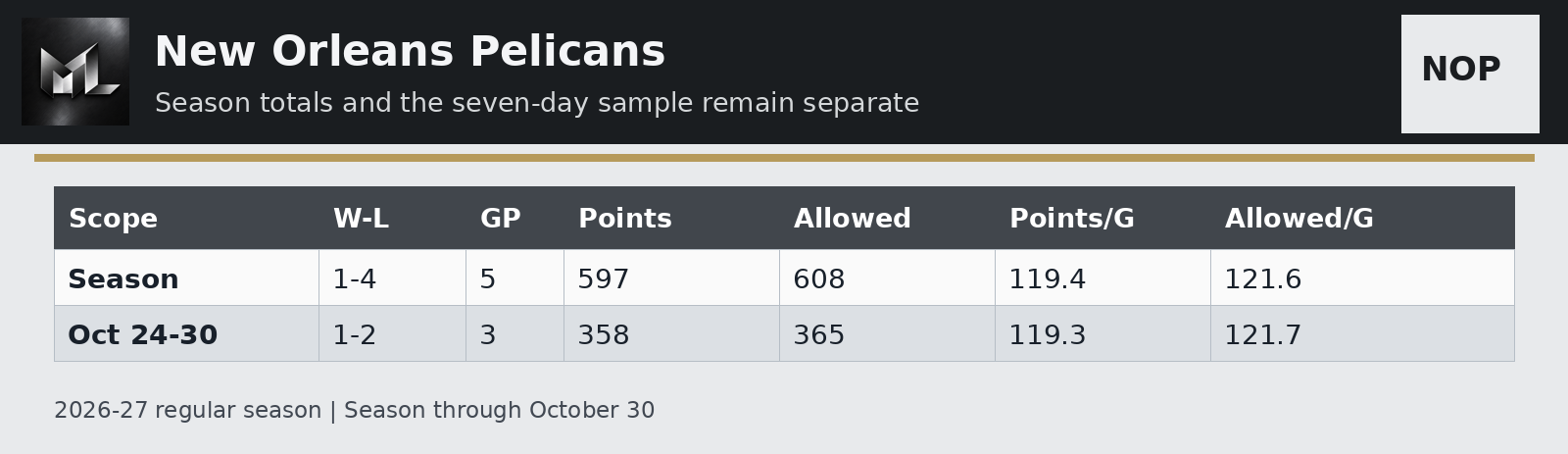
New Orleans finally won against Sacramento, 132–120, after two review-window losses to Denver. The Pelicans scored 135 in the first Denver meeting and only 91 in the second. Those extremes help explain why a 119.4 season scoring average is not enough to describe the attack's reliability. At 1–4, New Orleans is also allowing 121.6 points per game.
Atlanta visits before a trip to Memphis, then Utah and Minnesota come to New Orleans. The Memphis game is the clearest test against an opponent that has controlled its early results. The Pelicans need more than another large scoring total against Sacramento to establish progress; reducing the swings between performances would be a better start.
Oklahoma City Thunder
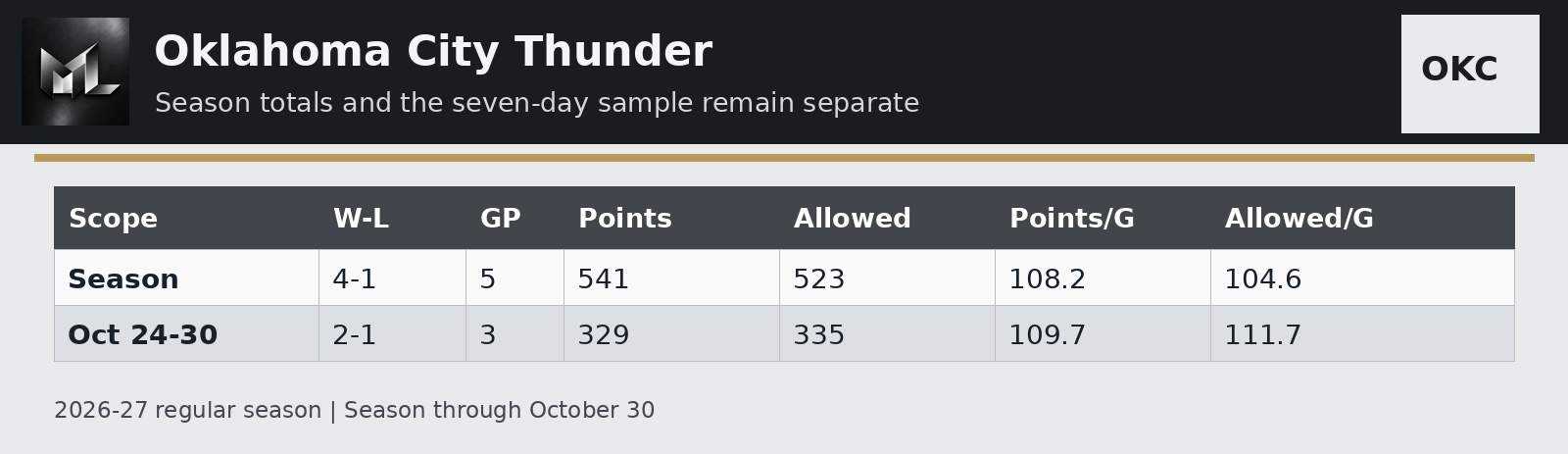
Oklahoma City won against the Clippers and Phoenix before losing 120–96 at Dallas. That defeat ended its unbeaten start and materially altered an otherwise restrictive scoring profile. The Thunder are still 4–1 and allow 104.6 points per game, but the latest game demonstrates the danger of treating the season average as protection against a specific opponent.
Houston comes first, followed by Cleveland twice and then Memphis. That is a demanding four-game sequence with three on the road. The consecutive Cleveland meetings offer an adaptation test; Memphis offers a chance to challenge the remaining unbeaten team. Oklahoma City's response should be judged across the sequence, rather than by one immediate rebound result.
Phoenix Suns
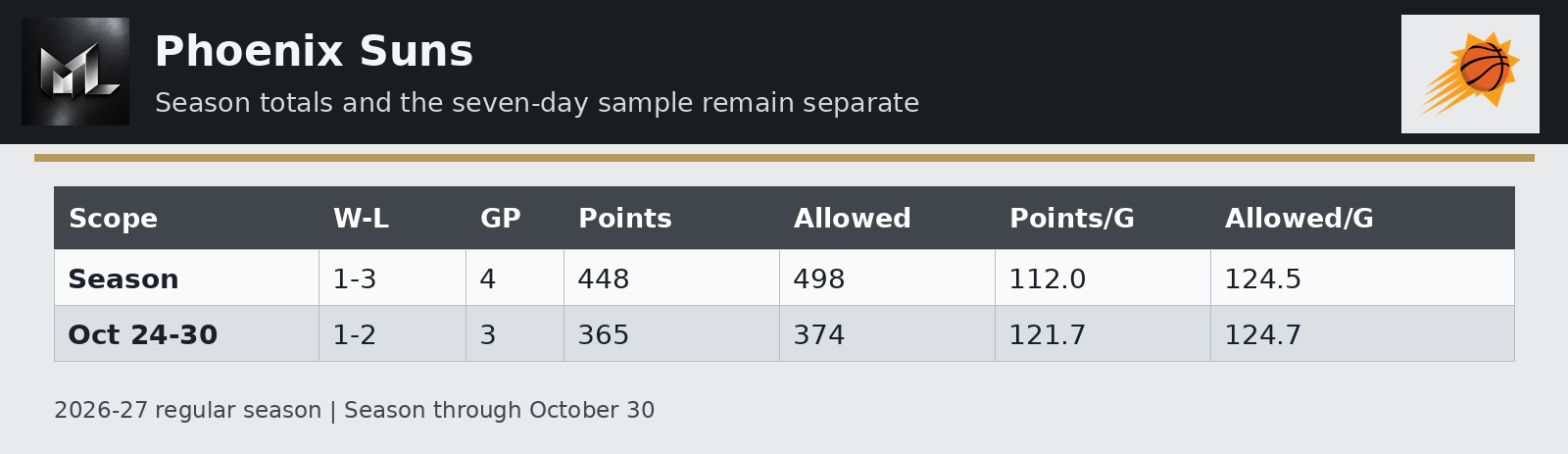
Phoenix's only win was the 131–122 victory over Golden State. Losses to Oklahoma City and Denver followed, leaving the Suns 1–3 with 124.5 points allowed per game. Scoring 114 and 120 in those defeats was not the main arithmetic problem. The opponents' totals have repeatedly required Phoenix to chase a result beyond its current average output.
The next three games are Golden State, Portland and Orlando. The Warriors rematch provides the most direct comparison with the one win, while Portland's 122.8 scoring average presents another substantial challenge. Phoenix needs a result that relies on more controlled concessions, not another assumption that scoring into the 120s will necessarily be enough.
Portland Trail Blazers
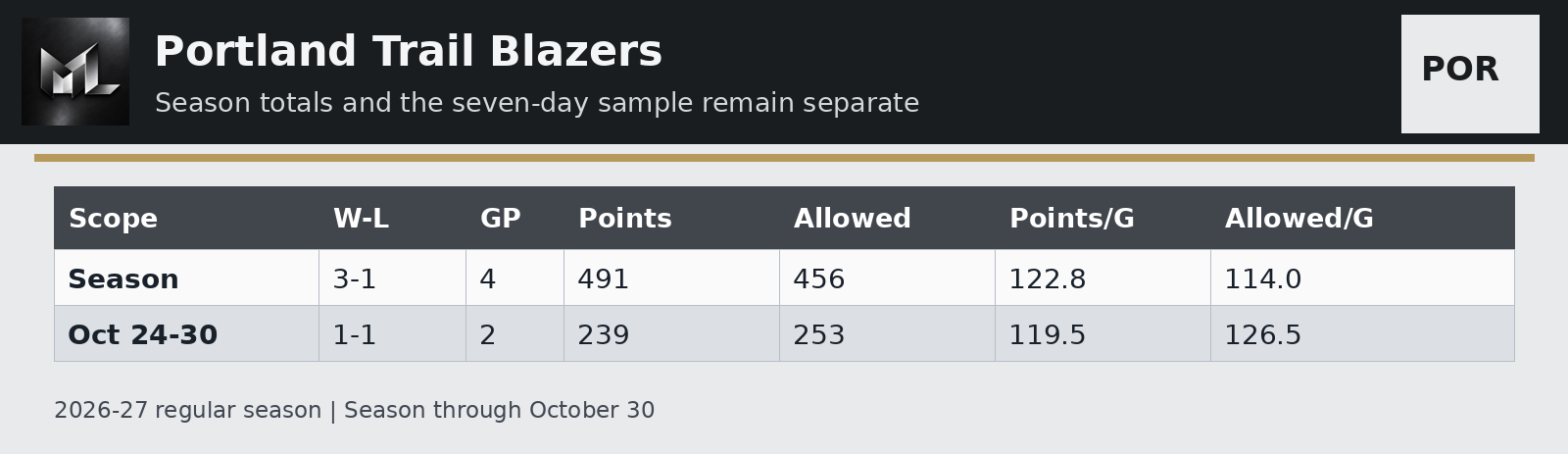
Portland moved to 3–0 by beating the Lakers 136–129, then lost 124–103 at Memphis. The Trail Blazers still average 122.8 points per game, but the Memphis defeat shows the limit of reading that number as a guarantee. When the attack fell to 103, conceding 124 left no route to a close finish.
Utah, Denver, Phoenix and the Lakers are next, all on the road. The four-game trip offers different tests of whether Portland can sustain its scoring away from home while improving control of the opponent. The final Lakers rematch should be especially revealing if the Trail Blazers cannot rely on reproducing the first meeting's 136.
Sacramento Kings
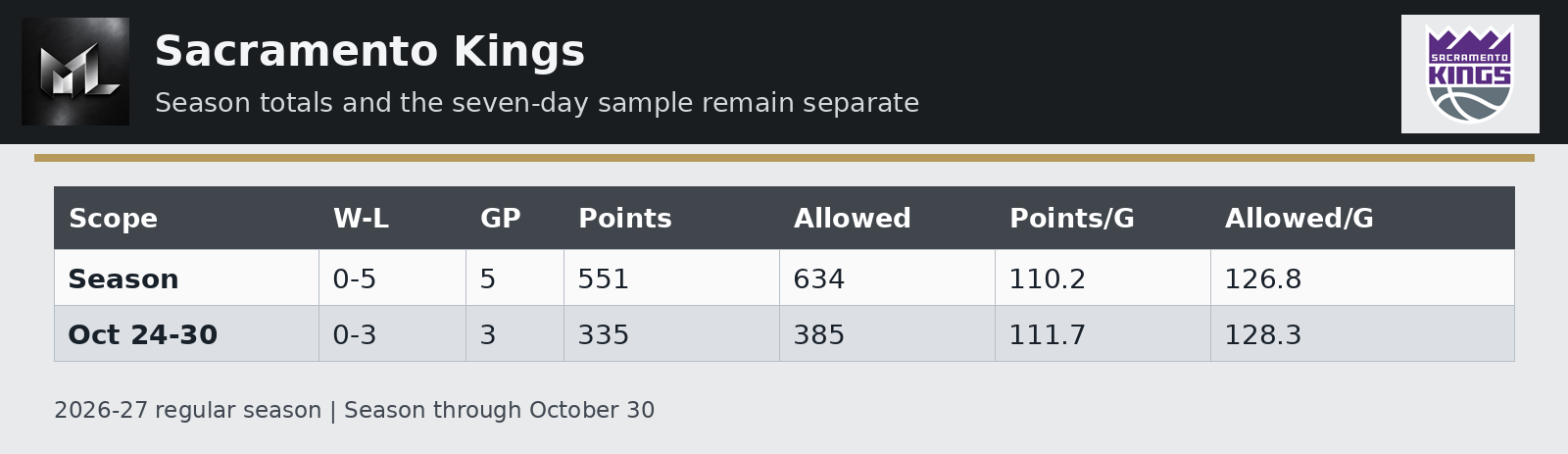
Sacramento is 0–5 and has allowed 126.8 points per game. The Kings lost to Memphis, San Antonio and New Orleans in the review window, with margins of 11, 27 and 12. Even the 120 scored against New Orleans left them well short. The immediate evidence points to a team regularly requiring too much from its own attack to offset what it concedes.
The next seven days bring Memphis and Dallas away, then the Lakers and Spurs at home. None arrives with a losing record. Sacramento needs to reduce the size of the task before discussing a turnaround. Keeping these games competitive for longer would provide a more useful foundation than another respectable scoring total attached to a double-digit defeat.
San Antonio Spurs
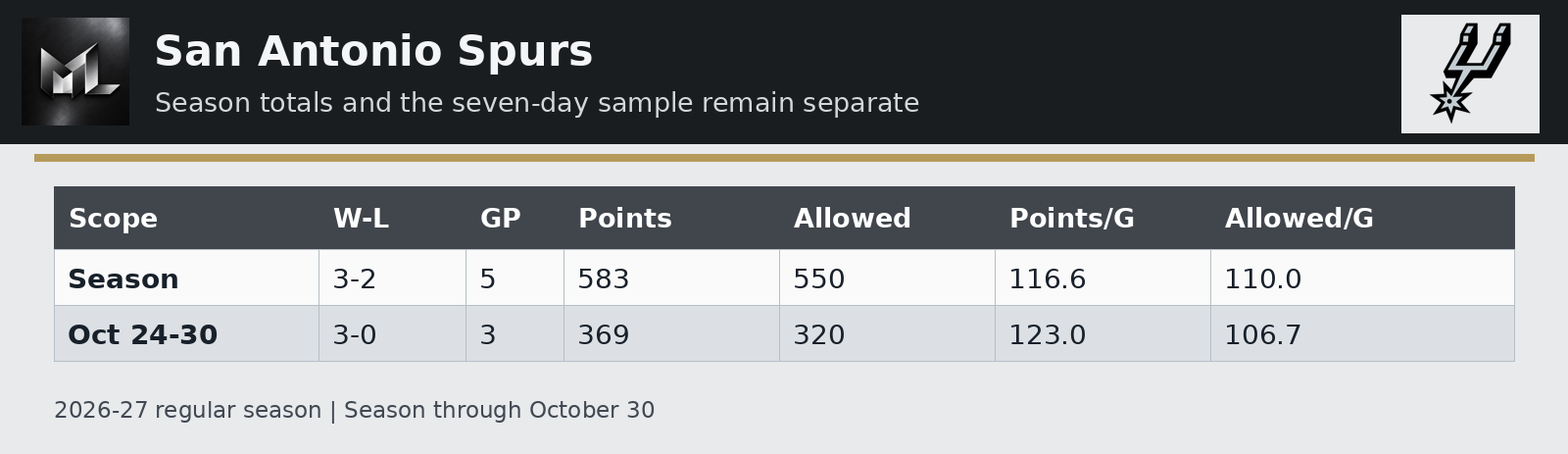
San Antonio won all three review-window games, beating Dallas by 16, Sacramento by 27 and Utah by six. The Spurs have reached 3–2 with 116.6 points scored and 110.0 allowed per game. Their strongest evidence is the variety of margins: two clear wins followed by a tighter result they still finished. The Utah game also warns against treating the run as uninterrupted dominance.
Minnesota visits next, followed by Utah and Dallas, before a trip to Sacramento. Three opponents are immediate rematches, making this a useful test of whether the Spurs can preserve advantages once the same matchup returns. Minnesota's large positive scoring margin gives the opening game a different and more demanding profile.
Utah Jazz
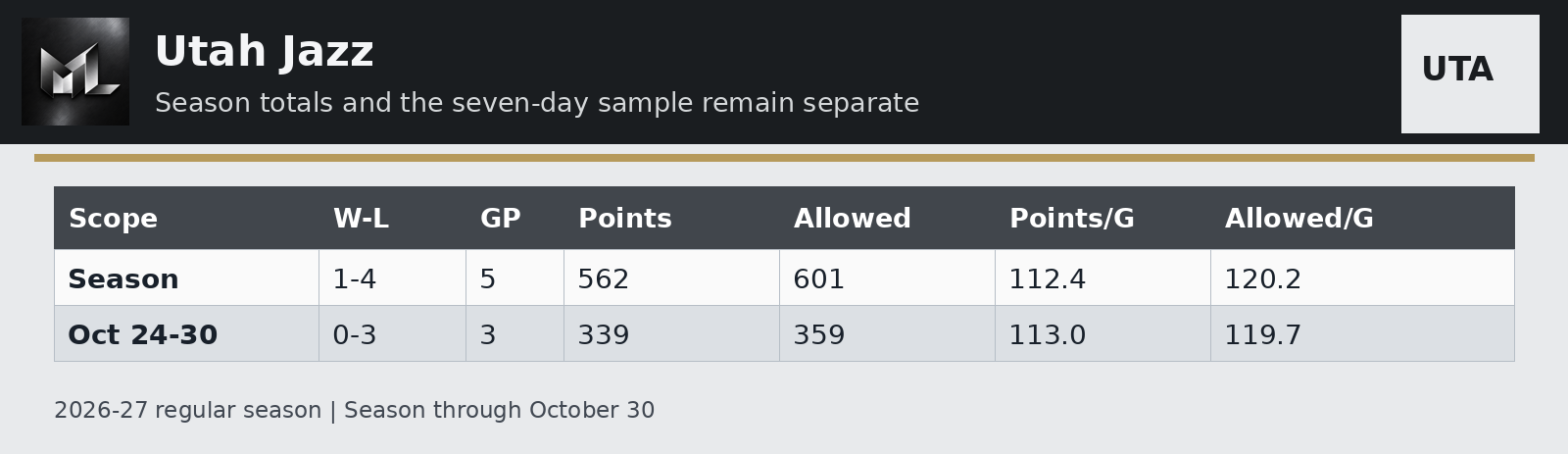
Utah lost all three review-window games and is 1–4. The Jazz conceded 132 to the Lakers, 110 to Memphis and 117 to San Antonio. The closer defeats to Memphis and San Antonio show that Utah has remained competitive at times, but the season average of 120.2 allowed leaves its 112.4 scoring output short of what has usually been required.
Portland visits before road games against San Antonio, New Orleans and Dallas. The Spurs rematch is the nearest comparison with the latest six-point defeat. Utah needs to turn a competitive stretch into a completed result, while the high-scoring Portland matchup will test whether the concessions can fall enough to make that possible.
Oklahoma City at Houston
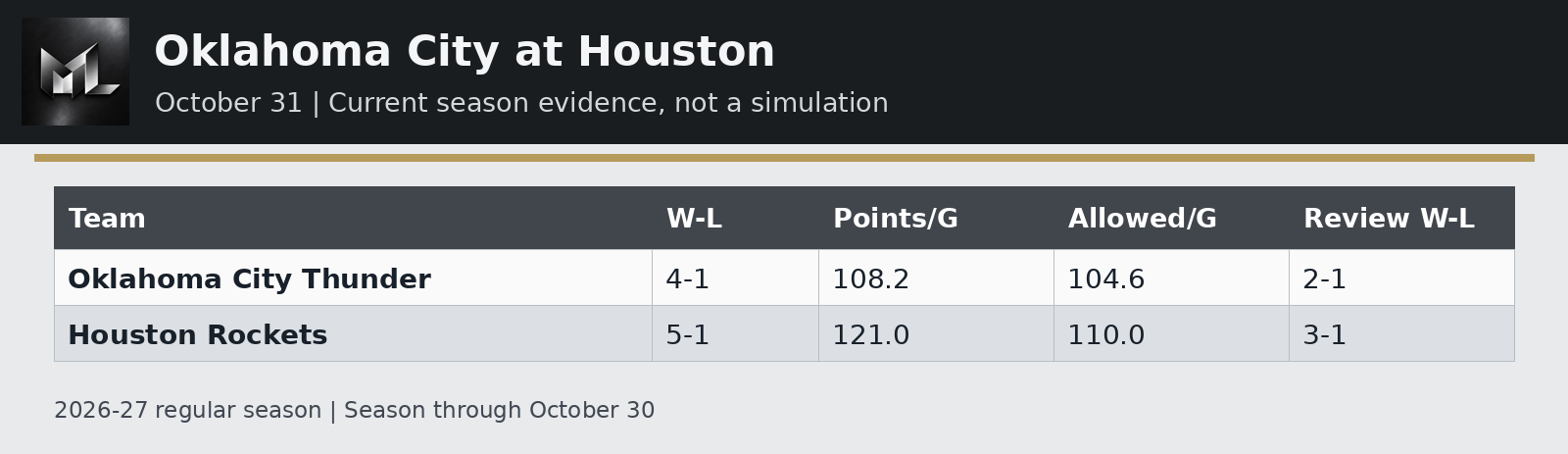
Both teams enter after their first defeat, and Dallas supplied the loss in each case. Houston lost 116–111; Oklahoma City lost 120–96. The immediate comparison is therefore not simply two attractive records. Houston maintained a competitive finish while the Thunder absorbed a much larger margin. That distinction deserves attention without being converted into a probability.
Houston averages 121.0 points and Oklahoma City allows 104.6, putting an established scoring output against an established restrictive average. Neither number is possession-adjusted, and the short samples do not identify exactly how the matchup will be decided. Houston also played the previous night, while Oklahoma City's last completed game was October 28. The calendar difference is verified; its effect on individual availability is not assumed.
Boston at Houston
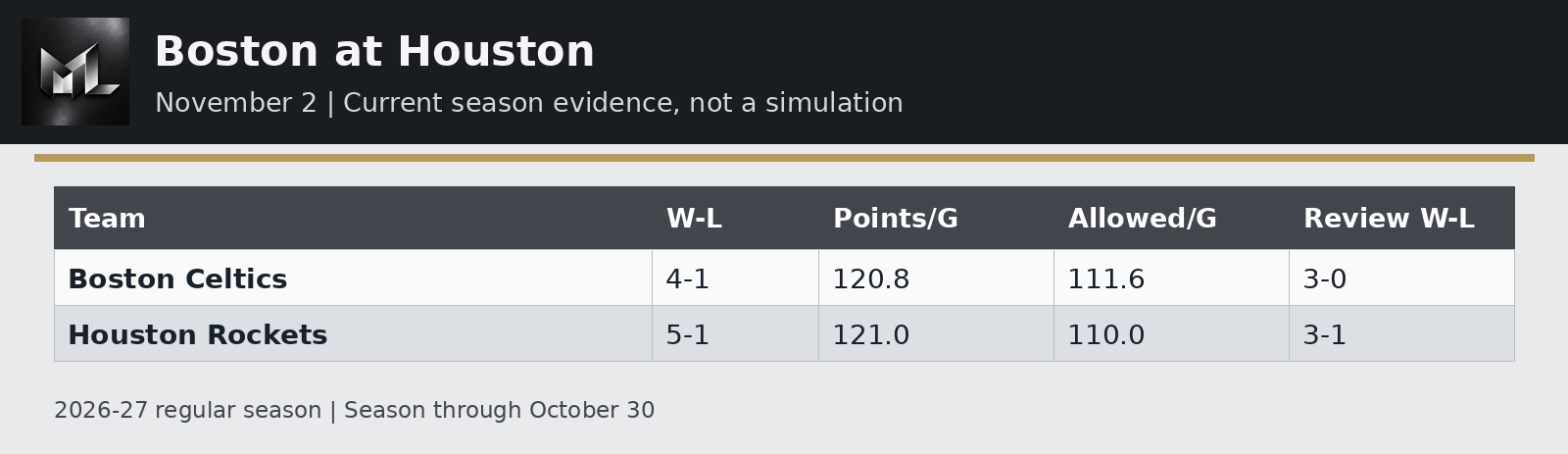
Boston's 120.8 points per game and Houston's 121.0 make a scoring comparison unavoidable, but the concessions offer a useful check. Houston allows 110.0 and Boston 111.6. Both teams have produced positive early margins. The Celtics' one-point Brooklyn win and the Rockets' five-point Dallas loss show that the averages still leave room for difficult finishes.
Boston is scheduled to play at Orlando the previous day, while Houston's preceding game is Oklahoma City on October 31. This makes the trip part of the assessment rather than a standalone meeting between records. A large total would not by itself prove either team controlled the game. The clearer question is which side can create separation without needing its highest scoring night of the season.
Philadelphia at Detroit
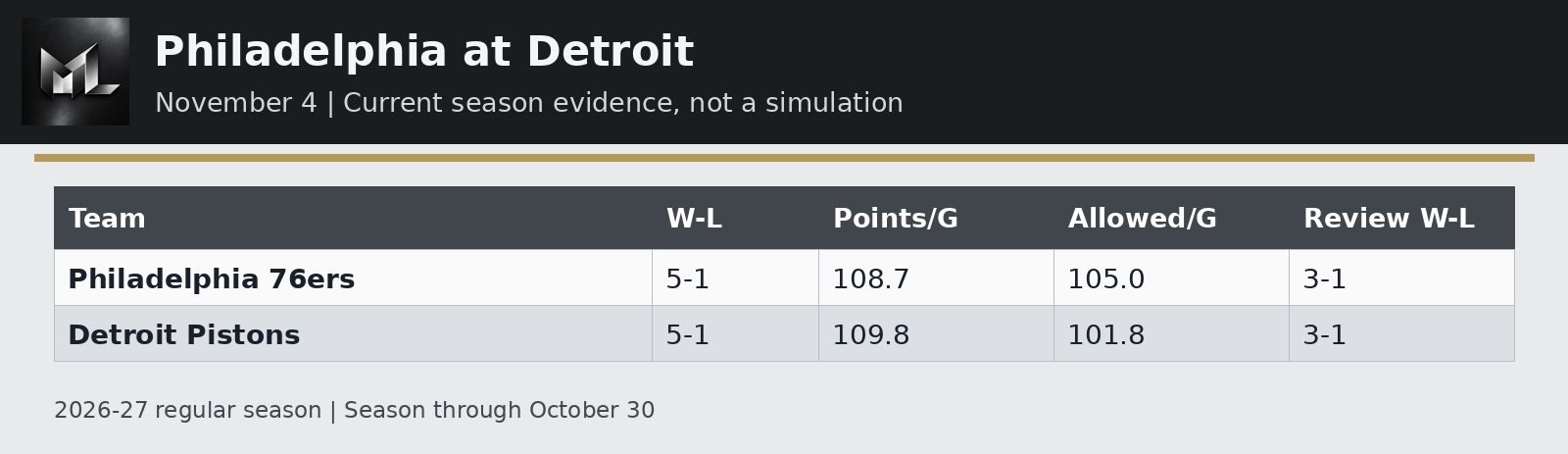
Detroit already won this matchup 106–93 on October 25. Philadelphia has since beaten Indiana and New York, including a 98–93 finish against the Knicks. Both teams stand 5–1, so this is an early rematch between successful records whose scoring averages remain below 110. A modest combined score would be consistent with their starts, although no total or wager is being forecast.
For Philadelphia, the question is whether it can produce more against the one opponent that has beaten it. For Detroit, the task is to repeat enough of the earlier control after the 76ers have had that direct comparison. The existing result belongs in the analysis; treating its 13-point margin as a standing entitlement would be a poor way to assess the second meeting.
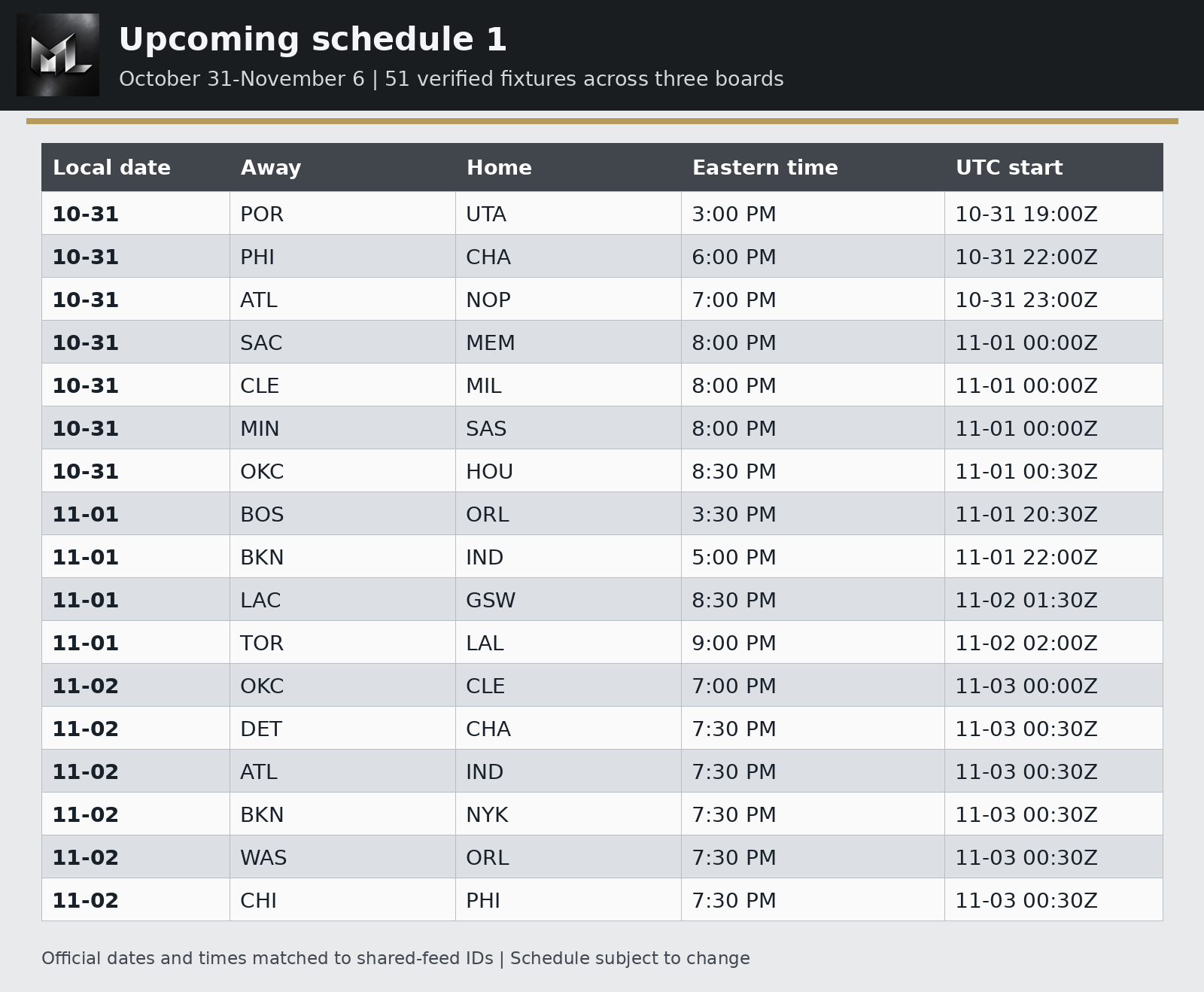
Upcoming schedule 1
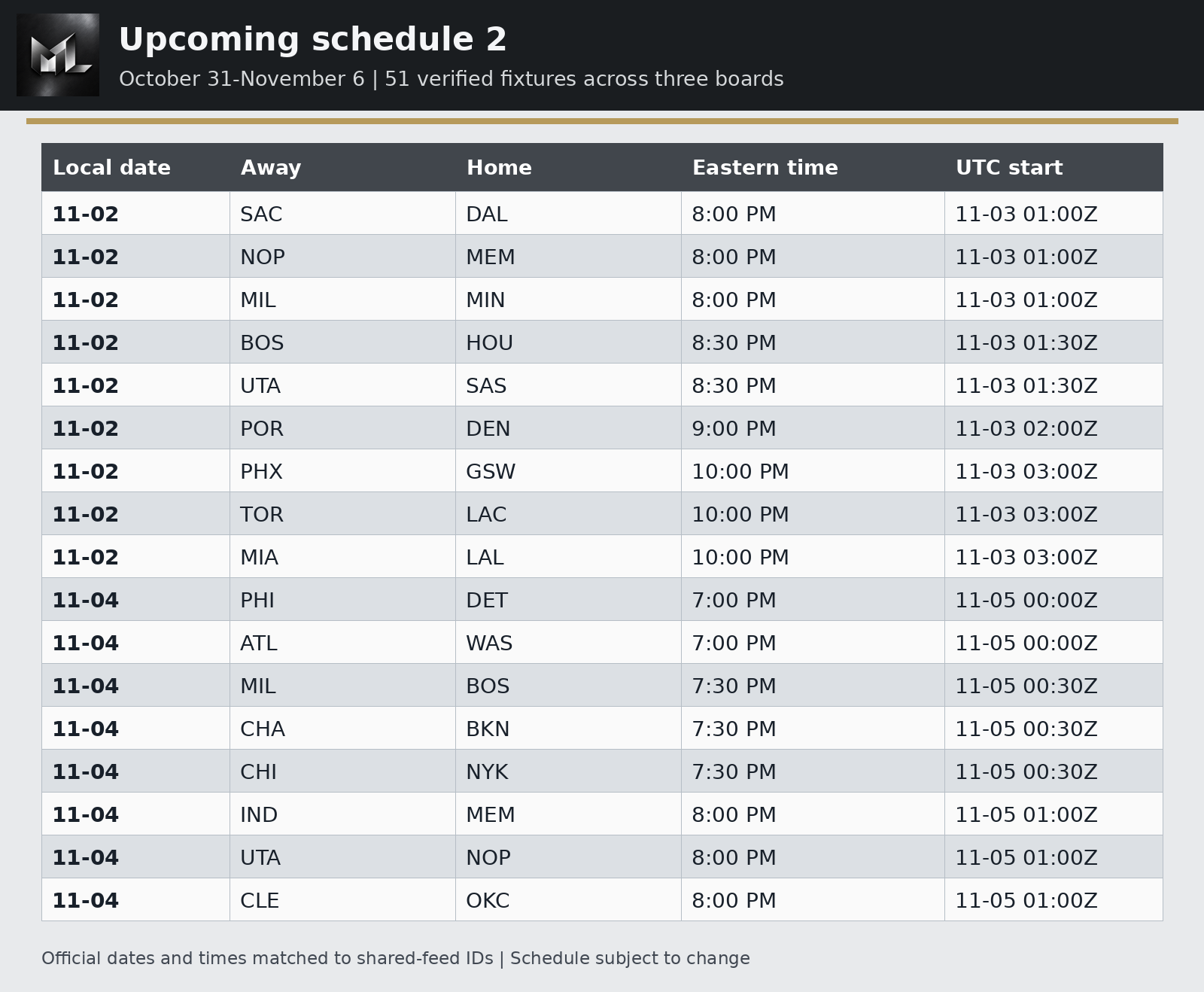
Upcoming schedule 2
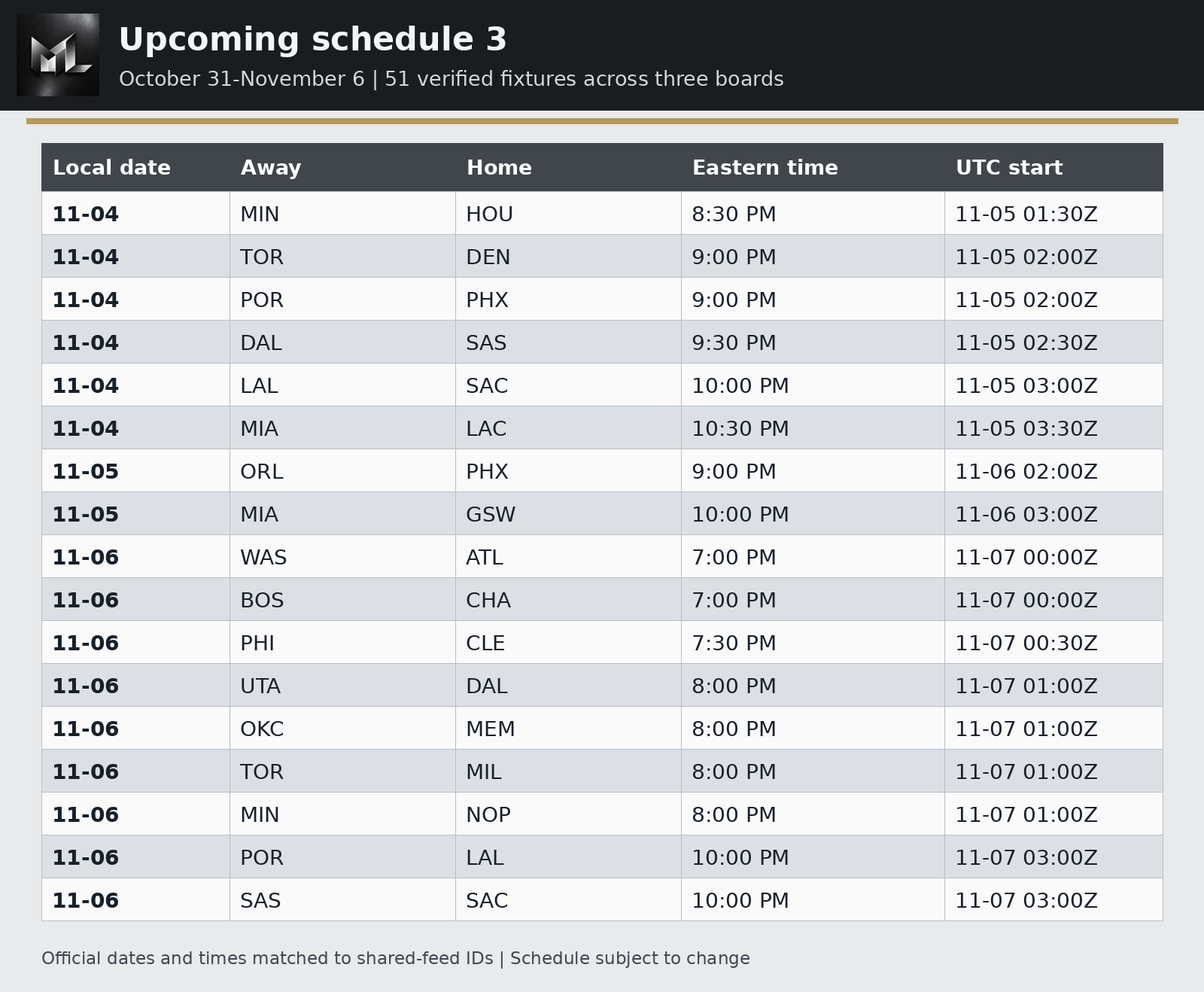
Upcoming schedule 3
How to read the rankings and statistics
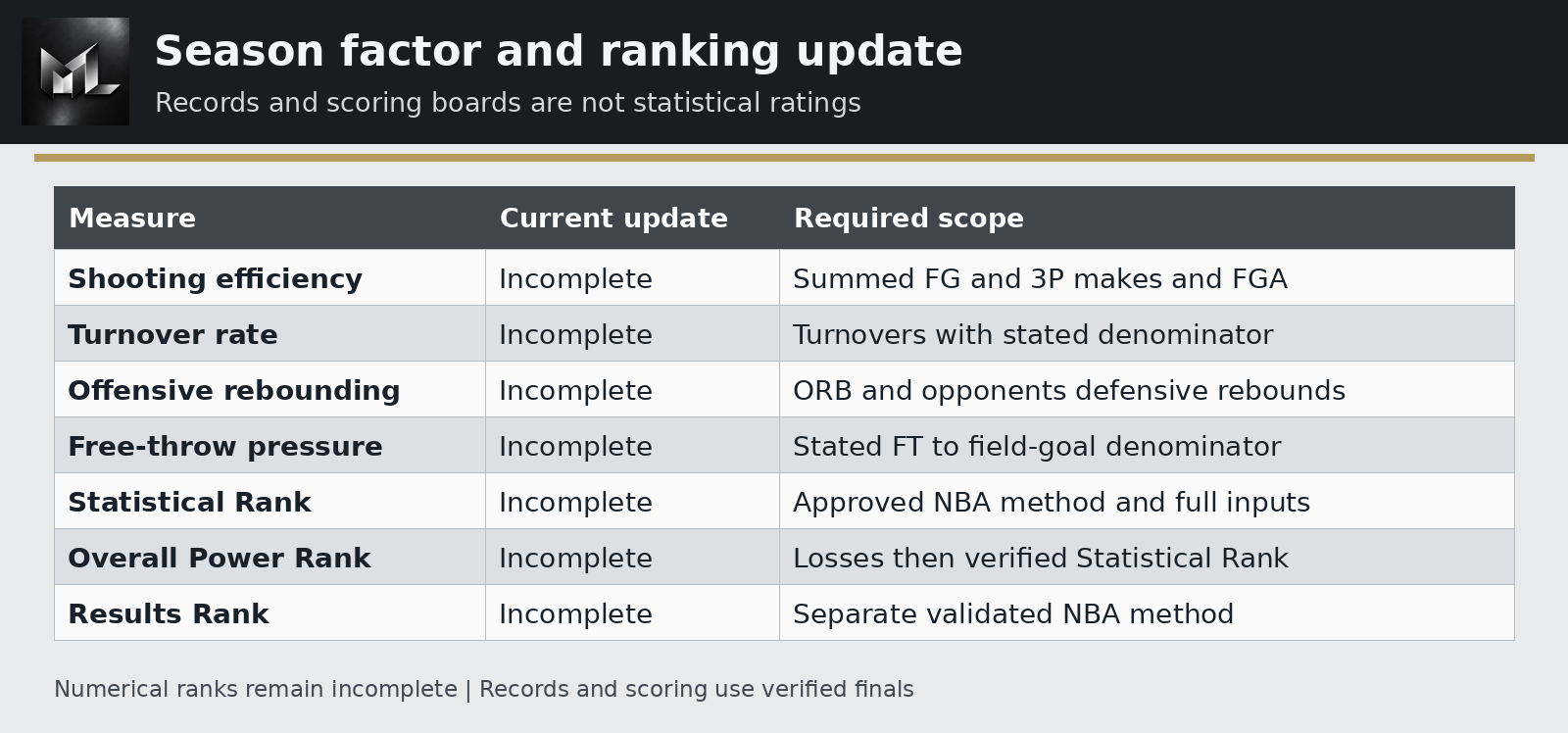
Statistical Rank is incomplete. The current full-season count population and the approved NBA method binding have not been verified together, so no statistical score is shown. Overall numerical Power Rank is also incomplete: the results rule orders losses first, then uses the unchanged Statistical Rank within equal-loss groups. An unsupported tie-breaking score would defeat that distinction.
A separate calculated Results Rank is unavailable because a separately validated NBA method and its complete inputs have not been established. The record boards are records and scoring summaries, not a replacement statistical model. There are no draws in the completed basketball results. Actual period evidence distinguishes regulation from the four overtime games in the completed season population.
The four season factors remain incomplete. Shooting efficiency requires summed field goals, three-pointers and attempts; turnover rate needs its stated possession or opportunity denominator; offensive rebounding needs offensive rebounds plus opponents' defensive rebounds; free-throw pressure needs the stated free-throw-to-field-goal denominator. Points per game cannot fill those gaps. No verified betting snapshot is shown, no betting result is graded, and the analysis offers no betting guarantee.
Canonical game pages
Every completed season game used in the records and every upcoming fixture has its own exact game page.
- 2026-10-20 · BOS at DET
- 2026-10-20 · PHI at NYK
- 2026-10-20 · OKC at SAS
- 2026-10-21 · ATL at ORL
- 2026-10-21 · MIL at WAS
- 2026-10-21 · CHA at BKN
- 2026-10-21 · MIN at MIA
- 2026-10-21 · CHI at TOR
- 2026-10-21 · UTA at MEM
- 2026-10-21 · IND at NOP
- 2026-10-21 · DAL at HOU
- 2026-10-21 · GSW at LAL
- 2026-10-21 · PHX at POR
- 2026-10-21 · SAC at LAC
- 2026-10-22 · CLE at PHI
- 2026-10-22 · DEN at OKC
- 2026-10-23 · NYK at BOS
- 2026-10-23 · ATL at CHA
- 2026-10-23 · DAL at IND
- 2026-10-23 · MIN at ORL
- 2026-10-23 · TOR at WAS
- 2026-10-23 · DET at MIA
- 2026-10-23 · CHI at MIL
- 2026-10-23 · HOU at SAS
- 2026-10-23 · NOP at UTA
- 2026-10-23 · MEM at GSW
- 2026-10-23 · LAC at LAL
- 2026-10-23 · POR at SAC
- 2026-10-24 · MIA at CHA
- 2026-10-24 · BKN at CLE
- 2026-10-24 · MIL at PHI
- 2026-10-24 · HOU at ATL
- 2026-10-24 · WAS at CHI
- 2026-10-24 · SAS at DAL
- 2026-10-24 · NOP at DEN
- 2026-10-24 · GSW at PHX
- 2026-10-25 · LAL at UTA
- 2026-10-25 · IND at BKN
- 2026-10-25 · ORL at NYK
- 2026-10-25 · TOR at MIN
- 2026-10-25 · LAC at OKC
- 2026-10-25 · DET at PHI
- 2026-10-25 · MEM at SAC
- 2026-10-26 · WAS at CHA
- 2026-10-26 · MIN at CLE
- 2026-10-26 · CHI at BOS
- 2026-10-26 · DAL at MIA
- 2026-10-26 · IND at MIL
- 2026-10-26 · PHX at OKC
- 2026-10-26 · ATL at HOU
- 2026-10-26 · MEM at UTA
- 2026-10-26 · GSW at DEN
- 2026-10-27 · BKN at BOS
- 2026-10-27 · DET at NYK
- 2026-10-27 · SAC at SAS
- 2026-10-27 · POR at LAL
- 2026-10-28 · MIA at ATL
- 2026-10-28 · WAS at CLE
- 2026-10-28 · CHA at DET
- 2026-10-28 · PHI at IND
- 2026-10-28 · ORL at TOR
- 2026-10-28 · NYK at CHI
- 2026-10-28 · HOU at MIL
- 2026-10-28 · GSW at MIN
- 2026-10-28 · DEN at NOP
- 2026-10-28 · SAS at UTA
- 2026-10-28 · OKC at DAL
- 2026-10-28 · LAL at LAC
- 2026-10-29 · CLE at ATL
- 2026-10-29 · SAC at NOP
- 2026-10-29 · MEM at POR
- 2026-10-30 · CHA at WAS
- 2026-10-30 · CHI at BOS
- 2026-10-30 · DET at BKN
- 2026-10-30 · NYK at PHI
- 2026-10-30 · ORL at TOR
- 2026-10-30 · IND at MIA
- 2026-10-30 · HOU at DAL
- 2026-10-30 · LAC at MIN
- 2026-10-30 · LAL at GSW
- 2026-10-30 · DEN at PHX
- 2026-10-31 · POR at UTA
- 2026-10-31 · PHI at CHA
- 2026-10-31 · ATL at NOP
- 2026-10-31 · SAC at MEM
- 2026-10-31 · CLE at MIL
- 2026-10-31 · MIN at SAS
- 2026-10-31 · OKC at HOU
- 2026-11-01 · BOS at ORL
- 2026-11-01 · BKN at IND
- 2026-11-01 · LAC at GSW
- 2026-11-01 · TOR at LAL
- 2026-11-02 · OKC at CLE
- 2026-11-02 · DET at CHA
- 2026-11-02 · ATL at IND
- 2026-11-02 · BKN at NYK
- 2026-11-02 · WAS at ORL
- 2026-11-02 · CHI at PHI
- 2026-11-02 · SAC at DAL
- 2026-11-02 · NOP at MEM
- 2026-11-02 · MIL at MIN
- 2026-11-02 · BOS at HOU
- 2026-11-02 · UTA at SAS
- 2026-11-02 · POR at DEN
- 2026-11-02 · PHX at GSW
- 2026-11-02 · TOR at LAC
- 2026-11-02 · MIA at LAL
- 2026-11-04 · PHI at DET
- 2026-11-04 · ATL at WAS
- 2026-11-04 · MIL at BOS
- 2026-11-04 · CHA at BKN
- 2026-11-04 · CHI at NYK
- 2026-11-04 · IND at MEM
- 2026-11-04 · UTA at NOP
- 2026-11-04 · CLE at OKC
- 2026-11-04 · MIN at HOU
- 2026-11-04 · TOR at DEN
- 2026-11-04 · POR at PHX
- 2026-11-04 · DAL at SAS
- 2026-11-04 · LAL at SAC
- 2026-11-04 · MIA at LAC
- 2026-11-05 · ORL at PHX
- 2026-11-05 · MIA at GSW
- 2026-11-06 · WAS at ATL
- 2026-11-06 · BOS at CHA
- 2026-11-06 · PHI at CLE
- 2026-11-06 · UTA at DAL
- 2026-11-06 · OKC at MEM
- 2026-11-06 · TOR at MIL
- 2026-11-06 · MIN at NOP
- 2026-11-06 · POR at LAL
- 2026-11-06 · SAS at SAC