Bundesliga Weekly Review and Outlook

Bayern and Dortmund return level on points with different ways of winning
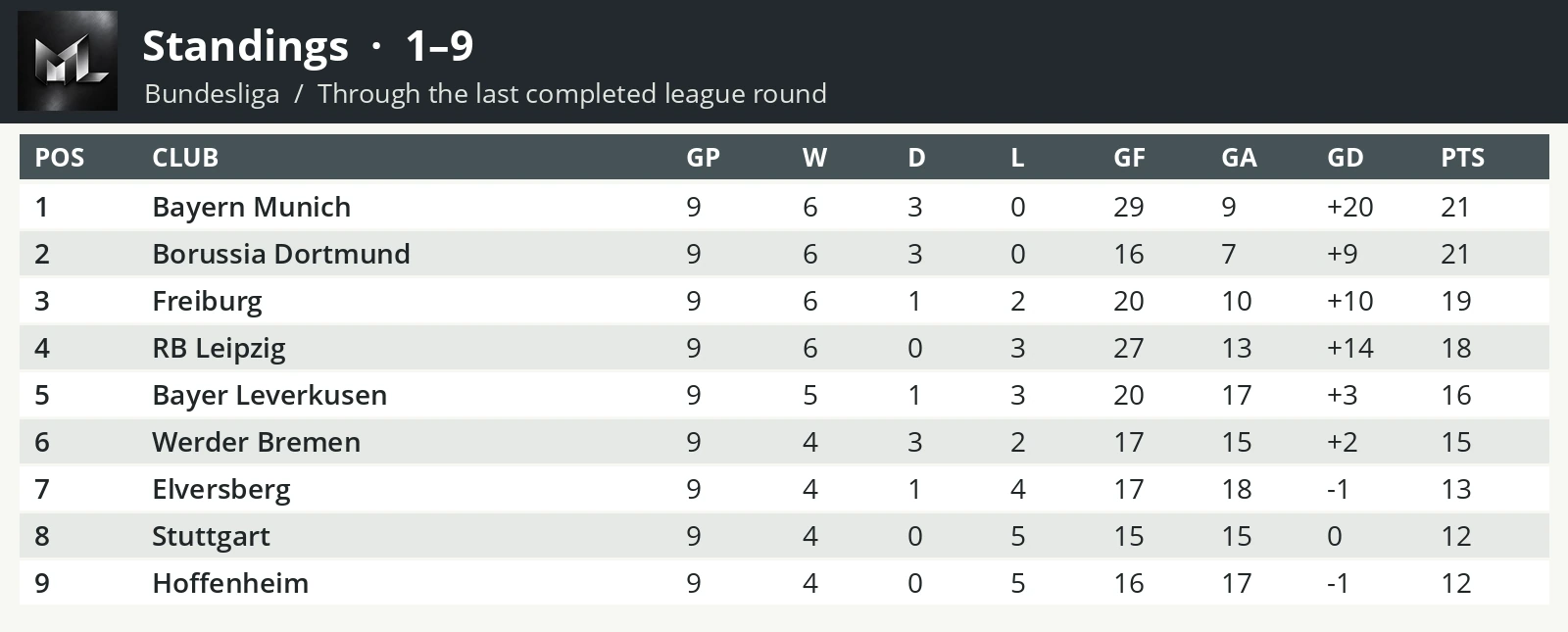
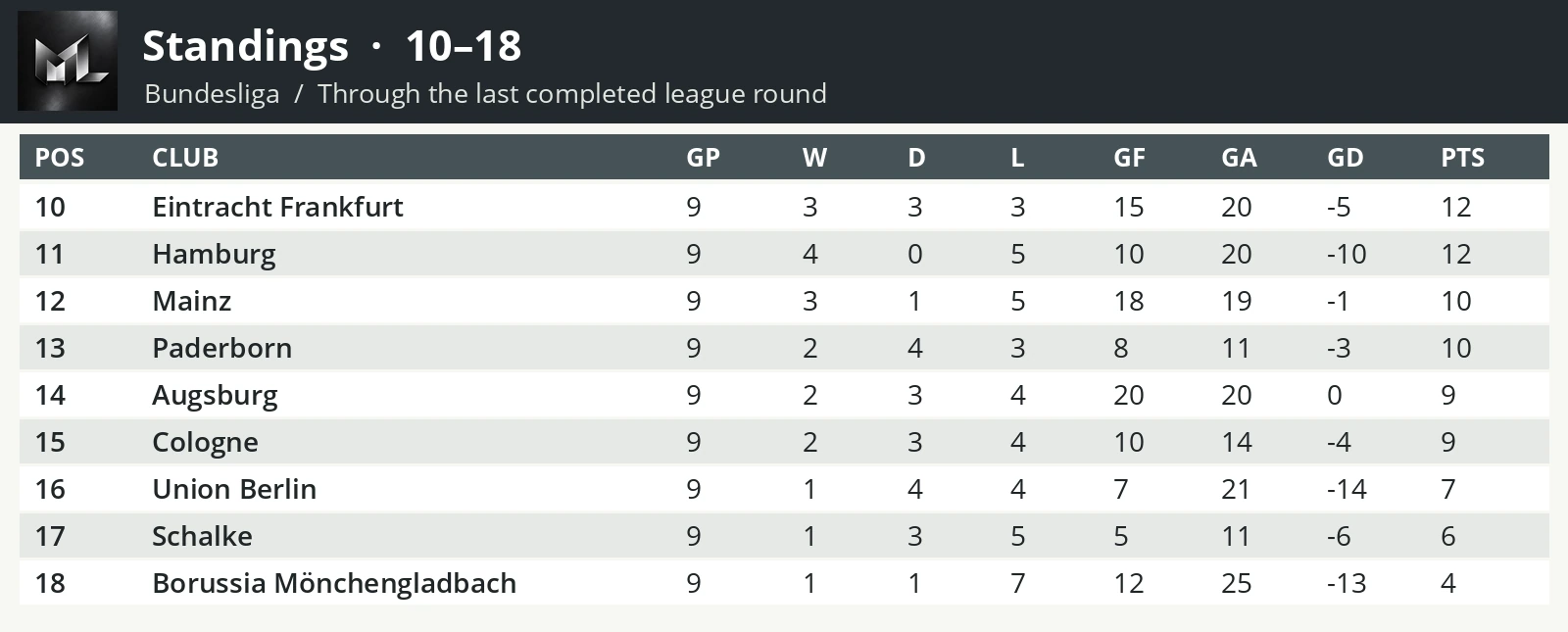
Bayern Munich and Borussia Dortmund have both won six and drawn three. Bayern have scored thirteen more goals. Dortmund have conceded two fewer. Freiburg are two points back with a goal difference better than Dortmund’s, and Leipzig have already scored 27 despite losing three times. The race resumes with the leaders travelling at different speeds toward the same finish line. On Friday Bayern host Cologne. On Saturday Dortmund go to a Gladbach side that needs a win for very different reasons.
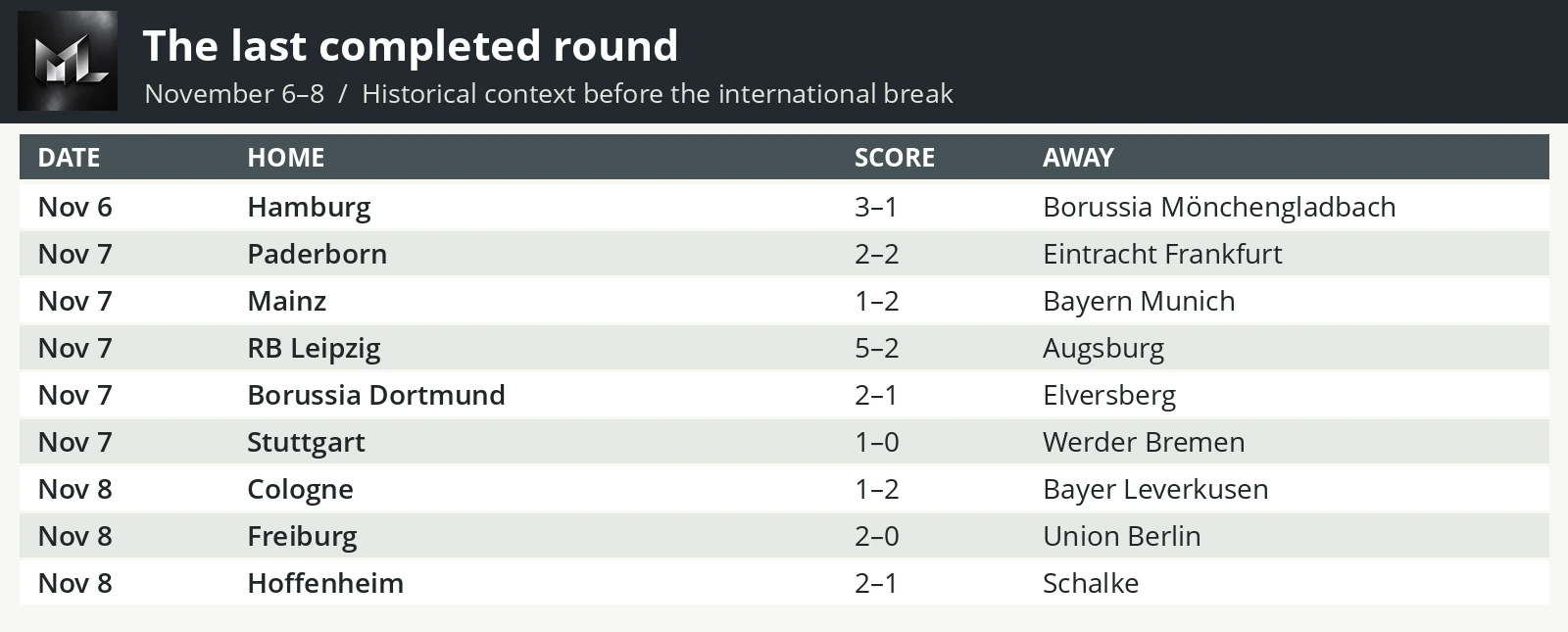
The seven days just completed
There were no completed Bundesliga fixtures in the seven days before Monday’s cutoff. The last completed round ran November 6–8. Leipzig scored five against Augsburg, Bayern and Dortmund each won 2–1, and Freiburg beat Union 2–0. Paderborn and Frankfurt supplied the only draw. Those results explain the table that carries into the restart.
The league table
Bayern lead Dortmund on goal difference, plus 20 to plus nine. The most congested part of the table starts at eighth, where Stuttgart, Hoffenheim, Frankfurt and Hamburg all have twelve points. Their goal differences run from level to minus ten. The table follows the official competition order. A separately validated statistical performance ranking is unavailable at this cutoff.
The next seven days
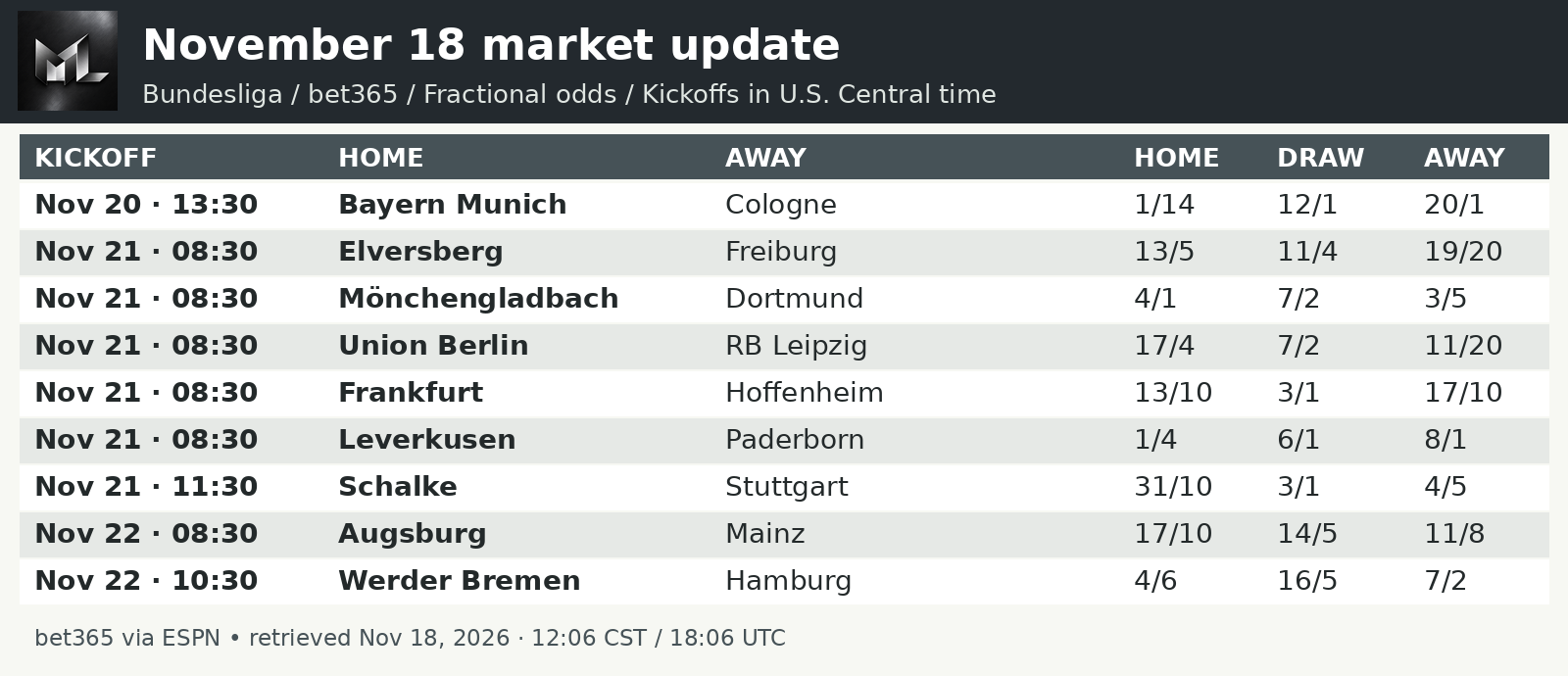
All eighteen teams play in the November 20–22 round. The joint leaders face opponents from the bottom four. Freiburg travel to a promoted side that has already won four times, and Bremen meet Hamburg with three points separating them. Kickoffs below are Central time.
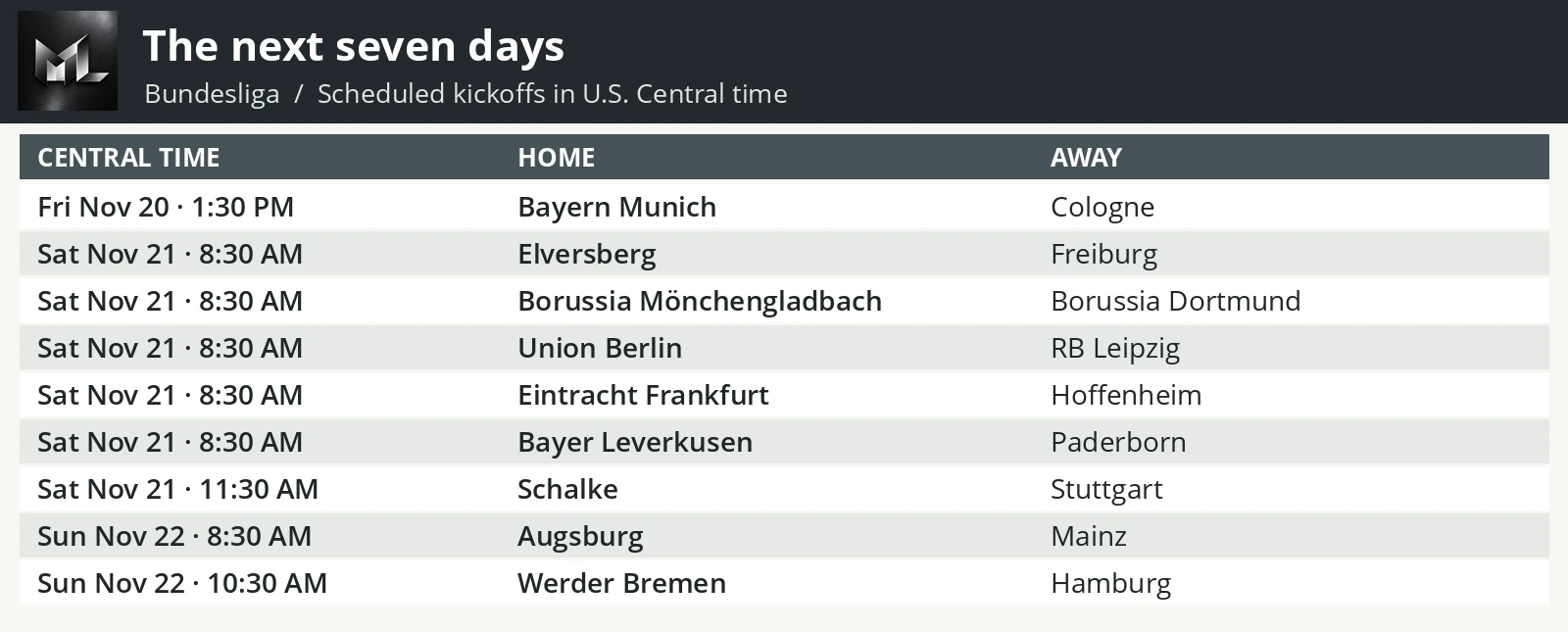
A complete, time-stamped set of betting prices was unavailable for this slate. The schedule shows confirmed fixtures and kickoff times.
Bayern Munich and Borussia Dortmund

Bayern Munich
Bayern have scored 29 times without losing, but their 2–1 victory at Mainz is a better warning to Cologne than an average of more than three goals a game. They can take all three points without producing a rout. Dortmund have matched all six wins and three draws. The cushion Bayern have actually earned is a superior goal difference, which helps separate them today but cannot protect them from dropping points on Friday. The question for their attack is whether it can make Cologne chase a game the visitors would prefer to keep tight.
Borussia Dortmund
Dortmund share the lead by a route quite unlike Bayern’s. Sixteen goals have been enough for six wins because they have conceded only seven. Their 2–1 win over Elversberg preserved that balance in a game where one more concession would have cost two points. At Mönchengladbach the opportunity is to move a struggling side into unfamiliar territory by scoring first. The danger is to mistake a team with four points for one incapable of scoring. Gladbach have found twelve goals, enough to make a thin lead uncomfortable.
Freiburg and RB Leipzig

Freiburg
Freiburg’s 2–0 win against Union helps explain how they are two points from the leaders after nine games. Twenty goals for and ten against leave them room to win without asking for a clean sheet every time. Their trip to Elversberg tests that balance. The hosts have scored 17 and allowed 18, suggesting an opponent capable of answering even when it has already conceded. Freiburg can afford to contest the middle of the pitch patiently. They have less reason to let a chance at a quick second goal expose the space behind them.
RB Leipzig
Leipzig’s 5–2 win against Augsburg brought their total to 27 goals, two behind Bayern. They have yet to draw. Their six victories have built an 18-point season, but three defeats explain why scoring almost as often as the leader has still left them fourth. Union’s seven goals represent a different kind of threat in Berlin. If the home side can keep the score level until late, Leipzig will have to decide how much defensive cover to sacrifice in pursuit of two extra points. A draw would be a new outcome for them, not necessarily a calamity.
Bayer Leverkusen and Werder Bremen

Bayer Leverkusen
Leverkusen left Cologne with a 2–1 win and sit fifth, three points behind Freiburg. Their 20 goals match Freiburg’s total exactly. The gap at the other end is seven conceded goals across nine games. Against Paderborn, a team that has drawn four times, the most consequential moment may follow a Leverkusen goal. If they protect the restart and force their visitors to build from deep, they can make eight season goals look like a limitation. If they concede quickly, they risk giving a side practiced at earning a point a reason to settle.
Werder Bremen
Bremen have fifteen points and seventeen goals, both good enough to place them above the middle of the table. Their 1–0 loss at Stuttgart is a reminder that one quiet attack can erase any benefit of keeping the opponent close. Hamburg arrive with twelve points and a minus-ten goal difference. Winning by one or losing by several still produces only a three-point swing, and Hamburg already have four victories. Bremen need to test that defence repeatedly without treating their visitors’ season deficit as a goal already on the board.
Elversberg and Stuttgart

Elversberg
Elversberg came within a goal of taking something from Dortmund. Seventeen goals through nine games give the promoted side a credible attacking argument, and four wins have carried them to seventh. The less comfortable figure is eighteen conceded. Freiburg, their next visitors, have scored twenty while conceding ten. Against an opponent capable of protecting a lead, a goal conceded before Elversberg have settled into the game changes the value of every subsequent decision. The best use of home advantage may be to press selectively enough to keep their own shape intact.
Stuttgart
Stuttgart’s record contains four wins and five defeats, no draws and a level goal difference. Their 1–0 win over Bremen shows how little margin there is between improving that record and giving two points away. Schalke have scored just five times. Away from home, Stuttgart can press for the first goal without assuming they must score several. A cheap concession would change the match entirely, allowing a side that has conceded only eleven in nine outings to defend the kind of narrow lead it rarely gets to enjoy.
Hoffenheim and Eintracht Frankfurt

Hoffenheim
Hoffenheim beat Schalke 2–1 and share twelve points with their next opponents, Frankfurt. They have reached that total with four wins and no draws, while Frankfurt have won, drawn and lost three each. Hoffenheim’s sixteen goals and seventeen conceded suggest that the difference between another win and a first draw might be a single decision in either penalty area. Keeping an extra defender against a counterattack could cost a passing option. Frankfurt’s twenty concessions give Hoffenheim a reason to be selective about when it is worth taking that risk.
Eintracht Frankfurt
Frankfurt came away from Paderborn with a 2–2 draw. A third draw in nine games helped put them level with Stuttgart, Hoffenheim and Hamburg on twelve points, though only Hamburg have a worse goal difference in that group. Fifteen scored and twenty conceded leave Frankfurt little margin when their attack falls quiet. Hoffenheim are next and have conceded seventeen themselves. Frankfurt’s practical route to breaking the tie in the standings is to create another scoring chance after going ahead without leaving a direct route back to their own box.
Hamburg and Mainz

Hamburg
Hamburg beat Gladbach 3–1. That single game accounts for three of their ten league goals, so it matters whether the attack can carry any of that production into Bremen. Four wins with a minus-ten goal difference show how the size of a defeat can distort the impression of an otherwise competitive points return. Hamburg have won as often as Bremen while losing twice more. They can ask a useful question on their travels by making the hosts defend a lead change or an equaliser, rather than requiring their own defence to absorb the whole afternoon.
Mainz
Mainz took Bayern to a 2–1 finish. Their nine league games have produced eighteen goals for and nineteen against, a far more open season than the ten-point total alone suggests. Augsburg, who also average more than two goals each way, pose a different challenge from the leaders. Mainz need to choose which exchanges are worth accelerating. A turnover just outside the opposition area may open the door to a second chance, but an unsupported runner sent forward in search of one can just as easily invite a counterattack.
Paderborn and Augsburg

Paderborn
Paderborn’s 2–2 draw against Frankfurt supplied a quarter of their season goals in one game. With eight scored, eleven conceded and four draws in nine, they have generally found points by keeping the margin small. At Leverkusen that approach has a clear test. Their hosts have twenty goals, but have also conceded seventeen. Paderborn need enough of an attacking presence to stop Leverkusen treating the entire match as a siege. Simply extending a spell at 0–0 will be worth less if every clearance hands the hosts another immediate attack.
Augsburg
Augsburg scored twice in Leipzig and still lost by three. A season total of twenty scored and twenty conceded carries a different lesson from a single 5–2 result. They have enough attack to force answers, yet only two of their nine matches have ended in victory. Mainz arrive with a similarly narrow season goal balance. Augsburg’s chance is to keep their central defenders protected when the first attack breaks down. A second goal is a far better asset if the opposing side has not already put two past them.
Cologne and Union Berlin

Cologne
Cologne lost 2–1 to Leverkusen and have nine points, level with Augsburg despite having scored only half as often. Fourteen conceded in nine gives them a plausible platform for a difficult Friday in Munich. The problem will be turning a stop into a possession long enough to bring the team upfield. A hurried clearance can improve the view of one defensive sequence and make the next one harder. Ten goals are enough to threaten a close game. They are a slender basis for a plan that expects Cologne to recover from two down.
Union Berlin
Union came out of Freiburg with a 2–0 defeat and have seven points. Four draws account for more of those points than their only win. That habit of keeping a contest within reach is useful against Leipzig, but the visitors have scored twenty more goals than Union through the same nine games. It would help Union to earn a restart or a shot after a defensive stand, giving Leipzig a reason to retain cover rather than simply restarting another attack. Seven goals scored leave limited room for a series of missed opportunities.
Schalke and Borussia Mönchengladbach

Schalke
Schalke lost 2–1 in Hoffenheim. They have allowed only eleven goals, fewer than fourth-placed Leipzig, and still sit seventeenth because they have scored five. Against Stuttgart, the challenge is to have enough players available for the second ball without breaking up a defence that often keeps matches close. A quarter-hour spell after taking the lead could be more valuable to Schalke than a succession of isolated chances from distance. Stuttgart have yet to draw, but a level game deep into the second half would ask something new of both teams.
Borussia Mönchengladbach
Gladbach trail Schalke by two points after losing 3–1 in Hamburg. Twelve goals scored distinguish them from the teams immediately above them. Twenty-five conceded explain why that output has bought just one win and one draw. Hosting Dortmund is a particularly demanding time to address the problem, because Dortmund have needed so few goals to win. Keeping the visitors out early would leave Gladbach’s attack a meaningful target. If they chase recklessly after conceding once, they risk giving Dortmund the second goal that the visitors’ defence seldom needs.
Bayern Munich against Cologne

The question for Cologne is what to do with the ball after a promising first tackle. Bayern have already scored 29 goals in nine matches. Holding them to one manageable chance is worthwhile, but an aimless clearance lets the same attackers set up ten yards further forward. A pass that reaches a teammate beyond the first press gives Cologne’s defenders time to move up and makes Bayern decide how much cover to keep behind the ball. This is one place where an apparently minor technical choice could change the score much later.
Cologne have conceded fourteen, only five more than Bayern. That offers a clearer reason for hope than a comparison of their respective attacks. With ten goals, Cologne would be asking a great deal of their finishing if they fell two behind. Bayern, meanwhile, have drawn three times. Remaining level into the final stretch would give the visitors an outcome they have already secured on three occasions themselves. The challenge is to remain capable of scoring while holding that position. Defending the box with every player may keep the first cross out, at the cost of ensuring that the second follows almost immediately.
Bayern’s 2–1 win in Mainz gives the favourite a practical reference. A margin of one was enough when they could defend it. If Cologne’s line stays compact, a patient switch of play costs Bayern little and may force the visitors to cover both wings repeatedly. If a full-back goes forward, someone still has to guard the first pass out. Dortmund do not play until Saturday. Bayern can put three points between the sides for a night without producing an emphatic scoreline. Cologne’s opportunity is to make each extra Bayern runner represent a genuine risk, then turn one of those risks into a shot.
Schalke against Stuttgart

Schalke have conceded eleven, matching Paderborn and fewer than Leipzig. Those figures look out of place beside seventeenth until the other half of their season comes into view. Five goals have yielded one win. Against Stuttgart, the first goal is worth more to the home side than a simple improvement to that total. It would allow the strongest part of their season, defending with a narrow margin, to dictate what follows. Their 2–1 defeat at Hoffenheim is an example of how little comfort one goal provides when the opposition gets two.
Stuttgart have scored and conceded fifteen. They beat Bremen 1–0 in the last round and have no draws in nine outings. It would be easy to read that as a promise of an open game. The Bremen score suggests the opposite can happen. In a contest that produces few clear chances their ability to see out a single-goal lead is a substantial advantage. Stuttgart should want Schalke’s first forward pass to arrive with the receiver facing his own goal. That makes it harder for Schalke to bring a second attacker close enough to benefit from a rebound.
For Schalke the answer need not be a bigger commitment on every attack. It could be more support on the few that start from favourable territory. A defender who wins the ball near the halfway line has already done much of the work that five season goals suggest the attack struggles to do. One extra runner there is a different risk from one sprinting away after a clearance deep inside the box. Stuttgart can force Schalke to take the more expensive risk by scoring first and keeping the ball after they regain it. Schalke can change the evening if they finally give their defence a lead worth protecting.
November 18 market update
These 9 home, draw and away prices are fractional odds from bet365 through the ESPN event feed, retrieved on November 18 at 18:06:53 UTC (12:06:53 CST). These are retrieval times, not bookmaker last-change timestamps.
The November 16 note above records that a complete set of prices was unavailable at the original cutoff. The table below supplies newly observed prices from one bookmaker for all nine fixtures. The official standings and all nine kickoff times remain unchanged. Prices may change before kickoff.